

The Paperclip
Name an Indian war hero who became a legend not only in his home but more so in a foreign land. So much so that when local people commemorate their ancestors, they remember him in every prayer. Read on to know who he is. 1/15
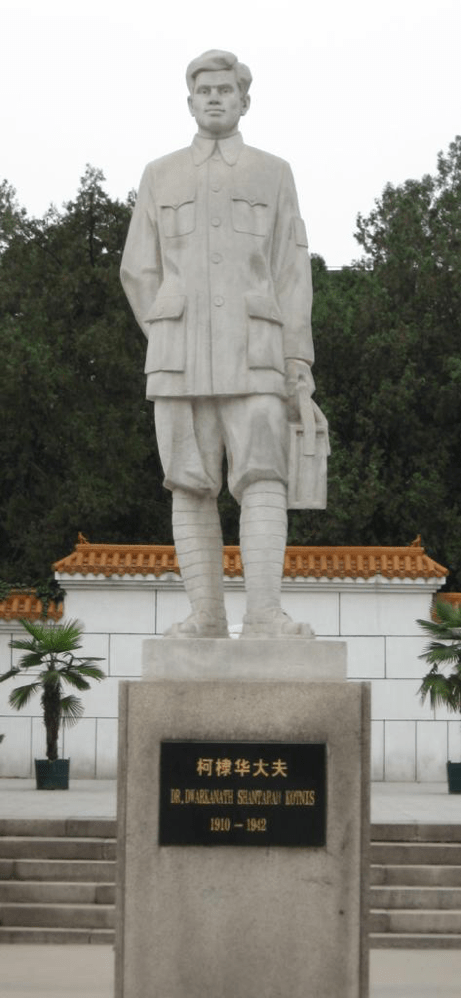
Qingming Festival, otherwise known as the Tomb-Sweeping Day is a 1,300-years-old ritual observed by the people in mainland China. On the day of the festival, everyone comes together to clean the tomb and offer flowers to pay respect to their ancestors. 2/15
The Martyrs’ Memorial Park in Shijiazhuang in the picturesque Hebei Province, one of the five bouquet UNESCO World Heritage sites, is dressed in flowers during the first week of April each year. 3/15
It remains the resting home for 640 fallen heroes of the Chinese Civil War and the Second Sino-Japanese War. As each grave is stacked under piles of flowers, one particular grave of a certain doctor named ‘Kē Dìhuá’ absorbs the maximum weight of offerings. 4/15

What’s more astonishing is that although the name sounds Chinese, it’s given to an Indian doctor whose original name was Dwarkanath Kotnis, born in Solapur, Maharashtra. So how did a doctor from faraway Maharashtra find a pride of place amongst the Chinese heroes? 5/15
The story goes back to 1938. As the Japanese troops invaded China during the second Sino-Japanese War, General Zhu De requested Jawaharlal Nehru to send a team of well-trained physicians to treat wounded Chinese soldiers. 6/15
Nehru discussed the possibility with Subhash Chandra Bose, then the president of the Indian National Congress, and together they sent a team of five volunteer doctors and an ambulance to war-torn China. Kotnis was one of them. 7/15
When the medical team arrived at the revolutionary base of Yan’an, they received a warm welcome from the top leaders like Mao Zedong, Zhu De as it was the first team to extend support from another Asian country. 8/15
Under the leadership of Mao, Kotnis began his mission to provide medical assistance to Chinese soldiers in mobile clinics at the Jin-Cha-Ji border near the Wutai Mountain Area. 9/15
While the soldiers went on to save the nation with bayonets and bullets, Kotnis fought it with scissors and bandages. 10/15
Kotnis’s most prolific battlefield heroic came during a long-drawn out battle against the Japanese troops in 1940, when he performed operations, one after another, for 72 hours at a stretch without any sleep. 11/15
During his three years of service in the battlefield, Kotnis had treated more than 800 wounded soldiers – a remarkable feat that earned him immortality in a foreign country. He became one of their own not only for his heroics but also for his love for their culture. 12/15
When he was appointed as the Director of the Dr. Bethune International Peace Hospital, he met Guo Qinglan – a nurse at the hospital. Despite being a foreigner, his impeccable skill in Mandarin initially brought them close and they were soon married. 13/15
When they had their first son, Kotnis named him ‘Yinhua’ – meaning India (Yin) and China (Hua). It was not only a name but a constant reminder of the friendship between two countries for which Kotnis became the most respected ambassador. 14/15
Despite the shifts in politics & power & subsequent tension boiling between the two-neighboring countries, let’s take a moment to remember the brave and kind soul of Dr. Kotnis who remains alive & well in prayers of people beyond the borders, amongst friends & foes alike. 15/15
https://www.chinadaily.com.cn/china/2010-04/02/content_9678431.htm
Images:
“A statue of Dwarkanath Kotnis in Shijiazhuang, Hebei, China” by David Chen, CC BY 3.0, From @WikiCommons
“The tomb of Dwarkanath Kotnis in Shijiazhuang, Hebei, China” by David Chen, CC BY 3.0, From @WikiCommons
“Dwarkanath Kotnis in China”. From @WikiCommons
 Knock nock
Leave a comment