

PEOPLES DIISPATCH
For Prabir: No jail can arrest the march of time towards a more just tomorrow
Prabir’s ever-growing legacy continues to inspire the struggle for Indian intellectual and material self-reliance, regardless of the misguided attempts of the RSS-BJP to throttle and subjugate the masses’ aspirations for a better and more inclusive tomorrow.January 16, 2024 by Nikhil Mathew

On December 2 and 3 of 1984, a toxic mix of gases leaked from the Union Carbide Pesticide Plant into the Indian city of Bhopal, in what has come to be known as one of the world’s worst industrial disasters. The leak spread across 40 sq km of the city, covering 36 of Bhopal’s 56 municipal wards. Over 550,000 people have come to be affected in the immediate aftermath of this disaster that resulted in the death of over 20,000 men, women, and children. Between December 9 and 11, a fact-finding team from the Delhi Science Forum (DSF) comprising its founding members, Prabir Purkayastha and Dinesh Abrol, both then young engineers, was tasked with formulating a technical analysis of the disaster.
Over the span of two days, the team visited the regions around the plant that was the hardest hit in this episode of wholesale murder sponsored by the logic of corporate greed; they spoke with survivors, with workers who manned the plant, and with local journalists, politicians, social workers, and doctors, amongst others. The outcome of this investigation was a landmark – it provided the basis for much of the demands that were raised by popular mass movements to follow, including on matters relating to industrial licensing and the regulation of occupational safety. When on December 4, 1985, an oleum gas leakage took place in India’s capital from a factory operated by the Shriram Food and Fertilizers resulting in the hospitalization of more than 700 of Delhi’s residents, the Supreme Court of India appointed a three-member Expert Committee including DSF’s Prabir Purkayastha to examine the leak and suggest corrective measures. The subsequent case and ruling are said to be a landmark case in environmental jurisprudence. However, it remains to be noted that neither Union Carbide Corporation nor Dow Chemical Company – the American multinational who having acquired all of UCC’s assets and liabilities in 2001 now owns the company – have ever been held to account; Warren Anderson, chief executive of UCC at the time of the disaster never stood trial, and passed away on a Florida beach at the age of 92. India’s political and juridical establishments stand complicit in this contravention of justice.
It is this same Prabir Purkayastha that the Delhi Police has now arrested in a case registered under the draconian Unlawful Activities (Prevention) Act, despite the decades he has spent in furthering the cause of an independent and sovereign Indian polity. On October 3, 2023, in an authoritarian display of governmental malfeasance, the Delhi Police arrested Prabir, founder and chief editor of the online news platform NewsClick, and Amit Chakraborty, NewsClick’s Head of Human Resources. This arrest was preceded by early-morning raids against nearly 50 journalists and contributors to the platform, who were quizzed, amongst other issues, as to whether or not they had covered the courageous farmers’ struggle against the Union Government’s draconian farm laws. The attack against free, independent, and fearless journalism under the RSS-BJP has been long drawn. One study notes that since 2014, over 135 journalists have been arrested, detained, interrogated, or served show cause notices. It is to be necessarily viewed as an attack against the anti-colonial legacy of the Indian freedom struggle and as an attack against India’s sovereignty at the altar of the imperialist enterprise, underwritten by the anti-people and parasitic sensibilities of global business. It is to be seen as an attack against rationality and against the progressive mass movement’s project to build a democratic and constitutional consciousness.
Although India has had its own flavor of McCarthyism in the decades-long attack that the country’s political establishment has waged against agents of socialism in India, that the latest instantiation of the undermining of the fourth pillar came on the back of spurious claims made in the pages of the New York Times took many by surprise. However, when situated in context of NewsClick’s and Prabir’s staunch support of people’s movements across the world and the portal’s increasing importance as a voice against the social, cultural, environmental, and moral destruction wrought by neo-colonial campaigns that have come to enwreathe the globe, it is but natural that mouthpieces of the US empire would facilitate an exercise to tarnish and tame beacons of hope that brought to light the lies and deceit of anti-people governments everywhere. It is therefore that in this latest campaign to do away with an important catalogue marking people’s resistance against oppression, exploitation, and deceit, we see the comfortable alignment between the RSS-BJP and various shades of the US empire’s imperialist machinery.
When one speaks about Prabir Purkayastha, one often speaks about his courage during the Emergency when as an activist of the Students’ Federation of India at the Jawaharlal Nehru University, he was kidnapped by the Delhi Police and then subsequently kept in jail for a year under the Maintenance of Internal Security Act. A story just as inspiring, if not even more so, is how for years after his release from jail he has nurtured and continues to cultivate the progressive mass movement in India, both as an advocate of democracy and of science in the service of the people. Prabir’s ever-growing legacy continues to inspire the struggle for Indian intellectual and material self-reliance, regardless of the misguided attempts of the RSS-BJP to throttle and subjugate the masses’ aspirations for a better and more inclusive tomorrow. It is in the upkeep of this dream on whose foundation the Indian anti-colonial freedom struggle built its roots that Prabir has dedicated the vast majority of his working life – towards ensuring prosperity for the people whose sweat and tears continue to stitch together the fabric of Indian society. This is not a dream that can be snuffed out through arrests or the petulant protestations of the bigoted, for there aren’t enough jails in all the world and not enough bullets in all the world’s armories that can arrest the march of time towards a more just tomorrow.
Nikhil Mathew is the secretary of Students’ Federation of India, United Kingdom. The views are personal. The article first appeared in Students’ Struggle.

English – Europe Solidaire Sans Frontières (europe-solidaire.org)
The Tragedy Of India’s Authoritarian Descent: The Case of Prabir Purukayastha
Saturday 13 January 2024, by VANAIK Achin


- MODI Narendra
- State of emergency
- 2014
- PURUKAYASHTA Prabir
- Enforcement Directorate (ED) (India)
- Administrative detention / Preventive detention
- Unlawful Activities Prevention Act (UAPA) (India)
- Laws (anti-terror)
- Surveillance (Eng)
Despite all the talk about India being the world’s largest democracy the existing reality is very different indeed. For persistent dissidents and opponents of the current Hindu nationalist regime headed by Prime Minister Narendra Modi, the general political environment is effectively an undeclared emergency. In many respects it is worse than the declared Emergency of 1975-77 with its suspension of fundamental civic and political rights. That lasted a little less than two years. The current process of systematic degradation of the basic institutions of Indian democracy under the Modi government has been going on since 2014 when it first came to power.
Matters have been getting progressively worse and will be more difficult to reverse institutionally and practically even if the ruling BJP does not get a third term of office which it is most likely to achieve in the coming general elections in May this year. One of the most dangerous aspects of what has been happening is that behind the electoral mask, a host of laws have been amended in a very repressive direction. This has been done with the support of a compliant judiciary at even the highest level ensuring that the government can and does get away with criminal behaviour at a large, sometimes mass scale as well as in respect of targeting individuals like journalists, academics, social activists of various kinds, recalcitrant NGOs and ordinary citizens seeking to defend their minority religious communities from discriminatory policies and onslaughts.
An entity called the Enforcement Directorate (ED) is used by the government to raid civil society organisations and investigate their economic resources and activities despite knowing they are operating legally. Here, as elsewhere, the process is itself the punishment, with their work seriously or completely disrupted. The targeted seek legal recourse through the courts at different levels, which results in great delays before final judgements are passed. This too suits the purposes of the government agencies which have initiated the process and sends the desired warning to the organisations concerned to behave as the ruling powers want. But when it comes to actions against individuals deemed by the government to be their critics and opponents, i.e., ‘anti-national’, punishment by process is of a much more severe character. Here is where the most draconian of laws in the government’s armoury—the Unlawful Activities Prevention Act or UAPA —comes into play. Preventive detention laws were first laid down by British colonial rule but were carried over into independent India and some of them through amendments over time were made even more stringent and cruel.
This happened with the UAPA which was first formulated not by the BJP but by the Congress government in 1967. A series of amendments took place. By 2013 it became the supreme legislated law for application to organisations that are deemed to be guilty of terrorist behaviour even as there is no universally accepted definition of terrorist action. So every government is free to have its own, good or bad, legal definition. Here is how the UAPA defines the terrorist act:
“Whoever does any act with intent to threaten or likely to threaten the unity, integrity, security or sovereignty of India or with intent to strike terror or likely to strike terror in people or any section of the people in India or in any foreign country.”
This was initially applicable only to groups. But in 2019, the Modi government made it applicable for the first time to individuals. It is so vaguely worded and so broad in its areas of possible application that the state can (and does) arrest anyone on mere ‘suspicion’ before any actual commission. Moreover, bail can be denied for as long as the courts accept that the police or a central agency has ‘reasonable grounds’ to continue its investigation for as long as it thinks necessary which all too often extends into many years without the case coming to trial. Between 2014 and 2020, 10,552 people have been arrested under UAPA and only 2.3% of them have been convicted. Some 6,952 have been arrested since 2020.
By way of illustration of how and why the government resorts to this law to curb lawful dissent, I will only take up one very recent case—that of Prabir Purukayastha—whom I have personally known and worked with in one way or the other on various issues/campaigns. These include the anti-nuclear weapons peace front after India’s 1998 test explosions; in anti-communal efforts; and in support of Palestine. Purukayastha has an engineering background and therefore has technical expertise. He has been involved in a host of political campaigns and has also shed light on the growing surveillance nature and capacities of the Indian state which has certainly not been to the government’s liking. Among other things Purukayastha is the founder of Newsclick, a news and analysis portal that has constantly given space in word and image to critics of this government’s policies and behaviour. Regularly presented are the concerns of Dalits, tribals, women, workers, farmers, oppressed religious minorities as well as progressive single-issue or sectoral movements about health, education and civil liberties.
He and other senior employees of Newsclick and even select outside contributors were raided and electronic devices seized ostensibly to reveal alleged economic and political ‘infractions’ and ‘illegalities’. Despite the over two years’ passage of time, no crime has been detected. But the investigation continues. Purukayastha was unfairly imprisoned for several months during Mrs. Gandhi’s emergency period (1975-77). Both as part of and beyond, the Communist Party of India-Marxist (CPM) of which he is a senior member, he has engaged in various struggles ranging from defending secularism and democracy to helping set up after 1998 the Movement in India for Nuclear Disarmament (MIND). He is one of the founders of the Delhi Science Forum and has been the President of the Free Software Movement of India. Among the books he has authored and co-authored are Enron Blowout: Corporate Capital and Theft of the Global Commons; Uncle Sam’s Nuclear Cabin; Political Journeys in Health; Knowledge as Commons: Towards Inclusive Science and Technology.
On October 3, 2023, he was arrested and put in police custody under UAPA as a possible terrorist threat to ‘national integrity’. This action came about two months after a New York Times article of early August on philanthropist Neville Roy Singham, an American citizen of Sri Lankan origin who currently resides in China. He has through various legal channels contributed funds to a host of left-wing organisations in the Global South—in Africa, Latin America, India’s Newsclick as well as in the North to such groups as Code Pink. Given India’s hostility to China, this was seized as an opportunity by the Modi government agencies to take a different tack for continuing the harassment of Purukayastha, another employee, Amit Chakrabarty, and Newsclick more generally. On China, there may well be some shared positions of support but the crucial points are that Singham has no editorial connection to the organisation and that the funding process is above board. Furthermore, coverage of China’s affairs is very sparse compared to their overall coverage of domestic and international issues and it is its criticisms of the government that has set the latter’s back up and hence the over two years of harassment.
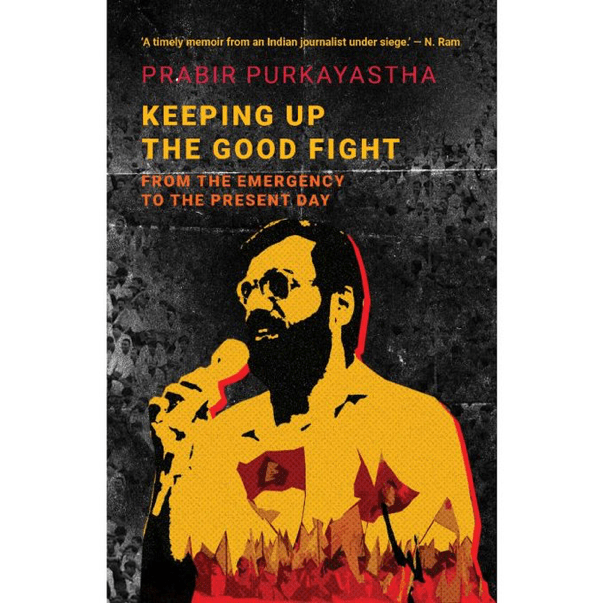
Purukayastha is in jail since November 2, 2023. There is an interesting parallel between the case of Russian dissident Boris Kagarlitsky and that of Prabir Purukayastha. Both have suffered previous incarcerations. Both have been steady and courageous critics of their respective governments regardless of which party has been in central power. Both situate themselves on the Marxist-influenced left. Both have used their latest period of incarceration to write a book. That by Kagarlitsky will be brought out very soon by Pluto Press. Leftword publishers have very recently brought out Purukayastha’s Keeping Up The Good fight: From the Emergency to the Present Day.
Boris, fortunately, has finally been released and in this respect international publicity on the internet certainly played its part. It is hoped that here too, publicity not just of Prabir’s plight but that this highlighting of the iniquity of UAPA (and the general compliance of the judiciary) under which so many others have been unfairly imprisoned can help release, at least on bail, Prabir Purkasyastha and so many others. We need to get more people the world over to recognise that an India that will very soon become the globe’s most populated country is also rapidly transiting into, if not already having become, the world’s largest highly authoritarian electoral autocracy!
Achin Vanaik
January 13, 2024
 Knock nock
Leave a comment