

On the unintended consequences of anti-nuclear zealotry.
| Quico Toro and Guido Núñez-Mujica Feb 2 |
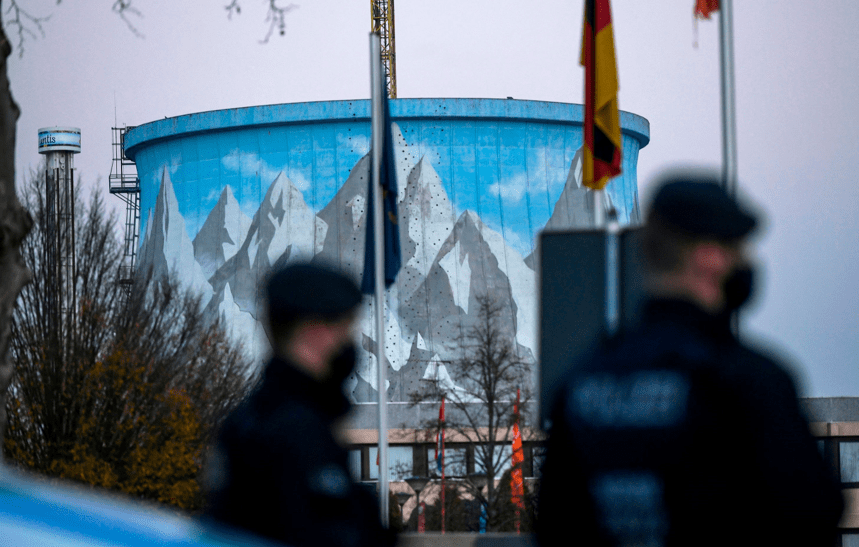
Police officers stand in front of a former nuclear power plant during an anti-AFD protest in November 2020. (Photo by Ina Fassbender / AFP via Getty Images.)
Last month, hundreds of thousands of Germans marched against the far right, as more and more polls show the extremist Alternative für Deutschland attracting almost a quarter of the electorate. The event received quite a lot of media attention. But not as much attention as another, intimately related story: As part of the “Energiewende” policy ostensibly meant to clean up its energy grid, Germany announced, with great fanfare, that it had brought its carbon emissions from the electricity sector down by a record amount, 21%, and the figure now stands at the lowest level since the 1950s.
The one statistic that brings these two stories together is this one:
Data source: European Network of Transmission System Operators for Electricity.
According to data we’ve analyzed from ENTSO-E, the official European body of electricity generation entities, net electricity generation for the public power supply in Germany fell in 2023 by 11.5%. Generation is now down 19% since its peak in 2017. Bragging about falling emissions when you’re in an electricity generation freefall is a little like bragging that you’ve lost weight after an amputation.
To put it into context, the 103 TWh in electricity generation Germany lost between 2017 and 2023 is more than all the electricity generated last year by Bangladesh, a country of 171 million people. And 75% of that lost generation is down to one decision: Since 2017 Germany shut down eight perfectly good, safe, reliable, job-creating nuclear power plants.
Why can’t Germany generate as much electricity as it could just six years ago? The war in Russia sure didn’t help, though counterintuitively oil and gas generation have held mostly steady over the past few years. The answer is that the speed of take-up of wind and solar just hasn’t been able to keep up with demand. Yes, high-carbon power generation continues to fall, but renewable generation stopped growing after the pandemic:
Data source: European Network of Transmission System Operators for Electricity.
The result is that less energy is being produced overall, and Germany is loath to buy it from France—where power is much cleaner, because it’s mostly nuclear.
So who absorbed the adjustment? Easy: industry, the old backbone of the German manufacturing state, which has been closing production facilities in significant numbers.
This does not, of course, reduce the overall atmospheric pollution generated in the world, as the old clients of German firms turn to alternatives in other locations that are, almost always, fueled with high carbon sources. The Indonesian, Brazilian, Indian and Chinese companies that will now manufacture the products that German workers used to make are largely run on fossil fuels.
Also read: “The Green Technology That Dare Not Speak Its Name.”
Now, you don’t need to be a detective to understand the link between the far right’s rise and the German government’s increasingly self-destructive energy policies.
Part of the problem is that there are inherent technical limitations to how high a country can drive wind and solar in its energy mix. State of the art lithium-ion batteries can only store energy in the range of megawatts, up to the low gigawatts. In order to store electricity to survive a German winter with next to no sunlight and long low-wind periods, the country would need to increase its storage capacity by orders of magnitude.
There are only three presently known energy sources that can be used at scale to balance a natural grid: hydroelectricity, nuclear and fossil fuels. Germany’s rivers are dammed, and its nuclear stations damned: decommissioned ahead of time. As a result, Germany was left with little choice but to double-down on fossil fuels, getting poor Greta Thunberg arrested when the government went to reactivate a coal mine (and destroying an old village on top).
Going too far in this direction was politically hazardous, so they decided to simply make do with less power: economic degrowth in action. Of course, people depended on those power sources for jobs: good, well-paid, stable union jobs that guys without university degrees could get. The government closed down the factories—can they really be surprised some of these people now want to vote for the far right?
Of course, Germany’s terrible energy policy isn’t the only reason its economy is in a funk. And anti-immigration sentiment has long fuelled the popularity of the AfD. But the botched energy transition does appear to be a major reason Germany is the world’s worst performing major economy, and why its far right is doing better. And the Energiewende even fails on its own terms, because after sacrificing a major chunk of its industrial base to China, Germany continues to generate about seven times more greenhouse gasses than France, and a shocking 15 times more than Sweden, when measured per kWh.
Germany didn’t adopt degrowth by choice, but through a series of blunders. The comic edge of its misfortunes is that so many of them occurred because of miscalculation or just sheer bloody-mindedness on the part of the Greens and Social Democrats. First, a few months before becoming a Russian energy lobbyist in 2005, then-Chancellor Gerhard Schröder insisted on putting Russian natural gas at the core of Germany’s energy grid, continuing a Social Democratic tradition of entwining Germany’s future with Russia’s. Then, a Green Party with its roots in 1970s anti-nuclear weapons activism carried this atavistic policy into the 21st century when it entered government, insisting that Germany decommission the backbone of its zero-emission energy matrix. Then the war in Ukraine happened, and the pipelines were cut. Oooops. Guess who’s digging for coal now?
But whether arrived at by choice or by blunder, Germany’s growing flirtation with the far right is a neat demonstration of why “degrowth” can never prove durable in a democracy. Voters won’t stand for it. When they sense that a policy of the university class and for the university class threatens their livelihoods, normies will look for alternative options. And if it’s the far right that gives them those options, well… you can’t be surprised.
Look, we’re not saying Germans shouldn’t march against the AfD. By all means, they should! But not if that’s a substitute for thinking hard about how failed energy policies can destroy the prestige of the ruling class and send voters scurrying to places we’d rather they didn’t visit. For the people in industries decimated by the Energiewende, the grievances are real, not imagined.
Francisco Toro is a contributing editor at Persuasion.
Guido Núñez-Mujica is a data scientist and researcher at the Anthropocene Institute.
Follow Persuasion on Twitter, LinkedIn, and YouTube to keep up with our latest articles, podcasts, and events, as well as updates from excellent writers across our network.
And, to receive pieces like this in your inbox and support our work, subscribe below:
You’re currently a free subscriber to Persuasion. For the full experience, upgrade your subscription.
 Knock nock
Leave a comment