

by Alex Hochuli
REVIEW ESSAY
The Death of the Millennial Left: Interventions 2006–2022
by Chris Cutrone
Sublation, 2023, 293 pages
If We Burn: The Mass Protest Decade and the Missing Revolution
by Vincent Bevins
PublicAffairs, 2023, 352 pages
The Populist Moment: The Left after the Great Recession
by Arthur Boriello and Anton Jäger
Verso, 2023, 224 pages
We failed. We millennials missed a historic political opportunity in the long decade following the 2008 crash. “At least we tried,” we could say with some justice. After all, the generation that came of age in the 1990s didn’t even do that. But raised as we were on reality TV tropes about participants rising from obscurity and taking their dramatic shot at success—a generation whose older cohorts could certainly recite by heart Eminem’s lyrics about only getting one shot—one would have expected better. Then again, we are also the generation of participation trophies.
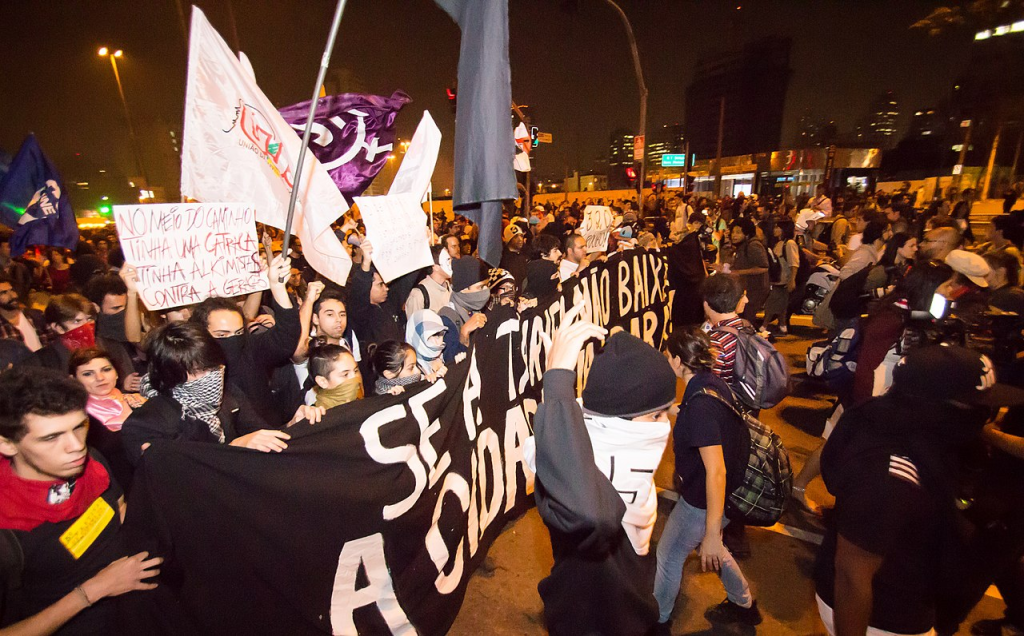
The 2010s was the protest decade, the populist decade, when the “end of history” of the long 1990s came to end. It was a proto-revolutionary moment, as discomfiting or “cringe” as it may be to think in such terms.
Self-conscious, willed political change doesn’t come out of the blue, but neither is it solely the product of incremental building. It is the product of both organization and spontaneity. Marxists have long known this, motivated by the notion of preparing, waiting for the next crisis. So did the original neoliberals, whose Mont Pelerin Society laid the intellectual groundwork for a new political-economic order decades in advance of the crisis of Fordist-Keynesianism in the 1970s. Indeed, in a notable salvo by two millennial leftists, Nick Srnicek and Alex Williams, the authors urged the Left to imitate the Mont Pelerin Society—tool up and await an opportunity. Published in 2015, Inventing the Future was already too late for the immediate post-2008 period and the wave of protests it generated. The moment was already upon us: that year Jeremy Corbyn became leader of the UK Labour Party and Bernie Sanders began his first campaign for president. In the country where the crisis was most acute, where political contestation reached its loudest crescendo, left-wing populism flunked its big test: syriza capitulated in Greece that same year.
For this generation, it seemed as if the crisis was always arriving too early—we were always unprepared, both in ideas and organization. We didn’t know what hit us; no one told us politics was like this. Generation X was the generation that imbibed the failures of the boomers and the New Left; it was the generation of the end of history. And so millennials took a world without politics as a given—until this was suddenly thrown into question in the 2010s. In terms of the transmission of ideas derived from experience, a gulf separates us from previous generational waves of activism, from the New Left of the 1960s, and before that, the Old Left of the 1920s and ’30s. No one was there to hold our hand. And yet, our failure might turn out to be a consequence of the fact that we were too beholden to the past, without even knowing it.
The millennial Left can be periodized into three phases. Its prehistory concerns the antiwar movement of the 2000s. The election of Obama and the 2008 crash terminated what was by then already lacking in energy and focus. The second phase was marked by mass street protests and occupations; opposition to “capitalism” as such returned to the fore. I recall thinking at the time that Occupy Wall Street’s appeal to the 99 percent seemed to herald a turn—an opening to the majority of citizens, the people—after decades in which to be left-wing was to belong to a minority subculture, standing away from and opposed to mainstream society. Protest grew more frequent, though it was also disorganized and leaderless—and so demonstrations and occupations tended to run out of steam, or else be co-opted or outflanked. The latter half of the decade represents the third phase, in which millennials began to reckon with power. On both sides of the Atlantic, millennial leftists like Jacobin editor Bhaskar Sunkara or Novara Media’s Aaron Bastani began to talk about winning. It seems so obvious now, but the very notion of victory was a novel idea to a generation for whom power was almost a dirty word. John Holloway (not a millennial) even wrote a book popular with young Gen Xers and older Millennials called Change the World without Taking Power.
What does the balance sheet of the 2010s show? The global protest wave that followed the financial crisis, from the nerve centers of global capitalism to languishing peripheries, was mostly “nonideological,” the divorce from previous traditions evidenced by its principal proposition: the rejection of old, corrupt elites, the political class, the establishment, la casta. The millennial Right did likewise, of course, and with greater success. In protests that were amorphous, leaderless, open to all comers, the Right mobilized an anti-politics more effectively. It is worth recalling that Leszek Kołakowski defined the Right by its lack of utopianism—the feature that marked the Left—and thus identified ‘Right’ essentially with opportunism. Hence, the sword of judgement necessarily falls heavier on the left.
The result of this anti-political muddle was countries left worse off than when they started. Some resulted in bloody civil war (Syria, Ukraine), others in a terrible restoration (Egypt, Brazil). Even in the best-case scenarios, change was halting and fragile (Tunisia, South Korea).
For others, the denouement would be more protracted, and thus more tragic. In Greece, Spain, and Chile, the activists drove straight from the streets to the halls of power, seeking to institutionalize their demands. In the latter of the three, the grand promise that neoliberalism would die in the very country in which it was first implemented was not delivered upon. A gleeful Left overloaded a proposed constitution with pet concerns, and the Chilean masses rejected it. In Spain, the inchoate Indignados that occupied the squares birthed an actual party, Podemos. It ended up as a junior coalition partner to the very party, PSOE, it held culpable for the neoliberal turn and which it aimed to displace. Alexis Tsipras’s betrayal provided a defining moment—a “bigger blow to the Left than Thatcher”—in the assessment of former syriza finance minister Yanis Varoufakis, who saw it all from the inside.
Greece is only an extreme case of what went on across and beyond the West: a populace exhausted by neoliberal austerity and angry at the lack of democratic accountability and meaningful participation was ready, finally, to ditch the old and make a play for the new. The moment had arrived. And the millennial Left could not lead. In a first instance, it rejected the very idea of leadership. Then, in a second, it refused the sort of rupture necessary for serious reform. Its unpreparedness—some would say opportunism—has now led the Left back to the marginal, subcultural position it had sought to escape.
Greece again provides a crystalline example. In syriza’s second mandate, after it had swallowed whole the Troika’s deadly memorandum, thereby turning its back on the majority of citizens who had rejected austerity and diktat from the Eurogroup and international financial institutions, the party turned to easy fights like the “moral war” against corruption and postmaterial reforms around sexuality, gender, and so on. It became concerned with implementing austerity in a “sensitive” manner. Rejecting Old Left sectarianism, the party wished to be pragmatic. But remarkably quickly, “let’s dare to govern” became “let’s govern at any cost.” This could serve as left-populism’s epitaph, well beyond Greece.
In the final analysis, the Left became the last defender of neoliberalism, not its undertaker. For all its denunciations, was it incapable of imagining anything else? Too many of its practices reflected back some of the worst features of the current order: short-termism; a bias against political programs, mass organization and institution-building; and reliance on media and charismatic leaders. This is why the 2010s are a historic missed opportunity: when amid signs of mass revolt for the first time in decades, the ostensible forces of utopianism sought to change the content of politics without challenging the neoliberal shell that contained it—to make an omelet without breaking any eggs.
In 2023, three books emerged that attempt a reckoning with this history. Chris Cutrone’s The Death of the Millennial Left is explicit in pronouncing fatality. Cutrone sets out to demonstrate how this generation’s failure is a product of past defeats and the bad ideas it has internalized. Journalist Vincent Bevins’s If We Burn reconstructs the narrative of global street protest, taking aim at the movements’ “horizontalism,” which he holds responsible for the “missing revolution” of the book’s subtitle. Political scientists Anton Jäger and Arthur Borriello’s The Populist Moment deals with the third phase, in which the Left turned to electoral politics. The book drives at the contradictions of the “populist gamble,” of trying to win without the social infrastructure that previous generations of the Left had at their disposal.
Taken together, the three works illustrate not just how protest and populism were characterized by their own internal cycles of growth and decay, but how the historical moment just passed represented a genuine opening, through which we failed to step. For those of us who grew up in the deep freeze of the end of history, wondering whether there might ever be politics again, whether human beings might ever group together and rebel and try to change things, to reflect on the 2010s invites a certain bitterness. We should be angry. The 2010s gave us masses in the streets and revolts at the ballot box, and we ended up quite possibly worse than where we started. But as always, the real catastrophe would be not to learn any lessons—or to learn the wrong ones.
Millennial Elegies
In If We Burn, Vincent Bevins, a former correspondent in Brazil and then in Southeast Asia for leading U.S. newspapers, weaves a narrative from January 2010 to January 2020 that ties together mass protest in Tunisia, Egypt, Bahrain, Yemen, Turkey, Brazil, Ukraine, Hong Kong, South Korea, and Chile. Through interviews with those who were there, on the streets of São Paulo or in Tahrir Square or Maidan, Bevins tells the story of the decade that “surpassed any other in the history of human civilization in its number of mass street demonstrations.”1 Bevins’s method is “judging the movements by their own goals.” So we learn that seven of these cases experienced a fate worse than failure. More than just a scorecard, the author also, in initial and final chapters, traces the ways that intellectual history shaped protest, through the tension between verticalism and horizontalism, hierarchy versus spontaneous self-organization, and on questions of representation, meaning, and technological mediation.
Appropriate to what the mainstream media treated as social media-driven protest, Bevins satirizes the imagined life course of 2010s-style protests in the style of a tweet2:
(1) Protests and crackdowns lead to favorable media (social and traditional) coverage
(2) Media coverage leads more people to protest
(3) Repeat, until almost everyone is protesting
(4) ???
(5) A better society
This naïveté runs right through protests in places as different as Chile and Turkey and Hong Kong—perhaps a product of a post-historical generation who really did think that if you got enough people and shouted loud enough, good things would happen. Or as the popular Egyptian blogger “Sandmonkey” explained, via a Lord of the Rings reference, he and those he fought alongside in Tahrir Square believed that when Sauron was defeated, all evil would simply disappear from the land. Get rid of Mubarak—good things ensue. In the most tragic of circumstances (Libya, Syria, Ukraine), a protest became a kind of revolution, which became a civil war, which became a bloody international quagmire: “we were very far from the digital world that Western leaders had envisaged. Bad things were happening all around, and raising awareness was very far from sufficient to stop them,” Bevins poignantly puts it.3
Politics abhors a vacuum. Those more organized or more powerful than you will fill the gap. If you don’t speak for yourself, to say what you are for, someone else will. All the protests Bevins reconstructs “start over something very specific; then they explode to include all kinds of people, accommodating numerous competing or even contradictory visions; finally, the resolution imposes very specific meaning once more. In the middle, infinite possibilities present themselves.”4
Anton Jäger and Arthur Boriello—millennials, like Bevins—pick up the thread at the point that protesters decide to pursue electoral means. Focused on Western Europe and North America (Bevins is more concerned with the world beyond the core), the authors depict what seems to be an abrupt about-face: from unorganized, free-for-all demonstrations featuring every demand under the sun and none at all, to formal political parties vying for government through elections. “They developed an earnest interest in power, for they did not believe one could ‘change the world’ without taking it.” They were serious about organizing themselves into parties, but, as we discover, they were held back by a world in which the power of parties as such was weakened.
Some created a new party out of nothing, like the academics at Madrid Complutense University who birthed Podemos; others transformed existing parties, like Jean-Luc Mélenchon in France, who took parts of the Front de Gauche to generate La France insoumise (LFI; “France Unbowed” in English). In countries without proportional electoral systems, left-populists availed themselves of the insider route: attempting to take over existing, mainstream parties like the Democrats or Labour. All, though, shared the same “political grammar”: to orient themselves around “the people,” discarding an older Left focus on “the working class.”
This abandonment of traditional leftist symbolism was an attempt to respond to two crises, “a short history of content and a long history of form,” as Jäger and Borriello put it: the economic crisis and austerity, and the longer-term crisis of politics, of representation and organization—in a word, the “void” between state and citizens that the late political scientist Peter Mair revealed.5 What becomes clear is that the “populism” in question refers to a strategy pursued within the Left as a response to this crisis of politics: “All hoped to rethink and revive the Left by adopting a populist identity—either through the installation of new, dynamic party machines or by the capture of existing sclerotic parties.”6 We should, therefore, speak of a populist Left, rather than left-populism.
All of Jäger and Borriello’s cases passed through the same process of constructing the people as a political subject and then finding a charismatic leader to embody their hopes, dreams, and demands. All of them sought mass participation across classes, but with a particular emphasis on the following: the lost generation (young, educated, “connected outsiders”); the squeezed middle class that had voted for Third Way progressive neoliberals in previous decades, but who now feared joining the “new poor” of the long-term unemployed; and the surviving industrial working class. It was the latter’s relative absence which would prove the most damaging to the left-populist gamble.
Indeed, the book’s strongest contribution is in making clear this tension between a populism of the Left and social democracy: populism arises at times when the organization necessary for social democracy is not present. Absent today are the trade unions, party branches, civic associations, athletic clubs, and the like that formed a thick network of associations providing the ballast for social-democratic politics. Notably, the book does not feature sustained discussion of program—a reflection, surely, of platforms that, though they promised many decent policies, had little of the coherence needed to unify vision and policy in one.
So, though they eschewed the horizontalism of the early 2010s protests, left-populist electoral strategies were still confounded by very contemporary problems. Between the leadership at the top and the masses of potential voters, there was nothing, a great big void. For all the novelty of left-populism, what emerges is a picture where nothing really is all that new—rather like the two elderly representatives that Anglo-American leftists adopted as their respective standard-bearers.
The intellectual inspiration came from Latin America. Argentinian theorist Ernesto Laclau was the thinker who urged leftists to drop the rhetoric and symbolism of the proletariat in favor of a “people” that would be constructed discursively, in opposition to and in contestation with the elite. This was an adaptation to a South American context in which the formal working class was a small minority among the laboring masses, and thus in which industrial trade unions could not serve as the building blocks of party organization. The influence was most self-conscious in Spain, where “Latin Americanization” was an explicit goal of Podemos, and ganar (to win) became a key word of a “populism without apology.”
But they did not win. They all went through the same cycle of an early electoral breakthrough, which generated high expectations, followed by a period of institutionalization marked by scandals or internal tensions. The cycle then comes to a close as relative failure leads to a downscaling of ambitions. Left-populist campaigns, much like the mass protests that gave birth to them, were confounded by a void, where mediating organizations, and the organized working class that could give them weight and strength, should have been. They tried to do “socialism without the masses,” and failed.
Of the three books, it is in Chris Cutrone’s contribution that this point is most underscored. Cutrone is the “original lead organizer” of the Platypus Affiliated Society, a group whose name reflects its central idea: that if an authentic Marxian Left were to emerge today, it would be unrecognizable, unclassifiable. This is so because, in Cutrone’s account, the Left itself has become so distorted by the experience of defeat that it hardly recognizes its own traditions. Not surprisingly for a group which declares that “the Left is dead,” it is mostly despised by fellow leftists (the back cover endorsements are—hilariously—all condemnatory).
Cutrone’s book is distinctive in this trio in that it is not a retrospective account but “a running chronicle of [the millennial Left’s] key moments,” composed of contemporaneous polemical essays originally published between 2006 and 2022, and now pulled together by Sublation publisher Doug Lain. It forms an “inadvertent history of the Millennial Left.”
In a 2009 essay, Cutrone remarks upon the absence of a Left that could be meaningfully critiqued and pushed forward. Nevertheless, the global crisis provided “better ground for the Left than the US wars of the 2000s had been. The issue of capitalism has re-emerged.”7 But the Left thought that the neoliberal era could simply be reversed with progressive policies, reflecting the fact it had never properly understood the crisis of the Keynesian-Fordist state, and so the reasons why neoliberalism provided a solution of sorts. Moreover, the status quo ante to which the millennial Left appealed—the social democratic settlement—had not been progressive but rather regressive in terms of social emancipation. Reading history forwards, the Grand Compromise of the postwar era—workers get higher wages and welfare in exchange for not rocking the boat—was a defeat from the perspective of the dreams of interwar, let alone nineteenth-century, socialism.
Remarking on the first Sanders campaign, Cutrone asks whether it represents a potential political turn or instead the “last gasp of Occupy activism” before growing up and joining the fold of the Democrats. Similarly, observing the Arab Spring in an essay entitled “A Cry of Protest before Accommodation?,” Cutrone compares the 1960s and 2010s protests and warns that revolution might not be the one the protesters want but “rather one that used their discontents for other purposes.” Both proved correct—even if the costs of being proved wrong when pessimistic are much lower than when being optimistic.
For all of Cutrone’s searching and deep historical critique of a millennial Left whose failures are mere iterations on previous failures, one is left with a sense of something strangely apolitical, or what Marx called “political indifferentism.”8 If every struggle is corrupted by its limited, complicit nature, then what would Cutrone have millennial leftists do—other than read the classics? Yes, the millennial Left played its cards badly, but at least it sat down at the table and played online poker—and not quadrille or speculation or whatever it was that was popular in the nineteenth century.
Now we face the pendulum of capitalist politics swinging away from a “free market” period and toward a “state-centric” one—back to “government regulation after neoliberalism, but under worsened conditions.” Cutrone is glum, seeing liberal, cosmopolitan moments as more propitious. This is surely wrong: periods of more “public” capitalism allow for contestation over what the state promises but doesn’t deliver.9 The past forty years have seen the absence of promises in which responsibility for outcomes has been outsourced to individual citizens. This cynical privatism is an abdication of authority on the part of political elites. The result has been a citizenry operating under extremely reduced expectations. The millennial Left at least sought to raise them, in however limited and backward-looking a fashion.
Four problematics thus suggest themselves for a new generation on the left seeking to respond to mass protest and ballot-box revolts: organization, media, rupture, and tradition.
The Problem of Organization
Cutrone notes that the protests of the 2010s, like the 1990s-era Left, understood themselves as doing “resistance,” rather than trying to get reforms passed, let alone make revolution. This defensive stance in part explains the organizational form that the protest wave took: horizontal, leaderless, pluralistic, spontaneous, and organized via social media. This was so irrespective of internal tensions that Bevins discovers in participant interviews. Anarchists saw their occupation of the streets and squares as creating a prefigurative space and self-governing community (one in which ultimately only students or the unemployed could participate in the long term), while others felt it was a mere temporary rallying point. Regardless, the unifying factor was rejection; the protests were anti-political. In Brazil, party emblems were banned; in Hong Kong, the key word was “no stage”—no leaders, no representation.
The rejection of formality ran deep. Some mass protests were originally organized by a small nucleus with clear goals. Such was the case in Brazil, which serves as the central case study in If We Burn. The Movimento Passe Livre (MPL), or free fare movement, was a group of anarchists agitating around the question of public transport. The MPL was organized on the basis that “everyone does everything”—this resistance against a division of labor works when you are a small, tight-knit group. But as the protests developed and became the largest in Brazil’s history, the group found no way of integrating new members. Following a script that would play out in many other cases, a small protest came to face heavy repression, widely circulated images of police violence (against the “wrong” sort of victim—in this case, a white, middle-class, female journalist) triggered something in the populace, and protest exploded, drawing in a huge mass of citizens. Yet the fiercely anti-hierarchical group ended up relying on the informal hierarchy of the original friendship group: effectively, a decision-making clique with no accountability to anyone.
Jäger and Borriello relate the same ironic process years later in France’s LFI. The absence of the usual party structures running from grassroots to leadership—obviated through digital consultancy and plebiscitary tools—led to “super-volunteers” becoming a new sort of internal oligarchy, making decisions behind the backs of the mass of online supporters who, in digital terms, would constitute “lurkers.” It is one of the many ironic reversals that we encounter throughout this history, where overcorrection ends up reproducing the original problem in a different form.
The prejudice against formality even appears in dress. Gabriel Boric, now president of Chile, made his name in the student demonstrations of 2011, and then surfed the 2019 uprising all the way to the top job. When entering parliament in 2015, Boric “turned heads” when he “showed up with messy emo-rock hair, a trench coat, and no tie.” Boric was an “autonomist,” and like the MPL in Brazil, sought to distinguish himself from the Old Left and “Leninist” practices. In this sense, his style was in keeping with the New Left that emerged in the 1960s—that is, one that was already fifty-plus years old—which sought to reject anything that reeked of Stalinism. And so it opposed everything that was big, inflexible, centralized, organized, bureaucratic, and formal.
Bevins maintains a journalistic detachment throughout, but we can glimpse who his true enemy is: “anti-Soviet and neo-anarchist thinking” which, he argues, found elective affinity with technological and corporate developments in the 2000s.10 The revolution would not be televised, but it would be Facebooked. For all their “resistance,” the young protesters bore striking similarities to the disposition of contemporary capitalism. “Smash things up, something better will emerge from the wreckage” sounds awfully like Silicon Valley–style “disruption.” Or, in a nice touch that Bevins reserves for a footnote, it sounds like Obama, who claimed his biggest mistake was failing to plan for “the day after” in Libya. Twenty-first-century capitalism continues to be anti-institutional, non-normative, anti-planning, short-termist, and rests on controlling flows more than building. What, then, is the point of a Left that only reflects these dominant characteristics of contemporary society back at it?
That so many bought into these ideas is tragic. “We thought representation was elitism, but actually it is the essence of democracy,” remarks activist Hossam Bahgat in Bevins’s book, reflecting on the failure of the Egyptian Revolution.11 Knowing the shape the counterrevolution took—General Sisi’s even more authoritarian dictatorship—one can only be left sad, bitter, angry.
Did the third coming of the millennial Left, the formation of parties, resolve these deficiencies? Street protests were open to all comers, and so the costs of exit were just as low. Yet, despite the turn to the party form, left-populism suffered the same problem. For instance, Jeremy Corbyn was only elected leader of the Labour Party because, in an effort to dilute the influence of trade unions, previous leader Ed Miliband had made membership available to the general public at the cost of only £3. Left-populist party campaigns were built on the internet model: anyone is one click away from registering, starting an action group, and campaigning for party candidates. You are also only one click from dropping out.
This has its benefits. In an ecosystem of “unmediated democracy,” malleability allowed left-populists to attract voters beyond traditional class-based alignments. A charismatic leader (or one onto which devotees project values) unifies the movement; such a personalization of politics has been the political norm for at least thirty years. New communications tools and techniques attract the youth. An antiestablishment attitude captures the prevailing sentiment. “With no powerful institutions like the labor movement to call upon, leftists were forced to take the battle to the electoral arena, thereby launching the true left populist gamble,” as Jäger and Borriello put it.12
This “attack” on the very idea of mediation presupposes a rapid assault on power—“as if by surprise,” Jäger and Borriello remark. Bernie Sanders hoped to go from being a forgotten, fusty old leftie senator to leader of the free world in the space of eighteen months. That may not have played out, but syriza really did transform from a new, small, radical Left coalition to unifying and representing all segments of society frustrated by austerity. Originally identified with “the protesters,” in a short space of time it became the recognized representative of a social majority. And it took office. But we know what happened next.
Jäger and Borriello argue that the “left-populist gamble” is premised on a wholly different understanding of the (bourgeois-democratic) political party: its goal is no longer about entrenching voting blocs over the long run, but about serving as the best disposable tool for each electoral contest. Again, the speculative, flexible, opportunistic nature of left-populism eerily reflects the functioning of capitalism today. This should alert us to the fact that the questions that vexed left-populism—To ally or not with the institutional center-left? Digital pop-up blitzkrieg or build party structures? Place yourself on the left-right axis or try to be indeterminate?—are not merely organizational.
Cutrone is in agreement. Within the Marxist tradition, revolutionaries Rosa Luxemburg and Vladimir Lenin stand, in part, for spontaneity versus organization, respectively. Citing J. P. Nettl, Luxemburg’s biographer, Cutrone notes that both German and Russian revolutionary leaders addressed complementary questions, which can’t be reduced to that simple dichotomy: “How does political action enable transformative organization; and how does political organization enable transformative, emancipatory and not foreclosing action?” These are the questions that must be addressed to the millennial Left, because organizational problems are more than just impediments, they are symptoms that need to be worked through. “Perhaps we need to be ‘conservative’ in our ‘revolutionary’ politics in order to be actually radical in the present,” Cutrone concludes.13 Indeed.
This might well apply to another postmodern innovation: leaderism. Examined by sociologist Paolo Gerbaudo a few years earlier,14 the Left electoral movements of the 2010s relied on hyperleaders who draw legitimacy from emotional recognition and the acclaim of the base, rather than legal investiture by the party. The personalization of politics around the leader serves to compensate for the absence of mediating structures between base and leader. There are no local branches, no cadres, and indeed, no real party loyalty. We talk of Corbynism, mélenchonisme, pablismo instead. This is different from Leninism, Maoism, or Trotskyism, terms which represent variations of a common body of thought—socialism—and are thus total philosophies. As the authors rightly insist, leaderism is not really the overcoming of leaderlessness: it is not a cure, but a symptom of the same problem. The anti-Stalinism of the horizontal occupations transformed into something more personalistic than Stalinism itself!
The Problem of Media
Leaderism also generates new problems. The populist hyperleader is meant to be down-to-earth and morally irreproachable. It is a political truism that he who rides the highest horse falls hardest. So it proved with Corbyn, destroyed by accusations of anti-Semitism, or Mélenchon, undermined by media attention on his short temper, or Iglesias, who was found to have bought a €600,000 house with his political and life partner, Irene Montero. The hyperleader carries so many hopes and expectations that when he falls, so does the whole project. As Jäger and Borriello note in reference to Jeremy Corbyn, that project relied on new media to communicate with enthusiastic millennial voters, circumventing the mainstream media. But this underscored how much of a mediatic affair it was. A “media party will always be vulnerable to media attacks.”
The mediatic nature of so much of millennial Left politics comes through loud and clear in Bevins’s study of the protest decade. Already in the introduction he notes how the experience of May 1968 came to be traduced by those who were selected to appear on TV to talk about it in the aftermath (naturally, the more trained and educated). With the 2010s mass protests being even more inchoate than the 1960s, the space for imposing an ex post facto meaning on them was even greater.
Over the course of the book we find that fights over who controlled the social media accounts were a feature of both New York’s Occupy and Spain’s Indignados. And that Brazil’s MPL would share media responsibilities but “they would certainly make sure to offer the media the sort of content they loved to run.”
As Bevins remarks about Egypt in the critical moment of late January 2011: “the revolutionaries could have taken anything. They chose to stay in Tahrir Square, the default destination for many in the crowd; it was an empty piece of land, and its conquest offered no strategic value, except for its visibility.”15 The absence of clear political and class identities and meanings meant that symbols were sought elsewhere. One leading participant in Brazil’s June Days tells Bevins that the activist group’s main influence was Mexico’s Zapatistas, whose struggle had been introduced to them via the ’90s band Rage Against the Machine. In Hong Kong, a three-finger salute, taken from The Hunger Games films, became a common marker. “I think it is also a little sad, and definitely very unfortunate, that we got so many of our ideas from pop culture,” one Hong Konger concluded.16 The ersatz character of politics at the end of the end of history was on full display in these demonstrations. In Ukraine’s EuroMaidan, after Viktor Yanukovych announced he was not taking the EU’s deal, one group of leftists took a red flag embroidered with EU stars on it. “Europe” here represented not austerity and anti-democracy but “social democracy and human progress, prosperity and rights.”
Reflecting on the “missing revolution,” Bevins asks himself whether the mass insurrections were genuine moments, glimpses into “the way that life is really supposed to be,” and “the most real thing that one can ever feel,” or if, on the contrary, they were empty expressions of mass ecstasy, having more in common with Woodstock and Coachella than the storming of the Bastille. He concludes that “people went back and forth” on this—though one suspects this is the author’s view, too.
In lieu of a definitive conclusion, Bevins’s direct political object is the condemnation of Western journalists and their synergistic relationship with educated professionals, often from nonprofits, whom they selected as mouthpieces for the uprisings. “The Western media gave special attention to the euphoric, prefigurative, and ultra-democratic elements within the revolt,” he notes with regard to Egypt.17 In Ukraine, the liberal wing of EuroMaidan included workers in the tech sector who were mostly pro-Brussels, spoke the language of democratic ideals, in competent English, and were associated with NGOs who had full-time employees “trained and paid to interact with people like me [Bevins].” It is this prejudicial dynamic that complicates an already difficult task: finding the “truth” of the movements. There is an evident manipulability here. In Brazil, a right-wing pro-business group was able to seize leadership over the left-leaning social democratic protests by astroturfing themselves. Their name? MBL (Free Brazil Movement)—almost indistinguishable, especially in spoken Portuguese, from the autonomist initiators of the June 2013 protests, MPL. In Ukraine, Far Right nationalists became the predominant force in Maidan, punching above their weight. As one of Bevins’s interviewees explains, “they did not pull this off because regular Ukrainians supported them—they fought for it, and they won.”18
The Problem of Rupture
The left-populist gamble may have represented an attempt to seize power, but it also evinced a radical underestimation of power. In the best of cases, left-populists took office, yes, but never power. In another ironic reversal, the millennial Left dropped the notion of being self-consciously marginal and began addressing, and seeking to represent, basically everyone. But this meant avoiding hard ideological choices. You can’t be friends with the Eurogroup and the 61 percent of Greek voters who rejected the Memorandum. You can’t lead middle-class metropolitan Remainers and Northern working-class Leavers in the UK. You can’t unify a coalition of college-educated woke culturalists and working-class provincial materialists simply through the lure of executive power. There remains a potentially hostile legislature, a certainly hostile judiciary, a diabolical deep state, and even supranational institutions that will scupper the best laid plans. The long-term crisis of politics cannot be ignored in a rapid quest for executive power, under the illusion that neoliberalism will be swept away with the stroke of a pen.
Other ironies abound. Jäger and Borriello note how technocratic left-populism actually was. Because they lacked a mass membership capable of shaping policy, and their voters came from different groups in society with conflicting preferences, left-populist parties relied on technocratic policy fixes to resolve deep contradictions. But there is a limit to this—how, for example, would one reconcile urban middle-class and industrial working-class attitudes to climate change? Investment in the person of Jeremy Corbyn—or more credibly, Jean-Luc Mélenchon, for he is a much better orator and tribune—can only go so far. But step back a second: personalism and technocracy? Is that not essentially Blairism? And so left-populism remained, in essence, an urban middle-class professional affair. In France, Mélenchon spoke about conquering the fachés mais pas fachôs (the angry but not fascist—the workers who had not turned irrevocably to Le Pen’s Rassemblement National). But “that coalition never materialized.” It continued to rely on urban, highly educated youth and the suburban proletariat in the service sector. As such, left-populism failed to deliver on its populist, unifying promise.
Jäger and Borriello locate the ultimate problem in the fact that the left‑populists were never able to transform their army of election campaigners into something more durable: “without waging a war of position to consolidate the gains of the digital vanguard, left populism will be remembered as little more than a wasted opportunity.” Had this succeeded, the left-populists may not have taken power, not in the short‑term anyway, but could have constituted themselves as something of a post-neoliberal force, exerting pressure to change economic policy, as well as going a little way toward mending the secular crisis of politics. Ultimately, the authors conclude, the experience was very short-lived—fitting for an ecosystem that is increasingly short-termist and “awash with exit options.”
A grander play for social transformation is barely hinted at as a possibility. Yet Jäger and Borriello note that the UK lacked the sort of constitutional barriers that would have held back a Corbynist program elsewhere, and are aware that Labour suffered a heavy defeat in 2019 after it failed to honor the result of the 2016 Brexit referendum. Where is the full-throated denunciation? The authors simply explain that the mostly Remainer activist base “mainly knew British politics as a torture chamber for fiscal discipline, not as a site for sovereignty.” True though this is, the authors end up somewhat recapitulating the low expectations of the age.
The popular appetite for change was there though (even if fear of the future always lurks round the corner). When people are given the opportunity to reject the status quo, they do, rightly insists Cutrone. The status quo’s response is always that they should not have been given the opportunity. Hence the importance of striking when the iron is hot. Organization, yes, but also some spontaneity.
Similarly, Jäger and Borriello observe that the Sanders campaign ended up as “another quixotic attempt from within a party of capital.” If the failure to break through in Britain concerned the question of the EU, in the United States, it was about the Democratic Party. “To succeed,” insists Cutrone, “Sanders would have needed to run against the Democrats the way Trump has run against the Republicans. This would have meant challenging the ruling Democratic neoliberal combination of capitalist austerity with New Left identity politics of ‘race, gender and sexuality’ that is the corporate status quo.” This, though, would have been a more thoroughgoing “populism” than what the actually existing left-populists ever countenanced—or if they did consider it, they were dissuaded by the bulk of activists wedded to a self-defeating leftism.
Cutrone concludes that whatever expectations the millennial Left “once fostered were dashed over the course of a decade of stunning reversals.” This rather overstates how much the millennial Left had to lose. Yes, it missed a historic opportunity, but this is more like missing the last bus out of town than getting your car stolen. In an interview with me, Cutrone conceded that the millennial Left “did the best they could,” but, crucially, that this is also what the New Left of the 1960s and the Old Left of the 1930s told themselves.19
Once again, Greece provides the clearest picture of the stakes involved. There were many on the international left20 who, though lamenting Tsipras’s white flag, explained in “realist” terms that taking Greece out of the eurozone and the EU would have meant utter chaos, the poorest would have suffered hardest, syriza would be blamed, the Far Right might benefit, and so on. But this is exactly what Greece has suffered anyway, even if in a more drawn-out fashion. To crash out would at least have offered Greece a horizon, a possibility to build itself up once again as an independent nation. And, crucially for internationalists, it had the potential to set off a chain reaction. Nothing of this is certain, but it would have been a play for greater possibility. Cutrone rightly cites Leon Trotsky in saying “those who demand guarantees in advance should in general renounce revolutionary politics.” The problem is that most of the millennial Left have. And this makes reform even less likely.
The Problem of Tradition
Cutrone, like Jäger and Borriello, makes use of the gambling metaphor. Cutrone, however, argues that the millennial Left chose not to play the hand it was dealt. It shied away in fear from the gamble itself, falling back instead on replaying the cards dealt to previous generations. What does this mean? This is best explored through reference to left-wing political traditions.
The thrust of Bevins’s analysis of the protests is that they were expressive of the legacies of the anti-Stalinist New Left, which, cut off from the Old Left through world war and McCarthyism, acted on the basis of half-absorbed, half-forgotten lessons. The result was a rejection of structure and preference for prefigurative rather than instrumental politics. Outside North America, though, the Old Left was very much alive, Bevins reminds us, citing Marxist-Leninist parties as well as national developmentalists who often repressed communists, even while they allied with the USSR (Egypt’s Nasser is a case in point).
This is a false dichotomy. The legacy of the 1960s runs through both sides: it’s there in “Stalinophobic” anti-communism (of both Cold War liberalism and social democracy—including in today’s “populist” attempts to refound social democracy without working-class organization) and in Stalinophilic “militancy” (Maoism, Guevarism). Setting up quasi-Stalinist or quasi-Maoist politics as “leftism that works” against the self-evident failures of anarchist horizontalism is a mistake. It merely results in a sterile and undesirable opposition between two leftist dead-ends: Stalinist “seriousness” and “organization,” and anarcho-liberal “narcissism” and “prefiguration.”
Indeed, for Cutrone, what is taken to be “left-wing” or “socialism” today is nothing more than the “naturalization of the degeneration of the Left into resignation and abdication.” The Left takes the product of earlier failures and holds them up as objects of desire. Elements of this are visible in Bevins’s commentary on protest. He suggests that the collapse of governments is unlikely in the West, and that the armed forces in NATO countries “were certainly not going to abandon the state,” nor was NATO “going to bomb itself.” Is Bevins saying that the criterion of success is the establishment of separate, militarized blocs of nation-states, making political contestation over the future a geopolitical matter? That would be to rerun the Cold War! The Cold War was in fact testament to the failure of global revolution, to the ossification of the struggle for socialism into a mere “alternative” to capitalism, rather than a more advanced form of civilization. Nevertheless, Bevins indicates radical change is not really possible in the most advanced states, and only possible in peripheral “weak links.” This would seem to recapitulate a Third Worldism that is surely as exhausted as revolutionary politics in core countries. There is a certain conservatism in this. Is this also why Bevins does not deal with the Yellow Vests in France, who stood out for being the most sustained and proletarian of such protests, while also taking place in a core capitalist country? It would have been interesting to see this explored.
Meanwhile, though Cutrone underplays the specific problems of organization of our age—specifically the decline of associationism—his essays are useful for urging historical thinking. Millennials “blew their chance to relate to history in new ways that challenged and tasked them beyond post-60s doxa.” Instead, the millennial Left, in both protest and populist phases, evince a nostalgic quality, whether in pushing for a new New Deal or (much worse) replaying 1960s hippie protests or 1980s “resistance” to neoliberalism. These practices and beliefs “do not augur new possibilities but hold to old memories from a time when many if not most were not yet even alive. Its spectral—unreal—quality is evident.”
We should be alert to a troubling fact: over the past one hundred years, the left has mostly arrived post-festum, certainly in the West. It plays a role in ushering in a new era, then attacks the new era, and finally finds itself nostalgic for it. So the Left attacked the stultifying welfare-warfare state in the 1960s in the name of individualism, actions which, despite their intentions, laid the ground for neoliberalism once the postwar order fell into crisis. The Left then set up its stall as the resistance against the reorganization of capitalism along neoliberal lines, accompanied by the most forceful, moralized rhetoric in defense of society against individualism. Finally, the Left finds itself neoliberalism’s last defenders in the face of so-called right-populism in the form of Trump, Le Pen, Brexit, Vox, Fratelli d’Italia, or what have you. The Left may not defend neoliberal policies, but it holds to neoliberal or neoliberalized organizations and institutions, be it the Democratic Party or the EU or the university or the NGO.
Commonsense Communism
In 2011, Colin Crouch’s The Strange Non-Death of Neoliberalism was published. That its central question could still be asked today is damning of both our complacent, gerontocratic elites as well as the forces of contestation that should push things forward. Indeed, it is the absence of a credible, popular Left that solidifies elite complacency. For all the critiques presented here, this should concern those observers who, unlike the present author, have no investment in the Left.
Why was the Left unable to achieve even its reformist goals, let alone any revolutionary dreams it may have had? A central question raises itself across the three eulogies of the millennial Left: when politics itself is in crisis, is the necessary first step to reconstruct civic association as a building block of a credible, mass left-wing political party? Or must the Left be prepared to act quickly, to seize authority, and to lead at moments when the masses’ conservatism rapidly evaporates and the status quo is rejected—as happens with some frequency, albeit unpredictably?
We should answer these questions with another question, already asked earlier: “how does political organization enable transformative, emancipatory, and not foreclosing action?” The answer, to take our two alternatives above, is surely “both.” The millennial Left’s failure was to do neither. It neither was able to bind the masses, to whom it briefly appealed, in new political organizations, nor was it able to act and lead in moments of crisis when the destruction of the old order (however conceived) was in shooting distance.
Jäger and Borriello write that the left-populist experience failed for being “too left, too populist”—it failed to break free from its minoritarian left concerns and symbolism, while failing to build a genuine party along the old lines, preferring instead the populist gamble. Perhaps another way to frame this is that the millennial Left would have benefited from a more “populist” ideology—that is, not beholden to the failed modes of Left activism of the late twentieth century—while also being more organizationally “conservative.” This would seem to tally with Cutrone’s call that a “Marxian approach should seek to occupy the vital, radical center of political life.”
In the U.S. context, this would mean “completing the American Revolution”—not MAGA but “Make America Revolutionary Again.” The sign of the times, of the 2010s, has been an expressed desire to break with the old—a sign the Left has too often ignored. Yes, Sanders called for a “political revolution” in the name of “democratic socialism.” What that meant was “an electoral shift to support new policies.” But reckoning with the crisis of the postwar order, and the current crisis of neoliberalism, means taking seriously the notion that there is no going back, that the end of history is over—and so is the twentieth century.
This article originally appeared in American Affairs Volume VIII, Number 1 (Spring 2024): 85–104.
Notes
1 Vincent Bevins, If We Burn: The Mass Protest Decade and the Missing Revolution (New York: PublicAffairs, 2023), 235.
2 Bevins, If We Burn, 258.
3 Bevins, If We Burn, 169.
4 Bevins, If We Burn, 167.
5 Peter Mair, Ruling the Void: The Hollowing of Western Democracy (London: Verso, 2013).
6 Arthur Boriello and Anton Jäger, The Populist Moment: The Left after the Great Recession (London: Verso, 2023), 3.
7 Chris Cutrone, The Death of the Millennial Left: Interventions 2006–2022 (Portland, Ore.: Sublation, 2023) 75.
8 Karl Marx, “Political Indifferentism [1873],” Marxists.org, accessed January 9, 2024.
9 See my review of Fritz Bartel’s The Triumph of Broken Promises: Alex Hochuli, “Democracy and Discipline,” American Affairs 6, no. 2 (Summer 2022): 125–41.
10 Bevins, If We Burn, 268.
11 Bevins, If We Burn, 265.
12 Boriello and Jäger, The Populist Moment, 45.
13 Cutrone, The Death of the Millennial Left, 11.
14 Paulo Gerbaudo, The Digital Party: Political Organisation and Online Democracy (London: Pluto Press, 2019).
15 Bevins, If We Burn, 67, emphasis added.
16 Bevins, If We Burn, 269.
17 Bevins, If We Burn, 69.
18 Bevins, If We Burn, 162.
19 “Death of the Millennial Left ft. Chris Cutrone,” Bungacast, podcast audio, January 9, 2024.
20 See for instance veteran boomer socialists Sam Gindin and Leo Panitch in Jacobin, who argued that more preparation would be necessary for Greece to ever leave: Sam Gindin and Leo Panitch, “The Syriza Dilemma,” Jacobin, July 27, 2015.
About the Author
Alex Hochuli is a freelance writer and research consultant based in São Paulo, Brazil. He is a cohost of the global politics podcast Aufhebunga Bunga and coauthor of the forthcoming The End of the End of History (Zero Books, 2021).
 Knock nock
Leave a comment