

Memory is deeply affected by poor listening and this kind of noise. When we recollect happenings or try to construct a past incident, what we recall is one more step removed
T.M. Krishna Published 29.03.24, 05:38 AM

Representational image.Sourced by the Telegraph
Learning music requires the activation of two cognitive processes — listening and remembering. In this context, I would like to distinguish listening from hearing. Hearing is involuntary; the registering of a sound. There is no association, recognition and understanding born from the incident. I also propose that mere repetition or rote action, even if accurate, remains within the domain of hearing, when there is no mental application. Listening, on the other hand, is the completion of the entire process beginning from the arrival of the sound and ending with awareness and understanding. This is how, even in a crowded train, we are able to converse. The ambient sound is pushed to the background because we make the effort to concentrate on what an individual is saying. But listening is not stand-alone. It is influenced by visual cues and stimuli, tactility, and olfactory and gustatory changes.
Memory is an unusual creature. To begin with, its quality is influenced by whether the individual heard or listened. If he heard, then memory fails or results in incoherent recollections. When sound is internalised completely, memory is richer. But even this is suspect because the mind is never static and, hence, the social environment and life experiences of the listener add, delete, turn and twist that which has been listened to.
In a music class, I often encounter a situation where my student is unable to comprehend what I teach. I repeat the same line over and over again; yet the student repeats the same mistake. My student appears to be attentive and putting in the required effort. Yet, it does not happen. It is possible that the individual does not have the intellectual tools to understand the line of music. In which case, I need to go back to the drawing board and ensure that the needed inputs are first put in place. But I face the same problem even when the student is fully capable. In these cases, something else is happening. As I begin to sing, the student is unconsciously singing in his mind. He follows the tune a micro-second behind me, overlapping my voice with his own mental voice. In other words, his mind is mapping the musical flow and intonations based on all the knowledge his mind has already gathered. Much like how we tune out other sounds when we speak in a crowd, the individual here pushes my voice to the background and hears himself even though his voice is in the mind and not audible. When we sing in our mind, the song is listened to from within. If the impression of the inaudible music is strong enough, it can drown the auditory stimuli.
All that I have said about music and music learning is applicable to our everyday lives. In the public discourse, we encounter misunderstandings that do not make sense. We believe that what has been communicated is crystal clear and the nuances obvious. But the person listening interprets the narrative very differently. Other than those who are purposely perpetrating incorrect tales, the larger population is a victim of the situation.
When we are predisposed to dislike an idea or a way of thinking, anything that resembles it is received with a coloured lens. The simplest statements sound offensive. When our comfortable present is disturbed, the mind rushes in to reject or trivialise those thoughts. Much like the student who sings in his mind and shuts out the teacher, our conditioned mind-voice screams from within, overriding the speaker. The speaker’s words are retold in order to suit or justify our position. Not only are the words transformed but the mind also adds tonalities and different emphasis. All this happens even when we read. Every written word is aural. In fact, as I type this article, I am listening to the words in my mind. Therefore, these forced changes also jump mediums: from the visual to the sonic.
In our public discourse today, we are amidst a lot of chatter and noise. We are unable to sift out voices of sense, calmness and seriousness from within the cacophony. Unlike the situation where we are able to zero in on the voice we want to listen to, here we lose that discernment due to the emotional and mental instability that this noise creates. Noise is not just a physical phenomenon; it is psychological. When we are bombarded constantly by innumerable phrases and words from all directions that intentionally excite us and muffle our ability to listen, it is impossible to reflect. We become a part of the noise. In that state, much like our primordial physical survival instinct, our mind’s first objective is to find some semblance of security and safety. This is naturally found in our previously-held opinions, leading to the delegitimisation of anything that points to the contrary. Noise is the best mechanism to ensure that there is no serious conversation. The higher the decibel levels, the more difficult it is for us to engage in any meaningful conversation. Noise accentuates fear, anger, and even contrives and contorts things.
Memory is deeply affected by poor listening and this kind of noise. When we recollect happenings or try to construct a past incident, what we recall is one more step removed. To make things worse, there are gaps in the story which are formed because of our emotional state at the time of the event. Muddled by the panic and reactionary environment, we may not have even known what we were doing or saying.
Due to the incessant noise, we move between poor listening and just hearing. This, once again, is a self-preservation technique. These gaps are filled by newly-imagined information that only validates our position. Social media has further accentuated this human vulnerability. Because of its intrinsic structural capacity to draw people in by the thousands and reach out to as many, social media is a tumultuous place. Algorithms are designed in such a manner that we are drawn to pages and handles that aggravate us and push our minds further away from reason. Social media adds another dimension to the problem: the intoxication of instant gratification and collective bullying.
If we are not watchful, we will be constantly triggered. It is up to each one of us to step back, remain detached, observe and listen. This requires immense courage, poise and honesty. But unless we are willing to make that effort, we cannot grow as people and live together despite all our differences.
T.M. Krishna is a leading Indian musician and a prominent public intellectual

Book review: A Southern Music- The Karnatik Story
Reported By:| Edited By: Ashwin KM |Source: DNA |Updated: Dec 05, 2017, 02:43 PM IST
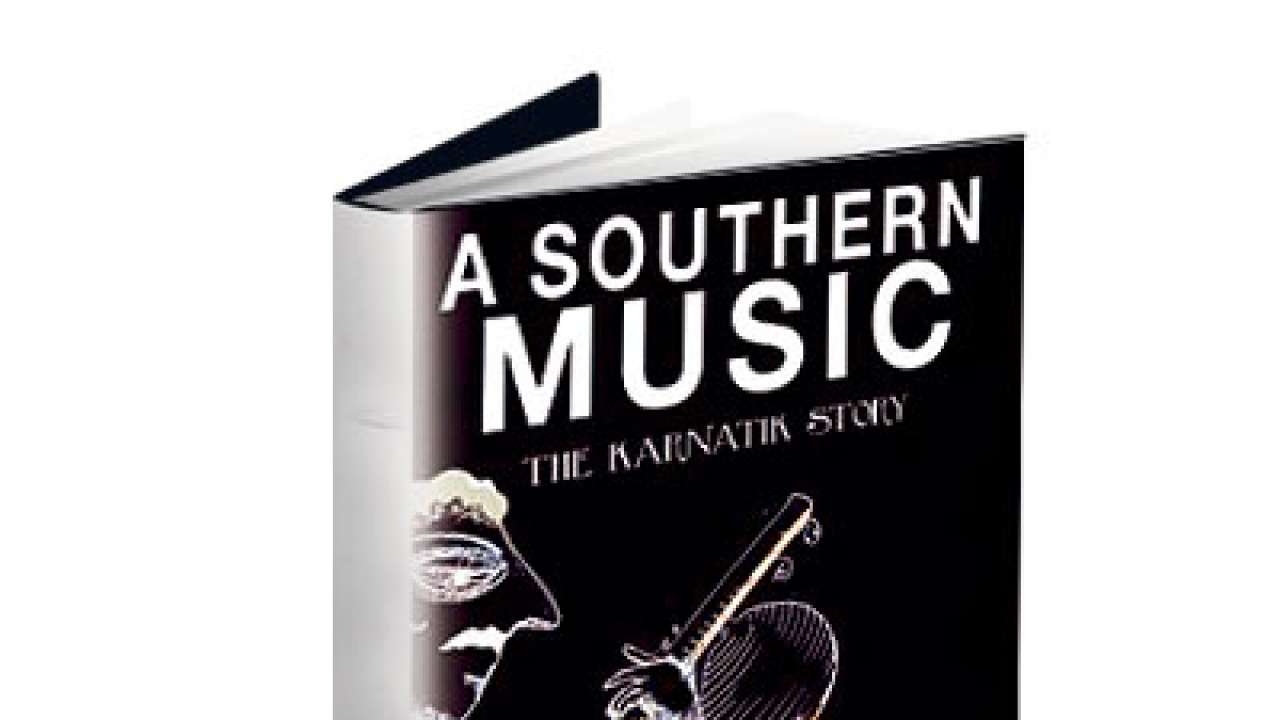
Book review: A Southern Music: The Karnatik Story
Author: TM Krishna
Publishing House: Harper India
Cost: Rs799
604 pages
To read a book like TM Krishna’s A Southern Music — The Karnatik Story is like attending one of his full-blown concerts that comfortably breaches the four-hour mark, in a packed hall, with the audience barely batting an eyelid till the maestro is done. It doesn’t matter if it’s Chennai, Mumbai, Cleveland or anywhere else. It’s captivating, powerful and engulfs the whole audience — irrespective of how clued in they are to the intricacies of a Karnatik Kutcheri. It may be undeniably technical at times for the layman but never once loses its magnetism in arresting the amateur senses of a new listener. You know you are in for a elevating experience and often with a surprise quotient packed in, when you are constantly trying to predict what comes next, but don’t quite get it right.
Only Thodur Madabusi Krishna (TM Krishna or ‘TMK’ as he’s popularly known), among the current crop of young Karnatik musicians could have come up with this idea of a book like this on southern India’s classical music system (also referred as ‘Carnatic’ since the British colonials called it that), which is nothing less than an encyclopaedia itself. This sweeping exploration of the tradition of Karnatik music begins with a fundamental question: What is music? Taking nothing for granted and addressing readers from across the spectrum — musicians, musicologists as well as laypeople — TMK provides a path-breaking overview of south Indian classical music. Not just as a definitive study of the Karnatik classical system and the works, but as an overall encapsulation of varied forms of music and even dance, that has fused well along with this classical form, drawing inspirations from it.
He also suggests the welcoming nature of this art form, in terms of accepting foreign instruments as one of its own and the constant evolution within this system, viz. the violin, clarinet and saxophone.
One of the beauties of this book lies in TMK’s commendable effort to get his audience on a chance visit to an artist’s imagination, its limitless horizons with unexplored boundaries. Emphasising a lot on aesthetics involved in appreciating an art form as diverse and oceanic like our classical music, TMK tries to imbibe the readers with the aspect of understanding the idea and beauty of the classical form.
Like a Karnatik concert, TMK has partitioned A Southern Music into three sections — experience, context and history; suggesting that the reader have the ‘experience’ before moving on to the ‘history’. Just like you don’t expect an artist to start a kutcheri with a Thillana and end it with a Varnam.
Also thrown into the mix are some honest, yet controversial observations and facts from TMK on how society and the politics of caste and sexism have had a constant ride along with the evolution of the classical music scene, not to mention criticisms on some of the kutcheri bani itself. “An art music presentation has no room for light miscellanies like tukkadas, and a kutcheri is not a variety entertainment show or a circus presentation where you need to experience the frown of the lion and the snigger of a clown,” avers TMK, who also wonders whether an atheist or a non-Hindu can be a Karnatik musician.
Nonetheless, this book is as brave and intelligent as its artistic author himself; an apt promotion for the Karnatik music brand, not that it ever lacked one. This is a must have for anybody even remotely associated with music and not just people who are pursuing it. More importantly, this book should be on the shelves of parents who have enrolled their children in learning this art form — be it vocal, instrument, percussion or dance. Their engagement in understanding the music will help them appreciate their children in pursuing it.
Considering Nobel laureate Amartya Sen has himself has said, “What you get from the book is a deeper sense of experience, a better understanding context and, of course, a kind of commanding view of the history of the discipline”, if you haven’t got a copy of this book yet, one can only recommend you do so immediately.
—(Ashwin KM is a Karnatik vocalist)

About the Book
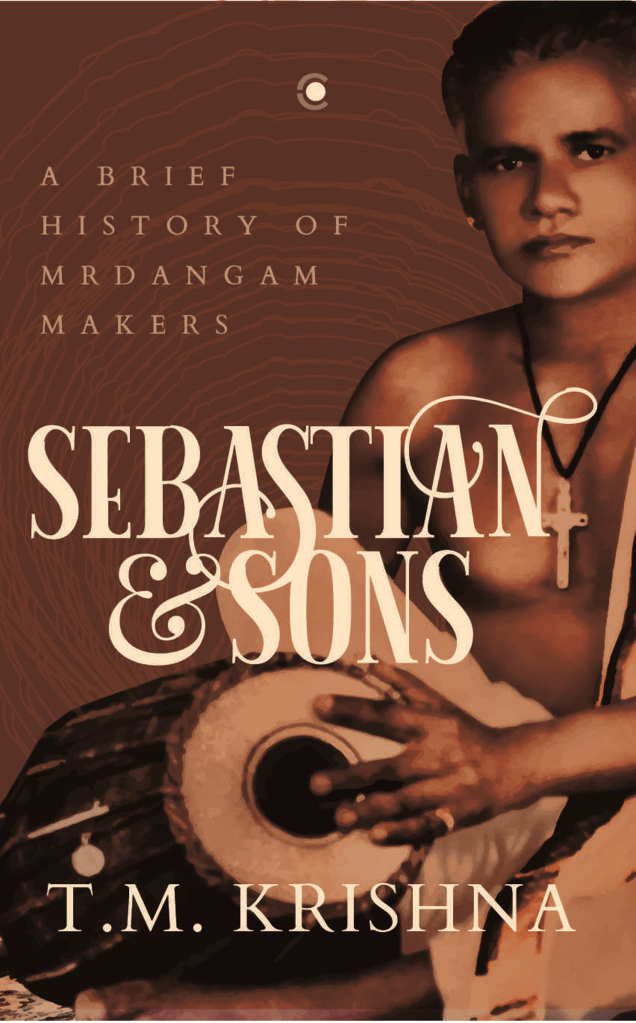
MUSICIAN AND ACTIVIST T.M. KRISHNA INVESTIGATES THE HISTORY OF THE MRDANGAM AND MEETS THE INVISIBLE KEEPERS OF A TRADITION: THE MRDANGAM MAKERS.
The mrdangam is an integral part of the Karnatik stage, its primary percussion instrument. Yet—startling as this is—the instrument as we know it is only a century old. T.M. Krishna investigates the history of the mrdangam and meets the invisible keepers of a tradition: the mrdangam makers.
The making process is an intellectually, aesthetically and physically taxing one. From acquiring the skins for the circular membranes and straps to the wood for the drum, from curing the material to the final construction, and at the end of it all, making sure that it has the tone that the mrdangam player wants, mrdangam-making is also a highly nuanced operation at every stage.
While several artists have been credited with the evolution of the instrument, including the stalwart Palghat Mani Iyer, none of them had knowledge of a fundamental aspect of the making: hide. The quality of the hide and how it is cured, cut, stretched, bound and braided impacts the tone, timbre and sound of the instrument. This requires a highly tuned ear and an ability to translate abstract ideas expressed by musicians into the corporeal reality of a mrdangam. Yet, their contribution to the art of the mrdangam is dismissed as labour and repair—when it is spoken of at all.
There are legendary mrdangam players, yes; there are also distinguished mrdangam makers, many of them from Dalit Christian communities, who remain on the fringes of the Karnatik community. Sebastian and Sons explores the world of these artists, their history, lore and lived experience to arrive at a more organic and holistic understanding of the music that the mrdangam makes.
About the Author
Thodur Madabusi Krishna is a vocalist in the Karnatik tradition. Uncommon in his rendition of music and original in his interpretation of it, he is at once strong and subtle, manifestly traditional and stunningly innovative.
Krishna is also a prominent public intellectual, writing and speaking on issues of structural inequality and culture. He intervenes musically on current issues, whether it is the deoperationalising of Article 370, the vandalising of a Periyar statue or to save the wetlands. He is the driving force behind the Chennai Kalai Theru Vizha (formerly Urur Olcott Kuppam Vizha) and the Svanubhava initiative. He has been part of inspiring collaborations, such as Chennai Poromboke Paadal, performances with the Jogappas who are traditional transgender musicians, the Karnatik Kattaikuttu that brought together art forms from two ends of the social spectrum, and an enduring poetic partnership with Tamil writer Perumal Murugan.

TM Krishna Periyar Controversy – Maruthaiyan explains carnatic music his…

‘Brahmin citadel’, rebranded Bharatanatyam — what’s Madras Music Academy, in eye of TM Krishna storm
97-year-old academy has been credited for patronising performing arts. But it has also been frequently criticised for its lack of inclusivity.
28 March, 2024 06:09 pm IST

Chennai: In the 1920s and early 1930s, when the classical dance now known as Bharatanatyam was on the brink of a complete wipeout, it was one landmark music institution that helped revive and rebrand it. That was the Madras Music Academy, the home of Carnatic music.
“In 1932, the Madras Music Conference of the Music Academy passed a resolution to rename sadhir (sadhir attam, or court dance) into Bharatanatyam. The idea was to remove the unsavoury connotations of the previously existing names like sadhir, dasi attam, etc. The ‘depraved’ Sadhir entered a ‘respectable’ home of Brahmin elites,” writes Jawaharlal Nehru University (JNU) scholar A. Jeevanandam in a 2016 research paper, ‘Exploring Bharatanatyam: A Reformed Dance Form of Devadasi Tradition in the 20th Century’.
Today, the 97-year-old academy is caught in a blazing row after announcing its decision to award the Sangita Kalanidhi — its most prestigious award, often regarded as the highest accolade in the field of Carnatic music — to T.M.Krishna, a vocalist known to challenge caste and religious boundaries with his art. At the centre of this controversy is the Margazhi Festival of Dance and Music, an event that Krishna, also a recipient of the Ramon Magsaysay award, will preside over by virtue of winning the award.
Seven Carnatic vocalists have withdrawn from the event and the Music Academy Conference 2024 — both in December — after accusing Krishna of trying to polarise the music world along caste and communal lines.
The academy has defended its stance, calling a letter written by singers Ranjani and Gayathri, who first objected to Krishna’s presence at the event, “unwarranted and slanderous assertions and insinuations verging on defamation”.
For the academy, which is often viewed as a symbol of Brahminical absolutism, this stance is notable. The row has also left the Tamil Brahmins divided — while some support the protesting musicians, others criticise their stance as perpetuating caste hegemony.
“The problem for those creating this uproar is that an institution that is supposed to represent ‘them’ has gone and sided with the enemy,” writer-columnist Sujatha Narayanan told ThePrint. “The teacher who once made the errant student (Krishna) stand outside the class is now awarding the very same student. And the class is not happy.”
Also Read: How TM Krishna got under the skin of the Carnatic music fraternity
Patron of arts, rebranding Bharatanatyam
According to its website, the academy emerged as an offshoot of the All India Congress Session held in Madras in December 1927.
“A music conference was held along with it and during the deliberations, the idea of a Music Academy emerged. Inaugurated on 18 August, 1928, at the YMCA Auditorium, Esplanade by Sir C.P. Ramaswami Aiyar, it was conceived to be the institution that would set the standard for Carnatic music,” the website says, adding that its objective was to “give to music its rightful place in our national life”.
Renowned musicians including Bidaram Krishnappa, Ariyakudi Ramanuja Iyengar, Palladam Sanjeeva Rao, and Pudukkottai Dakshinamurthy Pillai served as members of the academy’s first expert committee.
According to Chennai-based Carnatic vocalist Sivapriya Krishnan, there’s much that the institution deserves credit for.
“The academy has played quite a role in Carnatic music. It was started as an academy, the name itself denotes its higher purpose, beyond just being a sabha or institution that holds music concerts. The founders wanted to set up an academy with the objective of propagating music, where it would be sung, performed, discussed, researched, and documented,” Krishnan said.
Today, the institution is known not only for its music festivals — the Margazhi festival being the most prominent among them — but also for its role in collecting, archiving, and publishing an array of musical compositions, maintaining a library and a museum.
The academy’s annual music conference, held during the Marghazhi music festival, is attended by well-known musicians from around the world.
Apart from periodically holding workshops and helping musicians, the music academy also runs the Advanced School of Carnatic Music, an institution offering many courses on Carnatic music and education. In 2011 and 2012, the school signed a Memorandum of Understanding with the Singapore Indian Fine Arts Society (SIFAS) and Kalakruti School of Music, Melbourne, for academic support.
But the music academy’s earliest — and arguably its most notable — achievement was when it helped preserve Bharatanatyam in the early 1930s. Then called Sadir attam (court dance), the dance form was part of the devadasi system — a now-banned religious practice under which prepubescent girls are offered to gods for marriage and are frequently sexually exploited — and faced severe backlash from Periyar’s reformist Self-Respect Movement.
Jeevanandam writes: “The Self-Respect Movement propagated for the restriction of the performance of devadasi women. In 1928, the Youth Conference of Isai Vellalar at Chidambaram passed resolutions that the musical system of devadasi was degraded and recommended for reform. In 1930, the Women’s Conference asked the devadasi performers to leave their degraded profession, such as prostitution and it appealed to the people not to engage in nautch parties.”
A subgroup within the Vellalar (agrarian) caste, Isai Vellalars were traditionally performers of classical dance and music in Hindu temples and courts. This community, lower in the traditional hierarchy than Brahmins, comprises groups such as melakkarars (tavil artistes), nayanakarars (nadaswaram artistes), nattuvars (those who teach and conduct a dance recital), and Devadasis (women dancers).
By the late 1920s and 1930s, the process to revive the dance form had begun with the academy at the helm. The first step was rebranding — the Tamil sadhir or dasi attam gave way to the more Sanskritised ‘Bharatanatyam’.
However, this move too came under criticism, with many calling it the “Brahmanisation” of the art form, which has increasingly come to be dominated by Brahmin artistes over the past century. “While there were many discussions on renaming the dance form, it is difficult to find the exact person who coined the word Bharatanatyam,” writes Jeevanandam.
Overlooking musicians & question of inclusivity
Even before the T.M. Krishna row, the academy has had its fair share of controversies over the Sangita Kalanidhi award. For instance, violin maestro Lalgudi. G. Jayaraman famously declined the award, miffed that it came “too late” in his career.
The academy later bestowed the Lifetime Achievement Award upon him during its 80th anniversary celebrations in 2008.
The cultural lodestar also saw another controversy in 1978, when it announced the Sangita Kalanidhi award for Telugu Carnatic vocalist, musician, and composer Mangalampalli Balamuralikrishna for his contributions — including inventing ragas. Veena maestro S. Balachander opposed this move, saying that ragas can’t be invented.
“Many stalwarts like Lalgudi Jayaraman, Ramnad Krishnan, Madurai Somu, MD Ramanathan, T.N. Rajaratnam Pillai were not given the award. But even that didn’t become this controversial,” Carnatic vocalist Sivapriya Krishnan said.
In 2018, the #MeToo movement hit the academy, forcing it to bar seven musicians — N. Ravikiran, O.S Thyagarajan, Mannargudi A. Easwaran, Srimushnam V. Raja Rao, Nagai Sriram, R. Ramesh and Thiruvarur Vaidyanathan — from the Marghazhi festival.
But the biggest allegation against the music academy concerns its lack of inclusivity. Chennai-based Dalit activist and author Shalin Maria Lawrence calls it a citadel for “high-society Brahmins”.
“It (the academy) holds relevance only within the 3 percent (Brahmin) community. That too, only elite Brahmins. I know poor Brahmins who cannot even think of going and buying those expensive tickets,” Lawrence told ThePrint.
Tamil isais (songs) are less commonly performed at the academy and Telugu keertanas are more popular. “And most of the artistes performing there are Brahmins,” she told ThePrint.
According to Narayanan, what’s needed is the “democratisation” of the academy and its music.
“I await the day when a generation can follow Carnatic music, not because it’s the dhwani (note) they are used to hearing in their family homes but because it’s an art form that deserves attention and expression. It will be the day when an audience that has people from all economic groups can learn the art form irrespective of religion, caste, or subcaste from genius musicians who exist amongst us today,” she said.
However, vocalist Krishnan disagrees with the allegation that the academy isn’t inclusive.
“It’s about, talent, hard work, and persistence. It’s not and should not be about a group of people. The art is the most important thing. Anybody who has unwavering faith in the art does well in life,” she said.
(Edited by Uttara Ramaswamy)
Also Read: 1 yr on, Kalakshetra still fractured. ‘Passive aggressive’ jibes, no student on POSH panel
 Knock nock
Leave a comment