

Excerpts from her speech here: 👇
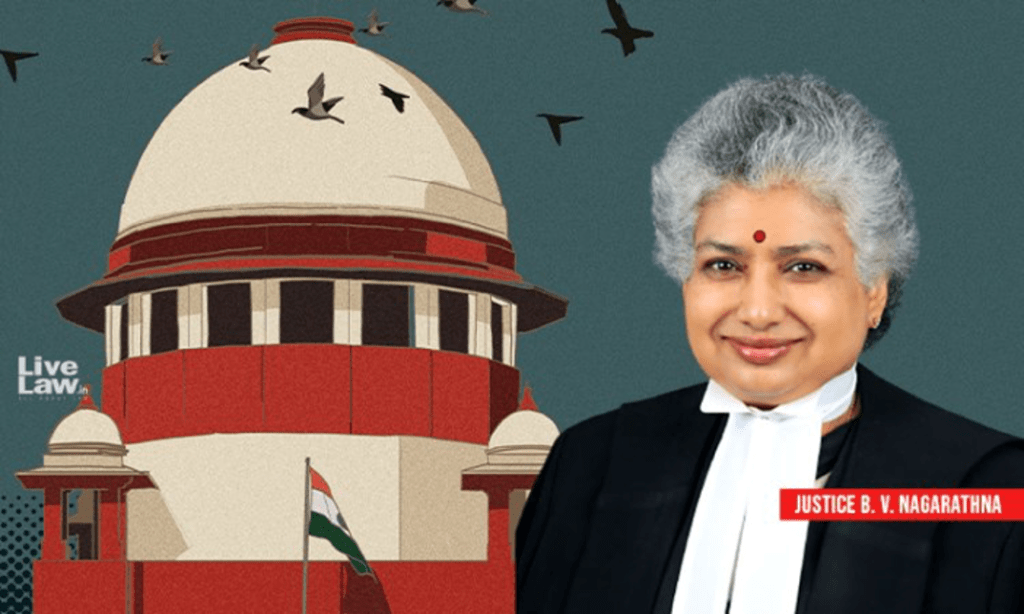
Justice Nagarathna: I am pleased to be here with you all today. It is an honour to deliver this inaugural address of this conference, I thank #NALSAR for extending the invitation to me.
Justice Nagarathna: As India commemorated 75 years of independence, the #SupremeCourtOfIndia, likewise, has commemorated the 75 years since its inception, it is therefore imperative for us all to reflect on the Judiciary journey towards realising the constitutional ideals.
Justice Nagarathna: I would like to outline the background for critical jurisprudential developments in the calendar year 2023, I shall speak on a few key judgments including a few which I may have authored. I will also speak on how the SC has continued to strengthen the foundation of our democratic society with particular reference to the Judicial developments in the year 2023.
Justice Nagarathna: let me begin with the background of COVID-19 2020, the proceedings in SC and other courts subsided because of the lockdown, and the proceedings used to be held through VC. With Justice UU Lalit becoming the CJI, who took over after the pandemic, he diligently planned the work of the SC.
Justice Nagarathna: He was determined to reform and dispose of the cases which were long pending and therefore, he constituted 5-constitution benches. All 30 judges of the SC got the chance to be on a constitution bench including myself who had joined the HC very recently.
Justice Nagarathna : The constitution benches took up 25 long pending cases covering the widest range of the legal spectrum. The constitution of benches after the pandemic was significant.
Justice Nagarathna : It is rightly said that the dissent is an appeal to the spirit of the law, to the intelligence of a future day, when a later decision may possibly correct the error into which the dissenting believe the court to have been betrayed…
Justice Nagarathna : These famous words were written by Justice HR Khanna in the Indian context of ADM Jabalpur by borrowing the statement of the 11th Chief Justice of the United States Charles Evans Hughes
Justice Nagarathna : This statement might look to be romantic, but it has withstood the passage of time, especially in India. Edmund Randolph once said a single executive is the foetus of a monarchy.
Justice Nagarathna : For anyone interested in ‘separation of power’ in the Indian context, the tale of Vivek Narayan Sharma vs Union of India 2023 is a must-read. It is popularly known as the #Demonetization case, I am happy to be a part of that bench.
Justice Nagarathna : We all know what happened on November 8, 2016, when 500 and 1000 rupee notes were #Demonetised. The interesting aspect is that in the Indian economy of that time, 86% of the currency comprised of 500 and 1,000 rupee notes.
Justice Nagarathna: 86% of the currency was 500 and 1,000 notes, which I think the Central government lost sight of while #Demonetising 86% of the currency. Imagine a labourer, who went to work those days, had to get his notes exchanged before he could go to the grocery shop to buy the daily essentials.
Justice Nagarathna: 98% of the currency came back to the RBI, so where were we heading towards black money eradication (the aim of demonetisation)?
Justice Nagarathna: I thought it was a good way of converting black money into white money. What happened about income tax proceedings thereafter, we don’t know. So, therefore, the common man’s predicament really stirred me and hence, I had to dissent (in the Vivek Narayan Sharma vs Union of India case)
Justice Nagarathna: The manner in which #Demonetisaiton was done, was not correct. There was no decision-making process, which was in accordance with the law. The haste with which it was done…some people say even the then Finance Minister did not know about it.
Justice Nagarathna: The communication went on one evening and the #Demonetisation happened the next day. If India wanted to go from paper currency to plastic currency, surely, the #Demonetisation was not also a reason for that, I thought.
Justice Nagarathna speaks about her dissent in the Kaushal Kishor case, wherein she did not agree with the majority view that fundamental rights under Article 19 of the Constitution should be made horizontally applicable against non-state entities and private persons.
In the Kaushal Kishor case, Justice Nagarathna differed from the majority view that a statement made by a Minister in an official capacity is not vicariously attributable to the Government.
Justice Nagarathna also speaks about the case of Association of Old Settlers of Sikkim vs Union of India, wherein the bench of Justices M R Shah and B V Nagarathna held that excluding Sikkimese woman merely because she married a non-Sikkimese after 01.04.2008 from exemption provision under Section 10(26AAA) Income Tax Act is totally discriminatory and thus unconstitutional.
In the Association Of Old Settles case, Justice Nagarathna wrote a separate judgment stating reasons for concurring with the view of Justice MR Shah.
More details here:
Justice Nagarathna mentions about the SC’s ruling in the case of Priya Indoria v. State of Karnataka
More details here:
High Courts, Session Courts Can Grant Interim/Transit Anticipatory Bail Even When FIR Is Registered In Another State: Supreme Court
livelaw.in/top-stories/su…
Justice Nagarathna, referring to SC’s Judgment in the case of The State Of Punjab v Principal Secretary To The Governor Of Punjab And Anr. 2023, expresses concerns about “Governors of State becoming points of litigation”.
Justice Nagarathna: This is not a healthy trend under the Constitution to bring the actions or omissions of the Governor of a state for consideration before constitutional courts. Though it is called a gubernatorial post, the Governor’s post is a serious constitutional post, and the Governors must discharge their duties and act as per the Constitution so this kind of litigation is reduced.
Justice Nagarathna: It is quite embarrassing for the Governors to be told to do a thing or not to do a thing. The time has come where they would be now told, I suppose, to discharge their duties as per the Constitution
Justice Nagarathna: 2023 saw the Supreme Court pendulum go from one end to another on reproductive rights concerns.
She refers to the case of XYZ vs State of Gujarat 2023 LiveLaw (SC) 680 wherein the Court held that a woman alone has a right over her body and she is the ultimate decision maker on Abortion.
Justice Nagarathna: “The debate with regard to pro-life and pro-choice arose. I would not like to speak much about it, but I will only say that we should not polarise the debate as pro-life and pro-choice”
Justice Nagarathna: “It is a very difficult decision for a woman to terminate her pregnancy. Even if a medical reason is there, she has to be psychologically ready…It does take time for a lady to come to a decision to terminate a pregnancy”
Justice Nagarathna: I am assured that in the decades to come, the Supreme Court as a composite institution, will serve We The People of India and steer the chariot of justice towards our constitutional destiny. For that to happen, we have to follow the diktats of the Constitution.
Justice Nagarathna concludes her address.
 Knock nock
Leave a comment