

From Wikipedia, the free encyclopedia
For the Arab-Israeli lawyer, see Elias Khoury (lawyer).
 | hideThis article has multiple issues. Please help improve it or discuss these issues on the talk page. (Learn how and when to remove these messages)This article needs additional citations for verification. (September 2024)This article’s factual accuracy is disputed. (September 2024) |
| Elias Khoury | |
|---|---|
| إلياس خوري | |
| Khoury in 2016 | |
| Born | 12 July 1948 Beirut, Lebanon |
| Died | 15 September 2024 (aged 76) Beirut, Lebanon |
| Nationality | Lebanese |
| Alma mater | Lebanese UniversityUniversity of Paris (PhD) |
| Occupations | Novelist and public intellectual |
| Notable work | Gate of The Sun |
Elias Khoury (Arabic: إلياس خوري; 12 July 1948 – 15 September 2024) was a Lebanese novelist and advocate of the Palestinian cause.[1] His novels and literary criticism have been translated into several languages. In 2000, he won the Prize of Palestine for his book Gate of the Sun, and he won the Al Owais Award for fiction writing in 2007.[2] Khoury also wrote three plays and two screenplays.[citation needed]
From 1993 to 2009, Khoury served as an editor of Al-Mulhaq, the weekly cultural supplement of the Lebanese daily newspaper Al-Nahar.[citation needed] He also taught at universities in Middle Eastern and European countries, and the United States.[citation needed]
The notion that Palestinians suffer from a continuous Nakba is a leitmotif running through much of his work.[3]
Biography
[edit]
Early life
[edit]
Elias Khoury was born in 1948 into a middle-class Greek Orthodox family in the predominantly Christian Ashrafiyye district of Beirut, Lebanon.[4][5]
He began reading Lebanese novelist Jurji Zaydan‘s works at the age of eight, which he later said taught him more about Islam and his Arabic background. Later, Khoury grew interested in classical Arabic literature, Russian novels by Pushkin and Chekhov, and modernist literature.[citation needed]
In 1966, he earned his high school diploma from al-Ra’i al-Saleh High School in Beirut. At the time he graduated, Lebanese intellectual life was becoming more polarized, with opposition groups adopting pro-Palestinian, radical Arab nationalist stances. The following year, in 1967, a 19-year-old Khoury traveled to Jordan, where he visited a Palestinian refugee camp and enlisted in Fatah, the largest resistance organization in the Palestinian Liberation Organisation. He left Jordan after thousands of Palestinians were killed or expelled in the wake of an attempted coup against King Hussein, in Black September.[6]
Khoury studied history at the Lebanese University and graduated in 1970. In 1973, he received his PhD in social history at the University of Paris.[7]
Involvement in the Lebanese civil war
[edit]
At the start of the Lebanese civil war, Khoury became a member of the Lebanese National Movement, an alliance of leftist, pan-Arab parties with mostly Muslim supporters. He was injured during the war, and temporarily blinded.[8]
Personal life and death
[edit]
Khoury and his wife, Najla, had two children. After a period of declining health, he died at a hospital in Beirut on 15 September 2024, at the age of 76.[1][7]
Career
[edit]
Literary career
[edit]
Khoury published his first novel in 1975, On the Relations of the Circle (Arabic: عن علاقات الدائرة). It was followed in 1977 by The Little Mountain (Arabic: الجبل الصغير), set during the Lebanese Civil War, a conflict that Khoury initially thought would be a catalyst for progressive change. Other works by him include The Journey of Little Gandhi, about a rural immigrant to Beirut who lives through the events of the civil war; and Gate of the Sun (2000), an epic re-telling of the life of Palestinian refugees in Lebanon since the 1948 Palestinian expulsion and flight. The book, which addresses the ideas of memory, truth, and storytelling, was adapted as a film of the same name by Egyptian director Yousry Nasrallah (2002).[citation needed]
In an interview by the Israeli newspaper Yediot Aharonot, after the publication of the Hebrew translation of Gate of the Sun, Khoury remarked:
“When I was working on this book, I discovered that the “other” is the mirror of the I. And given that I am writing about half a century of Palestinian experience, it is impossible to read this experience otherwise than in the mirror of the Israeli “other.” Therefore, when I was writing this novel, I put a lot of effort into trying to take apart not only the Palestinian stereotype but also the Israeli stereotype as it appears in Arab literature and especially in the Palestinian literature of Ghassan Kanafani, for example, or even of Emil Habibi. The Israeli is not only the policeman or the occupier, he is the “other,” who also has a human experience, and we need to read this experience. Our reading of their experience is a mirror to our reading of the Palestinian experience.”[9]
Khoury’s novel Yalo (2002, translated into English in 2008 by the American translator Peter Theroux) depicted a former militiaman accused of crimes during Lebanon’s civil war.[7] He described the use of torture in the Lebanese judicial system. The title refers to the name of a Palestinian Arab village that was annexed by Israel during the 1967 and later destroyed. All the inhabitants were expelled and most went to Jordan.[citation needed] Kirkus Reviews described the book as a “deceptively intricate” story and an “unsparing portrayal of a man without a country, a history or even an identity.”[10]
Khoury’s novels are notable for their complex approach to political themes and fundamental questions of human behavior. His narrative technique often involves an interior monologue, at times approaching a stream of consciousness. In recent works he tended to use a considerable element of colloquial Arabic, although the language of his novels remains primarily Modern Standard Arabic. While use of dialect in dialogue is relatively common in modern Arabic literature (for example, in the work of Yusuf Idris), Khoury also used it in the main narrative, which is unusual in contemporary literature. Khoury explained this choice by saying, “As long as the official, written language is not opened to the spoken language it is a total repression because it means that the spoken, social experience is marginalised.”[citation needed]

In addition to his novels, Khoury also served in several editorial positions, starting in 1972 when he joined the editorial board of the journal Mawaqif.[citation needed] He served as the editor of the Palestine Liberation Organization’s magazine Shu’un Filastiniyya (Palestinian Affairs Magazine) from 1975 to 1979 in collaboration with Mahmoud Darwish.[11] Between 1980 and 1985, Khoury worked as an editor of the series Thakirat Al-Shu’ub, published by the Arab Research Foundation in Beirut. In the 1980s, he was the editorial director first of Al Karmel magazine, and then of the cultural section of Al-Safir. Khoury also worked as the technical director of Beirut Theater from 1992 to 1998, and was a co-director of the Ayloul Festival of Modern Arts.[citation needed]
From 1992 to 20009, Khoury edited Al-Mulhaq, the cultural supplement of the Lebanese daily newspaper Al-Nahar.[7] Under his leadership, the magazine criticized controversial aspects of Lebanon’s post-Civil War reconstruction, which was led by former Lebanese prime minister Rafic Hariri. In a 2019 article, Khaled Saghieh wrote that Al-Mulhaq was “foundational in launching the debate over memory that would occupy a wide portion of the Lebanese cultural scene in the 1990s.”[12]
Khoury’s works have been translated and published in Catalan, Dutch, English, French, German, Hebrew, Italian, Portuguese, Romanian, Norwegian, Spanish, and Swedish.[citation needed]
Academic career
[edit]
Khoury taught at many universities, including New York University, University of Houston, Berkeley College, The University of Chicago, Columbia University, Georgetown University, the University of Minnesota, and Princeton University in the United States. He also taught at the University of Poitiers in France, the University of London in the UK, the University of Berlin in Germany, and the University of Zurich in Switzerland. In his home country Lebanon, he taught at the American University of Beirut, the Lebanese American University, and his alma mater, Lebanese University.[citation needed]
Published works
[edit]
Novels
- 1975: ‘an ‘ilaqat al-da’irah (عن علاقات الدائرة)
- 1977: al-Jabal al-saghir (الجبل الصغير); English translation: Little Mountain (1989, Maia Tabet)
- 1981: Abwab al-madinah (أبواب المدينة); English translation: The Gates of the City (1993, Paula Haydar)
- 1981: Wujuh al-bayda (الوجوه البيضاء); English translation: White Masks (2010, Maia Tabet)
- 1989: Rihlat Ghandi al-saghir (رحلة غاندي الصغير); English translation: The Journey of Little Gandhi (1994, Paula Haydar)
- 1990: Akaa wl Rahil (عكا و الرحيل); which was issued in Beirut.
- 1993: Mamlakat al-ghuraba (مملكة الغرباء); English translation: The Kingdom of Strangers (1996, Paula Haydar)
- 1994: Majma’ al-Asrar (مجمع الأسرار)
- 1998: Bab al-Shams (باب الشمس); English translation: Gate of the Sun (2006, Humphrey Davies)
- 2000: Ra’ihat al-Sabun (رائحة الصابون)
- 2002: Yalu (يالو); English translations: Yalo (2008, Peter Theroux), (2009, Humphrey Davies: short-listed for Best Translated Book Award)
- 2007: Ka-annaha na’imah (كأنها نائمة); English translations: As Though She Were Sleeping (2011, Humphrey Davies), (2012, Marilyn Booth)
- 2012: al-Maryia al-maksoura (المرايا المكسورة: سينالكول). English translation: Broken Mirrors: Sinocal (2012, Humphrey Davis)
- 2016: Awlad Al-Ghetto- Esme Adam (أولاد الغيتو- اسمي آدم); English translation: Children of the Ghetto: My Name is Adam (2018, Humphrey Davies)[13]
- 2018: “Awlad Al-Ghetto 2: Najmat Elbaher” (أولاد الغيتو ٢: نجمة البحر); English translation: Children of the Ghetto: Star of the Sea (2024, Humphrey Davies)
Story collections
- 1984: “Al-mubtada’ wa’l-khabar“, issued in Beirut.
- 1990: Al-lo’aba al-hakikiya(اللعبة الحقيقية); issued in Beirut.
Criticism
- 1979: Dirasat fi naqd al-shi’r
- 1982: Al-dhakira al-mafquda
- 1984: Tajribat al-ba’th ‘an ufq
- 1985: Zaman al-ihtilal
- 2023: النكبة المستمرة (The Continuous Nakba), compilation of 12 essays and articles.[14]
Plays
- 1993: Muthakarat Ayoub
- 1995: Habs al-Ramel (in collaboration with Rabih Mrouè)
- 2000: Thalathat Mulsakat (in collaboration with Rabih Mroué)
Screenplays
- 1992: Kharej al-Hayat (in collaboration with Maroun Baghdadi)
- 2002: Bab al-Shams (in collaboration with Yousry Nasrallah and Mohamed Soueid)
Awards and honors
[edit]
- 2000: Prize of Palestine for Bab al-Shams [Gate of the Sun]
- 2007: Al Owais Award for “Stories, Novels & Drama”[15]
- 2008: Prix du roman arabe for Comme si elle dormait [As Though She Were Sleeping][16]
- 2016: Mahmoud Darwish Award for Creativity[17]
References
[edit]
- ^ Jump up to:a b “Lebanese novelist Elias Khoury dies aged 76”. Al Jazeera. Retrieved 16 September 2024.
- ^ “Elias Khoury”. Banipal. Retrieved 11 January 2023.
- ^ Yehouda Shenhav-Shahrabani (15 May 2024). “How do we tell the story of the Nakba when the plot hasn’t ended?”. +972 Magazine.
- ^ Harding, Jeremy (16 November 2006). “Jeremy Harding goes to Beirut to meet the novelist Elias Khoury”. London Review of Books. Vol. 28, no. 22. ISSN 0260-9592. Retrieved 8 May 2024.
- ^ Fadel, Hazem (8 February 2016). From Damascus to Beirut: Contested Cities in Arab Writing (1969-1989). Cambridge Scholars Publishing. p. 92. ISBN 978-1-4438-8853-0.
- ^ Maya Sela (5 June 2014). “‘A Boycott on Institutions Is a Good Thing for Israelis’”. Haaretz.
- ^ Jump up to:a b c d Risen, Clay (18 September 2024). “Elias Khoury, Master of the Modern Arabic Novel, Dies at 76”. the New York Times. Retrieved 18 September 2024.
- ^ Silverman, Jacob (13 July 2017). “Elias Khoury: Profile of the Essential Arab Novelist Today”. Daily Beast. Retrieved 11 January 2023.
- ^ Anton Shammas (3 March 2002). “An Interview with Elias Khoury”. Seven Days – Yediot Acharonot. Translated by Ilan Safit. Archived from the original on 27 February 2006.
- ^ “Review: Yalo”. Kirkus Reviews. Retrieved 11 January 2023.
- ^ Farah Aridi (2019). “Elias Khoury”. In Rita Sakr (ed.). The Literary Encyclopedia. Vol. 6.
- ^ Saghieh, Khaled (February 2019). “1990s Beirut: Al-Mulhaq, Memory, and the Defeat”. E-flux (97).
- ^ Avraham Burg (11 May 2018). “Between the Trauma of the Holocaust and the Trauma of Nakba”. Haaretz.
- ^ Shenhav-Shahrabani, Yehouda (15 May 2024). “How do we tell the story of the Nakba when the plot hasn’t ended?”. +972 Magazine. Retrieved 28 May 2024.
- ^ “Elias Khoury”. http://www.aub.edu. Retrieved 16 September 2024.
- ^ “Elias Khoury Archives”. Archipelago Books. Retrieved 16 September 2024.
- ^ Agencies, IMEMC & (25 March 2016). “Lebanese Creativity Award Winner Donates Award to Birzeit University”. Retrieved 16 September 2024.
External links
[edit]


- At Levantine Cultural Center Archived 20 October 2008 at the Wayback Machine.
- Interview with Elias Khoury, from Lebanese Centre for Policy Studies website.
- Review of Gate of the Sun, The New York Times.
- Jeremy Harding goes to Beirut to meet the novelist Elias Khoury, London Review of Books.
- Maya Jaggi, “A circle of madness”, The Guardian, 28 July 2007.
- on war, literature and hope, BBC Newshour, 25 July 2015
- Nakba’s Second Generation Illuminates Dark Corners for Holocaust’s Second Generation, Sara Carmeli Warzager review of the Hebrew version of “Children of the Ghetto- My name is Adam”, Maktoob- The Translators forum from Arabic to Hebrew, 19 July 2018.
- “Elias Khoury, The Art of Fiction No. 233”, Paris Review, Spring 2017
- 1948 births
- 2024 deaths
- Academic staff of Lebanese American University
- Academic staff of Lebanese University
- Academic staff of New York University Abu Dhabi
- Academic staff of the American University of Beirut
- Academic staff of the Humboldt University of Berlin
- Academic staff of the University of Poitiers
- Academic staff of the University of Zurich
- Arabic-language novelists
- Columbia University faculty
- Georgetown University faculty
- Greek Orthodox Christians from Lebanon
- Lebanese novelists
- Lebanese socialists
- People of the Lebanese Civil War
- Princeton University faculty
- University of Chicago faculty
- University of Houston faculty
- University of Minnesota faculty
- University of Paris alumni
- Writers from Beirut

How do we tell the story of the Nakba when the plot hasn’t ended?
Elias Khoury’s new book encapsulates the symbiotic relationship between literature and the Nakba, exploring its nature as a continuum of calamities.
By Yehouda Shenhav-Shahrabani May 15, 2024
Palestinians march during a rally marking the anniversary of the Nakba in the West Bank city of Nablus, May 15, 2024. (Nasser Ishtayeh/Flash90)
“The Continuous Nakba,” by Elias Khoury, Dar Al Adab, 2023.
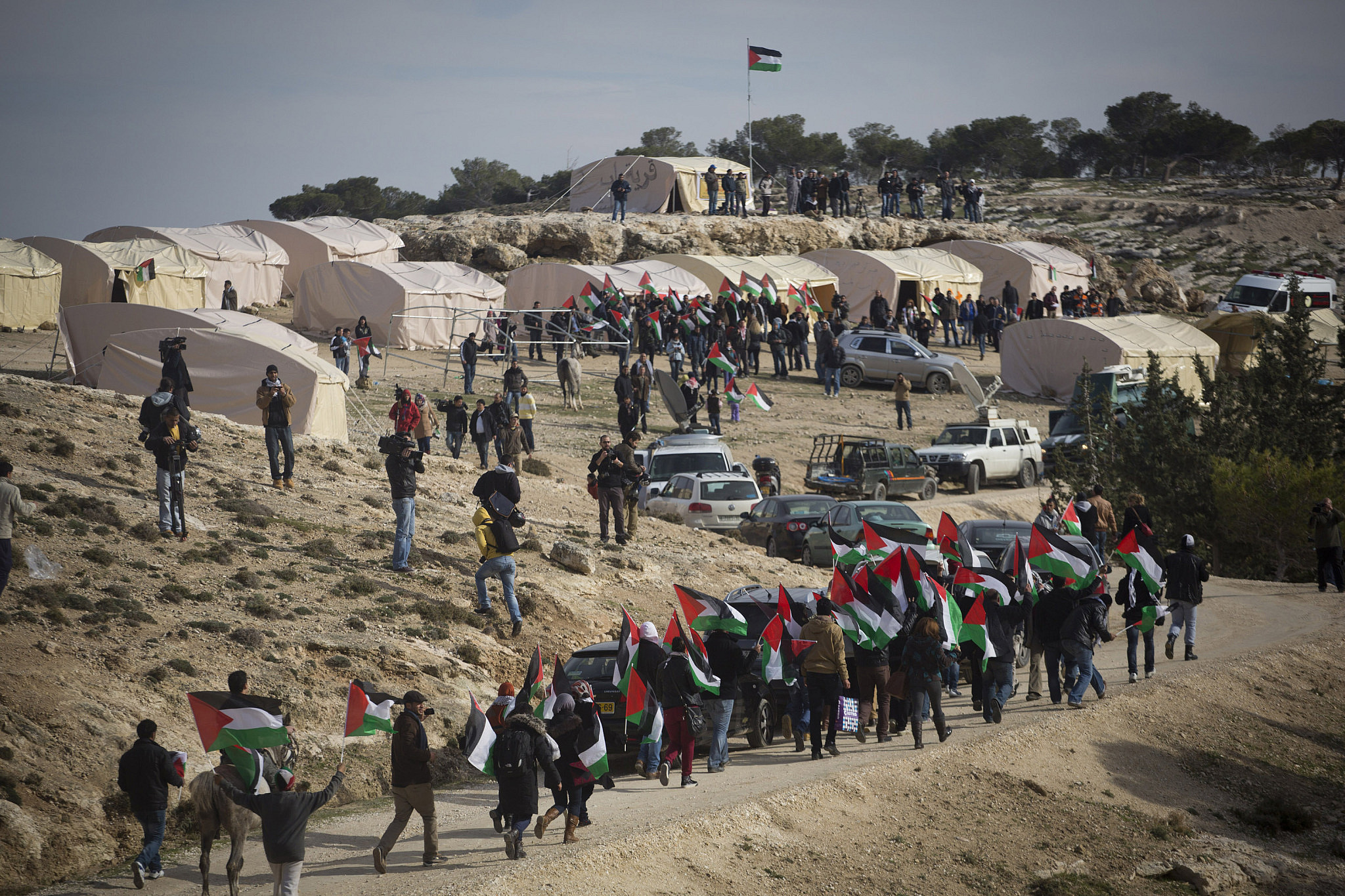
In 2013, Elias Khoury, the renowned Lebanese novelist and public intellectual, delivered a speech from Beirut via Skype to a group of 250 Palestinian activists. The activists had just established an encampment in the E1 area of the occupied West Bank, located between Jerusalem and Jericho, as an act of resistance. They called their encampment “Bab Al-Shams,” after Khoury’s novel of the same name.
In contrast to the activists, Khoury has never lived in Palestine, nor has he ever even been granted the opportunity to visit. Nevertheless, he told the activists: “I will not say, ‘I wish I were with you,’ for I am with you … This is the Palestine that Yunis envisioned in the novel Bab Al-Shams.”
The community of Bab Al-Shams lasted a mere two days before the Israeli army dismantled it. Undeterred, Palestinians attempted to rebuild it, calling it “The Grandchildren of Yunis” — this time, named after one of the novel’s central protagonists — only to see its swift destruction once again. After this second demolition, Khoury remarked that “the village may be erased, but literature cannot be.” This insight, vividly encapsulates Khoury’s view of the necessarily symbiotic relationship between literature and the Nakba.
Rarely do writers have the honor of seeing their words quite literally transform into reality, at least in their lifetimes. The establishment of Bab al-Shams, brief though its existence was, exemplifies the way in which Khoury enacts the evocative power of literature that he identifies in Ghassan Kanafani, one of his most prominent literary forebears. In an essay commemorating the assassinated writer and thinker, Khoury emphasizes Kanafani’s role as the first chronicler of Palestine after the Nakba and shows the crucial role of literature in imagining the nation. Khoury, it must be said, is part of this tradition himself.
The establishment and destruction of Bab Al-Shams also echoes the dispossession of the Nakba, an echo surely not lost on Khoury, who has spent much of the last 20 years writing about the “continuous Nakba” — the ongoing cycle of violence committed against the Palestinian people. The Nakba, as he and all Palestinians contend, was not a single event that occurred in 1948, but rather a persevering process of dislocation and violence.
Palestinian activists arrive at the “Bab al-Shams” (Gate of the Sun) camp, E1 area, West Bank, January 12, 2013. (Oren Ziv/Activestills)
Witnesses of their era
Last year, Khoury published a book in Arabic titled “Continuous Nakba,” a compilation of 12 essays and articles, including the speech he delivered to the Palestinian activists in 2013. The book stands as a tour de force, powerfully intertwining the political discourse on the Nakba with the realms of literature, culture, and language. Khoury adeptly integrates literature into the grammatical narrative of the Nakba, portraying it as present continuous rather than past perfect (“the Nakba is happening,” not “the Nakba happened”).
Khoury has authored 15 novels to date, which have been translated into multiple languages (I have translated eight of his novels into Hebrew). His literary works explore various writing techniques and narrative forms, while challenging the notion of storytelling itself.
Khoury’s vast knowledge of Palestine was amassed mainly through the stories of others, both fictional and not. While in primary school in the 1950s and ‘60s, Khoury learned about the Nakba from his Palestinian friends who had arrived in Lebanon as refugees. His empathy toward the Palestinian plight only grew over time, having spent his high school years teaching in refugee camps in and around Beirut. At the age of 19, he joined the fedayeen (Palestinian guerilla fighters) in Jordan until the events of “Black September” in 1970, when the Hashemite kingdom fought and expelled the resistance groups. After this, Khoury fought alongside the Palestinians in the civil war in Lebanon.
His immersion in Palestinian life is inseparable from his literary career. As part of the research process for his 1998 novel, “Bab Al Shams” — now considered the ultimate literary work about the Nakba — Khoury went to refugee camps around Beirut and Sidon (such as Shatila, Burj el-Barajneh, and Ain al-Hilweh), conducting painstakingly in-depth interviews with hundreds of Palestinians about the fall of the Galilee and Haifa to Zionist forces.
Through this research process and in his writing, Khoury makes clear that he views writers as crucial witnesses of their era. In his novels, Khoury delves into fragmented stories and memories of the Nakba, whether it be the events of 1948 or the “continuous Nakba”: whereas “Bab Al-Shams” is mainly about 1948, much of his last novel, “Man in My Image,” the third volume of “Children of the Ghetto,” is set in 2002, in the refugee camps of Nablus and Jenin.
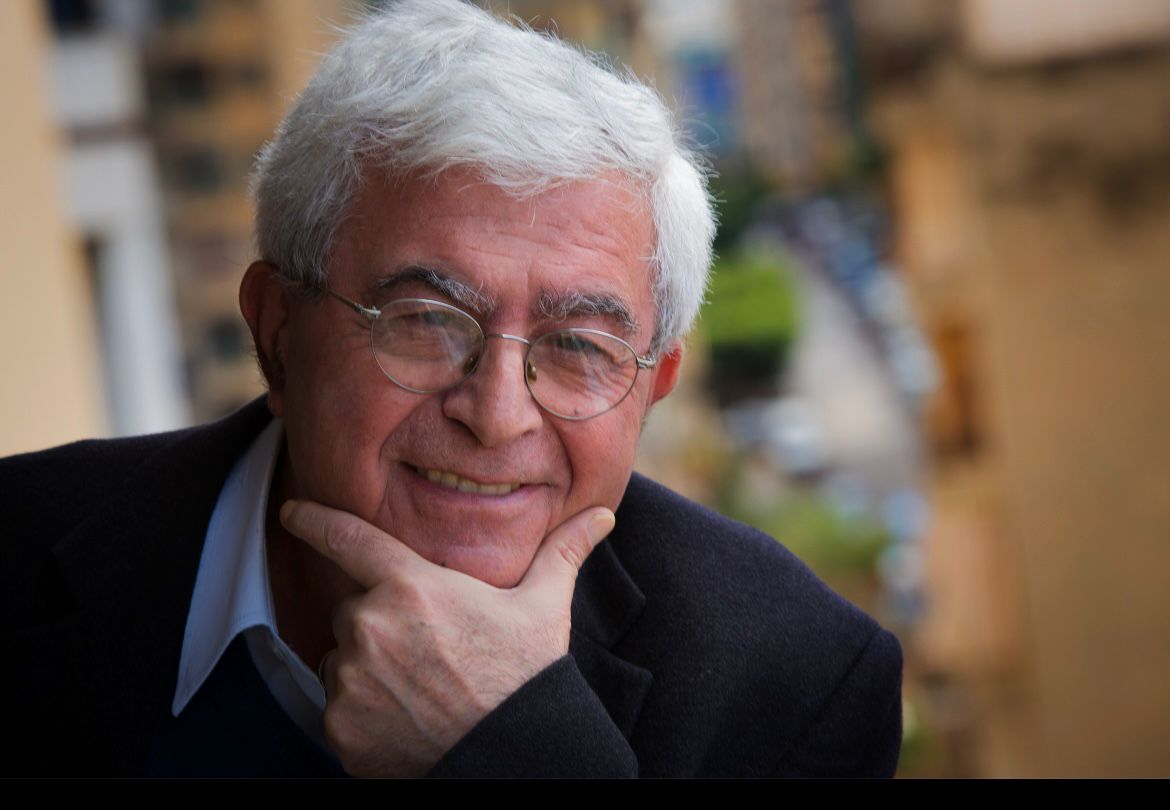
Lebanese writer and novelist Elias Khoury. (Courtesy of the Khoury family)
Khoury is not only a gifted novelist; he is also a well-known intellectual, often addressing the public on the ideological implications of linguistic hierarchies, the idea that the language we use to describe events reflects and perpetuates real-world power structures — all in the service of interpreting and diffusing his ideas about the continuous Nakba.
He does this relentlessly, to the point that it sometimes seems that the concept applies to him personally: for Khoury, continuous Nakba is a state of mind. He lives this continuity, writes constantly about it (one of the fruits of which is this most recent book), and digs into its meaning through time and place. Like Shehrezad of “A Thousand and One Nights,” who tells stories every day in order to live, each day Khoury tells yet another story of the Nakba.
He meticulously delineates a catalog of tragedies, ranging from the small-scale to the monumental, all of which comprise the continuous Nakba. These include not only the ethnic cleansing of Palestine, but also the establishment of Palestinian ghettos within the new Jewish cities, the imposition of military governance on Palestinian citizens of Israel, the proliferation of settlements, the plight of unrecognized villages, etc. (Even the inclusion of “etc.” in Khoury’s oeuvre can serve as a semiotic symbol of the Nakba’s continuity.)
The Nakba thus transcends the individual events that took place; it represents a continuum of calamities across various scales, forming different repetitions yet interconnected parts of an ongoing process. This, he writes, is what fuels perpetual resistance, as it is not confined to the past but is, instead, a present-day lived reality.
Dismantling linguistic myths
“Continuous Nakba” is the culmination of the years Khoury has spent analyzing and writing about Palestinian life and history. In it, he essentially offers a new version of “The Meaning of the Nakba,” a book published in October 1948 by the Syrian historian Constantine Zurayq and the first to name “the disaster” of that year as “the Nakba.” Khoury now presents “the meaning of the continuous Nakba,” thereby transforming our understanding of the Nakba from being a singular event into an enduring process. He traces a lengthy trajectory that commenced in that pivotal year and has continued through various “winding forms” to “the present day.”
Khoury asserts that Zurayq helped articulate the Palestinian predicament to the Arab world, while the intellectual Edward Said did so on the global stage. Khoury, too, stands in this tradition, with his works and engagements with political audiences bringing the literary world’s attention to the Palestinian issue.
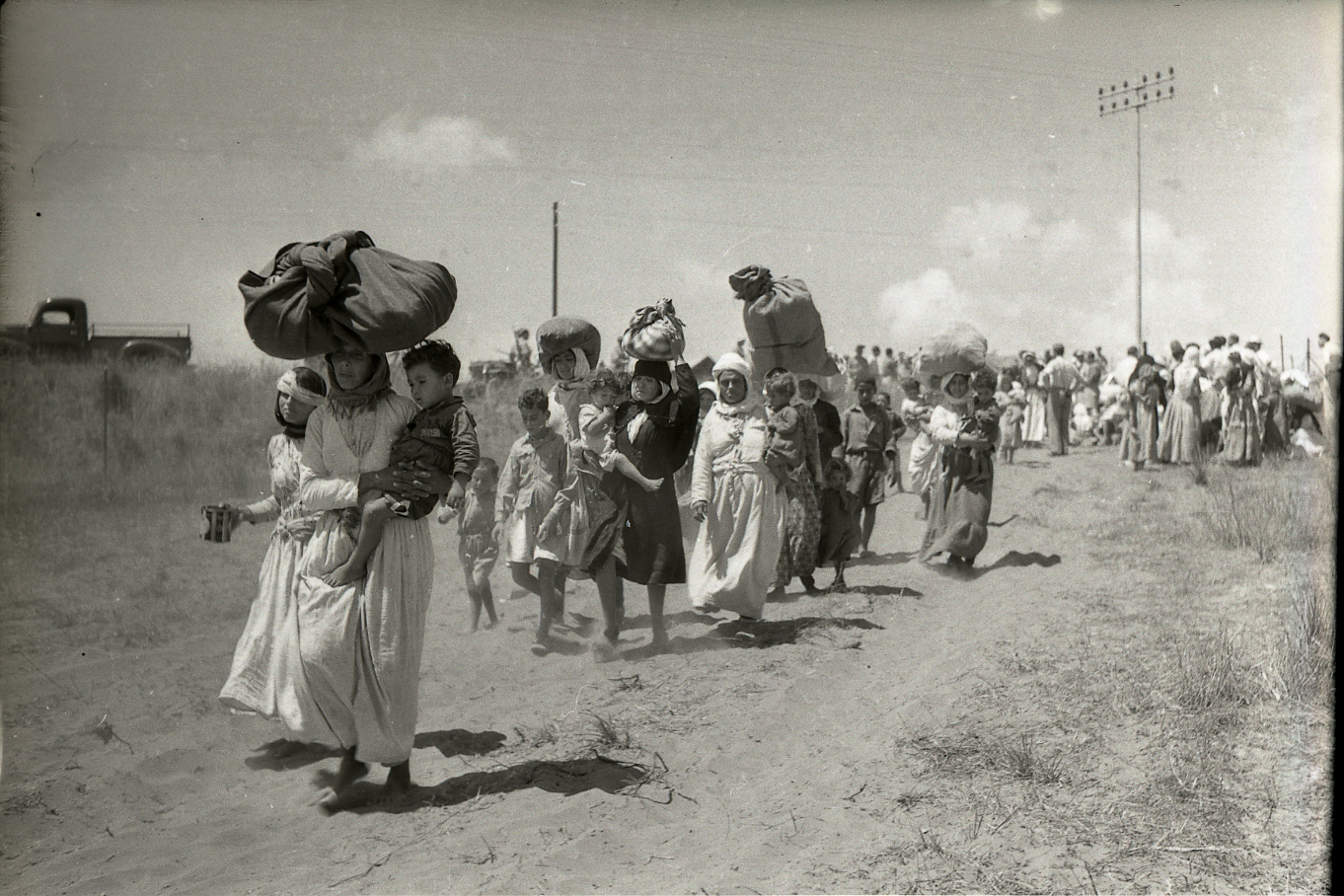
Palestinians from Tantura are expelled to Jordan, June 1948. (Benno Rothenberg/Meitar Collection/National Library of Israel/The Pritzker Family National Photography Collection/CC BY 4.0)
One particularly fascinating engagement was an address that he gave in 2015 before the European Parliament (included in the book). It was about harnessing one’s intellectual strength, the breadth of one’s horizons, and the desire for an honest dialogue with those whose deafness prevents them from hearing the Palestinian voice.
He starts the lecture by analyzing the word “misunderstanding” and its relationship to Palestinian existence. To do so, he told the story of a creepy encounter between a Palestinian farmer from the village of Sa’sa’ and Israeli soldiers who stormed his village and demolished its homes on Feb. 14, 1948. (Khoury depicts this event in his novel “Stella Maris.”) One of the Jewish soldiers aims his weapon at an elderly Palestinian man who inquires in Arabic, “Eish hādhā?” (“What is this?”). The soldier responds, using the Hebrew meaning as his second word, “Hādhā esh!” (“This is fire!”), and then fires upon him.
Khoury elucidates for Arab readers unfamiliar with Hebrew the origin of this bilingual collision: while these expressions may sound alike phonetically, they reveal what is known in French as a “faux-ami,” or false cognate. However, Khoury firmly asserts that behind the misunderstanding (which in itself breeds uncertainty and terror) lies a multitude of exclamation marks. Thus, alongside the question marks, Khoury provides a succinct chronicle of the exclamation marks, namely a roadmap of the Israeli colonial project, illustrating how it effectively converted the Palestinian into “the Jew of the Jews” or, in other words, the victim of the victim, as poignantly depicted in the literary trilogy “Children of the Ghetto.”
Throughout that speech, Khoury challenged and deconstructed the narratives that have historically marginalized the Palestinian voice. By dismantling and debugging linguistic myths that obscure oppressive realities — terms like “the peace process,” “the partition plan,” “the Hebrew David and the Arab Goliath” — Khoury not only sheds light on historical truths but also exposes the ongoing destruction of the present. His refusal to accept superficial peace agreements highlights the importance of addressing root causes rather than settling for temporary solutions that perpetuate oppression.
Khoury’s address to the European Parliament was a virtuoso performance by an artist — an artist of words, of ideas, of the relationship between politics, literature, and life. He reckons with literary representations that change reality. He sees a war of understanding against misunderstanding, of recognition against lack of recognition, and of representations against misrepresentations — a war in which he is an enlisted soldier.
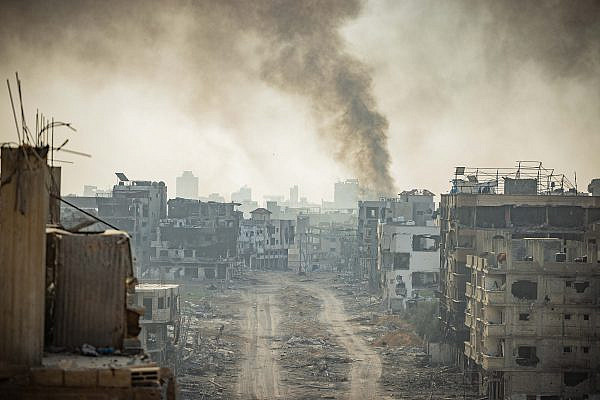
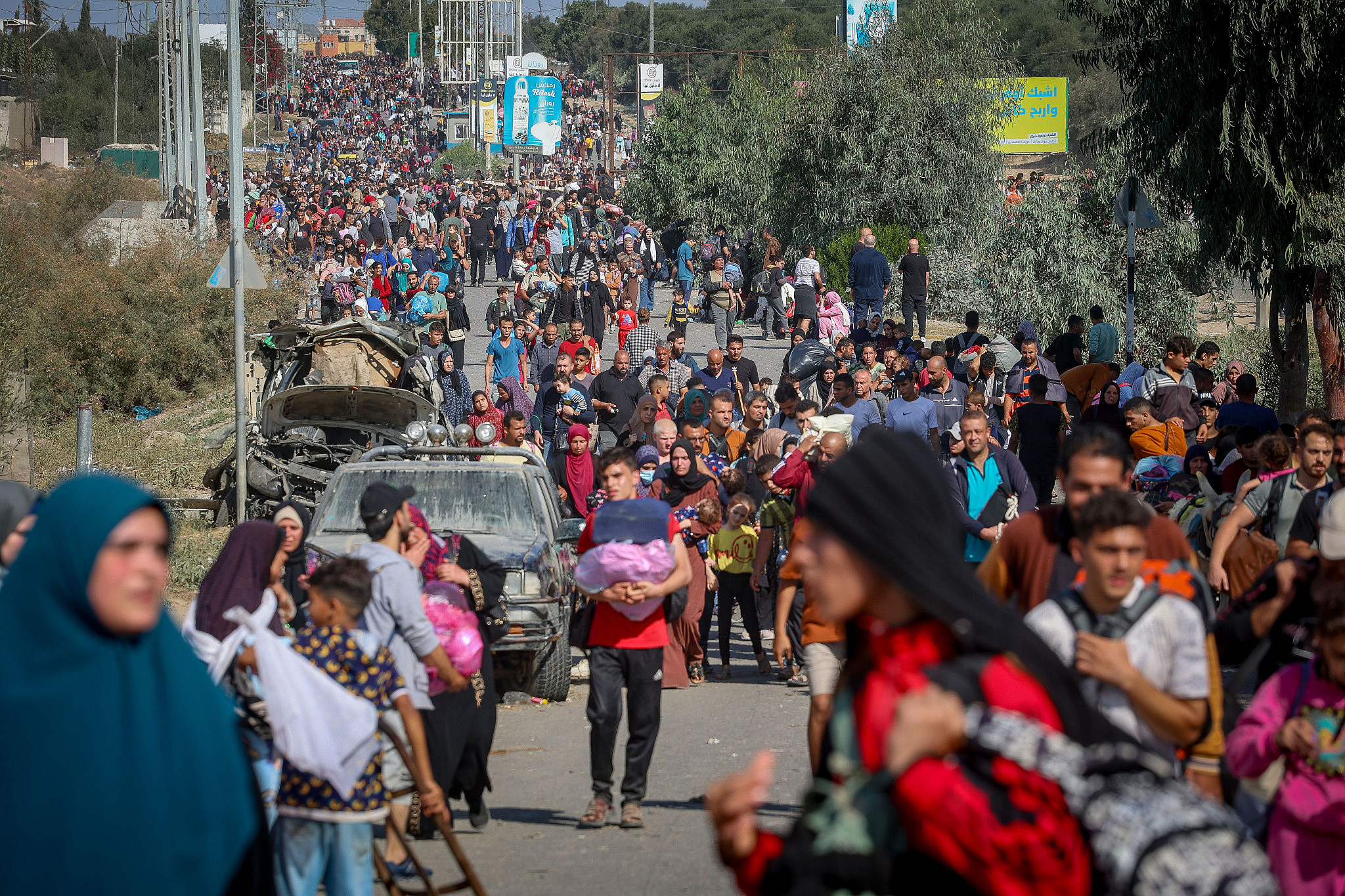
Palestinians walk on a main road after fleeing from their homes in Gaza City to the southern part of Gaza, November 10, 2023. (Atia Mohammed/Flash90)
Spectral figures
Elias Khoury’s work consistently acknowledges and pays tribute to his predecessors and compatriots, such as Mahmoud Darwish, Walid Khalidi, Edward Said, and Ghassan Kanafani. In many ways, he represents a link between past and current generations embodying the struggle for Palestinian rights and dignity. He has highlighted Darwish’s significance in narrating the Nakba, and by weaving his own experiences of displacement and exile into his poetry, Khoury not only honors Darwish’s literary prowess but also recognizes the personal and collective trauma embedded in the Palestinian narrative, following in Darwish’s footsteps.
Similarly, Khoury’s recognition of the historian Walid Khalidi, and his efforts in reconstructing the historical map of Palestine, acknowledges the importance of reclaiming and preserving Palestinian history in the face of attempts to erase or distort it. And Kanafani, with his poignant storytelling and unflinching portrayal of Palestinian life under occupation, also receives warm acknowledgment from Khoury.
Khoury’s rare and profound engagement with Hebrew literature underscores his enduring commitment to understanding the “other” and fostering literary dialogue. He does so, in part, by acknowledging the inherent challenge of engaging with a literary tradition that often erases the Palestinian narrative and rejects the dialogue Khoury seeks.
Despite its purported leftist orientation, Hebrew literature, in practice, plays a role in obscuring the Nakba, justifying or silencing it. Kanafani once asserted that literary Zionism preceded political Zionism, and Khoury builds on this argument, particularly by applying it to the work of A. B. Yehoshua.
Yehoshua’s short story “Facing the Forests,” for example, metaphorically silences the Palestinian narrative by focusing on a Palestinian man with no tongue, perpetuating the idea that Palestinians are spectral figures, not full subjects themselves. No Hebrew writers today possess a depth of understanding of the Arab world comparable to Khoury’s immense knowledge of Hebrew literature and the Jewish world.
Yet Khoury’s criticism is sharply nuanced and complex. He is also critical of Kanafani for employing a similar silencing technique: Khoury asks why the Palestinian men in “Men in the Sun,” (published, incidentally, the same year as Yehoshua’s story), remain voiceless, dying silently in a water tank crying for water. Khoury responded by writing a novella — about the poet Waddah Al-Yaman, who dies silently in a box to spare his lover, the Caliph’s wife, from embarrassment — in order to explain and critique the trope of the silenced Palestinian.
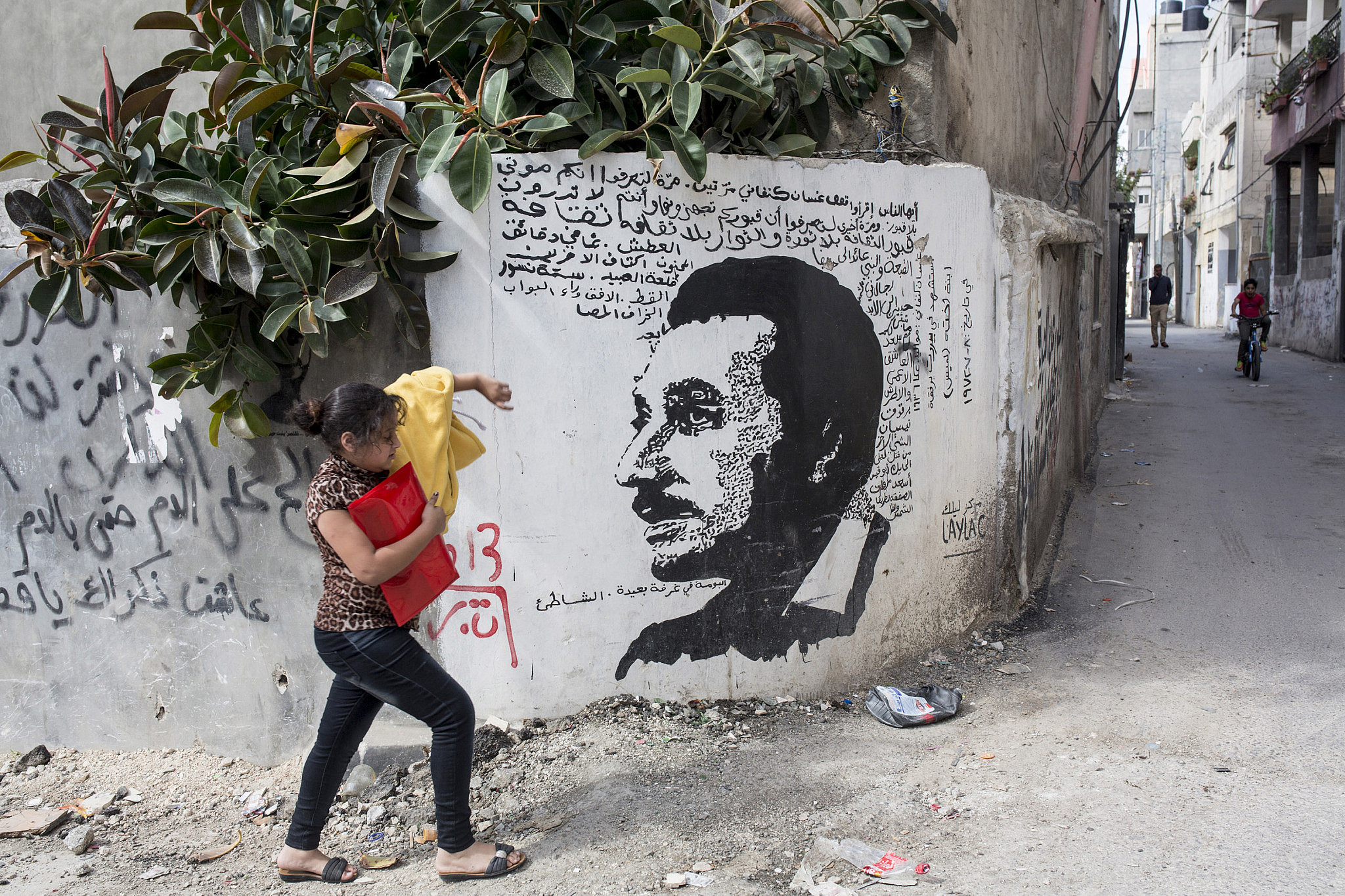
A Palestinian girl passes by a mural of Ghassan Kanafani, a Palestinian writer and leading member of the Popular Front for the Liberation of Palestine, in Dheisheh Refugee Camp, Bethlehem, West Bank, May 12, 2018. (Anne Paq/Activestills)
A timeless thesis
“Continuous Nakba” was published shortly before the current war began, but Gaza has occupied a major place in Khoury’s analysis long before October 2023. He repeatedly highlights Gaza’s transformation into a locked and confined enclave, often describing it as a “ghetto” with no apparent outlet except eruption and resistance
In his article “In front the Gates of Gaza” (which unfortunately is not anthologized in the book), Khoury delves into the intricate link between Palestinian refugees in Gaza and Jewish settlements in the areas surrounding Gaza (often known as the “Gaza Envelope”) — a link violently exposed on October 7.
In that essay, Khoury explores General Moshe Dayan’s 1956 eulogy, delivered at Kibbutz Nahal Oz, for an Israeli soldier who was killed by Fedayeen. Khoury writes:
“When Dayan eulogized the Israeli space in Nahal Oz, he eulogized the ‘Zionist dream,’ which turned out to be a nightmare. He recognized early on the moral deadlock of Israel in front of the gates of Gaza, and in the face of the question of Palestine as a whole … for seventy years the refugees have not stopped knocking on the gates of Gaza, which are locked with hatred and death, and they will continue to knock on them until the locks are broken, and Palestine will reach out its hands to its people who return to it invaded by the water and mud of the earth, and build from their death a gate to life.”
The retaliatory war in Gaza today, with its devastating toll on civilian life and infrastructure, is painful proof of Khoury’s words.
In light of the current Israeli assault on the Strip, Khoury’s work, and especially this recent book, poses a profound question: How do we read a story when we know that its plot has not yet come to an end? How do we tell the story of the Nakba when it is not over? How do we recognize when we have reached the conclusion?
Most read on +972

Why did a British Jewish newspaper publish fake Israeli intelligence?

A plan to liquidate northern Gaza is gaining steam
‘Lavender’: The AI machine directing Israel’s bombing spree in Gaza
Notably, the book was published before the emergence of the new/old Israeli discourse around the “Second Nakba” — a term utilized by Israeli officials in recent months to refer to the war on Gaza and which, inadvertently, validates Khoury’s central thesis. In this light, the book has proven to be timeless, rather than ahead of its time, in that it addresses perennial issues and enduring realities faced by Palestinians.
Khoury’s exploration of the continuous Nakba challenges the prevailing discourse, and its significance lies in its ability to provoke critical reflection and dialogue on the Palestinian experience, both past and present. It is pressingly important now — and it always will be.
Yehouda Shenhav-Shahrabani is a sociologist and critical theorist. He serves as the chief editor of Maktoob, a project for translating Arabic books into Hebrew. He has translated eight of Elias Khoury’s novels into Hebrew including the trilogy Children of Ghetto. His last translation is “A Man in my Image” (أولاد الغيتو 3 – رجل يشبهني).
Our team has been devastated by the horrific events of this latest war. The world is reeling from Israel’s unprecedented onslaught on Gaza, inflicting mass devastation and death upon besieged Palestinians, as well as the atrocious attack and kidnappings by Hamas in Israel on October 7. Our hearts are with all the people and communities facing this violence.
We are in an extraordinarily dangerous era in Israel-Palestine. The bloodshed has reached extreme levels of brutality and threatens to engulf the entire region. Emboldened settlers in the West Bank, backed by the army, are seizing the opportunity to intensify their attacks on Palestinians. The most far-right government in Israel’s history is ramping up its policing of dissent, using the cover of war to silence Palestinian citizens and left-wing Jews who object to its policies.
This escalation has a very clear context, one that +972 has spent the past 14 years covering: Israeli society’s growing racism and militarism, entrenched occupation and apartheid, and a normalized siege on Gaza.
We are well positioned to cover this perilous moment – but we need your help to do it. This terrible period will challenge the humanity of all of those working for a better future in this land. Palestinians and Israelis are already organizing and strategizing to put up the fight of their lives.
Can we count on your support ? +972 Magazine is a leading media voice of this movement, a desperately needed platform where Palestinian and Israeli journalists, activists, and thinkers can report on and analyze what is happening, guided by humanism, equality, and justice. Join us.

7 Translations & 7 Interviews in Memory of Elias Khoury, 1948-2024
September 15, 2024
SEPTEMBER 15, 2024 — Lebanese novelist Elias Khoury died on Sunday at the age of 76, according to multiple news accounts.
Author of the acclaimed Gate of the Sun, he was one of the most celebrated novelists of his generation.

Khoury was born into a middle-class Christian family in Beirut in 1948, but became deeply committed to Palestinian liberation. As a teen, he worked as a literacy teacher and volunteer in Palestinian refugee camps, and he was nineteen when he traveled to Jordan to join Fatah, the armed wing of the Palestine Liberation Organization (PLO). Still, throughout all this, he never stopped writing fiction.
His second novel Little Mountain (tr. to English by maia tabet) was written in 1975-76, at the beginning of Lebanon’s fifteen-year civil war. “Everybody who read it thought that I was not a real revolutionary because I was fighting and at the same time criticizing the civil war in my writing,” he said in a 2001 interview with Sonja Mejcher. “There was a contradiction between the euphoric optimistic ideology we were living and what I was writing.”
The open discussion of civil war that began in Little Mountain continued in the almost nihilistic Gates of the City and grew fiercer in the bleak, quasi-detective novel White Masks, published in Arabic in 1981 and in English (trans. Maia Tabet) in 2010. By the time he wrote White Masks, Khoury said in his interview with Mejcher, “I was considered to be against the revolution. The PLO practically banned the book.”
And yet, despite the shifts that took place in Khoury’s writing and in his worldview during the construction of these early novels, the author remained loyal to his earliest convictions and conceptions of justice.
“The most important thing is to be loyal to your convictions,” Khoury said at the 2015 Shubbak Festival in London, in a conversation with novelist-academic Marina Warner. “Sometimes it’s tough, sometimes it’s impossible. It becomes very, very difficult. I remember this especially in the so-called War of the Mountains, which happened in 1984, when the Druze massacred the Christians. And of course we were in alliance with Walid Jumblatt and his party. And we felt so awkward, because our colleagues who stayed in the mountains…they were massacred.”
“You cannot leave blood in the streets and go away,” he added. “You must at least collect the blood.”
In his novels and his scholarship, he continued his commitment to collecting the blood.
It was with his 1998 novel, Gate of the Sun, that Khoury became an internationally celebrated writer, associated from them on with Palestine. The novel came out in English in 2006, translated by Humphrey Davies, and was among the first Arabic novels creating a new wave of translation into English.
Although Khoury taught for many years in New York City, his novels continued to center Lebanon and Palestine. His 2002 post-civil-war novel Yalo is perhaps his most frightening, an entanglement of writing, memory, rape, and torture. His tender, almost dream-like 2007 novel As Though She Were Sleeping is set in the 1930s and 1940s, and moves easily between cities that are now impossibly separate: parts of Palestine, Lebanon, what is now Israel. The epic Sinalcol (2012), returns to Lebanon’s civil war with echoing near-twin-brother characters.
His latest, Children of the Ghetto: Star of the Sea, is coming in the late Humphrey Davies’ translation from Archipelago Books in November.
His novels not only inspired adaptations into other media (such as the film of Gate of the Sun), but also a real “Gate of the Sun” village that was a challenge to Israeli occupation.
Also, as Mezna Qato notes on Twitter, “Elias Khoury was a brilliant writer of fiction and non-fiction but also such a deft editor, especially of the political and intellectual contributions of colleagues in Shu’un Filastiniyya (the PLO journal), see issues from 1975-1979 in particular.”
We will have more reflections on Khoury and his work. Until then:
7 from Khoury’s work in translation:
An excerpt from the novella The Smell of Soap, trans. Ghada Mourad
An excerpt from White Masks, trans. Maia Tabet
An excerpt from Gate of the Sun, trans. Humphrey Davies
An excerpt from Yalo, trans. Humphrey Davies
An excerpt from As Though She Were Sleeping, trans. Marilyn Booth
An excerpt from Children of the Ghetto: My Name is Adam, trans. Humphrey Davies
An excerpt from Stella Maris: Children of the Ghetto 2, trans. Humphrey Davies
7 interviews and conversations
 Knock nock
.jpg)

Leave a comment