

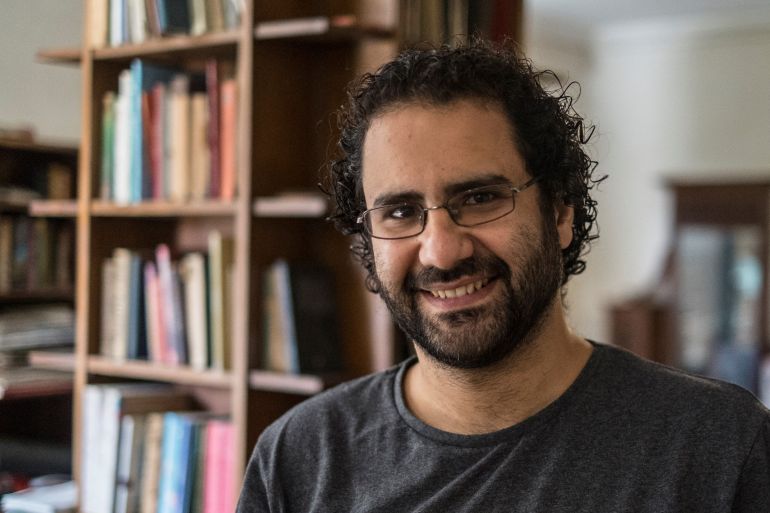
The Egyptian-British activist stopped drinking water on Sunday in an effort to bring attention to his plight as COP27 began.
Published On 9 Nov 20229 Nov 2022
Save articles to read later and create your own reading list.
Concern over the fate of jailed Egyptian-British activist Alaa Abd el-Fattah is growing as he continues to stage a hunger strike in protest against his years-long detention by Egyptian authorities on charges of spreading disinformation.
On Sunday, as world leaders gathered in Egypt for the COP27 climate summit in Sharm el-Sheikh, Abd el-Fattah announced he had stopped drinking water.
Recommended Stories
list of 4 itemslist 1 of 4
Baby murderer or scapegoat? Why is the Lucy Letby case so divisive?
list 2 of 4
What happened in Abu Ghraib and why did a US court award damages?
list 3 of 4
Putin must not win the Ukraine war, freed Russian dissident Kara-Murza says
list 4 of 4
New human rights report says Israeli prisons are ‘torture camps’
end of list
Relatives and concerned observers fear he could now die within days and are demanding his immediate release. The United Kingdom’s government has said it is pushing for him to be freed.
Here is what you need to know about the case.
Who is Abd el-Fattah and why is he in prison?
- Abd el-Fattah emerged as a leading pro-democracy activist and blogger during Egypt’s 2011 popular uprising, which forced former President Hosni Mubarak from office after three decades in power.
- But the 40-year-old has spent most of the past decade behind bars. In 2015, he was sentenced to five years in prison after being found guilty of violating protest laws two years earlier, when now-president Abdel Fattah el-Sisi led a coup against Mubarak’s democratically elected successor Mohamed Morsi.
- El-Sisi went on to win the presidency in a disputed 2014 vote marred by low turnout and a sweeping crackdown on dissent. He has since been accused of jailing tens of thousands of critics of his rule.
- Abd el-Fattah remained imprisoned until March 2019, when he was released on probation. But within six months he was rearrested and in December 2021 was sentenced to another five-year term on charges of spreading false news. Human rights advocates have said that the case against Abd el-Fattah and his continued imprisonment is unjust, and a “reprisal” against him for being a leader of the 2011 uprising.
Why did Abd el-Fattah choose to go on hunger strike?
- In April, days after obtaining British citizenship while behind bars on account of his mother having been born in the UK, Abd el-Fattah launched a hunger strike to protest against his continued detention and treatment in jail.
- Despite reportedly having been reduced to “skin on bone” since, he escalated his months-long demonstration over the weekend when he informed his family that he would stop drinking water.
- Volker Turk, the United Nations high commissioner for human rights, on Tuesday warned Abd el-Fattah was in great danger and called for Egypt to immediately release him. “His dry hunger strike puts his life at acute risk,” Turk’s spokesperson, Ravina Shamdasani, told a news briefing in Geneva.
What has the UK said about his case?
- The UK government has said it is “deeply concerned” by Abd el-Fattah’s case and is “doing everything it can” to secure his release.
- Prime Minister Rishi Sunak’s office said the British leader had raised the Egyptian activist’s detention with el-Sisi during a meeting between the pair on Monday on the sidelines of the COP27 summit. “The Prime Minister said he hoped to see this resolved as soon as possible and would continue to press for progress,” Sunak’s office said in a statement.
- But London’s efforts have proved fruitless to date, with Cairo showing no indication yet that it is planning to free Abd el-Fattah and Egyptian authorities having repeatedly stonewalled British consular officials’ requests to visit him in prison.
- Meanwhile, critics have accused ruling Conservative Party officials of failing to apply sufficient pressure over the case. “For too long this government’s diplomacy has been weak,” David Lammy, the main opposition Labour Party’s shadow foreign secretary, tweeted on Tuesday. “The government must make clear there will be serious diplomatic consequences if consular access is not granted immediately and Alaa Abd el-Fattah is not released and reunited with his family.”
For too long this government’s diplomacy has been weak.
The government must make clear there will be serious diplomatic consequences if consular access is not granted immediately and Alaa Abd el-Fattah is not released and reunited with his family. pic.twitter.com/f4cl4ZoeyM
— David Lammy (@DavidLammy) November 8, 2022
Could the Egyptian government back down?
- Several dual nationals have been released from prison sentences in Egypt in recent years after agreeing to relinquish their Egyptian citizenship – a move that paves the way for individuals to be deported as foreigners.
- In July 2020, Egyptian-American medical student Mohamed Amashah was released after spending more than a year in prison and allowed to return home to the United States. Amashah had been jailed for nearly 500 days. He had been initially arrested after protesting in Cairo’s Tahrir Square with a sign that read “freedom for all prisoners”. Amashah relinquished his Egyptian citizenship as a condition of his release.
- Fellow Egyptian American Reem Desouky was also freed in May 2020 after being held without trial in an Egyptian prison for more than 300 days over a social media post criticising el-Sisi. Desouky, a teacher from Pennsylvania, was similarly required to renounce her Egyptian citizenship to secure her release.
- However, the case involving Abd el-Fattah, who was born in Egypt and lived in the country before his jailing, is inherently more complex.
- While his family have stated that Abd el-Fattah is willing to relinquish his Egyptian citizenship in order to win his release, Egyptian officials have not publicly acknowledged his status as a dual national, meaning it may prove unlikely they allow him to walk free and leave the country.
Could COP27 increase the pressure on Egypt?
- The Egyptian government had hoped that hosting COP27 would bring positive coverage to Egypt, and legitimacy to President el-Sisi.
- Instead, Abd el-Fattah’s family and supporters have been able to use the event to bring international attention to his plight, and that of thousands of other Egyptian political prisoners. Journalists at the climate conference have repeatedly asked questions about Abd el-Fattah, and his sister Sanaa Seif has been able to freely speak about his case.
- On Monday, French President Emmanuel Macron said he had received assurances from el-Sisi that the Egyptian leader was “committed” to ensuring Abd el-Fattah’s health “is preserved”. Macron said el-Sisi had told him during a meeting on the sidelines of the COP27 summit that “the next few weeks and months will bring results”. There was no response from Cairo to Macron’s remarks, but Abd el-Fattah’s relatives said the alleged exchange indicated he may have been force-fed by his jailers and called for Egyptian authorities to provide “proof of life”.

Imprisoned British-Egyptian activist named PEN writer of courage 2024
This article is more than 1 month old
Alaa Abd el-Fattah, who is still in jail in Egypt despite completing his five-year sentence, was selected by PEN Pinter winner Arundhati Roy
Lucy KnightThu 10 Oct 2024 15.00 EDTShare
British-Egyptian writer, software developer and activist Alaa Abd el-Fattah has been named this year’s PEN writer of courage. The 42-year-old is still in prison in Egypt, despite having completed his five-year sentence for allegedly “spreading false news”.
“Let’s remember that this is an innocent man who has committed no crime, but even so, he will have served his time on 29 September,” Abd el-Fattah’s sister, Sanaa Seif, said last month.
Every year, the winner of the PEN Pinter prize shares their award with a writer of courage, chosen from a shortlist of international writers who have actively defended freedom of expression put forward by human rights organisation English PEN. Arundhati Roy, as winner of the 2024 prize, selected Abd el-Fattah.

The Indian author said she wanted to share her prize with Abd el-Fattah “for the same reason that Egyptian authorities have chosen to keep him in prison for two more years instead of releasing him last month. Because his voice is as beautiful as it is dangerous. Because his understanding of what we are facing today is as sharp as a dagger’s edge.”
Abd el-Fattah, a figurehead of Egypt’s 2011 uprising that overthrew the former dictator Hosni Mubarak, is one of the most prominent political prisoners in Egypt, having spent the majority of the past decade in detention. He was most recently arrested in 2019 and was sentenced in December 2021. The Egyptian authorities refused to release him on 29 September, when his five-year sentence was up, as they did not count the two years he had spent in pre-trial detention, going against international legal norms and Egypt’s criminal law.
Foreign secretary David Lammy has previously championed Abd el-Fattah’s case, accusing the former Conservative government of letting down British citizens by failing to take action, though he has not addressed the case publicly since taking office.skip past newsletter promotion
Discover new books and learn more about your favourite authors with our expert reviews, interviews and news stories. Literary delights delivered direct to you
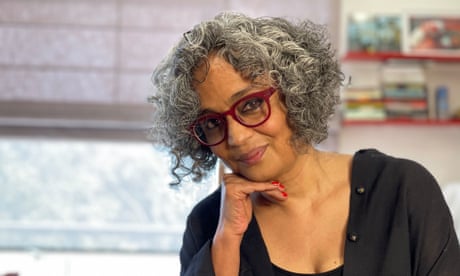
At a ceremony at the British Library in London on Thursday evening, Lina Attalah, editor-in-chief of independent Egyptian online newspaper Mada Masr, accepted the award on Abd el-Fattah’s behalf. “In his writing, newspaper articles, social media posts and prison letters, Alaa was finding the truth in and through language,” she said. “He has always been doing it not as a self-serving act of contemplation, but as an invitation to learn, think along and move on with it.”
Author and Guardian US columnist Naomi Klein, who spoke at the ceremony, said, “Alaa Abd el-Fattah embodies the relentless courage and intellectual depth that Arundhati Roy herself so powerfully represents, making her selection of him as the writer of courage profoundly fitting.”
Roy also announced at the ceremony that her share of the prize money will be donated to the Palestinian Children’s Relief Fund.

UN: Take action on case of British-Egyptian activist Alaa Abd el-Fattah
Posted on November 12, 2024 Protection 7 min read Share: Share on Facebook Share on Twitter Share on LinkedIn
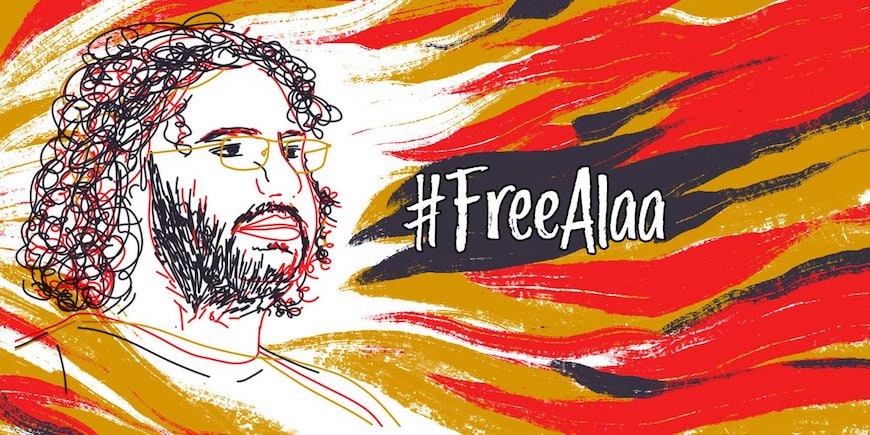
ARTICLE 19 and 26 other human rights organisations have appealed to the United Nations Working Group on Arbitrary Detention (UNWGAD) on behalf of award-winning British-Egyptian writer and activist Alaa Abd el-Fattah, who remains arbitrarily detained in Egypt.
The joint letter coincides with the Working Group’s meeting in Geneva from 11 to 15 November, and urges members to announce its opinion on Abd el-Fattah’s case at the earliest opportunity, following on from an international counsel team, led by barrister Can Yeğinsu, filing an urgent appeal on 14 November 2023.
The letter follows.
Dear Dr. Gillett, Dr. Yudkivska, Ms. Gopalan, Dr. Estrada-Castillo, and Dr. Malila,
We are writing, as a coalition of human rights organisations, regarding the urgent submission made to you, as members of the United Nations Working Group on Arbitrary Detention (UNWGAD), on behalf of Alaa Abd el-Fattah, the award-winning British-Egyptian writer and activist. Alaa Abd el-Fattah remains arbitrarily detained in Egypt and we strongly urge you to announce your opinion on his case at the earliest opportunity.
An international counsel team, led by barrister Can Yeğinsu, filed an urgent appeal with the UNWGAD on behalf of Mr. Abd el-Fattah and his family one year ago, on 14 November 2023, submitting that his continued detention is arbitrary and violates international law. Shortly afterwards, on 23 November 2023, 34 freedom of expression and human rights organisations sent a letter to the UNWGAD supporting that submission and urging the UNWGAD to promptly issue its opinion on this matter. On 17 April 2024, 27 freedom of expression and human rights organisations sent a follow-up letter to the UNWGAD, enquiring whether there was any update in respect of this urgent appeal.
Alaa Abd el-Fattah’s case remains of significant concern to our organisations. He has spent much of the past decade imprisoned in Egypt due to charges related to his writing and activism. He was most recently arrested in September 2019 and was sentenced in December 2021 to five years’ imprisonment, having already spent two years in pre-trial detention. Despite completing his unjust and arbitrary five-year sentence on 29 September 2024, the Egyptian authorities have refused to release him, ignoring the time he spent in pre-trial detention. This defies international legal norms and contradicts Egyptian law. Alaa Abd el-Fattah is currently being held at Wadi al-Natrun prison near Cairo and continues to be denied consular visits, despite his British citizenship. His mother, Laila Soueif, has been on hunger strike since 29 September 2024 in protest against her son’s unjust and prolonged detention.
In November 2022, UN Experts joined the increasing number of human rights voices demanding Alaa Abd el-Fattah’s immediate release. Yet two years later, having fully served his five-year sentence, he remains in prison.
Despite his ongoing incarceration, Alaa Abd el-Fattah’s writing and activism continue to be recognised worldwide: most recently, in October 2024, he was announced as the joint winner of the 2024 PEN Pinter Prize with Arundhati Roy, and recognised as the 2024 Writer of Courage, eliciting the following encomium from Naomi Klein at the ceremony:
Alaa Abd El-Fattah embodies the relentless courage and intellectual depth that Arundhati Roy herself so powerfully represents, making her selection of him as the Writer of Courage profoundly fitting. Despite enduring a series of unjust sentences that robbed him of over a decade of freedom, his liberation continues to be denied. This prize, shared between two vital voices, reminds us of the urgent need to continue to raise our own in a call to ’Free Alaa’ at long last.
Our organisations continue to call for Alaa Abd el-Fattah’s immediate and unconditional release and we request that the UNWGAD urgently announce its opinion on his case.
Yours sincerely,
Alejandro Mayoral Baños, Executive Director, Access Now
Ahmed Samih Farag, General Director, Andalus Institute for Tolerance and Anti-Violence Studies
Quinn McKew, Executive Director, ARTICLE 19
Neil Hicks, Senior Director for Advocacy, Cairo Institute for Human Rights Studies (CIHRS)
Gypsy Guillén Kaiser, Advocacy and Communications Director, Committee to Protect Journalists (CPJ)
Chris Doyle, Director, Council for Arab-British Understanding (CAABU)
Jillian C. York, Director for International Freedom of Expression, Electronic Frontier Foundation
Ahmed Attalla, Executive Director, Egyptian Front for Human Rights
Samar Elhussieny, Programs Officer, Egyptian Human Rights Forum (EHRF)
Daniel Gorman, Director, English PEN
Rasmus Alenius Boserup, Executive Director, EuroMed Rights
James Lynch, Co-Director, FairSquare
Khalid Ibrahim, Executive Director, Gulf Centre for Human Rights
Mostafa Fouad, Head of Programs, HuMENA for Human Rights and Civic Engagement
Matt Redding, Head of Advocacy, IFEX
Baroness Helena Kennedy LT KC, Director, International Bar Association’s Human Rights Institute (IBAHRI)
Alice Mogwe, President, International Federation for Human Rights (FIDH), within the framework of the Observatory for the Protection of Human Rights Defenders
Liesl Gerntholtz, Managing Director, PEN/Barbey Freedom To Write Center, PEN America
Mark Allen Klenk, Writers at Risk Committee Chair, PEN Austria
Grace Westcott, President, PEN Canada
Romana Cacchioli, Executive Director, PEN International
Rupert Skilbeck, Director, REDRESS
Antoine Bernard, Director of Advocacy and Assistance, Reporters Sans Frontières
Ricky Monahan Brown, President, Scottish PEN
Ahmed Salem, Executive Director, Sinai Foundation for Human Rights (SFHR)
Menna Elfyn, President, Wales PEN Cymru
Gerald Staberock, Secretary General, World Organisation Against Torture (OMCT), within the framework of the Observatory for the Protection of Human Rights Defenders

Mother of British-Egyptian political prisoner goes on hunger strike
21 October 2024ShareSave
Caroline Hawley
Diplomatic correspondent
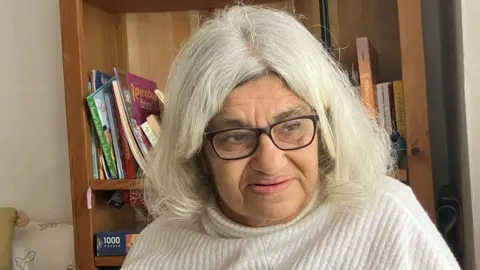
Laila Soueif has not eaten for more than three weeks and is past the stage of feeling hungry.
In London to campaign for the release of her British-Egyptian son, Alaa Abdel Fattah, the 68-year-old maths professor insists – stoically – that she’s “not feeling bad at all”.
She went on hunger strike the day after what should have been the end of his five-year prison sentence – though his relatives, along with human rights groups, say that he should never have been in prison at all.
Alaa Abdel Fattah is Egypt’s best-known political prisoner. A blogger, writer and outspoken pro-democracy activist, he has been in jail for most of the past decade.
His mother’s hunger strike – she’s surviving on water, rehydration salts and sugarless tea or coffee – is a sign of his family’s increasing desperation.
“I’m keeping it up until Alaa is free or I’m taken to hospital in a terrible state,” she tells me. “His life has been on hold for 11 years. It can’t go on.”
Alaa Abdel Fattah was arrested in September 2019, six months after finishing a previous five-year sentence.
He was convicted in 2021 of spreading false news, for sharing a Facebook post about torture in Egypt. The Egyptian authorities are refusing to count the more than two years he spent in pre-trial detention towards his time served.
ADVERTISEMENT
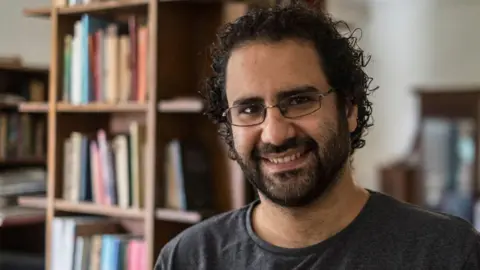
Although he acquired British citizenship in 2021, Egypt has never allowed him a consular visit.
In opposition two years ago, the UK’s then shadow foreign secretary, David Lammy, called for “serious diplomatic consequences” if access wasn’t granted immediately and Alaa Abdel Fattah was not freed.
But his family are deeply disappointed with how the current government, and the previous one, have handled his case. They believe the UK has more leverage with Egypt – a key ally – than it’s prepared to use.
“I’m not a fool. I don’t expect the government to ruin billions of dollars’ worth of trade deals for my son,” says Laila Souief, who lives in Cairo but was born in London.
She does, however, expect Mr Lammy, now that he is foreign secretary, to put pressure on Egyptian ministers to take action, she says.
“At least don’t give them photo opportunities like the one I saw recently of David Lammy grinning ear to ear with the Egyptian foreign secretary.”
A spokesperson for the Foreign Office said: “Our priority remains securing consular access to Mr El-Fattah and his release. We continue to raise his case at the highest levels of the Egyptian government.”
The family’s campaign has been supported by Richard Ratcliffe, who knows only too well what drives someone to go on hunger strike – as he himself did for his wife, Nazanin Zaghari-Ratcliffe.
ADVERTISEMENT
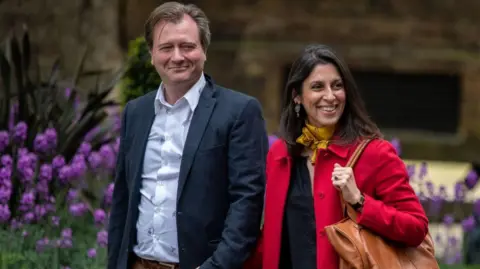
“We reached a point where we needed to do something drastic to shake the government’s complacency, and remind ministers they had a role beyond waiting and wringing or washing their hands,” he tells me of his family’s campaign.
“Alaa’s family will be fully aware that hunger strikes leave scars.”
Alaa Abdel Fattah’s own hunger strike in 2022, as Egypt hosted the UN climate conference, led to international pressure for his release and an improvement in his conditions in jail.
He is now allowed to read books and watch sports on TV. But he is “down most of the time” according to his mother, and despondent about the future and his chances of release.
He now only wants to leave Egypt to be with his 13-year-old son, who is on the autism spectrum and attends a special needs school in Brighton.
She says other countries have done deals allowing their citizens jailed in Egypt to be freed and deported if they give up their Egyptian nationality.
“He has no wish to lead the Egyptian opposition from Brighton,” she told me. “He’s going to be too busy with Khalid.”
As for her and her hunger strike, she says she wants to make herself a “headache” for both the British and Egyptian governments. “That’s the least of what I hope to achieve.”
 Knock nock
Leave a comment