

Robert Barsky examines the profound impact of Orwell’s “Homage to Catalonia” on Noam Chomsky’s early embrace of left-libertarian and anarchist ideologies.

By: Robert F. Barsky
Unlike the many members of the left who captivated him as a young man — such as Dwight Macdonald, George Orwell, and Bertrand Russell — Noam Chomsky himself did not come to left-libertarian or anarchist thinking as a result of his disillusionment with liberal thought. He quite literally started there. At a tender age, he had begun his search for information on contemporary left-libertarian movements, and did not abandon it. Among those figures he was drawn to, George Orwell is especially fascinating, both because of the impact that he had on a broad spectrum of society and the numerous contacts and acquaintances he had in the libertarian left. Chomsky refers to Orwell frequently in his political writings, and when one reads Orwell’s works, the reasons for his attraction to someone interested in the Spanish Civil War from an anarchist perspective become clear.

When Chomsky was in his teens he read Orwell’s “Animal Farm,” “which,” he told me in 1995, “struck me as amusing but pretty obvious”; but in his later teens he read “Homage to Catalonia” “and thought it outstanding (though he overdid the POUM role I felt, not surprisingly given where he was); it confirmed beliefs I already had about the Spanish Civil War.” “Homage to Catalonia,” Orwell’s description of the Spanish conflict, which he wrote after completing a stint as an active member of the POUM militia, is still a book to which people (including Chomsky) who are interested in successful socialist or anarchist movements refer, because it gives an accurate and moving description of a working libertarian society. The “beliefs” that it “confirmed” for the teenaged Chomsky were related to his growing conviction that libertarian societies could function and meet the needs of the individual and the collective.
There were three left-wing groups active on the scene in Barcelona during the 1930s: the Partido Obrero de Unificación Marxista, or POUM; the socialist PSUC (Partido Socialista Unificado de Catalunya), which was dominated by Stalinists; and the anarchist CNT-FAI (Confederación Nacional de Trabajadores-Federacion Anarquista Iberica), which honored Rudolf Rocker as “their teacher” on the occasion of his 80th birthday. Orwell joined the POUM militia at the end of 1936 as a means of entering Spain to write newspaper articles. His description, in “Homage to Catalonia,” of the POUM line sets up an oversimplified but provocative relationship between bourgeois democracy, fascism, and capitalism:
Bourgeois “democracy” is only another name for capitalism, and so is Fascism; to fight against Fascism on behalf of “democracy” is to fight against one form of capitalism on behalf of a second which is liable to turn into the first at any moment. The only real alternative to Fascism is workers’ control. If you set up any less goal than this, you will either hand the victory to Franco, or, at best, let in Fascism by the back door. The war and the revolution are inseparable.
Orwell maintains that revolution is the only way to remove from power the oppressive business-based ruling class of the type that has dominated the West since World War II. This concept is a difficult one to grasp for those of us who have been programmed, in large measure by the mainstream press, to think that battles must involve two opposing forces — one good and one evil. World War II is often portrayed this way: the Allied side is taken to represent freedom and democracy, while fascism and Nazism are considered synonymous with totalitarian oppression. Chomsky knew early on that there were other ways to conceive of contemporary political structures. He tended to lean towards the left-libertarian interpretation of events, and concluded that neither side deserved the support of those interested in a “good society.” How “good” is the society that drops atomic bombs on Japanese civilians, or reduces German towns to rubble? Isn’t there an alternative?
How “good” is the society that drops atomic bombs on Japanese civilians, or reduces German towns to rubble? Isn’t there an alternative?
This subject is still hotly debated, even among members of the libertarian left. Norman Epstein, who has been active in leftist movements for many years and who is otherwise generally sympathetic to Chomsky’s position, here dissents by taking exception to Orwell’s paraphrasing of the POUM line. He emphasizes that “fascism is not simply another name for capitalism. It is a form, and a particularly brutal one, which capitalism takes under certain historical circumstances (including today in many third world countries under the sponsorship of U.S. capital) which is different from bourgeois democracy. Someone like Chomsky is allowed to function under bourgeois democracy but not under fascism.” But we must recognize the similarities between a fascist agenda and that of the so-called democratic West if we are to understand where Chomsky is coming from in his political works, and to do so we have to engage with the anarchist position that he had begun to develop in his youth.
The most important point, perhaps, is that the anarchism of the type that reigned, in various degrees, in Barcelona in the 1930s, was not an anarchism of chaos, of random acts; it was not purely individualistic or hedonistic in character. When Chomsky considered the anarchist position as an alternative to the status quo, he may well have appealed to Orwell’s description, in “Homage to Catalonia,” of Barcelona in 1936. He refers to this passage on a number of occasions in his later works. Orwell begins by describing his arrival in the city, noting the physical changes that had been effected by the anarchists and the workers. Most of the buildings had been seized by the workers, churches had been gutted or demolished, there were no private motorcars or taxis, shops and cafes had been collectivized, and symbols of the revolution abounded. But it was the effect that this collectivization had upon the people that was most striking.
Waiters and shop-walkers looked you in the face and treated you as an equal. Servile and even ceremonial forms of speech had temporarily disappeared. Nobody said “Señor” or “Don” or even “Usted”; everyone called everyone else “Comrade” and “Thou,” and said “Salud!” instead of “Buenos dias.” … And it was the aspect of the crowds that was the queerest thing of all. In outward appearance it was a town in which the wealthy classes had practically ceased to exist. Except for a small number of women and foreigners there were no “welldressed” people at all. Practically everyone wore rough working-class clothes, or blue overalls or some variant of the militia uniform. All this was queer and moving. There was much in it that I didn’t understand, in some ways I did not even like it, but I recognized it immediately as a state of affairs worth fighting for.
But how does one achieve such a society? How did the young Chomsky explain to himself the great distance between his own world and the one about which he read in books such as “Homage to Catalonia”? And why didn’t he look to the Bolshevists rather than the anarchists?
The work of anarchist thinker Rudolf Rocker was a vital source of information and inspiration for him as he struggled to analyze these complex issues. Chomsky read Rocker’s work, including his book on the Spanish Civil War called “The Tragedy of Spain,” as a teenager. Rocker’s argument was that the Bolshevist rulers justified totalitarian practices by claiming to defend proletarian interests against counterrevolutionary actions. They were preparing society for socialism in accord with the teaching of Lenin. But Rocker’s claim, which is in line with Chomsky’s thinking, is that dictatorship and tyranny, even when couched in apparently libertarian ideology and objectives, can never lead to liberation. Says Rocker: “What the Russian autocrats and their supporters fear most is that the success of libertarian Socialism in Spain might prove to their blind followers that the much vaunted ‘necessity of dictatorship’ is nothing but one vast fraud which in Russia has led to the despotism of Stalin and is to serve today in Spain to help the counter-revolution to a victory over the revolution of the workers and the peasants.” The importance of the Spanish revolution is clear, for it served as a concrete example of how powers such as the Soviet Union and the United States, despite their apparent differences, did converge in their mutual fear of liberation movements. In this sense, apparent aberrations such as the Stalinist-Fascist pact that was signed on August 23, 1939, or the physical and verbal attacks made against the Spanish anarchists by both the Soviets and the Americans, make sense. The misrepresentation of events persists even today in standard historical texts.
Chomsky was fortunate to have made this connection early on, for it spared him from experiencing the disillusionment that ultimately afflicted many of his contemporaries. This sense of betrayal or surprise was very real for many members of Chomsky’s generation. His friend Seymour Melman, for example, described in a personal interview the important role that the Spanish Civil War played in revealing to him the Stalinist Fascist relationship and the so-called Communist hand:
We didn’t know the full role of the Communists until 1939 when this famous Russian general defected and wrote articles in the Saturday Evening Post. Therein he described in detail how Stalin was using his secret police to wage a war against the Anarchists. He described Stalin’s war within the war. He also described how the Stalinists stole the gold reserve of the Spanish Republic. He layed out a detailed analysis and prediction of the Nazi-Soviet pact.
Notice the time lag between the events of 1936 and the realization that the Soviets were “wag[ing] a war against the Anarchists.” Even more remarkable, of course, is that the generally accepted view, subsequently perpetrated by the Western press, was that the Spanish Civil War was a colossal failure, and had achieved no concrete results. It was branded as a failure of socialist, anarchist, or Marxist principles, depending upon who was doing the branding.
Orwell had noted, in “Homage to Catalonia,” the obvious schism between the events as they occurred and as they were reported, and pointed to the way in which media types and intellectuals tended to dismiss anti-status-quo movements, such as socialism, by distorting the principles that supported them or the movements that grew from them: “I am well aware that it is now the fashion to deny that Socialism has anything to do with equality. In every country of the world a huge tribe of party-hacks and sleek little professors are busy ‘proving’ that socialism means no more than a planned state-capitalism with the grab-motive left intact. But fortunately there also exists a vision of Socialism quite different from this.”
This is the crux of the matter; other visions did exist, and Chomsky had access to them as a young man. But it did take a certain amount of effort to uncover them, unless one was fortunate enough to have participated directly in events of the time, as Orwell was. “[I]t was here that those few months in the POUM militia were valuable to me,” he writes. “For the Spanish militias, while they lasted, were a sort of microcosm of a classless society. In that community where no one was on the make, where there was a shortage of everything but no privilege and no boot-licking, one got, perhaps, a crude forecast of what the opening stages of Socialism might be like. And, after all, instead of disillusioning me it deeply attracted me.”
Robert F. Barsky is a 2023 Guggenheim Fellow & Professor at Vanderbilt University. He has published widely in language theory, literary studies, and border studies with an emphasis on humanistic approaches to human rights. He is the author of several books, including “The Chomsky Effect: A Radical Works Beyond the Ivory Tower” and “Noam Chomsky: A Life of Dissent,” from which this article is excerpted.
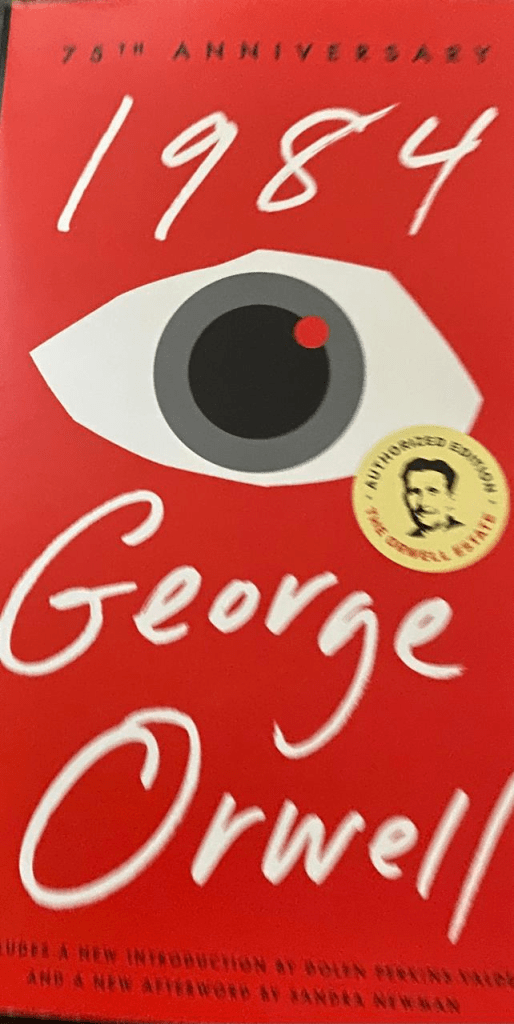
This is the 75th Anniversary Edition with a new introduction by
Dolen Perkins – Valdez,
A new Afterword by
Sandra Newman
and an Afterword by
Erich Fromm

Brief Introduction of the above three personalities

Dolen Perkins-Valdez is a black American writer, best known for her debut novel Wench: A Novel (2010), which became a bestseller.
She is chair of the PEN/Faulkner Foundation Board of Directors.[1]
Early life and education
[edit]
Dolen Perkins-Valdez attended Harvard College as an undergraduate, earning a BA degree. She completed a PhD in English at George Washington University in Washington, D.C.
Career
[edit]
Perkins-Valdez has published short fiction and essays in such magazines as The Kenyon Review, StoryQuarterly, StorySouth, African American Review, PMS: PoemMemoirStory, North Carolina Literary Review, Richard Wright Newsletter, and SLI: Studies in Literary Imagination.[2]
As of 2016 she was an associate professor at American University in Washington, D.C.[3]
Perkins-Valdez has said she was inspired to write her debut novel, Wench: A Novel (2010), after reading a biography of W. E. B. Du Bois and coming across a brief reference to the founding of Wilberforce University. It was noted as first being based at[clarification needed] the buildings and grounds of a former, privately owned resort called Tawawa House, named for the “yellow springs” in the area. The iron-rich waters were thought to have medicinal value. Among the regular summer visitors to the Ohio resort in the antebellum period were Southern white planters and their enslaved mistresses of color.[4]
Wench features Lizzie, a young enslaved woman, and her complicated relationship with her master. It also explores the lives of three other mistresses of color, whom Lizzie comes to know at the resort. They are influenced by spending time in a free state, and seeing free people of color there. It was published by HarperCollins in 2010 and in paperback the following year.
The book received positive reviews and notice as a debut novel.[5] The paperback edition became a bestseller. The novel was selected by NPR in 2010 as one of five books published that year that was recommended to book clubs, for “something to talk about”.[6]
Other works
[edit]
In 2013, Perkins-Valdez was invited to write an introductory essay to the 37th edition of Solomon Northup‘s autobiography Twelve Years a Slave.[7]
Her second novel, Balm, was published in May 2015.[8] The novel is set in Chicago during the Reconstruction Era. It explores a Tennessee black healer named Madge, who was born free; a white widowed spiritualist named Sadie; and a freedman called Hemp from Kentucky, who gained freedom by fighting with the Union Army. Each migrated to Chicago after the war, along with thousands of others working to rebuild their lives and to explore new kinds of freedom.[9]
Perkins-Valdez said that she wanted to “move the story out of the battlegrounds of the war into a place like Chicago […] taking it out of those traditional spaces such as the South or even thinking of Virginia or Pennsylvania… and putting it somewhere that was absolutely affected by the war but was still, in some ways, peripheral.”[9]
Dolen’s third novel Take My Hand was published by Berkley Books/Penguin Random House in Spring 2022.[10] According to its epilogue, it was inspired by a real case in which two sisters, aged 12 and 14, were sterilized against their will, in June 1973.
Honors
[edit]
- 2002–2003, she was a president’s postdoctoral fellow at the Center for African American Studies at the University of California at Los Angeles.[11]
- 2009, finalist for the Robert Olen Butler Fiction Award.[2]
- 2011, finalist for two NAACP Image Awards and the Hurston/Wright Legacy Award for fiction, for her novel Wench[3]
- 2011, First Novelist Award for Wench by the Black Caucus of the American Library Association.[12][13]
- She received a DC Commission on the Arts Grant to aid in completion of her second novel, Balm.[when?][citation needed]
Bibliography
[edit]
- Wench: A Novel (2010) ISBN 9780061706561
- Balm: A Novel (2015) ISBN 9780062318671
- Take My Hand (2022) ISBN 9780593337691
References
[edit]
- ^ “About Us | the PEN/Faulkner Foundation”.
- ^ Jump up to:a b “‘Wench- A Novel’: An Excerpt”. The Nervous Breakdown. January 30, 2010. Retrieved September 12, 2019.
- ^ Jump up to:a b “Profile Dolen Perkins-Valdez”. http://www.american.edu. Retrieved January 30, 2016.
- ^ O’Neal Parker, Lonnae. “A tender spot in master-slave relations”. Washington Post. Retrieved April 15, 2015.
- ^ Nelson, Samantha (January 2011). “Review: Dolen Perkins-Valdez: Wench”. AV Club. avclub.com. Retrieved April 15, 2015.
- ^ Neary, Lynn (December 6, 2010). “Best Books of 2010: Book Club Picks: Give ‘Em Something To Talk About”. NPR. Retrieved September 12, 2019.
- ^ Northup, Solomon & Perkins-Valdez, Dolen (Introduction) (September 17, 2013). Twelve Years a Slave (37th ed.). Atria. ASIN B00DJWV0VY.
- ^ Perkins-Valdez, Dolen (May 26, 2015). Balm: A Novel (1st ed.). Amistad. ISBN 978-0062318657.
- ^ Jump up to:a b NPR Staff (June 6, 2015). “Author Interviews: ‘Balm’ Looks At Civil War After The Battles, Outside The South”. NPR. Retrieved June 8, 2015.
- ^ “Book Deals: Week of October 5, 2020”.
- ^ “WEDDINGS/CELEBRATIONS; Dolen Perkins, David Valdez”. The New York Times. August 3, 2003. Retrieved September 11, 2019.
- ^ “Black Caucus of the American Library Association Literary Awards (1994–Present)”. Infoplease. Retrieved April 15, 2015.
- ^ Perkins-Valdez, Dolen (2010). Wench. Amistad. ISBN 9780061706547.
‘Balm’ Looks At Civil War After The Battles, Outside The South
June 6, 20155:15 PM ET

Dolen Perkins-Valdez wants to change readers’ perspective on the Civil War. Her best-selling debut novel, Wench, explored the lives of slave women — not on Southern plantations, but in a resort for slaveowners’ mistresses in Ohio. Her new book, Balm, is set in the postwar period, and it’s also in an unexpected place: Chicago.
In the years following the Civil War, thousands of people — black and white, men and women — descended on the city looking for a new start. Balm follows three characters — Madge, Hemp and Sadie — who are looking to rebuild their lives in that era of loss and hope.
“I really wanted to move the story out of the battlegrounds of the war into a place like Chicago,” Perkins-Valdez tells NPR’s Arun Rath. “I was really fascinated by the idea of taking it out of those traditional spaces such as the South or even thinking of Virginia or Pennsylvania … and putting it somewhere that was absolutely affected by the war but was still, in some ways, peripheral.”
To hear their full conversation, click the audio link above.
Interview Highlights
On the three main characters of the novel
There’s Madge, who is part of a healing family in Tennessee. Although her family is free, after emancipation she decides to leave her home and go north to see what she calls being “free free.”
There’s Hemp, who is from Kentucky. He receives his freedom papers when he goes to enlist in the Union Army at Camp Nelson.
Finally, there’s Sadie, who is a white woman who is married to a soldier during the war by her father. The soldier dies in a train accident, and she ends up in Chicago — so there are these three transplants who come there and are trying to rebuild their lives.
Dolen Perkins-Valdez is also the author of the novel Wench.
Courtesy of Amistad
I had always viewed Civil War narratives as segregated: There was a white Civil War narrative; there was a black Civil War narrative. I was really interested in how those narratives converged.
My feeling about it was that the thing that we all had in common was that at the end of the war, we were all rebuilding. There had been this great sacrifice on all sides whether you were black or white, Northern or Southern. So for Hemp, who is freed by enlisting in the Union Army, his main concern is finding his family. We often think of that as being a separate narrative than, you know, the South and its feeling of the lost cause, but I think there’s something that all of those stories have in common, which really does have to do with rebuilding, reinvention, resilience, the American story of triumph over adversity. That was something that really inspired me to think of this as a narrative that’s really tangled up into something bigger than one.
On wrestling with what it means to be free
What does it mean to be free? And as Madge says, “What does it mean to be ‘free free?’ ” — because she actually possesses her freedom papers before the war ends [but in Tennessee, a slave state].
For Hemp, for example, part of what it meant to be free was to be righteous, was to actually be in a universe where the system of morality was right side up instead of upside down. So after Hemp gets his freedom, the very first thing he wants to do is to give his master, who has died, a proper burial. He says [it’s] because that’s the first step to becoming a righteous man.
Everyone was going through that transitional moment of — and when I say everyone, I mean all of the freed men and women — were going through that transitional moment of understanding what freedom meant for them.
On the period after the Civil War
Obviously the war itself … was a great tragedy. But I do think the even bigger test was how we picked ourselves up at the end of it. How did we reform ourselves? How did the South deal with the legacy of having felt that it had lost it?
I think we’re still recovering in so many ways. And so I think … that rebuilding is a testament to who we are as a country, because we’re still doing it, but we’re still sort of surviving.
We’re a triumphant nation, and that’s what I focus on. I think about the South rising again, I think of the North rising again, I think of freed men and women. We reinvent. We survive.


Sandra Newman (born November 6, 1965, in Boston, Massachusetts) is an American writer. She has a BA from Polytechnic of Central London, and an MA from the University of East Anglia.[1]
Newman’s first novel, The Only Good Thing Anyone Has Ever Done,[2] was first published in 2002 and received a nomination for the 2002 Guardian First Book Award.[3] The novel features an American adoptee from Guatemala named Chrysalis Moffat and focuses on events in her and her family’s lives using an unusual style reminiscent of notes taken while composing the novel.[2]
Newman’s third novel, The Country of Ice Cream Star (2014), was among eighty titles nominated for 2015 Folio Prize,[4] and among twenty works nominated for the 2015 Baileys Women’s Prize for Fiction.[5] The novel follows the protagonist, Ice Cream Fifteen Star, through a dystopian future United States while she searches for a cure for her brother’s inherited disease.[5]
Her fourth novel, The Heavens (2019), published by Grove Atlantic, tells the story of a woman who lives in the early twenty-first century, but who returns every night in dreams to Elizabethan era England, where she lives as Emilia Lanier, a Jewish poet whose circle of acquaintances includes an obscure poet named William Shakespeare.[6] The New York Times Book Review called it “a strange and beautiful hybrid.”[7]
She is the author of the novel Cake (2008); a memoir, Changeling (2010); and a guide to Western literature, The Western Lit Survival Kit: How to Read the Classics Without Fear (2012). She is the co-author of How Not To Write A Novel (2008) and Read This Next (2010).
Her fifth novel, The Men (2022), published by Grove Atlantic, recounts a story in which all people with a Y chromosome vanish from the face of the Earth.[8] The book was controversial, with some critical of its focus on biology and exclusion of trans women.[9][10] However, in The Telegraph, Claire Allfree cites discussion of trans women in the book, and in Publishers Weekly, David Varno says “The Men is at once accessible and surprisingly complex,” and notes that “trans characters do feature in it.”[11][12] In a review for The Times, Jessa Crispin described The Men as “the most ill-conceived and badly executed novel of the year”.[13] In Financial Times, Erica Wagner wrote that the novel was a “confused and confusing book, a tangled mess of threads that never knit up into a satisfying whole.”[14] In The Spectator, Sarah Ditum called The Men “a gripping, haunting novel,” and in The Telegraph, Nina Power called it “compelling and enjoyable.”[15][16]
Her sixth novel, Julia (2023), published by Granta in the UK and Mariner Books in the US, and written at the request of George Orwell‘s estate, revisits the events of the dystopian classic 1984 through the eyes of Winston Smith‘s love interest, Julia. The LA Times called the book “a stunning look into what happens when a person of strength faces the worst in humanity, as well as a perfect specimen of derivative art“.[17] The Financial Times called it “a richly envisaged, frightening dystopia, wholly alive to Orwell’s text”,[18] while Erica Wagner dubbed it a “masterpiece” in The Telegraph.[19]


Erich Seligmann Fromm (/frɒm/; German: [fʁɔm]; March 23, 1900 – March 18, 1980) was a German-American social psychologist, psychoanalyst, sociologist, humanistic philosopher, and democratic socialist. He was a German Jew who fled the Nazi regime and settled in the United States. He was one of the founders of The William Alanson White Institute of Psychiatry, Psychoanalysis and Psychology in New York City and was associated with the Frankfurt School of critical theory.[4][n 1]
Life
[edit]
Erich Fromm was born on March 23, 1900, at Frankfurt am Main, the only child of Orthodox Jewish parents, Rosa (Krause) and Naphtali Fromm.[5] He started his academic studies in 1918 at the University of Frankfurt am Main with two semesters of jurisprudence. During the summer semester of 1919, Fromm studied at the University of Heidelberg, where he began studying sociology under Alfred Weber (brother of sociologist Max Weber), psychiatrist-philosopher Karl Jaspers, and Heinrich Rickert. Fromm received his Ph.D. in sociology from Heidelberg in 1922 with a dissertation “On Jewish Law”.
Fromm at the time became strongly involved in Zionism, under the influence of the religious Zionist rabbi Nehemia Anton Nobel.[6] He was very active in Jewish Studentenverbindungen and other Zionist organisations. But he soon turned away from Zionism, saying that it conflicted with his ideal of a “universalist Messianism and Humanism”.[7]
During the mid-1920s, he trained to become a psychoanalyst through Frieda Reichmann‘s psychoanalytic sanatorium in Heidelberg. They married in 1926, but separated shortly after and divorced in 1942. He began his own clinical practice in 1927. In 1930 he joined the Frankfurt Institute for Social Research and completed his psychoanalytical training.
After the Nazi takeover of power in Germany, Fromm moved first to Geneva and then, in 1934, to Columbia University in New York. Together with Karen Horney and Harry Stack Sullivan, Fromm belongs to a Neo-Freudian school of psychoanalytical thought. Horney and Fromm each had a marked influence on the other’s thought, with Horney illuminating some aspects of psychoanalysis for Fromm and the latter elucidating sociology for Horney. Their relationship ended in the late 1930s.[8] After leaving Columbia, Fromm helped form the New York branch of the Washington School of Psychiatry in 1943, and in 1946 co-founded the William Alanson White Institute of Psychiatry, Psychoanalysis, and Psychology. He was on the faculty of Bennington College from 1941 to 1949, and taught courses at the New School for Social Research in New York from 1941 to 1959.
When Fromm moved to Mexico City in 1949, he became a professor at the National Autonomous University of Mexico (UNAM) and established a psychoanalytic section at the medical school there. Meanwhile, he taught as a professor of psychology at Michigan State University from 1957 to 1961 and as an adjunct professor of psychology at the graduate division of Arts and Sciences at New York University after 1962. He taught at UNAM until his retirement, in 1965, and at the Mexican Society of Psychoanalysis (SMP) until 1974. In 1974 he moved from Mexico City to Muralto, Switzerland, and died at his home in 1980, five days before his eightieth birthday. All the while, Fromm maintained his own clinical practice and published a series of books.
Fromm was reportedly an atheist[9][n 2] but described his position as “nontheistic mysticism“.[10]
Psychological theory
[edit]
| This section needs additional citations for verification. Please help improve this article by adding citations to reliable sources in this section. Unsourced material may be challenged and removed. (May 2023) (Learn how and when to remove this message) |
Beginning with his first seminal work of 1941, Escape from Freedom (known in Britain as The Fear of Freedom), Fromm’s writings were notable as much for their social and political commentary as for their philosophical and psychological underpinnings. Indeed, Escape from Freedom is viewed as one of the founding works of political psychology. His second important work, Man for Himself: An Inquiry into the Psychology of Ethics, first published in 1947, continued and enriched the ideas of Escape from Freedom. Taken together, these books outlined Fromm’s theory of human character, which was a natural outgrowth of Fromm’s theory of human nature. Fromm’s most popular book was The Art of Loving, an international bestseller first published in 1956, which recapitulated and complemented the theoretical principles of human nature found in Escape from Freedom and Man for Himself—principles which were revisited in many of Fromm’s other major works.
Central to Fromm’s world view was his interpretation of the Talmud and Hasidism. He began studying Talmud as a young man under Rabbi J. Horowitz and later under Rabbi Salman Baruch Rabinkow, a Chabad Hasid. While working towards his doctorate in sociology at the University of Heidelberg,[11] Fromm studied the Tanya by the founder of Chabad, Rabbi Shneur Zalman of Liadi. Fromm also studied under Nehemia Nobel and Ludwig Krause while studying in Frankfurt. Fromm’s grandfather and two great-grandfathers on his father’s side were rabbis, and a great uncle on his mother’s side was a noted Talmudic scholar. However, Fromm turned away from orthodox Judaism in 1926, towards secular interpretations of scriptural ideals.
The cornerstone of Fromm’s humanistic philosophy is his interpretation of the biblical story of Adam and Eve‘s exile from the Garden of Eden. Drawing on his knowledge of the Talmud, Fromm pointed out that being able to distinguish between good and evil is generally considered to be a virtue, but that biblical scholars generally consider Adam and Eve to have sinned by disobeying God and eating from the Tree of Knowledge. However, departing from traditional religious orthodoxy on this, Fromm extolled the virtues of humans taking independent action and using reason to establish moral values rather than adhering to authoritarian moral values.
Beyond a simple condemnation of authoritarian value systems, Fromm used the story of Adam and Eve as an allegorical explanation for human biological evolution and existential angst, asserting that when Adam and Eve ate from the Tree of Knowledge, they became aware of themselves as being separate from nature while still being part of it. This is why they felt “naked” and “ashamed”: they had evolved into human beings, conscious of themselves, their own mortality, and their powerlessness before the forces of nature and society, and no longer united with the universe as they were in their instinctive, pre-human existence as animals. According to Fromm, the awareness of a disunited human existence is a source of guilt and shame, and the solution to this existential dichotomy is found in the development of one’s uniquely human powers of love and reason. However, Fromm distinguished his concept of love from unreflective popular notions as well as Freudian paradoxical love (see the criticism by Marcuse below).
Fromm considered love an interpersonal creative capacity rather than an emotion, and he distinguished this creative capacity from what he considered to be various forms of narcissistic neuroses and sado-masochistic tendencies that are commonly held out as proof of “true love”. Indeed, Fromm viewed the experience of “falling in love” as evidence of one’s failure to understand the true nature of love, which he believed always had the common elements of care, responsibility, respect, and knowledge. Drawing from his knowledge of the Torah, Fromm pointed to the story of Jonah, who did not wish to save the residents of Nineveh from the consequences of their sin, as demonstrative of his belief that the qualities of care and responsibility are generally absent from most human relationships. Fromm also asserted that few people in modern society had respect for the autonomy of their fellow human beings, much less the objective knowledge of what other people truly wanted and needed.
Fromm believed that freedom was an aspect of human nature that we either embrace or escape. He observed that embracing our freedom of will was healthy, whereas escaping freedom through the use of escape mechanisms was the root of psychological conflicts. Fromm outlined three of the most common escape mechanisms:
- Automaton conformity: changing one’s ideal self to conform to a perception of society’s preferred type of personality, losing one’s true self in the process; Automaton conformity displaces the burden of choice from self to society;
- Authoritarianism: giving control of oneself to another. By submitting one’s freedom to someone else, this act removes the freedom of choice almost entirely.
- Destructiveness: any process which attempts to eliminate others or the world as a whole, all to escape freedom. Fromm said that “the destruction of the world is the last, almost desperate attempt to save myself from being crushed by it”.[12]
The word biophilia was frequently used by Fromm as a description of a productive psychological orientation and “state of being“. For example, in an addendum to his book The Heart of Man: Its Genius For Good and Evil, Fromm wrote as part of his humanist credo:
“I believe that the man choosing progress can find a new unity through the development of all his human forces, which are produced in three orientations. These can be presented separately or together: biophilia, love for humanity and nature, and independence and freedom.”[13]
Erich Fromm postulated the following basic needs:
| Need | Description |
|---|---|
| Transcendence | Being thrown into the world without their consent, humans have to transcend their nature by destroying or creating people or things.[14] Humans can destroy through malignant aggression, or killing for reasons other than survival, but they can also create and care about their creations.[14] |
| Rootedness | Rootedness is the need to establish roots and to feel at home again in the world.[14] Productively, rootedness enables us to grow beyond the security of our mother and establish ties with the outside world.[14] With the nonproductive strategy, we become fixated and afraid to move beyond the security and safety of our mother or a mother substitute.[14] |
| Sense of Identity | The drive for a sense of identity is expressed nonproductively as conformity to a group and productively as individuality.[14] |
| Frame of orientation | Understanding the world and our place in it. |
| Excitation and Stimulation | Actively striving for a goal rather than simply responding. |
| Unity | A sense of oneness between one person and the “natural and human world outside.” |
| Effectiveness | The need to feel accomplished.[15] |
Fromm’s thesis of the “escape from freedom” is epitomized in the following passage. The “individualized man” referenced by Fromm is man bereft of the “primary ties” of belonging (such as nature, family, etc.), also expressed as “freedom from”:
There is only one possible, productive solution for the relationship of individualized man with the world: his active solidarity with all men and his spontaneous activity, love and work, which unite him again with the world, not by primary ties but as a free and independent individual…. However, if the economic, social and political conditions… do not offer a basis for the realization of individuality in the sense just mentioned, while at the same time people have lost those ties which gave them security, this lag makes freedom an unbearable burden. It then becomes identical with doubt, with a kind of life which lacks meaning and direction. Powerful tendencies arise to escape from this kind of freedom into submission or some kind of relationship to man and the world which promises relief from uncertainty, even if it deprives the individual of his freedom.
— Erich Fromm[16])
Five basic orientations
[edit]
Main article: Character orientation
In his book Man for Himself Fromm spoke of “orientation of character“. He differentiates his theory of character from that of Freud by focusing on two ways an individual relates to the world. Freud analyzed character in terms of libido organization, whereas Fromm says that in the process of living, we relate to the world by: 1) acquiring and assimilating things—”Assimilation”, and 2) reacting to people—”Socialization”. Fromm asserted that these two ways of relating to the world were not instinctive, but an individual’s response to the peculiar circumstances of his or her life; he also believed that people are never exclusively one type of orientation. These two ways of relating to life’s circumstances lead to basic character-orientations.
Fromm lists four types of nonproductive character orientation, which he called receptive, exploitative, hoarding, and marketing, and one positive character orientation, which he called productive. Receptive and exploitative orientations are basically how an individual may relate to other people and are socialization attributes of character. A hoarding orientation is an acquiring and assimilating materials/valuables character trait. The marketing orientation arises in response to the human situation in the modern era. The current needs of the market determine value. It is a relativistic ethic. In contrast, the productive orientation is an objective ethic. Despite the existential struggles of humanity, each human has the potential for love, reason and productive work in life. Fromm writes, “It is the paradox of human existence that man must simultaneously seek for closeness and for independence; for oneness with others and at the same time for the preservation of his uniqueness and particularity. …the answer to this paradox – and to the moral problems of man – is productiveness.”
Fromm’s influence on other notable psychologists
[edit]
Fromm’s four non-productive orientations were subject to validation through a psychometric test, The Person Relatedness Test by Elias H. Porter, PhD in collaboration with Carl Rogers, PhD at the University of Chicago’s Counseling Center between 1953 and 1955. Fromm’s four non-productive orientations also served as basis for the LIFO test, first published in 1967 by Stuart Atkins, Alan Katcher, PhD, and Elias Porter, PhD and the Strength Deployment Inventory, first published in 1971 by Elias H. Porter, PhD.[17] Fromm also influenced his student Sally L. Smith who went on to become the founder of the Lab School of Washington and the Baltimore Lab School.[18]
Critique of Freud
[edit]
Fromm examined the life and work of Sigmund Freud at length. He identified a discrepancy between early and later Freudian theory: namely that, prior to World War I, Freud had described human drives as a tension between desire and repression, but after the end of the war, began framing human drives as a struggle between biologically universal Life and Death (Eros and Thanatos) instincts. Fromm charged Freud and his followers with never acknowledging the contradictions between the two theories.
Fromm also criticized Freud’s dualistic thinking. According to Fromm, Freudian descriptions of human consciousness as struggles between two poles were narrow and limiting. Fromm also condemned Freud as a misogynist unable to think outside the patriarchal milieu of early 20th century Vienna. However, in spite of these criticisms, Fromm nonetheless expressed a great respect for Freud and his accomplishments. Fromm contended that Freud was one of the “architects of the modern age”, alongside Albert Einstein and Karl Marx, but emphasized that he considered Marx both far more historically important than Freud and a finer thinker.[19]
Political ideas and activities
[edit]
Fromm’s best known work, Escape from Freedom, focuses on the human urge to seek a source of authority and control upon reaching a freedom that was thought to be an individual’s true desire. Fromm’s critique of the modern political order and capitalist system led him to seek insights from medieval feudalism. In Escape from Freedom, he found value in the lack of individual freedom, rigid structure, and obligations required on the members of medieval society:
What characterizes medieval in contrast to modern society is its lack of individual freedom…But altogether a person was not free in the modern sense, neither was he alone and isolated. In having a distinct, unchangeable, and unquestionable place in the social world from the moment of birth, man was rooted in a structuralized whole, and thus life had a meaning which left no place, and no need for doubt…There was comparatively little competition. One was born into a certain economic position which guaranteed a livelihood determined by tradition, just as it carried economic obligations to those higher in the social hierarchy.[20]
Noam Chomsky discusses Erich Fromm’s theory of alienation.
The culmination of Fromm’s social and political philosophy was his book The Sane Society, published in 1955, which argued in favor of a humanistic and democratic socialism. Building primarily upon the early works of Karl Marx, Fromm sought to re-emphasise the ideal of freedom, missing from most Soviet Marxism and more frequently found in the writings of libertarian socialists and liberal theoreticians. Fromm’s brand of socialism rejected both Western capitalism and Soviet communism, which he saw as dehumanizing, and which resulted in the virtually universal modern phenomenon of alienation. He became one of the founders of socialist humanism, promoting the early writings of Marx and his humanist messages to the US and Western European public. He engaged with a Christian-Marxist intellectual dialogue group organized by Milan Machovec and others in 1960s Communist Czechoslovakia.[21]
In the early 1960s, Fromm published two books dealing with Marxist thought (Marx’s Concept of Man and Beyond the Chains of Illusion: My Encounter with Marx and Freud). In 1965, working to stimulate the Western and Eastern cooperation between Marxist humanists, Fromm published a series of articles entitled Socialist Humanism: An International Symposium. In 1966, the American Humanist Association named him Humanist of the Year.
For a period, Fromm was also active in U.S. politics. He joined the Socialist Party of America in the mid-1950s, and did his best to help them provide an alternative viewpoint to McCarthyist trends in some US political thought. This alternative viewpoint was best expressed in his 1961 paper May Man Prevail? An Inquiry into the Facts and Fictions of Foreign Policy. However, as a co-founder of SANE, Fromm’s strongest political activism was in the international peace movement, fighting against the nuclear arms race and U.S. involvement in the Vietnam War. After supporting Senator Eugene McCarthy‘s losing bid for the Democratic presidential nomination, Fromm more or less retreated from the American political scene, although he did write a paper in 1974 entitled Remarks on the Policy of Détente for a hearing held by the U.S. Senate Committee on Foreign Relations. Fromm was awarded the Nelly Sachs Prize in 1979.
Criticism
[edit]
In Eros and Civilization, Herbert Marcuse is critical of Fromm: In the beginning, he was a radical theorist, but later he turned to conformity. Marcuse also noted that Fromm, as well as his close colleagues Sullivan and Karen Horney, removed Freud’s libido theory and other radical concepts, which thus reduced psychoanalysis to a set of idealist ethics, which only embrace the status quo.[22] Fromm’s response, in both The Sane Society[23] and in The Anatomy of Human Destructiveness,[24] argues that Freud indeed deserves substantial credit for recognizing the central importance of the unconscious, but also that he tended to reify his own concepts that depicted the self as the passive outcome of instinct and social control, with minimal volition or variability. Fromm argues that later scholars such as Marcuse accepted these concepts as dogma, whereas social psychology requires a more dynamic theoretical and empirical approach. In reference to Fromm’s leftist political activism as a public intellectual, Noam Chomsky said “I liked Fromm’s attitudes but thought his work was pretty superficial”.[25]
- Das jüdische Gesetz. Ein Beitrag zur Soziologie des Diaspora-Judentums. Promotion, 1922. ISBN 3-453-09896-X.
- Über Methode und Aufgaben einer analytischen Sozialpsychologie. Zeitschrift für Sozialforschung, Bd. 1, 1932, S. 28–54.
- Die psychoanalytische Charakterologie und ihre Bedeutung für die Sozialpsychologie. Zeitschrift für Sozialforschung, Bd. 1, 1932, S. 253–277.
- Sozialpsychologischer Teil. In: Studien über Autorität und Familie. Forschungsberichte aus dem Institut für Sozialforschung. Alcan, Paris 1936, S. 77–135.
- Zweite Abteilung: Erhebungen (Erich Fromm u.a.). In: Studien über Autorität und Familie. Forschungsberichte aus dem Institut für Sozialforschung. Alcan, Paris 1936, S. 229–469.
- Die Furcht vor der Freiheit, 1941 (In English, “Fear/Dread of Freedom”). ISBN 3-423-35024-5
- Psychoanalyse & Ethik, 1946. ISBN 3-423-35011-3
- Psychoanalyse & Religion, 1949. ISBN 3-423-34105-X (The Dwight H. Terry Lectureship 1949/1950)
[edit]
- Escape from Freedom (US), The Fear of Freedom (UK) (1941) ISBN 978-0-8050-3149-2
- Man for Himself: An Inquiry into the Psychology of Ethics (1947) ISBN 978-0-8050-1403-7
- Psychoanalysis and Religion (1950) ISBN 978-0-300-00089-4
- The Forgotten Language: An Introduction to the Understanding of Dreams, Fairy Tales, and Myths (1951) ISBN 978-0-03-018436-9
- The Sane Society (1955) ISBN 978-0-415-60586-1
- The Art of Loving (1956) ISBN 978-0-06-112973-5
- Sigmund Freud’s Mission: An Analysis of his Personality and Influence (1959)
- Zen Buddhism and Psychoanalysis (1960) ISBN 978-0-285-64747-3
- May Man Prevail? An Inquiry into the Facts and Fictions of Foreign Policy (1961) ISBN 978-0-385-00035-2
- Marx’s Concept of Man (1961) ISBN 978-0-8264-7791-0
- Beyond the Chains of Illusion: My Encounter with Marx and Freud (1962) ISBN 978-0-8264-1897-5
- The Dogma of Christ and Other Essays on Religion, Psychology and Culture (1963) ISBN 978-0-415-28999-3
- The Heart of Man: Its Genius for Good and Evil (1964) ISBN 978-0-06-090795-2
- (editor) Socialist Humanism: An International Symposium, (1965)
- You Shall Be as Gods: A Radical Interpretation of the Old Testament and Its Tradition (1966) ISBN 978-0-8050-1605-5
- The Revolution of Hope: Toward a Humanized Technology (1968) ISBN 978-1-59056-183-6
- The Nature of Man (1968) ISBN 978-0-86562-082-7
- The Crisis of Psychoanalysis: Essays on Freud, Marx and Social Psychology (1970) ISBN 978-0-449-30792-2
- (with Michael Maccoby). Social Character in a Mexican Village: A Sociopsychoanalytic Study (1970) ISBN 978-1-56000-876-7
- The Anatomy of Human Destructiveness (1973) ISBN 978-0-8050-1604-8
- To Have or To Be? (1976) ISBN 978-0-8050-1604-8
- Greatness and Limitation of Freud’s Thought (1979) ISBN 978-0-06-011389-6
- On Disobedience and Other Essays (1981) ISBN 978-0-8164-0500-8
- The Working Class in Weimar Germany: A Psychological and Sociological Study (1984) ISBN 0-907582-09-5
- For the Love of Life (1986) ISBN 0-02-910930-2
- The Revision of Psychoanalysis (1992) ISBN 0-8133-1451-8
- The Art of Being (1993) ISBN 978-0-8264-0673-6
- The Art of Listening (1994) ISBN 978-0-8264-1132-7
- On Being Human (1994) ISBN 0-8264-0576-2
- The Essential Erich Fromm: Life Between Being and Having (1995) ISBN 978-0-8264-1133-4
- Love, Sexuality, and Matriarchy: About Gender (1997) Edited and with an introduction by Rainer Funk.
- The Erich Fromm Reader (1999) ISBN 1-57392-479-2
- Beyond Freud: From Individual to Social Psychoanalysis (2010) ISBN 978-1-59056-185-0
- The Pathology of Normalcy (2010) ISBN 978-1-59056-184-3
 Knock nock

Leave a comment