

V. Geetha is an Indian feminist activist who writes on issues related to caste, gender, education and civil rights.[1][2] She operates from Madras (now known as Chennai) and has carried out research on the nature and proliferation of NGOs operating in Tamil Nadu. She has set up the federation of women’s groups in the state and is also the editorial director at Tara Books.[3][1] Other than this, she has translated two of Perumal Murugan’s novels into English.[4] Based on her research, she has observed that “Violence as an experience seemed to me to represent a point of intersection of trajectories of hurt, touch, love, fear, hunger and shame. It seemed to inhere as much in the grime of every day life, in habitual tone, gesture and touch, as it did in the particular and determined act of violence.”[5]
Education
[edit]
V. Geetha is a feminist activist, writer and historian from Chennai, Tamil Nadu.[6] She studied at Madras Christian College and University of Iowa and was involved in political activism during her college days. Among various notable literary stalwarts, works by Shakespeare inspired her the most. 19th century fiction writers like George Eliot, Leo Tolstoy and Joseph Conrad has also influenced her intellectual understanding. Among Indian writers, she is fond of Medieval Vaishnavaite Bhakti Poetry and the modernists including A. Madavaihah and Subramania Bharati. Apart from this, Bangla writer Sabitri Ray, historian Sheila Rowbotham and critic Marina Warner are few among many women writers who have influenced her literary inclination. As far as her political ideology is concerned, teachings of Ambedkar, Periyar, Fanon and K.Balagopal has had an immense influence on her.[1]
Career
[edit]
After completing her studies in 1988, she was active in the women’s movement for over two decades, even as she worked at giving extra-mural lectures to women workers, activists and students. Working in the Indian women’s movement, she and several others were instrumental in setting up an independent feminist initiative in Tamil Nadu – the Tamil Nadu Women’s Coordination Committee (1990). Among other things, the Committee held state-level conferences of importance, including on Violence against Women (1992), on Women, Politics and Autonomy (1997), and Remembering Gujarat (2002). Geetha was also an active member of Snehidi, a women’s group that worked with those who faced abuse in the family. This work was carried on for over 8 years and in association with the Tamil Nadu State Legal-Aid Board. Along with S. V. Rajadurai, she published a series of pioneering Tamil texts that introduced key western Marxist thinkers. Starting from 1991, Rajadurai and Geetha have published in Tamil and English on the Tamil Non-Brahmin movement, including the radical Self-respect movement of E V Ramasamy Periyar. She is now engaged in writing, teaching and research on subjects related to women.[3][7] In 1998, she joined Tara books as an editorial director and has been associated with various kinds of art and literary projects on mythology and indigenous tribal and folk traditions since then.[1]
Notable publications
[edit]
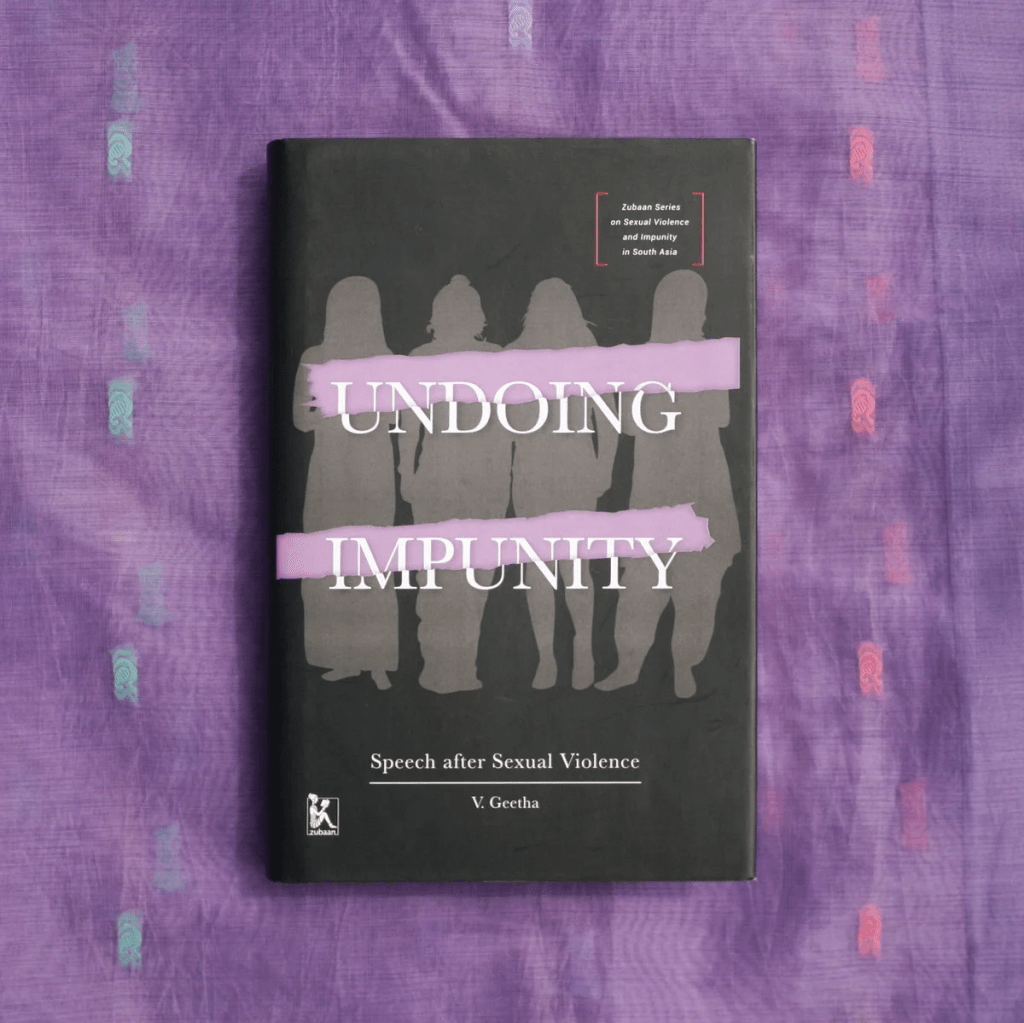
She has been consistently engaged in writing and translation work and has been actively contributing to various magazines and news portals. Some of her notable publications are: Translation of two novels of Perumal Murugan in Tamil into English;[8] Towards a Non-Brahmin Millennium: from Iyothee Thass to Periyar co-authored with S.V. Rajadurai; Undoing Impunity- Speech after sexual violence; Religious Faith, Ideology, Citizenship: The View from Below co-authored with Nalini Rajan Kita in which several essays deal with varied topics of history and thoughts starting from the Gandhian era of civil disobedience during the British Raj, on freedom movement which involved suppression of freedom and resulted in humiliation of people, and on the Islamic dogmas of universal brotherhood. She has discussed issues of secularism as it has evolved in the 21st century in many parts of South East Asian region and when communal issues have dominated in India;[9] and the book titled Fingerprint in which she has noted that fingerprinting has been opposed by people on the grounds that it violates fundamental rights of people as it tends to “foreclose their identities”.[10] Currently, she is engaged in researching the works of Dr. B.R. Ambedkar.[11]
In Undoing Impunity- Speech after sexual violence,[12] she unravels the idea of impunity with respect to sexual violence in South Asian context. She further highlights the idea of social recognition to describe how state not just misuses laws to disregard the victims of sexual violence but also denies their existence to further delineate them. The author argues that this can only be resolved through the collective effort from both the state as well as the citizens.[13] Towards a non-Brahmin Millennium is another book co-authored by V. Geetha which revisits the various transformations of Dravidian movements and highlights the radical and social content embedded within the non-Brahminism. Keeping in mind the contemporary Dravidian politics, the authors also throw light on the relevance of non-Brahmin movements.[14]
References
[edit]
- ^ Jump up to:a b c d “In conversation with V.Geetha, Editorial Director, Tara Books”. Kamalan Travel. 17 July 2017. Retrieved 26 May 2018.
- ^ Geetha, V. “V.Geetha Profile”. caravanmagazine.in. Retrieved 26 May 2018.
- ^ Jump up to:a b Eldrid Mageli (14 January 2014). Organising Women’s Protest: A Study of Political Styles in Two South Indian Activist Groups. Routledge. pp. 16–. ISBN 978-1-136-79169-7.
- ^ “V. Geetha”. The Indian Express. 23 May 2016. Retrieved 26 May 2018.
- ^ Deepti Priya Mehrotra (23 May 2003). Home Truths: Stories of Single Mothers. Penguin Books Limited. pp. 238–. ISBN 978-93-85890-37-6.
- ^ “Class and Caste in Tamil Literature: An Interview with V. Geetha”. தொழிலாளர் கூடம் (Thozhilalar koodam). 22 April 2016. Retrieved 26 May 2018.
- ^ Kītā, Va (1 March 2002). Gender (Theorizing Feminism). ISBN 978-8185604459.
- ^ Priyam, Manisha; Menon, Krishna; Banerjee, Madhulika. Human Rights, Gender and the Environment. pp. 117–. ISBN 978-81-317-4316-4.
- ^ Va Kītā; V. Geetha; Nalini Rajan (2011). Religious Faith, Ideology, Citizenship: The View from Below. Routledge. ISBN 978-0-415-67785-1.
- ^ V.. Geetha (2009). Fingerprint. Tara. ISBN 978-81-906756-2-8.
- ^ “V. Geetha | Author | Zubaan”. zubaanbooks.com. Retrieved 26 May 2018.
- ^ Geetha, V. (29 November 2016). Undoing Impunity – Speech After Sexual Violence. University of Chicago Press. ISBN 9789384757779.
- ^ “Book Excerpt: Undoing Impunity – Speech After Sexual Violence By V. Geetha”. Feminism in India. 15 May 2018. Retrieved 26 May 2018.
- ^ Ramaswamy, Sumathi (1 March 2000). “Book Reviews : V. GEETHA and S.V. RAJADURAI, Towards a Non-Brahmin Millennium: From Iyothee Thass to Periyar, Calcutta, Samya, 1998, pp. 556”. The Indian Economic & Social History Review. 37: 97–99. doi:10.1177/001946460003700109. S2CID 143492548

Book Excerpt: Undoing Impunity – Speech After Sexual Violence By V. Geetha
In Undoing Impunity – Speech After Sexual Violence, activist and historian V. Geetha unpacks the meanings of impunity in relation to sexual violence in the context of South Asia.
By FII Team May 15, 2018 3 min read
Dear reader, this article is free to read and it will remain free – but it isn’t free to produce. If you want to support the work that goes behind publishing high-quality feminist media content, please donate to FII and keep us paywall free. Thank you!
In Undoing Impunity – Speech After Sexual Violence, activist and historian V. Geetha unpacks the meanings of impunity in relation to sexual violence in the context of South Asia. The State’s misuse of its own laws against its citizens is only one aspect of the edifice of impunity; its less-understood resilience comes from its consistent denial of the recognition of suffering on the part of victims, and its refusal to allow them the dignity of pain, grief and loss.
The author argues that the State and its citizens must work together to accord social recognition to the suffering of victims and survivors of sexual violence, and thereby join in what she calls ‘a shared humanity’. While this may or may not produce legal victories, the acknowledgment that the suffering of our fellow citizens is our collective responsibility is an essential first step towards securing justice. It is this, that in a fundamental sense, challenges and illuminates the contours and details of State impunity and positions impunity as not merely a legal or political conundrum, but as resolute refusal on the part of State personnel to be part of a shared humanity.
The link between sexual violence and impunity appears given. For many of us concerned with, or working on, issues to do with sexual violence in South Asia, what could be more self-evident? That this is a crime, a violation that is systematically misrecognized; that both perpetrator and the criminal justice system that is meant to investigate the crime are prone to blame the victim; that justice if and when it is delivered is almost always partial, inadequate and delayed: while enough and more has been written on all these matters, we don’t need the comforting bind of scholarship to assert what we know as concerned citizens and dismayed feminists.
We know too that this indifference to sexual assault is not merely a matter of State recalcitrance to prosecute a vile crime or an extraordinary effect of the perfectly ordinary workings of the criminal justice system in our contexts. We are all too aware that there exists immense tolerance for sexual violence against women in the social and cultural worlds we inhabit, which is not always evident, belied as it is by the dramatic horror that accompanies all discussions of it. Across our geographies, the social meanings invested in the violated woman’s body on the one hand and her so-called ‘character’ on the other precede and frame understanding and prove decisive in determining what she deserves: justice or the horrific violence she was subject to. In itself, sexual violence is not seen as problematic.
This might appear a harsh characterization, but it is not an inaccurate one. Writing of how rape has come to be viewed as ‘normal’ in Nagaland in India, Dolly Kikon notes that long decades of harsh militarization in the region (from the 1950s) have fostered an understanding of rape as a fundamental dividing line between the cruelty of the Indian Armed Forces and the resistance of the Naga people. Rapes committed by soldiers with impunity have thus come to stand in for ‘rape’ as such, and elided other sorts of sexual violence, such as they existed and continue to exist within Naga homes, rival insurgent groups and on the streets. It has been possible to ‘overlook’ these other forms of sexual violence, suggests Kikon, because they are not viewed as catastrophic for the victim, and instead understood in terms of what ‘men’ do and what in some instances women ‘incite’ them to do; that is, women, by their demeanor and behavior ‘ask’ to be assaulted. Thus, Naga women’s bodies materialize value only in the context of an embattled Naga identity; in contexts where questions of identity are not germane, the harm done to these bodies is naturalized as something ‘that happens’ and is allowed neither the dignity of rational analysis nor passionate anger that can challenge such hurt. Further, observes Kikon, the impunity enjoyed by the armed forces in the region, sanctified by legislation such as the Armed Forces Special Powers Act (AFSPA) has meant that soldiers who rape are not punished, and this has actually produced a wider culture of non-accountability with respect to rape, and ‘normalized’ it.
Excerpted with permission from Undoing Impunity – Speech After Sexual Violence by V. Geetha, Zubaan. You can buy the book here.
Also read: Why We Celebrate Kashmiri Women’s Resistance Day: A Statement
 Knock nock
Leave a comment