

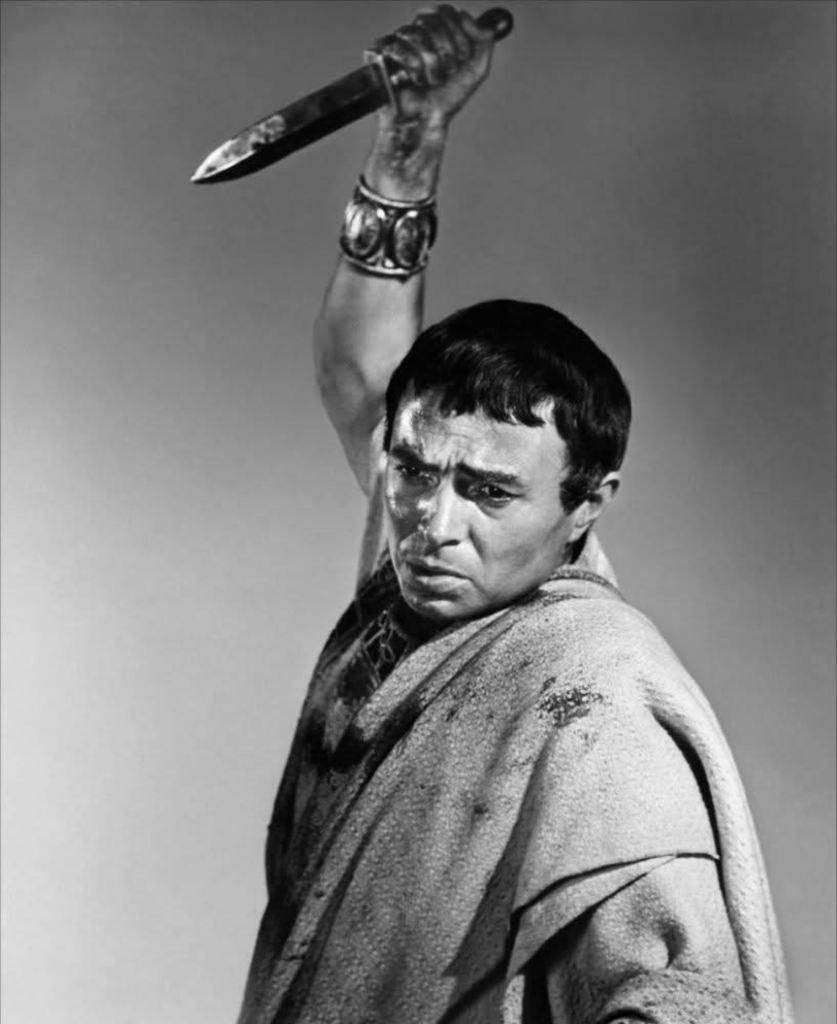
James Mason from “Julius Caesar” 1953
Brutus is one of the central characters in William Shakespeare’s Julius Caesar, portrayed as a complex figure torn between his personal loyalty to Caesar and his commitment to the Roman Republic.
Brutus is often described as the “noblest Roman of them all” (Act V, Scene V) because of his integrity and belief in acting for the greater good. He values the republic’s democratic ideals and opposes tyranny.
Brutus’s idealism blinds him to the manipulations of others, particularly Cassius. His trust in people’s intentions leads him to underestimate the political fallout of Caesar’s assassination.
Brutus is reflective and introspective, often debating his decisions and their ethical implications. His stoic philosophy influences his demeanor and actions.
Conflicted:
Throughout the play, Brutus wrestles with his love for Caesar and his fear that Caesar’s ambition threatens the republic.
Brutus joins the conspiracy because he believes Caesar’s growing power will lead to tyranny, endangering Rome’s democratic traditions. He sees the assassination as a necessary sacrifice for the greater good.
Cassius manipulates Brutus by appealing to his patriotism and using forged letters to convince him that the Roman people fear Caesar’s rule.
Moral Responsibility:
Unlike the other conspirators, Brutus is not driven by envy or personal gain but by what he perceives as a moral obligation to Rome.
Important Speeches
Soliloquy in Act II, Scene I (“It must be by his death”):
Brutus reasons that Caesar must die to prevent him from becoming a tyrant. He uses the metaphor of a serpent’s egg to suggest that Caesar’s ambition, if allowed to grow, will threaten Rome.
This speech reveals Brutus’s rationalization and internal conflict, as he acts on hypothetical fears rather than actual deeds.
Funeral Oration in Act III, Scene II:
Brutus explains to the Roman crowd that he killed Caesar out of love for Rome, not hatred for Caesar:
“Not that I loved Caesar less, but that I loved Rome more.”
His logical and unemotional appeal contrasts sharply with Mark Antony’s passionate and manipulative speech. Brutus underestimates Antony’s rhetorical skill and the crowd’s susceptibility to emotion.
Final Words in Act V, Scene V (“Caesar, now be still”):
As Brutus takes his life, he acknowledges Caesar’s moral victory:
“I killed not thee with half so good a will.”
This moment underscores his lingering guilt and the tragic futility of his actions.
Real-Life Brutus:
Marcus Junius Brutus was a Roman senator and a close associate of Julius Caesar. Historically, his motives for joining the conspiracy were likely more complex, including personal grievances and political ambitions, in addition to his republican ideals.
Relationship with Caesar:
Historical accounts suggest Caesar regarded Brutus as a son, possibly even biologically, as Brutus’s mother, Servilia, was rumored to be one of Caesar’s lovers. This adds a layer of betrayal to Brutus’s actions in both history and the play.
Outcome of His Actions:
Historically, Brutus fled Rome after Caesar’s assassination and later committed suicide after losing the Battle of Philippi against Antony and Octavian, as depicted in Act V of the play.
Brutus embodies the characteristics of a tragic hero—noble intentions, a fatal flaw (his idealism and naivety), and a downfall caused by his own decisions.
Moral Complexity:
Unlike other characters, Brutus acts on principle rather than personal ambition, making him a sympathetic figure. However, his inability to foresee the consequences of his actions and his misjudgment of others lead to his failure.
Conflict Between Public and Private Loyalties:
Brutus’s internal struggle between his loyalty to Caesar (personal) and to Rome (public) highlights the central theme of the play: the tension between friendship and duty.
Brutus’s role in Julius Caesar is pivotal, as his decisions drive the plot and explore universal themes of honor, loyalty, and the complexities of power. Shakespeare’s nuanced portrayal invites audiences to sympathize with Brutus even as they recognize his tragic flaws.
 Knock nock
Leave a comment