

A Collection of Classic Poetry About Social Protest
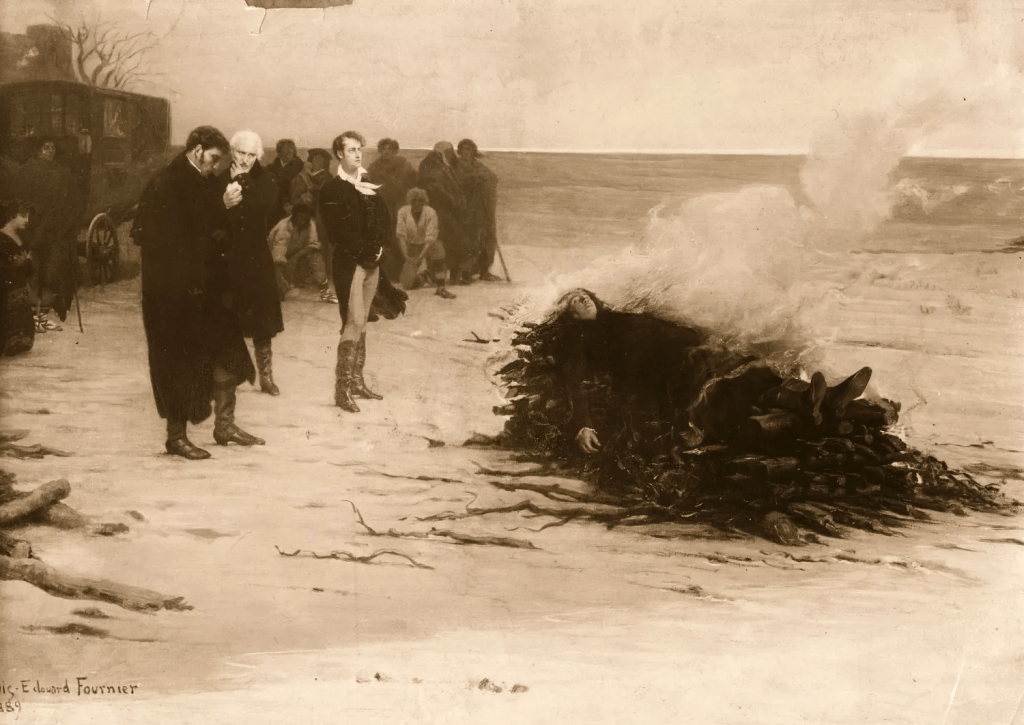
‘The Burning of Shelley’, July 1822. Hulton Archive / Getty Images
By
Updated on July 10, 2019
Nearly 175 years ago Percy Bysshe Shelley said, in his “Defence of Poetry”, that “poets are the unacknowledged legislators of the world.” In the years since, many poets have taken that role to heart, right up to the present day.
They’ve been rabble-rousers and protesters, revolutionaries and yes, sometimes, lawmakers. Poets have commented on the events of the day, giving voice to the oppressed and downtrodden, immortalized rebels, and campaigned for social change.
Looking back to the headwaters of this river of protest poetry, we’ve gathered a collection of classic poems regarding protest and revolution, beginning with Shelley’s own “The Masque of Anarchy.”
Percy Bysshe Shelley: “The Masque of Anarchy”
(published in 1832; Shelley died in 1822)

This poetic fountain of outrage was prompted by the infamous Peterloo Massacre of 1819 in Manchester, England.
The massacre began as a peaceful protest of pro-democracy and anti-poverty and ended with at least 18 deaths and over 700 serious injuries. Within those numbers were innocents; women and children. Two centuries later the poem retains its power.
Shelley’s moving poem is an epic 91 verses, each of four or five lines a piece. It is brilliantly written and mirrors the intensity of the 39th and 40th stanzas:
XXXIX.
What is Freedom?—ye can tell
That which slavery is, too well—
For its very name has grown
To an echo of your own.
XL.
’Tis to work and have such pay
As just keeps life from day to day
In your limbs, as in a cell
For the tyrants’ use to dwell,
Percy Bysshe Shelley: “Song to the Men of England”
(published by Mrs. Mary Shelley in “The Poetical Works of Percy Bysshe Shelley” in 1839)
In this classic, Shelley employs his pen to speak specifically to the workers of England. Again, his anger is felt in every line and it is clear that he is tormented by the oppression he sees of the middle class.
“Song to the Men of England“ is written simply, it was designed to appeal to the less educated of England’s society; the workers, the drones, the people who fed the wealth of the tyrants.
The eight stanzas of the poem are four lines each and follow a rhythmic AABB song-like format. In the second stanza, Shelley tries to wake up the workers to the plight they may not see:
Wherefore feed and clothe and save
From the cradle to the grave
Those ungrateful drones who would
Drain your sweat—nay, drink your blood?
By the sixth stanza, Shelley is calling the people to rise up much like the French did in the revolution a few decades prior:
Sow seed—but let no tyrant reap:
Find wealth—let no imposter heap:
Weave robes—let not the idle wear:
Forge arms—in your defence to bear.
William Wordsworth: “The Prelude, or, Growth of a Poet’s Mind”
Books 9 and 10, Residence in France (published in 1850, the year of the poet’s death)
Of the 14 books that poetically detail Wordsworth’s life, Books 9 and 10 regard his time in France during the French Revolution. A young man in his late 20’s, the turmoil took a great toll on this otherwise home-bodied Englishman.
In Book 9, Woodsworth writes passionately:
A light, a cruel, and vain world cut off
From the natural inlets of just sentiment,
From lowly sympathy and chastening truth;
Where good and evil interchange their names,
And thirst for bloody spoils abroad is paired
Walt Whitman: “To a Foil’d European Revolutionaire”
(from “Leaves of Grass,” first published in the 1871-72 edition with another edition published in 1881)
One of Whitman’s most famous collections of poetry, “Leaves of Grass” was a lifetime work that the poet edited and published a decade after its initial release. Within this is are the revolutionary words of “To a Foil’d European Revolutionaire.”
Though it’s unclear whom Whitman is speaking to, his ability to spark courage and resilience in the revolutionaries of Europe remains a powerful truth. As the poem begins, there is no doubting the poet’s passion. We only wonder what sparked such embroiled words.
Courage yet, my brother or my sister!
Keep on—Liberty is to be subserv’d whatever occurs;
That is nothing that is quell’d by one or two failures, or any number of failures,
Or by the indifference or ingratitude of the people, or by any unfaithfulness,
Or the show of the tushes of power, soldiers, cannon, penal statutes.
Paul Laurence Dunbar, “The Haunted Oak”
A haunting poem written in 1903, Dunbar takes on the strong subject of lynching and Southern justice in “The Haunted Oak“. He views the matter through the thoughts of the oak tree employed in the matter.
The thirteenth stanza may be the most revealing:
I feel the rope against my bark,
And the weight of him in my grain,
I feel in the throe of his final woe
The touch of my own last pain.
More Revolutionary Poetry
Poetry is the perfect venue for social protest no matter the subject. In your studies, be sure to read these classics to get a better sense of the roots of revolutionary poetry.
- Edwin Markham, “The Man With the Hoe” – Inspired by Jean-François Millet’s painting “Man with a Hoe,” this poem was originally published in the San Francisco Examiner in 1899. Upton Sinclair noted in “The Cry for Justice: An Anthology of the Literature of Social Protest” that Markham’s poem became “the battle-cry of the next thousand years.” Truly, it speaks to hard labor and the working man.
- Ella Wheeler Wilcox, “Protest” – From “Poems of Purpose,” published in 1916, this poem embodies the spirit of protest no matter the cause. To speak up and show your bravery against those who cause suffering, Wilcox’s words are timeless.
- Carl Sandburg, “I Am the People, the Mob” – Also from a 1916 collection of poetry, “Chicago Poems,” Sandburg reinforces the thoughts of Wilcox. He speaks of the power of “the people — the mob — the crowd — the mass” and the ability to remember wrongs while learning a better way.
- Carl Sandburg, “The Mayor of Gary” – A free-form verse that appeared in 1922’s “Smoke and Steel,” this poem looks at the Gary, Indiana of 1915. The “12-hour day and the 7-day week” of the workers drew a sharp contrast to Gary’s trim and proper mayor who had time for a shampoo and shave.
The Masque of Anarchy (or The Mask of Anarchy) is a British political poem written in 1819 (see 1819 in poetry) by Percy Bysshe Shelley following the Peterloo Massacre of that year. In his call for freedom, it is perhaps the first modern statement of the principle of nonviolent resistance.
The poem was not published during Shelley’s lifetime and did not appear in print until 1832 (see 1832 in poetry), when published by Edward Moxon in London with a preface by Leigh Hunt.[1] Shelley had sent the manuscript in 1819 for publication in The Examiner. Hunt withheld it from publication because he “thought that the public at large had not become sufficiently discerning to do justice to the sincerity and kind-heartedness of the spirit that walked in this flaming robe of verse”. The epigraph on the cover of the first edition is from Shelley’s The Revolt of Islam (1818): “Hope is strong; Justice and Truth their winged child have found.”
The poem’s use of masque and mask has been discussed by Morton Paley;[2] Shelley used mask in the manuscript but the first edition uses masque in the title. The poem has 372 lines, largely in four-line quatrains; two more quatrains appear in some manuscript versions.[3]
Synopsis
[edit]
Shelley begins his poem, written on the occasion of the Peterloo Massacre, Manchester 1819, with the powerful images of the unjust forms of authority of his time, “God, and King, and Law” – and then imagines the stirrings of a radically new form of social action: “Let a great assembly be, of the fearless, of the free”. The crowd at this gathering is met by armed soldiers, but the protesters do not raise an arm against their assailants:
Stand ye calm and resolute,
Like a forest close and mute,
With folded arms and looks which are
Weapons of unvanquished war.
And if then the tyrants dare,
Let them ride among you there;
Slash, and stab, and maim and hew;
What they like, that let them do.
With folded arms and steady eyes,
And little fear, and less surprise,
Look upon them as they slay,
Till their rage has died away:
Then they will return with shame,
To the place from which they came,
And the blood thus shed will speak
In hot blushes on their cheek:
Rise, like lions after slumber
In unvanquishable number!
Shake your chains to earth like dew
Which in sleep had fallen on you:
Ye are many—they are few![4]
Shelley elaborates on the psychological consequences of violence met with pacifism. The guilty soldiers, he says, will return shamefully to society, where “blood thus shed will speak / In hot blushes on their cheek”. Women will point out the murderers on the streets, their former friends will shun them, and honourable soldiers will turn away from those responsible for the massacre, “ashamed of such base company”. A version was taken up by Henry David Thoreau in his essay Civil Disobedience, and later by Mahatma Gandhi in his doctrine of Satyagraha.[5] Gandhi’s passive resistance was influenced and inspired by Shelley’s nonviolence in protest and political action.[6] It is known that Gandhi would often quote Shelley’s The Masque of Anarchy to vast audiences during the campaign for a free India.[5][6]
The poem mentions several members of Lord Liverpool‘s government by name: the Foreign Secretary, Castlereagh, who appears as a mask worn by Murder, the Home Secretary, Lord Sidmouth, whose guise is taken by Hypocrisy, and the Lord Chancellor, Lord Eldon, whose ermine gown is worn by Fraud. Led by Anarchy, a skeleton with a crown, they try to take over England, but are slain by a mysterious armoured figure who arises from a mist. The maiden Hope, revived, then calls to the people of England:
Men of England, heirs of Glory,
Heroes of unwritten story,
Nurslings of one mighty Mother,
Hopes of her, and one another!
What is Freedom? Ye can tell
That which Slavery is too well,
For its very name has grown
To an echo of your own
Let a vast assembly be,
And with great solemnity
Declare with measured words, that ye
Are, as God has made ye, free.
The old laws of England—they
Whose reverend heads with age are grey,
Children of a wiser day;
And whose solemn voice must be
Thine own echo—Liberty!
Rise, like lions after slumber
In unvanquishable number!
Shake your chains to earth, like dew
Which in sleep had fallen on you:
Ye are many—they are few![4]
Literary criticism
[edit]
Political authors and campaigners such as Richard Holmes and Paul Foot, among others, describe it as “the greatest political poem ever written in English”.[7][8] In his book An Encyclopedia of Pacifism, Aldous Huxley noted the poem’s exhortation to the English to resist assault without fighting back, stating “The Method of resistance inculcated by Shelley in The Mask of Anarchy is the method of non-violence”.[9]
Author, educator, and activist Howard Zinn refers to the poem in A People’s History of the United States. In a subsequent interview, he underscored the power of the poem, suggesting: “What a remarkable affirmation of the power of people who seem to have no power. Ye are many, they are few. It has always seemed to me that poetry, music, literature, contribute very special power.”[10] In particular, Zinn uses “The Mask of Anarchy” as an example of literature that members of the American labour movement would read to other workers to inform and educate them.
 Knock nock
Leave a comment