

In its 40-year journey, Frontline has evolved with changing times while steadfastly preserving its commitment to critical, investigative journalism.
Published : Dec 25, 2024 12:00 IST – 9 MINS READ

N. Ram, former Editor-in-Chief of The Hindu and Frontline, is currently a Director in THGPPL.

At a bus stop in Delhi in on January 6, 2019. Print media in India is still growing, but faces stiff challenges from new age media. | Photo Credit: V.V. Krishnan
Worldwide, professional journalism and the news industry are struggling to defend and, where possible, to reassert their relevance and value under profoundly changed and changing circumstances. Media transformation in this digital age is being powered and continuously challenged by new and rapidly developing technologies, platforms, and tools. The technology companies with their tremendous search, social networking, and messaging firepower have been engaged in a seemingly irreversible process of hegemonising the media ecosystem. With the accompanying changes in audience behaviour and news consumption, especially among the young, the big challenge for the news media industry and professional journalism is engagement of the audience that is getting away. Related to this, the revenue and business model that served the news media industry so well in the second half of the 20th century has come under intense and often overwhelming pressure, where it has not collapsed.
Another challenge is the nature and enormity of the problem posed by disinformation, especially online disinformation, which does not respect national borders. Scaled up and weaponised on the search, messaging, and social networking platforms owned and operated by the technology companies, disinformation causes great harm to democracy, to media freedom and credibility, and, in charged sociopolitical settings, to human life and welfare as well.
The COVID-19 pandemic had a profound impact on the news media, as it had on lives, health, the economy, and social and cultural life across the world. It disrupted the operations of the media, especially the legacy media. It took a heavy toll on journalist lives, livelihoods, and welfare. It slashed revenues, especially advertising revenues. But the crisis also underlined the trustworthiness, the relevance, and the value of professional journalism—wherever it was not suborned or turned propagandistic.
Stories that help you connect the dots
Into the brave new digital order
In conversation with Alan Rusbridger, former Editor of The Guardian.
July 22, 2015
- Topsy-turvy journalismMay 25, 2016
- With the relentless rise of AI, journalists face tough choicesAFPApril 20, 2024
- ‘Journalists can serve democracy but they can’t save it’: Joel SimonAbhinav ChakrabortyJuly 29, 2023
More stories from this issue
- Read this Issue
- FRONTLINE at 40The more things change, the more some things must stay the sameN. Ram
- FRONTLINE AT 40An alternative voiceR. Vijaya Sankar
- FRONTLINE AT 40Forty and still fightingVaishna Roy
- FRONTLINE at 40 | BOOKS & CULTURELibrary of legendsTEAM FRONTLINE
- FRONTLINE AT 40 | LABOURThe steady immiseration of labourSudha Bharadwaj
- FRONTLINE AT 40 | CONSTITUTIONRecalibrating the moral compassIndira Jaising
- FRONTLINE at 40 | AGRICULTUREAgriculture in the age of inequalityP. Sainath
- FRONTLINE AT 40From the Archives: A robust public intellectualAijaz Ahmad
- FRONTLINE AT 40From the Archives: Savarkar and GandhiA.G. Noorani
- FRONTLINE AT 40From the Archives: Might is rightShujaat Bukhari
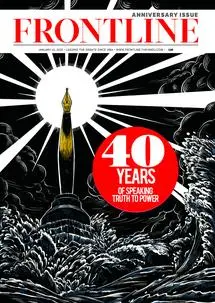
Forty and still fighting
The more things change, the more some things must stay the same
Insightful Reads
- Modi’s Billionaire Boom: The Hidden Cost to India’s Public SectorSaba Naqvi
- Sharp economic divergence in global impact of pandemicFrontline
- From Moderation to Polarisation: Maharashtra’s Political Identity CrisisSuhas Palshikar
- COVID and other diseases: An Animal Farm perspective&
- India’s Gen Z: Unpacking the ‘What’ and ‘How’ of the Demographic DividendRama Bijapurkar & Mathangi Krishnamurthy
Compelling stories that reward your time
The ism in journalism
Pseudoscientific beliefs and world views in the time of pandemic
Global chaos as COVID-19 rages across continents
The BJP has Reverted to Aggressive Communal Rhetoric in State Elections
Containing the coronavirus infodemic
‘India never had a golden age’



- Frontline
- Contact us
- Group News Sites
- Other Products
- Popular Sections
Trending on Frontline
- Women voters: New political powerhouse?
- Women of the Hindutva family
- Why the Hindu right is coming for India’s Sufi shrines
- SEBI’s great surrender
- Mayhem continues in Manipur
- India, Canada, and the Khalistan conundrum
- Maharashtra’s new reality: Beyond the revolving door
- Normal people, abnormal times: Sally Rooney’s beautiful world of radical romance
- Priyanka Gandhi Vadra, Member of Parliament
- Environment News
- Indian Politics News
Trending on Group sites
- Business News Live
- Budget 2024
- Stock Market Live Updates
- Stock Recommendation Today
- Silver Rate Today
- Gold Rate Today
- IPL 2024
- Lok Sabha Election Results 2024
- CSK Squad IPL 2024
- Market Top Gainers
- Market Top Losers Today
- Reliance Share Price
Copyright © 2024, THG PUBLISHING PVT LTD. or its affiliated companies. All rights reserved.
BACK TO TOP
 Knock nock
Leave a comment