

இப்படிக்கு,
ஜோ ஹில்
தமிழில் : நெய்திலினி

நூறு ஆண்டுகளுக்கு முன்பு, இதே நாளில் யூட்டா மாநில அரசால் மரண தண்டனை
நிறைவேற்றப்பட்ட தொழிலாளர்களின் பாடகர் ஜோ ஹில் எழுதிய இரண்டு கடிதங்கள்.
நூறு ஆண்டுக்கு முன்பு, இதே நாளில் யூனியன் அமைப்பாளரும், பாடலாசிரியருமான ஜோ
ஹில்லுக்கு யூட்டா மாநில அரசு மரண தண்டனையை நிறைவேற்றியது. “தேர் இஸ் பவர் இன் எ
யூனியன்”, “கேசி ஜோன்ஸ் – யூனியன் ஸ்கேப்” போன்ற பாடல்களை வழங்கிய ஜோ ஹில்லை
அன்று மௌனமாக்கியது யூட்டா மாநிலம்.
ஜோயல் ஹாக்லண்ட் 1879 இல் ஸ்வீடிஷ் பெற்றோருக்கு மகனாக பிறந்தார். தொழிலாளர்
பேரணிகளிலும், மறியல் போராட்டங்களிலும், அவர் பிரதானமானவராக திகழ்ந்தார். அந்த
போராட்டங்களில், உலக தொழிலாளர்களின் பாடல் தொகுப்பான “(Little Red Songbook) லிட்டில்
ரெட் பாடல் புத்தகத்தில்”உள்ள பாடல்களை உரக்கப் பாடினார்.1914 ஆம் ஆண்டில், ஒரு
சந்தேகத்திற்குரிய விசாரணைக்குப் பிறகு, ஒரு மளிகைக் கடைக்காரரையும் அவரது மகனையும்
கொலை செய்ததாக ஹில் குற்றம் சாட்டப்பட்டார். அவரை விடுவிக்கக் கோரி
முன்னெடுக்கப்பட்ட வலுவான பிரச்சாரங்கள் தோல்வியடைந்தது. மூன்று துப்பாக்கி
தோட்டாக்கள் ஹில்லின் வாழ்க்கையை முடிவுக்குக் கொண்டுவந்தன. ஆயினும், அந்த
தோட்டாக்கள் அவரது நிலையை தொழிலாளர் இயக்கத்தின் சின்னமாக உயர்த்தி
உறுதிப்படுத்தின.
பின்வரும் கடிதங்கள்- ஹில் உட்டா(Utah) சிறையில் இருந்தபோது அனுப்பப்பட்டது.
ஹேமார்க்கெட் புக்ஸ், வெளியிட்ட(newly released collection) அவரது கடித தொகுப்பிலிருந்து
எடுக்கப்பட்டது. அக்கடிதங்களில் அவர் தொழிற்சங்க பாடல்களை எழுதுவதற்கான தனது
உந்துதலை விளக்குகிறார். பெண் தொழிலாளர்களுக்கு முன்னுரிமை அளிக்க தொழிலாளர்
சங்கங்களை வலியுறுத்துகிறார், மேலும் அவரது இறுதி விருப்பங்களை சுருக்கமாக கோடிட்டுக்
காட்டுகிறார்.
நவம்பர் 29, 1914
ஆசிரியர், பொறுப்பு:
நீங்கள் பாடல் புத்தகத்தின் மறு பதிப்பை வெளியிடப் போகிறீர்கள் என்பதை “Sol” இல் பார்த்து
அறிந்து கொண்டேன். நான் பாடல்களில் சில மாற்றங்களையும், திருத்தங்களையும்
செய்துள்ளேன், அதை நான் இத்துடன் இணைக்கிறேன்.
தொழிலாளர் அமைப்பினுள் கேளிக்கைகளுக்கும், பாடல்களுக்கு இடமில்லை என்று வாதிட்ட பல
முக்கிய கிளர்ச்சியாளர்களைப் பற்றி நான் இப்போது நன்கு அறிவேன். தொழிலாளர் ஒற்றுமைக்கு
பாடல்கள் மட்டுமே அடிப்படை காரணமாக அமைவதில்லை என்பதை ஒப்புக்கொள்கிறேன்;
வர்க்கப் போராட்டம் என்பது மிகவும் தீவிரமான விஷயம் என்பதை நான் உணர்ந்துள்ளேன்,
ஆனாலும் நான் என்னுடைய முட்டாள் தனமான புரட்சிகர பாடல்களை மேலும், மேலும்
உருவாக்க எண்ணுகிறேன்.
ஒரு துண்டுப் பிரசுரம், எவ்வளவு நல்லதாக இருந்தாலும், அது ஒருமுறைக்கு மேல்
வாசிக்கப்படுவதில்லை, ஆனால் ஒரு பாடல் மக்கள் மனதுக்குள் நுழைந்து, பதிந்து விடுகிறது,
அதனால் அது மீண்டும் மீண்டும் பாடப்படுகிறது; ஒரு பாடலில் எளிமையான, பொது அறிவு
உண்மைகளை இணைத்து, நகைச்சுவை எனும் உடை அணிவித்து, வறட்சியான பகுதிகளை
நீக்கி, பாமர மொழியில் இயற்ற தெரிந்த ஒருவனால், பல தொழிலாளர்களின் மனதுக்குள் நுழைய
முடியும். பொருளாதார அறிவியல் பேசும் துண்டு பிரசுரங்களையோ, தலையங்களையோ படிக்கும்
அளவுக்கு கல்வி கற்காதவர்களையும், படிக்க நேரம் இல்லாதவர்களையும், படிக்க வேண்டும்
என்ற ஆர்வம் இல்லாத அலட்சியமான தொழிலாளர்களையும் இது போன்ற பாடல்கள்
சென்றடையும். அவர்களுக்குள் மாற்றத்தை நோக்கிய ஒரு வர்க்க பார்வையை ஏற்ப்படுத்தும்.
பழைய உறுப்பினர்களை தக்க வைத்துக் கொள்ளவும், வர்க்கப் போராட்டத்தில் ஆர்வம் உள்ள
புது உறுப்பினர்களை கவர்ந்திழுக்கவும் ஒரு விஷயம் அவசியம், அது தான் பொழுதுபோக்கு.
ஸ்வீடனின் கிளர்ச்சியாளர்கள் அந்த உண்மையை உணர்ந்துள்ளனர், அவர்கள் ஒவ்வொரு
வாரமும் இம்முறையிலான சங்க கூட்டங்களை கூட்டுவதை தங்களின் வழக்கமாக
கொண்டுள்ளனர். அதன் காரணமாக உலகில் உள்ள வேறு எந்த நாட்டையும் விட பெண்
தொழிலாளர்களை அதிக அளவில் சங்கத்தில் இணைப்பதில் அவர்கள் வெற்றி பெற்றுள்ளனர்.
துரதிர்ஷ்டவசமாக யுனைடெட் ஸ்டேட்ஸில், குறிப்பாக மேற்கு பகுதிகளில் பெண்
தொழிலாளர்கள் புறக்கணிக்கப்படுகிறார்கள். அதன் விளைவாகவே நாம் இங்கு வினோதமான
ஒரு கால் விலங்கை போன்ற தொரு தொழிற்சங்கத்தை உருவாக்கியுள்ளோம். நமது
நடனங்களிலும், கேளிக்கைகளிலும் ஆணுக்கான அதிகாரமும், பங்களிப்பும் அதிகமாக
உள்ளது.இது நமது தொன்மையான இயற்கைக்கு மாறானது. பெண்களின் சம பங்களிப்பின்றி
உயிர்ப்புள்ள அமைப்பை உருவாக்க இயலாது.
ஆண், பெண் தொழிலாளர்களுக்கு இடையே சமூக உணர்வுடன் கூடிய ஒரு வகையான நல்ல
நட்புறவினை ஏற்படுத்துவதே இதன் யோசனை. இது அவர்களுக்கு எதிர்காலத்தில் அமையப்
போகும் நமது சமத்துவம் நிறைந்த சமுதாயத்தைப் போன்றதொரு உணர்வை கொடுக்கும். அந்த
உணர்வு வர்க்கப் போராட்டத்தை நோக்கிய அவர்களின் ஆர்வத்தை அதிகரிப்பதோடு,
இப்போதுள்ள பழமையான ஊழல் முறையை அகற்றுவதில் அவர்களுடைய பங்களிப்பை
அதிகரிக்கும். உதாரணமாக, பெண் தொழிலாளர்கள் மத்தியில் வலுவான அமைப்பைக்
கட்டியெழுப்புவதற்காக எங்கள் பெண் அமைப்பாளர்களான குர்லி ஃப்ளைனைப்
பயன்படுத்துவது மிகவும் நல்ல யோசனையாக இருக்கும் என்று நான் நினைக்கிறேன். ஆண்
தொழிலாளர்களை விட பெண் தொழிலாளர்களே அதிகமாக சுரண்டப்படுகிறார்கள்.
போர்க்குணத்திலும், புரட்சிகர மனப்பான்மையிலும் ஆண்களை விட பெண்கள் எந்த வகையிலும்
குறைந்தவர்கள் இல்லை என்பதை சான்றுகளுடன் எடுத்துக் கூற ஜான் புல் தயாராக உள்ளார்.
நமது ஸ்வீடிஷ் நாட்டின் சக ஊழியர்களின் முன்மாதிரியைப் பின்பற்றி, சங்க நடவடிக்கைகளில்
வரட்சியற்ற மக்கள் கலையை பயன்படுத்த வேண்டும். பொழுதுபோக்கிற்கு இடமளிக்கும் சமூக
உணர்வுடன் கூடிய பாடல்களும், படங்களும் இளைய சமூகத்தின் மனதில் ஈர்ப்பை
உருவாக்கும்.பாலின வேறுபாடின்றி இளைய தலைமுறையை நமது யூனியனை நோக்கி
ஈர்ப்பதற்கு கலை நமக்கு பெரிதும் பயன்படும்.
மாற்றத்தை விரும்பும் உங்களின்,
ஜோ ஹில்
முகவரி: ஜோஸ். ஹில்ஸ்ட்ரோம், கோ. ஜெயில், சால்ட் லேக் சிட்டி, உட்டா.
நவம்பர் 18, 1915
டபிள்யூ. டி. ஹேவுட்
சிகாகோ, இல்லினாய்ஸ்
சென்று வருகிறேன் பில்: நான் ஒரு உண்மையான கிளர்ச்சியாளரைப் போல இறக்கிறேன்.
துக்கத்தில் உங்கள் நேரத்தை வீணாக்காதீர்கள் – ஏற்பாடு செய்யுங்கள்! இங்கிருந்து வயோமிங்
நூறு மைல் தொலைவில் உள்ளது. எனது உடலை மாநில எல்லைக்கு கொண்டு சென்று அடக்கம் செய்ய ஏற்பாடு செய்ய முடியுமா? நான் உட்டாவில் இறந்து கிடக்க விரும்பவில்லை.
-ஜோ ஹில்
Don’t Mourn, Organize!
ByJoe Hill
Two letters by the labor singer Joe Hill, who was executed 100 years ago today.

Our new issue, “Bye Bye Bidenism,” is out now. Subscribe to our print edition at a discounted rate today.
One-hundred years ago today, the state of Utah executed Joe Hill, silencing the union organizer and songwriter who gave us “There is Power in a Union” and “Casey Jones — the Union Scab.”
Born Joel Hägglund in 1879 to Swedish parents, Hill became a staple on picket lines and at worker rallies, belting out songs collected in the Industrial Workers of the World’s “Little Red Songbook.” In 1914, after a dubious trial, Hill was convicted of murdering a grocer and his son. An extensive exoneration campaign failed. Yet the three firing-squad bullets that ended Hill’s life cemented his status as a labor movement icon.
In the following letters — both sent during his imprisonment in Utah and excerpted from Haymarket Books’ newly released collection of his missives — Hill explains his motivation for writing union songs, urges labor to prioritize female workers, and briefly outlines his final wishes.
November 29, 1914
Editor, Solidarity:
I see in the “Sol” that you are going to issue another edition of the Song Book, and I made a few changes and corrections which I think should improve the book a little, which I am enclosing herewith.
Now, I am well aware of the fact that there are lots of prominent rebels who argued that satire and songs are out of place in a labor organization and I will admit that songs are not necessary for the cause; and whenever I “get the hunch” I intend to make some more foolish songs, although I realize that the class struggle is a very serious thing.
A pamphlet, no matter how good, is never read more than once, but a song is learned by heart and repeated over and over; and I maintain that if a person can put a few cold, common sense facts into a song, and dress them (the facts) up in a cloak of humor to take the dryness off of them, he will succeed in reaching a great number of workers who are too unintelligent or too indifferent to read a pamphlet or an editorial on economic science.
There is one thing that is necessary in order to hold the old members and to get the would-be members interested in the class struggle and that is entertainment. The rebels of Sweden have realized that fact, and they have their blowouts regularly every week. And on account of that they have succeeded in organizing the female workers more extensively than any other nation in the world. The female workers are sadly neglected in the United States, especially on the West coast, and consequently we have created a kind of one-legged, freakish animal of a union, and our dances and blowouts are kind of stale and unnatural on account of being too much of a “buck” affair; they are too lacking the life and inspiration which the woman alone can produce.
The idea is to establish a kind of social feeling of good fellowship between the male and female workers, that would give them a little foretaste of our future society and make them more interested in the class struggle and the overthrow of the old system of corruption. I think it would be a very good idea to use our female organizers, Gurley Flynn, for instance, exclusively for the building up of a strong organization among the female workers. They are more exploited than the men, and John Bull is willing to testify to the fact that they are not lacking in militant and revolutionary spirit.
By following the example of our Swedish fellow workers, and paying a little more attention to entertainment with original song and original stunts and pictures, we shall succeed in attracting and interesting more of the young blood, both male and female, in the One Big Union.
Yours for a change,
Joe Hill
Address Jos. Hillstrom, Co. Jail, Salt Lake City, Utah
November 18, 1915
W. D. Haywood
Chicago, Illinois
Goodbye Bill: I die like a true rebel. Don’t waste any time mourning — organize! It is a hundred miles from here to Wyoming. Could you arrange to have my body hauled to the state line to be buried? I don’t want to be found dead in Utah.
Joe Hill
Share this article
Contributors
Joe Hill was a famous labor organizer and songwriter.
“Don’t mourn, organize!” is an expression, abridged from a statement by labor activist and songwriter Joe Hill near the time of his death. Hill wrote the full statement in a telegram he sent to Bill Haywood, which stated, “Goodbye, Bill, I die like a true blue rebel. Don’t waste any time mourning. Organize!” Hill followed that telegram with another: “Could you arrange to have my body hauled to the state line to be buried? I don’t want to be found dead in Utah.”[1] In 1915, Hill was convicted and executed for the murder of John and Arling Morrison a year prior; he denied having committed the murders but, for reasons that remain a source of speculation, was unwilling to give an alibi during his trial.
Since the death of Hill, the phrase has been used both in association with other labour leaders’ deaths and on the occasion of severe defeats. It is particularly popular within the Industrial Workers of the World.
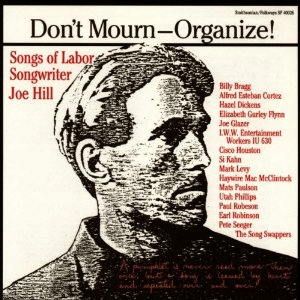
The phrase is popular enough in its association with Joe Hill and the labour movement that it was the title of a music compilation made in 1990 and released by Smithsonian Folkways. The full title is Don’t Mourn — Organize!: Songs of Labor Songwriter Joe Hill.
In 2010, after the death of Howard Zinn, a Boston Globe article was titled with this phrase.[2]
In 2017, activists used the phrase to motivate protest against President Donald Trump and his administration.[3][4][5]
References
[edit]
- ^ Roughneck: The Life and Times of Big Bill Haywood, Peter Carlson, 1983, pp. 235.
- ^ “Zinn: Don’t mourn, organize!”. The Boston Globe. January 29, 2010. Archived from the original on 2018-12-03. Retrieved 2011-09-14.
- ^ Steinem, Gloria (10 November 2016). “After the election of Donald Trump, we will not mourn. We will organize”. The Guardian. Retrieved 19 May 2019.
- ^ Ford, Kieran. “Don’t mourn, organize! Three ways millennials can build a better post-Trump future”. Open Democracy. Retrieved 19 May 2019.
- ^ Bauer, Andrea. “Don’t mourn, organize! Donald J. Trump and the year of voting dangerously”. Freedom Socialist Party. Retrieved 19 May 2019.
Joe Hill (October 7, 1879 – November 19, 1915), born Joel Emmanuel Hägglund and also known as Joseph Hillström,[1] was a Swedish-American labor activist, songwriter, and member of the Industrial Workers of the World (IWW, familiarly called the “Wobblies”).[2] A native Swedish speaker, he learned English during the early 1900s, while working various jobs from New York to San Francisco.[3] Hill, an immigrant worker frequently facing unemployment and underemployment, became a popular songwriter and cartoonist for the union. His songs include “The Preacher and the Slave“[4] (in which he coined the phrase “pie in the sky“),[5] “The Tramp“, “There Is Power in a Union“, “The Rebel Girl“, and “Casey Jones—the Union Scab“, which express the harsh and combative life of itinerant workers, and call for workers to organize their efforts to improve working conditions.[6]
In 1914, John G. Morrison, a Salt Lake City area grocer and former policeman, and his son were shot and killed by two men.[7] The same evening, Hill arrived at a doctor’s office with a gunshot wound, and briefly mentioned a fight over a woman. He refused to explain further, even after he was accused of the grocery store murders on the basis of his injury. Hill was convicted of the murders in a controversial trial. Following an unsuccessful appeal, political debates, and international calls for clemency from high-profile figures and workers’ organizations, Hill was executed in November 1915. After his death, he was memorialized by several folk songs. His life and death have inspired books and poetry.
The identity of the woman and the rival who supposedly caused Hill’s injury, though frequently speculated upon, remained mostly conjecture for nearly a century. William M. Adler’s 2011 biography of Hill presents information about a possible alibi, which was never introduced at the trial.[8] According to Adler, Hill and his friend and countryman Otto Appelquist were rivals for the attention of 20-year-old Hilda Erickson, a member of the family with whom the two men were lodging. In a recently discovered letter, Erickson confirmed her relationship with the two men and the rivalry between them. The letter indicates that when she first discovered Hill was injured, he explained to her that Appelquist had shot him, apparently out of jealousy.[9]
Early life
[edit]
Joel Emmanuel Hägglund was born 1879 in Gävle (then spelled Gefle), a city in the province of Gästrikland, Sweden. He was the third child in a family of nine, where three children died young. His father, Olof, worked as a conductor on the Gefle-Dala railway line.[10] Olof (1846–1887) died at the age of 41, and his death meant economic disaster for the family. Joe’s mother Margareta Catharina (1844–1902) did, however, succeed in keeping the family together until she died when Joel was in his early twenties.
The Hägglund family home still stands in Gävle at the address Nedre Bergsgatan 28, in Gamla Stan, the Old Town. As of 2011 it houses a museum and the Joe Hill-gården, which hosts cultural events.
In his late teens-early twenties, Joel fell seriously ill with skin and glandular tuberculosis, and underwent extensive treatment in Stockholm. In October 1902, when nearly 23, Joel and his brother Paul Elias Hägglund (1877–1955) emigrated to the United States. Hill became an itinerant laborer, moving from New York City to Cleveland, and eventually to the west coast. He was in San Francisco at the time of the 1906 earthquake.[11]
IWW
[edit]

By this time using the name Joe or Joseph Hillstrom (possibly because of anti-union blacklisting), he joined the Industrial Workers of the World (IWW) or Wobblies around 1910, when working on the docks in San Pedro, California. In late 1910 he wrote a letter to the IWW newspaper Industrial Worker, identifying himself as a member of the IWW local chapter in Portland, Oregon.
Hill rose in the IWW organization and traveled widely, organizing workers under the IWW banner, writing political songs and satirical poems, and making speeches. He and Harry McClintock were Spellbinders for the IWW and would show up as they did at the Tucker Utah strike on June 14, 1913 (Salt Lake Tribune). He shortened his pseudonym to “Joe Hill” as the pen-name under which his songs, cartoons and other writings appeared. His songs frequently appropriated familiar melodies from popular songs and hymns of the time. He coined the phrase “pie in the sky“, which appeared in his song “The Preacher and the Slave” (a parody of the hymn “In the Sweet By-and-By“). Other songs written by Hill include “The Tramp“, “There Is Power in a Union“, “The Rebel Girl“, and “Casey Jones—the Union Scab“.

Trial
[edit]
As an itinerant worker, Hill moved around the west, hopping freight trains, going from job to job. By the end of 1913, he was working as a laborer at the Silver King Mine in Park City, Utah, not far from Salt Lake City.
On January 10, 1914, John G. Morrison and his son Arling were killed in their Salt Lake City grocery store by two armed intruders masked in red bandanas. The police first thought it was a crime of revenge, for nothing had been stolen and the elder Morrison had been a police officer, possibly creating many enemies. On the same evening, Hill appeared on the doorstep of a local doctor, with a bullet wound through the left lung. Hill said that he had been shot in an argument over a woman, whom he refused to name. The doctor reported that Hill was armed with a pistol. Considering Morrison’s past as a police officer, several men he had arrested were at first considered suspects; 12 people were arrested in the case before Hill was arrested and charged with the murder. A red bandana was found in Hill’s room. The pistol purported to be in Hill’s possession at the doctor’s office was not found. Hill resolutely denied that he was involved in the robbery and killing of Morrison. He said that when he was shot, his hands were over his head, and the bullet hole in his coat—four inches below the exit wound in his back—seemed to support this claim. Hill did not testify at his trial, but his lawyers pointed out that four other people were treated for bullet wounds in Salt Lake City that same night, and that the lack of robbery and Hill’s unfamiliarity with Morrison left him with no motive.[12]
The prosecution, for its part, produced a dozen eyewitnesses who said that the killer resembled Hill, including 13-year-old Merlin Morrison, the victims’ son, and a brother, who upon first seeing Hill said, “That’s not him at all” but later identified him as the murderer. The jury took just a few hours to find him guilty of murder.[12]
An appeal to the Utah Supreme Court was unsuccessful. Orrin N. Hilton, the lawyer representing Hill during the appeal, declared: “The main thing the state had on Hill was that he was a Wobbly and therefore sure to be guilty. Hill tried to keep the IWW out of [the trial] … but the press fastened it upon him.”[12]
In a letter to the court, Hill continued to deny that the state had a right to inquire into the origins of his wound, leaving little doubt that the judges would affirm the conviction. Chief Justice Daniel Straup wrote that his unexplained wound was “a distinguishing mark”, and that “the defendant may not avoid the natural and reasonable inferences of remaining silent.”[13] In an article for the socialist newspaper Appeal to Reason, Hill wrote: “Owing to the prominence of Mr. Morrison, there had to be a ‘goat’ [scapegoat] and the undersigned being, as they thought, a friendless tramp, a Swede, and worst of all, an IWW, had no right to live anyway, and was therefore duly selected to be ‘the goat’.”[14]
The case turned into a major media event. President Woodrow Wilson, Helen Keller (the blind and deaf author and fellow-IWW member), the Swedish ambassador and the Swedish public all became involved in a bid for clemency. It generated international union attention, and critics charged that the trial and conviction were unfair. Despite the various petitions the governor at the time William Spry maintained Hill’s guilt. More recently, Utah Phillips considered Hill to have been a political prisoner who was executed for his political agitation through songwriting.[15]
In a biography published in 2011, William M. Adler concludes that Hill was probably innocent of murder, but also suggests that Hill came to see himself as worth more to the labor movement as a martyr than he was alive, and that this understanding may have influenced his decisions not to testify at the trial and subsequently to spurn all chances of a pardon.[16] Adler reports that evidence pointed to early police suspect Frank Z. Wilson, and cites Hilda Erickson’s letter, which states that Hill had told her he had been shot by her former fiancé.[8]
Execution
[edit]


Hill was executed by firing squad on November 19, 1915, at Utah’s Sugar House Prison. When Deputy Shettler, who led the firing squad, called out the sequence of commands preparatory to firing (“Ready, aim,”) Hill shouted, “Fire—go on and fire!”[17]
That same day, a dynamite bomb was discovered at the Tarrytown estate of John D. Archbold, President of the Standard Oil Company. Police theorized the bomb was planted by anarchists and IWW radicals as a protest against Hill’s execution. The bomb was discovered by a gardener, who found four sticks of dynamite, weighing a pound each, half hidden in a rut in a driveway fifty feet from the front entrance of the residence. The dynamite sticks were bound together by a length of wire, fitted with percussion caps, and wrapped with a piece of paper matching the color of the driveway, a path used by Archbold in going to or from his home by automobile. The bomb was later defused by police.[18]
Just prior to his execution, Hill had written to Bill Haywood, an IWW leader, saying, “Goodbye Bill. I die like a true blue rebel. Don’t waste any time in mourning. Organize … Could you arrange to have my body hauled to the state line to be buried? I don’t want to be found dead in Utah.”[12][19] Hunter S. Thompson asserted that Joe’s last words were “Don’t mourn. Organize.”[20]
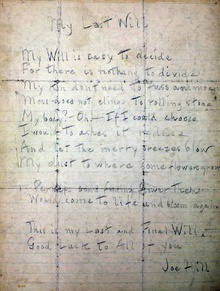
His last will, which was eventually set to music by Ethel Raim, founder of the group The Pennywhistlers, requested a cremation and reads:[21]
My will is easy to decide
For there is nothing to divide
My kin don’t need to fuss and moan
“Moss does not cling to rolling stone”
My body? Oh, if I could choose
I would to ashes it reduce
And let the merry breezes blow
My dust to where some flowers grow
Perhaps some fading flower then
Would come to life and bloom again.
This is my Last and final Will.
Good Luck to All of you
Joe Hill
Aftermath
[edit]
Hill’s body was sent to Chicago, where it was cremated; in accordance with his wishes, his ashes were placed into 600 small envelopes and sent around the world to be released to the winds. Delegates attending the Tenth Convention of the IWW in Chicago received envelopes November 19, 1916, one year to the day of Hill’s execution (and not on May Day 1916 as Wobbly lore claims).[22][page needed] The rest of the 600 envelopes were sent to IWW locals, Wobblies and sympathizers around the world on January 3, 1917.[23][page needed]
In 1988, it was discovered that an envelope had been seized by the United States Post Office Department in 1917 because of its “subversive potential”. The envelope, with a photo affixed, captioned “Joe Hill murdered by the capitalist class, Nov. 19, 1915″, as well as its contents, was deposited at the National Archives. A story appeared in the United Auto Workers‘ magazine Solidarity and a small item followed it in The New Yorker magazine. Members of the IWW in Chicago quickly laid claim to the contents of the envelope.
After some negotiations, the last of Hill’s ashes (but not the envelope that contained them) was turned over to the IWW in 1988. The weekly In These Times ran notice of the ashes and invited readers to suggest what should be done with them. Suggestions varied from enshrining them at the AFL–CIO headquarters in Washington, D.C., to Abbie Hoffman‘s suggestion that they be eaten by today’s “Joe Hills” like Billy Bragg and Michelle Shocked. Bragg did indeed swallow a small bit of the ashes with some Union beer to wash it down, and for a time carried Shocked’s share for the eventual completion of Hoffman’s last prank.[24] Bragg has since given Shocked’s share to Otis Gibbs.[25] The majority of the ashes were cast to the wind in the US, Canada, Sweden, Australia, and Nicaragua. The ashes sent to Sweden were only partly cast to the wind. The main part was interred in the wall of a union office in Landskrona, a minor city in the south of the country, with a plaque commemorating Hill. That room is now the reading room of the local city library.
One small packet of ashes was scattered at a 1989 ceremony which unveiled a monument to six unarmed IWW coal miners buried in Lafayette, Colorado, who had been machine-gunned by Colorado state police in 1927 in the Columbine Mine massacre. Until 1989 the graves of five of these men were unmarked. Another Wobbly, Carlos Cortez, scattered Hill’s ashes on the graves at the commemoration.[26]
On the night of November 18, 1990, the Southeast Michigan IWW General Membership Branch hosted a gathering of “wobs” in a remote wooded area at which a dinner, followed by a bonfire, featured a reading of Hill’s last will, “and then his ashes were released into the flames and carried up above the trees. … The next day … one wob collected a bowl full of ashes from the smoldering fire pit.”[27] At that event several IWW members consumed a portion of Hill’s ashes before the rest was consigned to the fire.
To commemorate the 50th anniversary of Hill’s execution, Philip S. Foner published a book, The Case of Joe Hill, about the trial and subsequent events, which concludes that the case was a miscarriage of justice.[28]
Archival materials and legacy
[edit]
_The_Food_Question.png)
Hill’s handwritten last will and testament was uncovered in the first decade of the 21st century by archivist Michael Nash of the Tamiment Library and Robert F. Wagner Archives of New York University.[29] Found in a box under a desk at the New York City headquarters of the Communist Party USA during a transfer of CPUSA archival materials to NYU, the document began with a couplet: “My will is easy to decide / For I have nothing to divide.”[29]
Additional archival materials were donated to the Walter P. Reuther Library by Carl XVI Gustaf of Sweden in 1976.[30]
Influence and tributes
[edit]
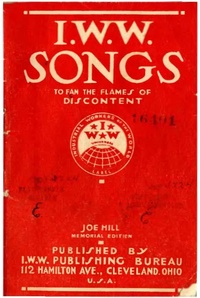
I.W.W. Songs to Fan the Flames of Discontent (1916, Joe Hill Memorial Edition)

Joe Hill’s Wake, Michigan (November 1990)
- Hill’s exhortation, “Don’t waste any time mourning. Organize!“, often shortened to “Don’t mourn—organize!”, has become a widely used slogan of the political Left, especially after a defeat or death.
- Hill was memorialized in a tribute poem written about him c. 1930 by Alfred Hayes titled “I Dreamed I Saw Joe Hill Last Night”, sometimes referred to simply as “Joe Hill“.[31][page needed] Hayes’s lyrics were turned into a song in 1936 by Earl Robinson, who wrote in 1986, “‘Joe Hill’ was written in Camp Unity in the summer of 1936 in New York State, for a campfire program celebrating him and his songs …”[32][better source needed] Hayes gave a copy of his poem to fellow camp staffer Robinson, who wrote the tune in 40 minutes.[33]
- Paul Robeson and Pete Seeger often performed this song by Earl Robinson and are associated with it, along with Irish folk group The Dubliners. Joan Baez‘s Woodstock performance of “Joe Hill” in 1969 (documented in the 1970 film “Woodstock” and corresponding soundtrack album) is one of the best known recordings. She also recorded the song numerous times, including a live version on her 2005 album Bowery Songs. Scott Walker recorded a version for his album The Moviegoer. In May 2014, Bruce Springsteen and the E Street Band opened their concert in Tampa, Florida, with the song.
- An eponymous opera by Alan Bush was premiered in Berlin in 1970 and later broadcast by BBC Radio 3.
- The Swedish socialist leader Ture Nerman (1886–1969) wrote a biography of Joe Hill. For the project, Nerman did the first serious research about Hill’s life story, including finding and interviewing Hill’s family members in Sweden. Nerman, who was a poet himself, also translated most of Hill’s songs into Swedish.
- Ralph Chaplin wrote a tribute poem/song called “Joe Hill”[34] and referred to him in his song “Red November, Black November”.
- Phil Ochs wrote and recorded a different, original song called “Joe Hill”,[35] using a traditional melody found in the song “John Hardy“, which tells a much more detailed story of Joe Hill’s life and death.
- Singer/songwriter Josh Joplin wrote and recorded a song entitled Joseph Hillstrom 1879–1915 as a tribute to Joe Hill for the self-titled debut album Among the Oak & Ash of his band.
- In 1990, Smithsonian Folkways released Don’t Mourn — Organize!: Songs of Labor Songwriter Joe Hill. The compilation album featured the likes of Harry “Haywire Mac” McClintock, Cisco Houston, Paul Robeson, and Entertainment Workers IU630 I.W.W. performing Hill’s songs, Billy Bragg and Si Kahn, and narrative interludes from Utah Phillips and Elizabeth Gurley Flynn.
- In 1990, Billy Bragg released his song “I Dreamed I Saw Phil Ochs Last Night”, set to the melody of “I Dreamed I Saw Joe Hill Last Night”, on his EP The Internationale.
- Wallace Stegner published a fictional biography called Joe Hill in 1950.
- Authors Stephen and Tabitha King named their second child Joseph Hillstrom King, after Joe Hill.[36]
- Gibbs M. Smith wrote a biography, Joe Hill, later adapted for the 1971 movie Joe Hill (also known as The Ballad of Joe Hill) directed by Bo Widerberg.[37] A novelization of the screenplay, released concurrently with the film by Tempo Books was written by John McDermott, under that byline, although, as a mainstream novelist, he had been previously known only by his pen name, J. M. Ryan.
- A chapter of John Dos Passos‘s novel 1919 is a stylized biography of Joe Hill.
- Thomas Babe’s 1980 full-length play Salt Lake City Skyline retells the story of Joe Hill’s trial.[38]
- “Calling Joe Hill” by Ray Hearne is frequently performed by Roy Bailey, a British socialist folk singer.
- In 1995, the first “Raise Your Banners” festival of political song was held in Sheffield, inspired by the 80th anniversary of the death of Joe Hill. Sheffield Socialist choir which was formed in 1988 organised the event and performed an arrangement by Nigel Wright of the Earl Robinson song about Joe Hill. Since then the festival has been held roughly every two years.[39]
- In 1980, Postverket, the Swedish postal service, issued a Joe Hill postage stamp. Red on a white background with the lyrics in English “We’ll have freedom, love and health/When the grand red flag is flying, In the Workers’ Commonwealth.” The stamp cost SKr 1,70 which was the amount for airmail to the United States.[40]
- In 2003, on the album Blackout, Dropkick Murphys performed a song quoting the beliefs of Joe Hill and using the phrase “pie in the sky”. The song was titled “Worker’s Song” and was composed by Ed Pickford. It was also performed by Dick Gaughan, Scottish folk singer and socialist.[41]
- Chumbawamba‘s song about Joe Hill, “By and By”, appears on the 2005 album A Singsong and a Scrap. It incorporates the first stanza of Alfred Hayes’ poem and is set to substantially the same melody as “The Preacher and the Slave“.
- Track three on Mickey Hart’s Mystery Box CD (2008) titled “Down The Road” makes reference to Joe Hill.[42]
- Seattle composer and bandleader Wayne Horvitz created a musical tribute to Joe Hill in 2008. Joe Hill: 16 Actions for Orchestra, Voice and Soloist, which premiered at Meany Hall in Seattle, features the Northwest Sinfonia and guest soloists Bill Frisell, Robin Holcomb, Danny Barnes, and Rinde Eckert.
- Singer-songwriter Justin Townes Earle‘s 2009 song “They Killed John Henry” references folk heroes such as John Henry and contains a verse about Joe Hill.
- Otis Gibbs made the Joe Hill’s Ashes album in 2010.
- Folk Punk Band Mischief Brew‘s song “Nevada City Serenade” in the 2011 Album The Stone Operation, vaguely references Joe Hill in its lyrics.
- In October 2011, activist/songwriter Si Kahn‘s one-man play Joe Hill’s Last Will, featuring Hill’s catalogue of songs and starring singer John McCutcheon, was produced by Main Stage West in Sebastopol, California.[43] The one-person musical was performed by McCutcheon several times, including a show in Salt Lake City on November 19, 2015, the 100th anniversary of Joe Hill’s death. The centennial event was recorded on video and audio.
- In 2012, Anti-Flag released The General Strike, an album including a song titled “1915” telling the story of Joe Hill.
- In 2013, trombonist Roswell Rudd recorded a four-movement tribute to Joe Hill with the NYC Labor Chorus and others as part of his Trombone for Lovers album.[44]
- In 2014, Finnish rap-artist Paleface referenced “Joel Hägglund’s ashes” in his song “Mull’ on lupa” (I Have a Permit/I Am Allowed).
- In 2016, Shelby Bottom Duo released the CD Joe Hill Roadshow as a companion to their multimedia presentation A Musical History of Joe Hill and the Early Labor Movement.
- In 2019 Joe Hill is a minor character in the novel Deep River by Karl Marlantes.
See also
[edit]
Works cited
[edit]
- Adler, William M. (August 31, 2011). The Man Who Never Died: The Life, Times, and Legacy of Joe Hill, American Labor Icon. Bloomsbury Publishing. ISBN 978-1-60819-285-4.
- Davidson, Jared (2011). Remains to be Seen: Tracing Joe Hill’s ashes in New Zealand. Wellington: Rebel Press. ISBN 978-0-473-18927-3.
- Zinn, Howard (September 2001). A People’s History of the United States (Revised and Updated ed.). New York, NY: HarperCollins Publishers. ISBN 0-06-093731-9.
References
[edit]
- ^ “Joehill.org”. Joehill.org. November 19, 1915. Archived from the original on July 3, 2013. Retrieved July 14, 2013.
- ^ Adler 2011, pp. 92–94, 121.
- ^ Adler 2011, pp. 115–119.
- ^ Harry McClintock (2004). Long Haired Preacher (Preacher and the Slave) – via YouTube.
- ^ Adler 2011, p. 182.
- ^ Adler 2011, pp. 12–13, 206.
- ^ Adler 2011, pp. 44–52.
- ^ Jump up to:a b Greenhouse, Steven (August 27, 2011). “Examining a Labor Hero’s Death”. The New York Times. p. A10. ProQuest 885453470.
His [William Adler’s] research is just incredible — it expands what we know in really dramatic ways,” said John R. Sillito, co-author of a new book on radicalism in Utah and a retired archivist at Weber State University in Ogden. “It builds a strong case that Wilson should have been the prime suspect.
- ^ Adler 2011, pp. 294–297.
- ^ “Joe’s bio”. The Joe Hill Project. Retrieved June 29, 2014.
- ^ Rosemont, Franklin (2015). Joe Hill : the IWW & the Making of a Revolutionary Workingclass Counterculture. PM Press. ISBN 978-1-62963-212-4. OCLC 1039093111.
- ^ Jump up to:a b c d “Joe Hill: Murderer or Martyr?”. H2G2. February 19, 2002. Archived from the original on March 29, 2005.
- ^ “Chief Justice Daniel N. Straup”. KUED. June 25, 1914. Archived from the original on February 21, 2012. Retrieved July 14, 2013.
- ^ Joe Hill, Appeal to Reason, August 15, 1915; cited in “Joe Hill: Murderer or Martyr?”
- ^ Phillips, Utah (February 2005). Utah Phillips covers Joe Hill’s “Pie in the Sky” “The Preacher and the Slave” (Speech). Live at the Rose Wagner Theater. Salt Lake City. Archived from the original on May 27, 2023. Retrieved May 9, 2017.
- ^ “Songwriter shot dead”. The Economist. August 6, 2011.
- ^ Hickerson, Joe (December 2, 2010). “Joe’s Last Will”. Labor Notes. Archived from the original on October 16, 2012. Retrieved November 21, 2012.
- ^ “Dynamite Bomb For J.D. Archbold”. The New York Times. November 22, 1915.
- ^ Zinn 2001, p. 335.
- ^ Thompson, Hunter (1967). Hell’s Angels: The Strange and Terrible Saga of the Outlaw Motorcycle Gangs. Random House. p. 260. ISBN 9780345301130.
- ^ Hill, Joe (November 18, 1915). My Last Will – via Wikisource. [scan ]
- ^ “Joe Hill’s Ashes Divided”. The New York Times. November 20, 1916. p. 22. Retrieved June 10, 2024.
- ^ Davidson 2011.
- ^ Jeff Ditz, “Drinking Joe Hill’s Ashes, “Fifth Estate”, 2005.
- ^ “Episode 29: Billy Bragg (Part 1)”. Thanks for Giving a Damn with Otis Gibbs. Episode 29. April 23, 2013.
- ^ Denver Post. June 11, 1989.
{{cite news}}: Missing or empty|title=(help) - ^ Landry, Carol (December 1990). “Joe Hill’s Wake”. Industrial Worker. p. 6.
- ^ Foner, P. (1965). The Case of Joe Hill. New York: International Publishers. ISBN 978-0-7178-0022-3..
- ^ Jump up to:a b Shapiro, Gary (August 23, 2012). “Michael Nash, Record-Keeper of the Left, Dead at 66”. The Villager. Archived from the original on December 8, 2012.
- ^ “Joe Hill Papers”. Walter P. Reuther Library. Retrieved August 18, 2019.
- ^ Hampton, Wayne (1986). Guerrilla Minstrels: John Lennon, Joe Hill, Woody Guthrie and Bob Dylan. University of Tennessee Press. ISBN 978-0870494895.
- ^ “Joe Hill (Alfred Hayes/Earl Robinson)(1936)”. Archived from the original on January 30, 2012. Retrieved January 16, 2012.
- ^ Taylor, Lori Elaine (1993). “Joe Hill Inc.: We Own Our Past”. In Reuss, Richard A.; Green, Archie (eds.). Songs about work: essays in occupational culture for Richard A. Reuss. Indiana University Press. p. 26. ISBN 1879407051.
- ^ Kornbluh, Joyce L. (2011). Rebel Voices: An IWW Anthology. PM Press. pp. 155–156. ISBN 9781604864830.
- ^ Ochs, Phil (January 19, 2002). “Joe Hill”. Trent A. Fisher. Portland State University. Retrieved July 14, 2013.
- ^ Fleming, Eric (March 18, 2007). “Horror Author Joe Hill’s True Identity Revealed”. Yahoo! Voices. Yahoo. Archived from the original on July 28, 2014. Retrieved August 19, 2013.
- ^ Joe Hill at IMDb
- ^ Babe, Thomas (1980). Salt Lake City Skyline. Samuel French. ISBN 978-0-8222-0982-9. Archived from the original on November 24, 2015. Retrieved November 23, 2015.
- ^ “Raise Your Banners”. Archived from the original on June 14, 2013. Retrieved July 14, 2013.
- ^ “joe hill030.jpg”. Gefle Dagblad (in Swedish). November 4, 2011. Archived from the original on May 17, 2014. Retrieved July 14, 2013.
- ^ “Dick Gaughan’s Song Archive”. Retrieved August 1, 2015.
- ^ Down The Road. Mickey Hart. Archived from the original on September 8, 2015. Retrieved May 27, 2014.
- ^ “Musical Theatre”. SiKahn. Retrieved November 16, 2017.
- ^ Rudd, Roswell. Trombone For Lovers. Sunnyside Records. Archived from the original on December 8, 2013. Retrieved January 1, 2014.
Recordings of songs
[edit]
Cover albums of his songs:
- Joe Glazer, Songs of Joe Hill, Smithsonian Folkways, 1954
- Bucky Halker, Anywhere But Utah: Songs of Joe Hill, Revolting Records, 2015
Further reading
[edit]
- Buhle, Paul; Schulman, Nicole, eds. (2005). Wobblies! A Graphic History of the Industrial Workers of the World. New York: Verso.
- Chaplin, Ralph (November 1923). “Joe Hill, a Biography”. The Industrial Pioneer. Chicago: Industrial Workers of the World: 23–26.
- Dubofsky, Melvyn (1969). We Shall Be All: A History of the Industrial Workers of the World. Quadrangle.
- Gibbs, Smith. Joe Hill: The Man and the Myth. Salt Lake: University of Utah Press.
- Leier, Mark (1989). Where the Fraser River Flows: The Industrial Workers of the World in British Columbia. New Star Books.
- Nolan, Dean; Thompson, Fred. Joe Hill: IWW Songwriter. Montreal: Kersplebedeb.
- Philips, Utah; Difranco, Ani (1999). Fellow Workers. NY: Righteous Babe Records.
- Rosemont, Franklin (2002). Joe Hill: The IWW & the making of a revolutionary workingclass counterculture. Chicago: Charles H. Kerr. ISBN 0-88286-264-2.
- Stavis, Barrie (1954). The Man Who Never Died: A Play about Joe Hill, with Notes on Joe Hill and His Times. New York: Haven Press. — The “notes” are actually a carefully researched, 116-page history of the period, with detailed analysis of the trial of Joe Hill, including photographs of people, events, and documents. The play was produced in New York City off-broadway at the Jan Hus Play House in 1958.
- Stavis, Barrie (1972). The Man Who Never Died: A Play about Joe Hill, with Notes on Joe Hill and His Times. Cranbury NJ: A. S. Barnes. — revised play and compressed notes
- The Nightwatchman (2007). “Union Song”. One Man Revolution.
External links
[edit]

Wikiquote has quotations related to Joe Hill (activist).

Wikisource has original works by or about:
Joe Hill

Wikimedia Commons has media related to Joe Hill (activist).
Video
- Joe Hill Documentary produced by PBS affiliate KUED.
- Discussion with William Adler, author of The Man Who Never Died: The Life, Times, and Legacy of Joe Hill, American Labor Icon on C-SPAN from October 29, 2011.
- Joe Hill documentary (Swedish with English subtitles)
Articles
YouTube Music
- Songs of Joe Hill, Joe Glazer, 1954, 10 songs, 22 minutes.
- Don’t Mourn—Organize!: Songs of Labor Songwriter Joe Hill, Various Artists, 1990, 15 songs, 54 minutes.
Smithsonian Folkways Recordings
- Songs of Joe Hill. Can purchase a digital download of the recording, or alternatively a CD. (Music on the album also available on ad supported YouTube Music for free)
- Don’t Mourn—Organize!: Songs of Labor Songwriter Joe Hill. Can purchase a digital download of the recording released in 1990, or alternatively a CD. Can also download a PDF file of the liner notes for free. (Music on the album also available on ad supported YouTube Music for free)
Songs
- The Songs of Joe Hill at Folk Archive.
- Lyrics, sheet music, and audio files at Political Folk Music (About).
University of Utah Special Collections
- Joe Hill photograph collection, 1914–1990
- Joe Hill Organizing Committee records, 1914–1991
- Joe Hill Conference photograph collection, 1915–1990s
County Museum of Gävleborg, Sweden
Internet Archive
- Songs of the Workers to Fan the Flames of Discontent—IWW songbook
- Joe Hill melodies
- Swedish labor songs
- Songs of the Wobblies LP
- “Joe Hill”: song by Alfred Hayes and Earl Robinson
- Works by Joe Hill at LibriVox (public domain audiobooks)

 Knock nock


Leave a comment