

Hannah Arendt was the rare philosopher who saw how limited her discipline could be. Poetry offered her another outlet for thinking.
Originally Published: January 12, 2025Share
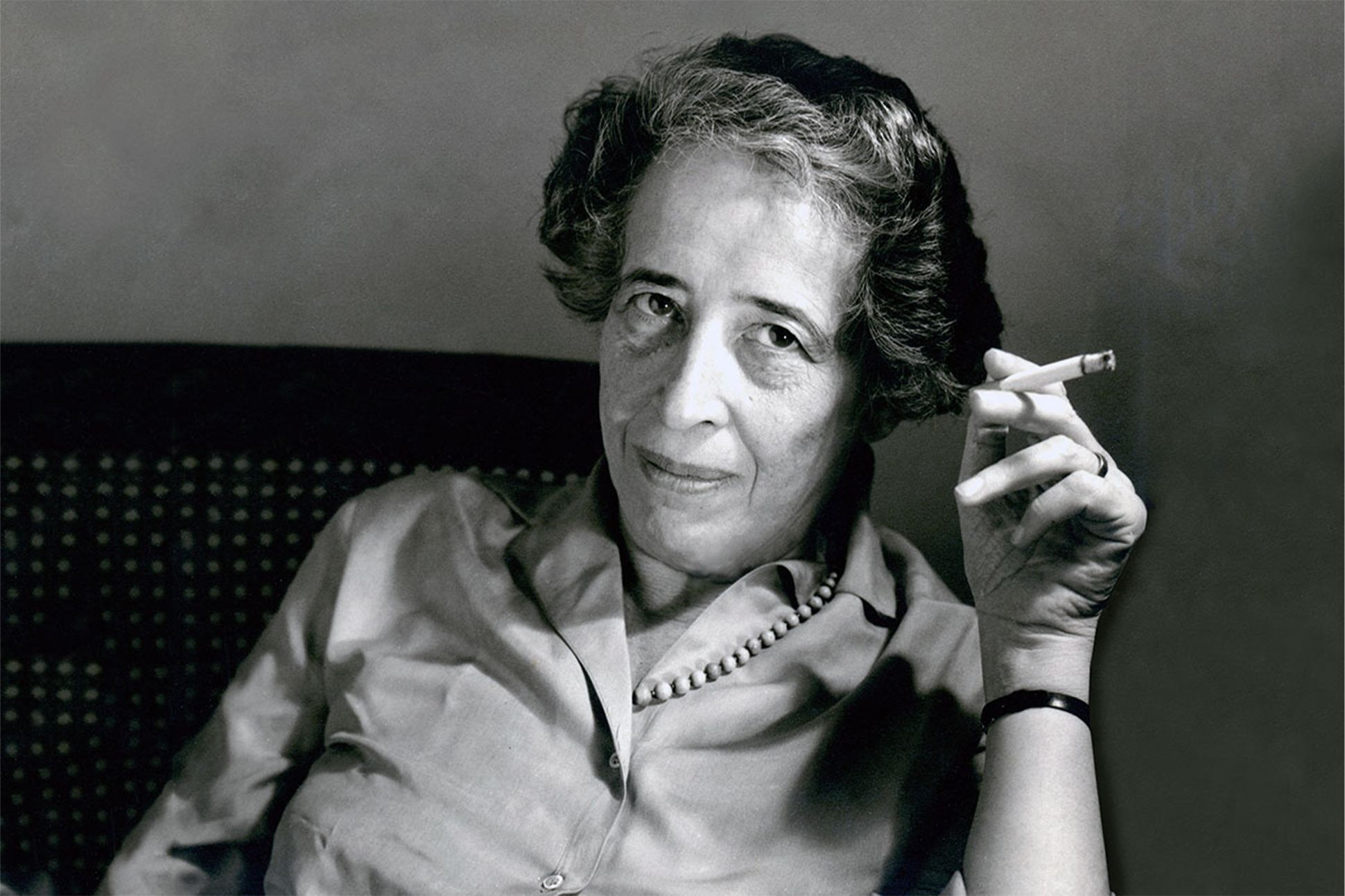
“What is the subject of our thought? Experience! Nothing else! And if we lose the ground of experience then we get into all kinds of theories.”
— Hannah Arendt
Hannah Arendt first fled the Nazis in 1933. It was a harrowing escape: she had just been released from the Gestapo prison in Berlin after eight days of interrogation for collecting evidence of German anti-Semitism from the stacks of the Prussian State Library. She knew she had little time before there was another knock at the door, and so she packed the single suitcase that would accompany her through the forests of the Erzgebirge Mountains to Czechoslovakia. Inside it were the few precious possessions she could not bear to leave behind: birth certificate, passport, marriage documents, doctoral diploma, some letters, the manuscript of the biography she was writing about the German Jewish intellectual Rahel Varnhagen, and twenty-one hand-penciled poems she had written between 1923 and 1926.
Arendt fled first to Prague, then to Geneva, and then spent eight years in Paris. The poems were with her when she was interned at Gurs—for she was a German Jew, and France was at war with the country of her birth—and when she escaped from that camp as the Nazis again closed in, she walked across France with them, crossed into Spain at Portbou, and made it to Lisbon. In May 1941, she shipped across the Atlantic to New York City, her poems again in her small suitcase, a few lines of Shakespeare supposedly the only English in her mouth, and twenty-five dollars in her pocket.
She would pen a few poems, always in German, most every year for the next two decades. “Eventide descends once more,” she wrote in a 1942 poem dedicated to her friend Walter Benjamin, who died by suicide rather than fall into Nazi hands. “Night falls down from the stars; / We stretch our limbs reaching out / To those near, and those far.” Though she never published her poems, she bound the first thirty-six into two small fascicles sometime after her arrival in the US—though few readers showed interest until recently.
This neglect is due in part to Arendt’s reputation as one of the most important thinkers and prose writers of the postwar West, her career built on political and philosophical tomes such as The Origins of Totalitarianism (1951), which saw a resurgence of popular interest after the election of Donald Trump in 2016. The Human Condition (1958), a beautiful and difficult text, seeks to understand how the West came to regard the world with loathing and searched for salvation in both artificial life and the isolation of interiority. Then there are the collections of essays: the mental workouts—“exercises . . . in how to think,” she called them—of Between Past and Future (1961); the astonishingly provocative Eichmann in Jerusalem (1963), which gave the world the phrase “the banality of evil;” On Revolution (1963); Men in Dark Times (1968); and Crises of the Republic (1972). The Life of the Mind (1977–78), which was to draw together a lifetime of thought on thinking, willing, and judging, was still unfinished in her typewriter when she died of a heart attack in 1975. There were also Love and Saint Augustine and Rahel Varnhagen: The Life of a Jewess, plus more than 100 articles and essays, twenty-two years’ worth of columns written for the German-language newspaper Aufbau, and the collections of other people’s work she edited and for which she wrote introductions, among them Benjamin’s Illuminations, parts of which Arendt smuggled out of Europe. Even death barely slowed her output. Volumes of Arendt’s correspondence, interviews, and lectures have appeared posthumously, along with her Denktagebuch, or private thinking journal, in which she rehearsed ideas and linguistic constructions before committing them to publication.
Few readers even knew the poems existed until 1988, when the writer and critic Mary McCarthy, Arendt’s literary executor, opened the archive. (The biographer Elisabeth Young-Bruehl did include twenty-one of them, in the original German, in an appendix to her 1982 biography, Hannah Arendt: For Love of the World.) Only in the past decade have complete collections emerged—in French, German, and Spanish. Samantha Rose Hill and Genese Grill’s What Remains: The Collected Poems of Hannah Arendt (Liveright, 2024) is the first complete English-language translation of Arendt’s poetry, which poses the question: what do these poems do for our understanding of Arendt, famously private and known for her intellectual, analytical rigor?
“It is my hope,” Hill writes in her efficient and compact introduction, “that these poems, which belonged to her inner private life, add to the complex portrait of a great thinker for our times.” In this modest aim, Hill and Grill’s collection succeeds brilliantly, in part because the poems give us a glimpse of the private life that Arendt worked so hard to keep out of the public sphere. In the early poem “In the Tune of a Folksong,” we get the heartache of the young Arendt in love:
We’ll see each other soon,
When white lilacs bloom,
I’ll make a soft bed
For you to rest your head.
And in an untitled poem from 1946, Arendt, having decisively lost the country of her birth and the European cultural tradition into which she emerged, reveals a very different kind of heartache:
Mournfulness is like a flame lit in the heart,
Darkness, a light that leads us through the night.
We need only ignite our grief,
To find home in the long dark night, like shadows.
The forest is illuminated, the city, the street, and the trees.
Blessed is he who has no home; he still sees it in his dreams.
The last known poem she wrote, in January 1961, was to her husband, who had decided not to travel from their home in New York to Evanston, Illinois, where Arendt was wrapping up two courses at Northwestern University before flying to Jerusalem for Eichmann’s trial:
January 1961, Evanston
Then I will run as I ran before
Through grass and trees and fields;
Then you will stand as you once stood
The most heartfelt greeting in the world.Then the steps will be counted
By what is near and what is far;
Then this life will be recounted
As a dream from long ago.
If What Remains was nothing more than an English-language collection of Arendt’s poetry, that would be achievement enough—but Hill, the author of an earlier biography of Arendt (Hannah Arendt, from Reaktion in 2021), writes with the keen insight of one who has spent years sifting the finest details of another’s thought. She makes a convincing case for the role poetry played in Arendt’s life: swapping lines with Robert Lowell, who dedicated his poem “Pigeons” to her; becoming close friends with W.H. Auden, whose poetry so perfectly captured her desire to love the world that she quoted lines of his (“Bless what there is for being, / Which has to be obeyed, for / What else am I made for, / Agreeing or disagreeing?”) three times in her final book. For his part, Auden proposed what Hill calls a platonic marriage “to take care of one another in old age.”
Hill writes that it was these New York poets who taught Arendt the art of English, and you can feel their gravity in Arendt’s finest lines, which mix rigor with style in their push past purely communicative prose. As in On Revolution: “And since the storehouse of memory is kept and watched over by the poets, whose business it is to find and make the words we live by . . .” Or from her marvelous essay “The Concept of History”: “Whenever men pursue their purposes, tilling the effortless earth, forcing the free-flowing wind into their sails, crossing the ever-rolling waves, they cut across a movement which is purposeless and turning within itself.” Or the terrible judgement she pronounces upon Adolf Eichmann, the Nazi official in charge of figuring out how to ship millions of Jews first to the ghettoes and then to the camps:
[P]olitics is not like the nursery; in politics obedience and support are the same. And just as you supported and carried out a policy of not wanting to share the earth with the Jewish people and the people of a number of other nations . . . we find that no one, that is, no member of the human race, can be expected to want to share the earth with you. This is the reason, and the only reason, you must hang.
Her sentences often move gracefully, rarely ploddingly, never predictably.
Hill’s own writing courses with the sober delight of a scholar leading her reader to dusty, overlooked archival nooks, and her footnotes are quick to key many verses to particular places or events in Arendt’s life. The semi-furnished apartment near Riverside Park that Arendt and her second husband, Heinrich Blücher, rented when they first arrived in New York gives biographical substance to the otherwise unremarkable poem “Park on the Hudson.” Or the poem “March 8, 1952,” which, Hill notes, commemorates the sea-tossed ship in which Arendt sailed back to Europe on a Guggenheim-funded research trip that informed The Human Condition. Hill knows what Arendt read, knows her intellectual influences, and can trace a not-quite surefooted poem like this one—
The thoughts come to me,
I’m no longer a stranger to them.
I grow into their dwelling
like a plowed field.
to the specific line of Martin Heidegger’s (“We never come to thoughts. Thoughts come to us.”) on which Arendt’s poem plays.
It’s hard to resist mining Arendt’s lines for biographical tidbits, such as in the long, funny, sweet poem she composed for her friend Kurt Blumenfeld’s 70th birthday. (Blumenfeld, then the president of the Zionist Organization of Germany, recruited Arendt for the work that first landed her in the Gestapo prison). It’s hard, too, to read without an ear tuned for echoes of Arendt’s prose. “No word breaks the dark— / No god lifts a hand— / Wherever I look: / This tremendous land,” she wrote in an untitled poem from the winter of 1923-24, when she was only seventeen, and which resonates with the first paragraph of the last book she ever wrote: “Nothing and nobody exists in this world whose very being does not presuppose a spectator. In other words, nothing that is, insofar as it appears, exists in the singular; everything that is is meant to be perceived by somebody.”
But the life isn’t the poetry, and I came to What Remains hoping to find Arendt’s poems standing on their own, free from the weight of her essays and books and biography. When I couldn’t hear each line clearly, I worried that I wasn’t giving the poems their due—though I was confusing clarity with singularity: to read the poems in isolation is to miss the work they do. Hill argues that Arendt wrote poetry as an act of commemoration, or reflection, or simply as part of what Arendt called “the free play of thinking,” which is no doubt true; many of the poems are sentimental and romantic, Hill notes. Like much of her prose, they’re marked by existential concerns; unlike her prose, though, their gaze is directed inward, to sound the experience of modern life. “When I consider my hand,” begins the poem “Lost in Myself,” from 1924,
—A foreign thing related to me—
I stand in no country,
I am neither here nor there
I am not certain of anything.Then it seems to me I should scorn the world,
Let time slip quietly away,
As long as no more signs should appear.I look at my hand,
It’s uncannily near to me.
And yet a foreign thing.
Is it more myself than I am?
Does it have higher meaning?
I wanted to find the poems standing on their own, separate from the life and the philosophical work, and perhaps they could have done so had Arendt been one of the rare great poets whose lines take root on their own. But neither are her poems the sort of mental warm-ups an incisive mind scribbles out on its way to profundity—ephemera, merely. Instead, she is the rare great philosopher who saw how limited her chosen discipline could be: the act of writing, reading, discussing, sharing—experiencing—poetry gave to Arendt’s thought the breath that continues to keep her work alive.
Density condenses the poem,
shelters its core from evil intentions.
Shell, when the seed breaks through,
show the world your dense interior.
Arendt loved that image of a poem as something vital and condensed. She revisited it in The Human Condition (“The durability of a poem is produced through condensation, so that it is as though language spoken in utmost density and concentration were poetic in itself”) and again in one of the last essays she wrote, “Remembering Wystan H. Auden, who Died in the Night of the Twenty-Eighth of September, 1973”: “I rather gladly respected [Auden’s reserve] as the necessary secretiveness of the great poet, one who must have taught himself early not to talk in prose, loosely and at random, of things that he knew how to say much more satisfactorily in the condensed concentration of poetry.”
She is the rare great philosopher who saw how limited her chosen discipline could be: the act of writing, reading, discussing, sharing—experiencing—poetry gave to Arendt’s thought the breath that continues to keep her work
alive.
“Of all things of thought, poetry is closest to thought,” she wrote, and no matter how hard-nosed, critical, and rigorously philosophical her prose is, there is still space in it for something like mysticism, as if she, too, had the negative capability for pulling at the edges of rational thought just enough to uncover the dense, durable, concentrated interior of mystery. “While thinking I am not where I actually am,” she wrote in Life of the Mind, “I am surrounded not by sense-objects but by images that are invisible to everybody else. It is as though I had withdrawn into some never-never land, the land of invisibles, of which I would know nothing had I not this faculty of remembering and imagining.”
Poetry and thinking both swept Arendt away, and though she believed that they were close kin owing to their shared reliance on metaphors, which bridge “the abyss between inward and invisible mental activities and the world of appearances,” poetry was never her primary work, and it would be foolish to call her own writing condensed. Her thinking was at once an act of distillation—boiling off the impurities of thoughtlessness that had poisoned particular ideas in their descent—and volatile in the way it then diffused through her various essays and books.
Take love, for instance. Arendt’s dissertation, which she wrote in the late 1920s, was on Saint Augustine’s idea of love, which the fourth- and fifth-century theologian defined as craving; he worried it got in the way of the only love that mattered for good Christians: the love of God. Arendt set Augustine’s craving a-boil, and watched it break down into cupiditas (cupidity), or a love of the world, and caritas (charity), or the love of God. Cupidity is wrong, thought Augustine, for it is based on a fear of death and it ties us to this mortal coil, to the things of the world, and to each other, keeping us from salvation.
But Arendt found a flaw in Augustine’s ideal of charity. Because it turns us away from the world and everything in it, Augustinian charity also leaves stranded the neighbor, whom Christians are commanded to love as one loves oneself. Rather than declare Augustine vanquished by contradiction, Arendt turned the heat of her thinking still higher, until even charity starts to catalyze. “For the lover who loves as God loves,” Arendt writes, “the neighbor ceases to be anything but a creature of God,” and creatures of God are themselves nothing at their core but God’s love. “It is not really the neighbor who is loved in this love of neighbor—it is love itself.” The ideal Augustinian society, then, is one united in its love against the world, against life; estrangement is the key to togetherness, the world just a brief place we pass through, and death the porter of everlasting love.
Arendt spent the rest of her life correcting what she saw as Augustine’s great mistake: the equation of love with world-alienation. She wrote something of a credo in a poem titled “Lament,” from late 1925, when she was studying Augustine:
Oh, the days, they waste away, like an unplayed game.
And the hours succumb to torment’s playThe time rises and falls
Slipping softly through me,
As I sing the old songs,
Knowing only the beginning.And no child could follow her predestined path more dreamily
And no old man could know how long life is more certainly.But sorrow will not silence
Old dreams or young wisdom.
Nor will it make me give up on
The beautiful pure joy of life.
Life, for Arendt, was meant for living, for co-existing in the only world we have, obedient to the earth’s lone law: plurality. “The world men are born into contains many things,” she wrote in the first line of The Life of the Mind:
[N]atural and artificial, living and dead, transient and sempiternal, all of which have in common that they appear and hence are meant to be seen, heard, touched, tasted, and smelled, to be perceived by sentient creatures endowed with the appropriate sense organs.
It wasn’t Augustinian Christianity alone that turned us away from life and from love of the world. All ideologies—capitalism as well as totalitarianism, technocracy, scientism, and doctrinaire Marxism—blind and deaden, because they all “pretend to know the mysteries of the whole historical process” and “are never interested in the miracle of being.” Arendt distrusted professional philosophers, intellectuals, and experts as too enamored of their own glittering theories and assurances; lamented that academia had eyes only for whatever was resplendently mediocre; and never tired of pointing out that elite education and erudition were not inherent defenses against barbarism. (Heidegger, Arendt’s former mentor and one-time lover, had openly embraced Nazism, as did many of Germany’s leading intellectual lights.) She was critical of conscience as too-private, of “reckless optimism and reckless despair” as too anesthetic, and withering when she thought someone was confusing what she saw as a social question—such as whether schools should be racially integrated—with legal or political fixes.
It is with love that we turn the world, in all its plurality, into a home and life into something worth living, and Arendt thought that among the most important ways that world-loving humans expressed that love of life was through thinking. Everyone can think, she believed, because thinking is not the same as intelligence. Neither is it the same as knowledge, the province of science. One needs no instruments to think, no specialized training. One needs only solitude—the company of oneself—to undertake what she called “the quest for meaning,” which could be dangerous for any established doctrine, because real, true thinking knows no bounds and consistently remakes the world for the thinker, just as no two loves are ever the same. “There are no dangerous thoughts,” Arendt wrote. “Thinking itself is dangerous,” because the capacity to think is also the capacity to make up one’s own mind—and to change it.
The alternative—thoughtlessness—is where the trouble lay. When Arendt went to Jerusalem in the spring of 1961, on assignment for The New Yorker to cover Eichmann’s trial, she expected to find radical evil incarnate—a person so depraved as to defy conception, as if all light and air, all space and time collapsed suddenly into a human-shaped abyss. What she found instead was a pedestrian man, “terrifyingly normal”: efficient, bureaucratic, fastidiously concerned with climbing the career ladder and becoming successful, not at all ideological, poorly read, incurious about the world and those in it, prone to speaking in empty officialese—not so much a monster as a clown from mid-level management. Watching Eichmann, listening to him prattle on about administrative trivia, Arendt came to realize that evil, even the greatest evil, isn’t so much radical as banal. It’s not that there’s a little bit of Eichmann in all of us—on this point, Arendt has been widely misunderstood—but that there’s no depth to evil. It has no roots, which is why it can rove so widely, drawing sustenance not from the world but from its interdependence with the oblivion of thoughtlessness.
‘There are no dangerous thoughts,’ Arendt wrote. ‘Thinking itself is dangerous,’ because the capacity to think is also the capacity to make up one’s own mind—and to change
it.
Though Arendt would hold that thinking and meaning-making alone makes nothing happen, she also wrote that “a life without meaning is a kind of living death,” and that “the only possible metaphor one may conceive of for the life of the mind is the sensation of being alive.” Being fully alive, of course, is more than a sensation, more than the willingness to think: it is the experience of coexisting in a world filled with other beings, and for Arendt, as for many thinkers, the way thoughts turn into phenomenal, life-like things is through the miracle of language (Arendt extended this miracle to art in general), and, especially through metaphor, that poetic figure of speech that unites the world before our eyes and the world inside our heads.
Poetry and thinking may be kin, but whereas thinking—“the speechless wonder of gratitude” for all that is—attunes us to the world, it is beauty, “the faculty of arresting our attention and moving us” that “reifies and transforms into an ‘objective,’ tangible, worldly presence.” Thinking is ethereal, while a poem is durable, as real as a neighbor or a home.
November 19, 1953
I love the earth,
as if traveling
to a foreign place
and not otherwise.
So life spins me
quietly on its thread
into unknown designs.
Until suddenly,
like a journey’s farewell—
the great silence cuts the thread.
As real as a neighbor or a home, but far more durable. While a home can’t outlive its inhabitants, and all humans are mortal, a poem, like philosophy and art, can resist the great silence for ages, and culture, which preexists each of us, remaining long after our deaths, endures as if it were a world.
“Poetic language / is a place, not a refuge,” Arendt wrote in an untitled poem from December 14, 1952, but it’s a place that isn’t quite reasonable, a place of mysteries and uncertainties, not irritable facts. There’s something miraculous—one of Arendt’s well-used adjectives for describing life’s generative unpredictability—in how poetry condenses the ether into droplets of clear image and thought, which then fall as words onto the page. Perhaps poetry condenses out of the same nothingness from which every human is born (“the dark / That created us” Arendt wrote); perhaps poetry, like a new life, is a miracle. The peculiarly human capacity for creativity, the ability to begin and begin again, Arendt called “natality” and connected to the simple biological fact that every one of us is born into life and will die out of it. This phenomenon—“appearing from a nowhere, and from which we disappear into a nowhere,” as she put it—was the mystery of creativity (from where did it come?); it led Arendt, who so rigorously argued that knowledge (facts and know-how) is limited and that without real thinking the world remains meaningless, to the limits of thought itself.
A pair of essays on poetry from later in Arendt’s life are among the most moving and least philosophically disciplined pieces in her corpus, as if her mind picked its own path down the page. The first, published in The New Yorker in 1966 as “What Is Permitted to Jove,” is nominally about the poet and playwright Bertolt Brecht and what happens when art is put in service of ideology. The conceit of the essay is that “poets have not often made good, reliable citizens” because, just as all thoughts are dangerous, so is all true art. And yet we give poets license—Ezra Pound was a fascist and antisemite, yet, Arendt points out, was still revered as a poet—as long as their poetry rings true because, Arendt writes, a poet, impossibly, is “someone who must say the unsayable,” and so “coin the words we live by.”
For a long time, Brecht did both, and his poetry was filled with life and love for “everything that the earth, in its sheer thereness, had to offer.” But then he aligned himself with the Stalinists, and his work cracked. He gave up his independence of thought and voice and became a parrot, echoing the Party line throughout the 1930s and ’40s, until his work no longer sang. And why? If we humans give license to poets, it must be because we know that their gifts are not earthly. Arendt writes of divinity—Jove, after all, was the Romans’ chief god—and if the poet is not exactly godlike, the poet’s gift of birthing the words that make our world certainly is. Not even the philosophers can claim to have been so chosen. “What is permitted to an ox is not permitted to Jove,” Arendt writes, and if the philosopher occasionally sins, even, like Heidegger, unforgivably, he may still think. Poets get no such leniency from the gods. “It is true that mere intellectuals or literati are not punished for their sins by loss of talent,” Arendt writes, “no god leaned over their cradle; no god will take his revenge”—but that’s exactly what happened to Brecht, who one day woke up and could no longer write a line worth reading.
Not so with Auden, whom Arendt memorialized in another New Yorker essay. If Arendt turned Brecht’s life into a fable about flouting the gifts the gods give, Auden’s life stood for her as a parable of a sower: “The main thing,” she wrote of her friend, “was to have no illusions and to accept no thoughts—no theoretical systems—that would blind you to reality.” For all she wrote about poetry and divinity and license when she bent her mind around Brecht, what made Auden great to Arendt is that he thought “it was sheer nonsense for the poet to claim special privileges,” for, as Auden put it, “poetry makes nothing happen: it survives.” The real gift, Arendt writes, is to see the divine in the everyday, to imbue the pedestrian with beauty, and to turn Descartes right-side up and declare with Auden “I am loved, therefore I am.”
The essay on Auden is short, and as poetic as anything Arendt ever wrote. In it you can feel that with poetry—others’ as well as her own—she found something she could never quite reach in her prose, and to which she clung fiercely, whether fleeing extermination or thinking through what made for a meaningful life. Through thoughtlessness, we render the world sterile and lifeless, but when we write thoughtfully and beautifully, in obedience of the law of plurality, we make the world thoughtful and beautiful—not only for ourselves, but for our neighbor, and for those who will come after we are gone. It’s no wonder Arendt hand-bound her own early poems—the remains of the world she knew before the Holocaust—the better to weather the uncertainties of time.
Daegan Miller is an essayist and critic who lives in the Hilltowns of Western Massachusetts. He is the author of This Radical Land: A Natural History of American Dissent (University of Chicago Press, 2018), and his writing has appeared in The Yale Review, Emergence Magazine, Guernica, The Point, and The North American Review.
Related Content
Related Articles
 Knock nock
Leave a comment