

Bombshell insights from world-renowned economist Jeffrey Sachs on the Russia-Ukraine war, CIA coups, American super-imperialism, the origins of Covid, the Kennedy assassination and much more

JUN 05, 2024
I don’t know how many of you out there suffer from my same “condition”, but I can only really digest information in written form. This means that I have a really hard time watching/listening to video interviews and podcasts for an extended period of time, no matter how interesting the content may be. Indeed, I often find myself searching for transcripts of interesting videos and podcasts — or transcribing them myself (automatically of course: thank you, AI!).
This is what I did with the Tucker Carlson’s recent interview with Jeffrey Sachs — which, I was told, was not to be missed. It’s true: it’s a real banger. Thus, in the hope of providing a useful service for those of you who are video/audio-averse like me, here’s a written selection of the interview’s highlights, edited by me for clarity.
The Jeffrey Sachs interview
Why the war in Ukraine was definitely not “unprovoked”
The end of the Cold War and the beginning of NATO expansion
[Saying that Russia’s invasions of Ukraine was unprovoked is] very dangerous because it’s wrong. It gets the whole story completely wrong, and it misunderstands the trap that we set for ourselves as the United states to push Ukraine deeper and deeper and deeper into this hopeless mess that they’re in right now.
Basically, it started very simply, which is that the United States government — let’s not call it the US people, they had nothing to do with this — but the US government said: “We’re going to put Ukraine on our side and we’re going to go right up to that 2,100 kilometre border with Russian. We’re going to put our troops and NATO and maybe missiles, whatever we want, because we are the sole superpower of the world and we do what we want”.
And it goes back, actually a long way. It goes back 170 years. The Brits had this idea, first surround Russia in the Black Sea region, and Russia’s not a great power anymore. And that was Lord Palmerston’s idea in the Crimean War, 1853 to 1856. And the Brits taught us what we know about empire, and they basically taught us the idea. Russia, it needs an outlet. It needs an outlet to the Middle east. It needs an outlet to the Mediterranean. You surround Russia and the Black Sea, you have rendered Russia a second or third rate country. And [Zbigniew] Brzezinski, one of our lead geostrategists of the current era, wrote in 1997: “Let’s do this. Let’s make sure that we basically surround Russia in the Black Sea region”. They got this idea that will expand NATO so that every country in the Black Sea around Russia is a NATO country right now. Well, back then, Turkey was a NATO country, but we said: “Okay, we’ll get Romania and Bulgaria and we’ll get Ukraine and we’ll get Georgia”.
[Georgia is] way out there on the eastern edge of the Black Sea region. People can look at a map. But we said: “Yeah, we’ll make Georgia part of NATO, too”. And the reason was very clear, and [Brzezinski] was very explicit about it, that this is our way to basically dominate Eurasia. If we can dominate the Black Sea region, then Russia’s nothing. If we make Russia nothing, then we can basically control Eurasia, meaning all the way from Europe to Central Asia and through our influence in East Asia, do the same thing. And that’s American unipolarity. We run the world. We are the hegemon. We are the sole superpower. We are unchallenged. So that’s the idea.
The Russians said: “Please don’t do that. Don’t bring your troops, your weapons, your missiles right up to our border. It’s not a good idea”. And the US — I was around in those years, involved in Russia and in central Europe — was [like]: “We don’t hear you. We do what we want”. They kept pushing inside the US government in the 1990s when this debate was going, should NATO expand? Some people said “Yeah”, but we told Gorbachev and we told Yeltsin we weren’t going to expand at all. “Now, come on, the Soviet Union’s done. We can do what we want. We’re the sole superpower”. Clinton bought into that. That was Madeleine Albright’s line. NATO enlargement started. And our most sophisticated diplomats — we used to have diplomats at the time, we don’t have them anymore, but we used to have diplomats like George Kennan — said: “This is the greatest mistake we could possibly make”. We had a defense secretary, Bill Perry, who was Clinton’s defense secretary, who agonised: “God, I should resign over this. This is terrible, what’s going on?”.
But he was outmanoeuvred diplomatically by Richard Holbrook and by Madeleine Albright. And Clinton never thought through anything systematically, in my opinion. And so they decided: “Okay, Hungary, Poland, Czech Republic, first round”. And then Brzezinski, in a 1997 article in Foreign Affairs magazine, which is kind of the bellwether of foreign policy, wrote “A Geostrategy for Eurasia”, where he laid out exactly the timeline for this US expansion of power. And he said: “Late 1990s will take in Central Europe, Hungary, Poland, Czech Republic. By the early 2000s, we’ll take in the Baltic states. Now, that’s get close to Russia. By 2005 to 2010, we’ll invite Ukraine to become part of NATO”. So this wasn’t some flippant thing. This was a long-term plan, and it was based on a long term geostrategy. Now the Russians are saying: “Are you kidding? We wanted peace. We ended the Cold War, too. You didn’t just defeat us, said no more. We disbanded the Warsaw Pact. We wanted peace. We wanted cooperation. You call it victory? We just wanted to cooperate”. I know that for a fact because I was there in those years: what Gorbachev wanted, what Yeltsin wanted. They didn’t want war with the United States, nor were they saying: “We’re defeated”.
They were saying: “We just want to cooperate. We want to stop the Cold War. We want to become part of a world economy. We want to be a normal economy. We want to be normal society connected with you, connected with Europe, connected with Asia”. And the US said: “We get it, we get it. We won. You do everything we say and we determine how the pieces are going to go”. So in the early 2000s, Putin comes in first. Business for Putin was good cooperation with Europe. You go back to the early 2000s again. I know the people. I was a participant in some of it. Putin was completely pro-Europe. Yes, and pro-US, by the way, and we don’t want to talk about this. We don’t want to admit it, because we don’t want anything other than “unprovoked”. So everything is phony. What we say, everything is a lie. But just to say, the US kept doing unilateral things that were really outrageous. In 2000, in 1999, we bombed Belgrade for 78 days. Bad move. Absolutely. We bombed a capital of Europe for 78 days.
The point of that was to break Serbia in two, create a new state, Kosovo, where we have the largest NATO military base in southeast Europe. We put Bondsteel base there because we wanted a base in southeastern Europe. And again, you look at the neocons. They actually describe all of this in various documents. You have to make the links. But in a document called Rebuilding Americas Defenses in the year 2000, they say the Balkans is a new strategic area for the US. So we have to move large troops to the Balkans because their idea is literally the game of risk, not just you need good relations or peace. We need our pieces on the board. We need military bases with the advanced positioning of our military everywhere in the world. So they wanted a big base in southeastern Europe. They didn’t like Serbia. Serbia was close to Russia anyway. We’re the sole superpower. We do what we want. So they divided the country, which they now claim you never do. You know, you never change borders. We broke apart Serbia, established by our declaration, a new country, Kosovo. We put a huge NATO base there, and that was the goal. [The goal] wasn’t to save the oppressed Muslim population. It was very much to save the military-industrial complex, to have a nice location in southeastern Europe.
[Then] in 2002, the US unilaterally pulled out of the Anti-Ballistic Missile Treaty. Unilaterally. Well, that was one of the stabilisers of the relationship with Russia, and it was one of the stabilisers of the global nuclear situation, which is absolutely dangerous. And the US unilaterally started putting Aegis missiles into first Poland, then Romania. And the Russians are saying: “Wait a minute, what do we know? You’re putting in this? You’re a few minutes from Moscow. This is completely destabilising. Do you think you might want to talk to us?”. So then comes 2004, seven more countries in NATO: Latvia, Lithuania, Estonia, Romania, Bulgaria, Slovakia and Slovenia now starting filling in the Black Sea. Romania and Bulgaria. Suddenly they’re now North Atlantic countries. But it’s all part of this design, all spelled out, all quite explicit. We’re surrounding Russia. In 2007, President Putin gave a very clear speech at the Munich security conference, very powerful, very correct, very frustrated, where he said: “Gentlemen, you told us in 1990 NATO would never enlarge. That was the promise made to President Gorbachev, and it was the promise made to President Yeltsin. And you cheated, and you repeatedly cheated, and you don’t even admit that you said this, but it’s all plainly documented, by the way, and as you know, in a thousand archival sites, so it’s easy to verify all of this”.
James Baker III, our Secretary of State, said that NATO would not move one inch eastward. And it wasn’t a flippant statement. It was a statement repeated and repeated and repeated. Hans-Dietrich Gensher, the foreign minister of Germany, same story. The Germans wanted reunification. Gorbachev said: “We’ll support that. But we don’t want that to come at our expense”. “No, no, it won’t come at your expense”, [we said]. “NATO won’t move one inch eastward, mister president”. Repeated so many times in many documents, many statements by the NATO Secretary General, by the US Secretary of State, by the German Chancellor. Now, of course, all denied by our foreign policy blob because we’re not supposed to remember anything. Remember, this was all unprovoked. So back to 2007, Putin gives the speech and he says: “Stop. Don’t even think about Ukraine. This is our 2100 kilometer border. This is absolutely part of the integrated economy of this region. Don’t even think about it”. Now, I know from insiders, from all the diplomatic work that I do, that Europe was saying to the US: “Don’t think about Ukraine. Please, this is not a good idea. Just stop”. We know from our current CIA director, Bill Burns, that he wrote a very eloquent, impassioned, articulate, clear, secret as usual memo, which we only got to see because WikiLeaks showed [it] to the American people.
[But we’re not supposed to know what our government is doing], how they’re putting us at nuclear risk and other things. Okay, this one did get out. And it’s called “Nyet means nyet”, no means no. And what Bill Burns very perceptively, articulately conveys to Condoleezza Rice and back to the White House in 2008 is [that] Ukraine is really a red line. Don’t do it. It’s not just Putin. It’s not just Putin’s government. It’s the entire political class of Russia. And just to help all of us, as we think about it, it is exactly as if Mexico said: “We think it would be great to have Chinese military bases on the Rio Grande”. We can’t see why the US would have any problem with that. Of course, we would go completely insane. And we should, of course. The whole idea is so absurdly dangerous and reckless that you can’t even imagine grown ups doing this. So what happens is — for what I’m told by European leaders and by long, detailed discussions — Bush Junior says to them: “No, no, no, it’s okay. Don’t worry. I hear you about Ukraine”. And then he goes off for the Christmas holidays and comes back, whether it’s Cheney, whether it’s Bush, whatever it is, says: “Yeah, NATO’s going to enlarge to Ukraine”. And the Europeans are shocked, pissed. They said: “What are you doing?”.
And then they had the NATO summit in Bucharest, and this was 2008. And the Europeans, Chancellor Merkel, the French president, all of them, said: “George, don’t do this. Don’t do this. This is extraordinarily dangerous. This is really provocative. We don’t really need or want NATO right up to the Russian border”. Bush pushed, pushed, pushed. This is a US alliance fundamentally, and they made the commitment. Ukraine will become a member of NATO. The dodge was: “Okay, we won’t give them exactly the roadmap right now, but Ukraine will become a member of NATO”. Because in those days, the US and Russia met in a NATO partnership. Even then, Putin was there the next day in Bucharest saying: “Don’t do this. This is completely reckless. Essentially, this is our fundamental red line. Do not do this”.
The US can’t hear any of this. This is our biggest problem of all, because the neocons who have run the show for thirty years believe the US can do whatever it wants. This is the most fundamental point to understand about US foreign policy. They’re wrong. They keep screwing up. They keep getting us into trillion-dollar-plus wars. They keep killing a lot of people. But their basic belief is the US is the only superpower. It’s the unipolar power, and we can do what we want. So they could not hear Putin even at that moment. They couldn’t hear the rest of the Europeans. And by the way, they said: “Georgia would become part of NATO” again. The only way to understand that is in this longstanding Palmerston-Brzezinski theory. This isn’t just haphazard: “Oh, why don’t we take Georgia?”. This is a plan, okay? The Russians understand every single step of this.
This has been just about the most disastrous foreign policy imaginable. How can you go from peace in 1991 when you have a chance for creating a peaceful, cooperative world that could actually be prosperous and do good things together to this mess that we’re in? It took a strategy so stupid, so reckless, so blind. And that’s what the neocons gave us. They gave us a strategy which said: “We now run the world, and explicitly, we will be the world’s policemen. We will fight the wars that we need to fight whenever and wherever we need to fight them. We will make sure that there’s never a rival”. Well, you do that long enough, you end up in lots of absolutely destructive, stupid wars. And the rest of the world doesn’t just sit back and say: “Oh, thank you, US. We’re so grateful you’re the leader”. They say: “Come on, you’re 4.1% of the world population. There’s another 95.9% of the world population that actually would just like peace and some cooperation and not you to be telling us what to do”. So this strategy was explicit, clear, adopted in the last years of basically a 1991.
The 2014 US-engineered coup in Ukraine and the beginning of the Ukrainian civil war
So another thing goes awry. What goes awry? The Ukrainians don’t want NATO enlargement. The Ukrainians don’t want it. They’re against it. The public opinion said: “No, this is very dangerous. Neutrality, it’s safer. We’re in between east and west. We don’t want this”. So they elect Viktor Yanukovych, a president who says: “We’ll just be neutral”. The US is [like]: “Oh, what the hell is this? Ukraine, they don’t have any choice either”. Yanukovych becomes the enemy of the neocons, obviously. So they start working, of course, the way that the US does. We got to get rid of this guy. Maybe we’ll elect his opponent afterwards. Maybe we’ll catch him in a crisis and so forth. And indeed, at the end of 2013, the US absolutely stokes a crisis that becomes an insurrection and then becomes a coup. And I know again, from firsthand experience, that the US was profoundly implicated in that. But you can see our senators standing up in the crowd. Like, if Chinese officials came to January 6 and said: “Yes, yes, go”, you know, how would we like it if Chinese leaders came and said: “Yeah, we were with you 100 percent”. American senators standing up in Kiev saying to the demonstrators: “We’re with you 100 percent”. Victoria Nuland famously passing around the cookies. But it was much, much more than the cookies, I can tell you. And so the US conspired with the Ukrainian right to overthrow Yanukovych, and there was a violent overthrow in the third week of February of 2014.
That’s when this war started. This war didn’t even start in 2022. It started in 2014. That was the outbreak of the war, when a violent coup overthrew a Ukrainian president that wanted neutrality. And his security people told him: “You’re going to get killed”. And so he flew to Kharkiv and then flew onward to Russia. That day, the US immediately, in a nanosecond, recognised the new government. This is a coup. This is how the CIA does its regime change operations. So this is when the war starts. Putin’s understanding, completely correct in this moment, was: “I’m not letting NATO take my naval fleet and my naval base in Crimea. Are you kidding?”. The Russian naval base in the Black Sea, which was the object of the Crimean War, and in its way is the object of this war in Sevastopol, has been there since 1783. And now Putin’s saying: “Oh, NATO’s going to walk in. No”. And so they organised this referendum. This is a Russian region and there’s an overwhelming support: “We’ll stay with Russia, thank you. Not with this new post-coup government”. An outbreak breaks out in the eastern provinces, which are the ethnic Russian provinces, in the Donbas, in Luhansk and Donetsk, and there’s a lot of violence.
So the war starts in 2014. So saying something’s unprovoked in 2022 is a little bizarre for anyone that actually reads a normal newspaper to begin with. But in any event, the war starts then, and within a year, the Russians are saying very wisely: “We actually don’t want this war, we don’t want to own Ukraine, we don’t want problems on our border. We would like peace based on respect for the ethnic Russians in the east and political autonomy, because you, the coup government, tried to close down all Russian language, culture and rights of these people after having made a violent coup. So we don’t accept that”. So what came out of that was two agreements called the Minsk 1 and the Minsk 2 agreements. The Minsk 2 agreement was backed by the UN Security Council and it said that will make peace based on autonomy of the Donbas region. Now, very interesting. The Russians were not saying: “That’s ours, we want that”, all the things that are claimed every day, that Putin just wants to recreate the Russian empire, wants to grab territory.
Nothing like that, the opposite. [He was saying:] “We don’t want the territory. We actually just want autonomy based on an agreement reached with the Ukrainian government”. So what was the US attitude towards that? It was to say to the Ukrainians: “Don’t worry about it. Come on, don’t worry about it. You keep your central state. We don’t want to see Ukraine weakened. We just want NATO in a unified Ukraine. Don’t go for decentralisation”. We tell them to blow off the very treaty that they’ve signed. Then we accuse Russia of not having diplomacy. We blow off every single agreement. We blow off not moving one inch eastward. We blow off the Anti-Ballistic Missile treaty. We have so many NATO-led wars of choice in between. I didn’t even mention Syria, the CIA’s attempt to overthrow Assad in Libya and so forth. And we blow off the Minsk agreements. And actually, Angela Merkel explained in a rather shockingly frank interview that she gave last year when asked why Germany didn’t help to enforce the Minsk agreement, because Germany and France were the guarantors of the Minsk agreement under something called the Normandy process, she said: “Well, we just thought this was to give some time to the Ukrainians to build up their strength”.
The run-up to Russia’s 2022 invasion of Ukraine
So the war continued. The US pumped in arms, built up armaments, was building up what would be the biggest army of Europe, actually a huge army that Russia was watching [and saying:] “What are you doing? You’re not honouring Minsk. You’re building up this huge Ukrainian army”. [An army] paid for by the United States. And in 2021, Putin met with Biden. And then after the meeting, he put on the table a draft Russia-US security agreement. He put it on the table on December 15, 2021. It’s worth reading. Very plausible document. I don’t agree with some of it. It’s a negotiable document, something you would negotiate. I thought the core of it was: “Stop the NATO enlargement”. And I called the White House myself at that point and said: “Don’t have a war over this. We don’t need NATO enlargement for US security. In fact, its counter to US security. The US should not be right up against the Russian border. That’s how we trip ourselves into World War III. We’re not threatened by Russia. We are not threatened by Russia and Ukraine being neutral is not a threat to US security. It builds US security, period. It’s not even a concession It’s a benefit for us. Leave some space between you and them. That’s what we want, some space so we don’t have an accidental tripwire. That’s the real logic of this world. Give a little space, we don’t have to be everywhere. We’re not playing risk. We’re trying to run our lives. We’re trying to keep our children safe. We’re not trying to own every part of the world”.
The formal response of the United States was that issues about NATO are non-negotiable. They’re only between NATO countries and NATO candidates. No third party has any stake or interest or say in this. Again, to use the analogy, [it’s as if] Mexico and China want to put Chinese military bases on the Rio Grande [and saying] the United States has no right to interfere and no interest in it. And this was the formal US response in January 2022. So unprovoked? Not exactly. Thirty years of provocation where we could not take peace for an answer. All we could take is: “We’ll do whatever we want, wherever we want, and no one has any say in this at all”.
The vassalisation of Europe (and the Nord Stream bombing)
Before Europe completely became a kind of vassal province of the United States government, they wanted what they called collective security, which was, we want security arrangements in which one country’s security doesn’t ruin the security of another country. There were basically three paths. One path was what the OSCE, the Organization for Security and Co-operation in Europe. A really good idea. It’s Western Europe, Central Europe, Eastern Europe and the former Soviet Union. And the idea was: let’s bring us all together under one kind of charter and we’ll work out a collective security arrangement. I liked it. This is what Gorbachev was saying: “We don’t want war with you, we don’t want conflict with you, we want collective security”. Second arrangement, that actually makes a lot of sense: Gorbachev disbanded the Warsaw Pact, we should have disbanded NATO, [we should have] said: “NATO was there to defend against a Soviet invasion. There’s not going to be any Soviet invasion. In fact, after December 1991, there’s not even a Soviet Union”. Why is there NATO? NATO was established to defend against the Soviet Union. So why did it continue after Gorbachev and Yeltsin? The neocons. They say it explicitly in their documents: this is our way of keeping our hegemony in Europe. In other words, this is our way of keeping our say in Europe. Not protecting Europe, not even protecting us. This is hegemony. We need our pieces on the board. NATO’s our pieces on the board.
Why would Germany allow foreign troops garrison garrisoned on its soil for eighty years? I don’t understand. Why would European countries allow that? There are basic mechanisms that I don’t understand. Truly, after being around more than forty years in this and knowing all the leaders, and I know Schulz and I know others, I don’t understand it. But when the US has a military base in your country, it really pulls a lot of the political strings in your country. It really influences the political parties. It really pays. In other words, the Germans are not free actors in this. That’s the point.
The question is: why would the Germans want this? After the US blew up the Nord Stream pipeline, why wouldn’t the Germans have said: “Why did you do that? This is our economy. You just blew it up”. But they don’t. They’re so subservient to the US interests. It’s a little hard to understand because it makes no sense for Europe. It’s really sad. And it’s doing a lot of damage to Europe. It’s destroying Ukraine, by the way. That’s the first point. It’s destroying Ukraine. It’s doing a lot of damage to Europe, wasting a hell of a lot of lives and money in the United States, which the neocons don’t count. And almost nobody stands up and talks about it. [The story about this war being unprovoked is] complete bull. It’s complete nonsense. It’s for people who don’t want to remember anything before February 24, 2022. But there’s a whole long history to this that’s absolutely kind of absurd and tragic. I mean, it’s absurd. It’s utterly tragic. 500,000 Ukrainians dead for nothing.
America’s perpetual war machine
This has nothing to do with morality. It has nothing to do with Western values. It has nothing to do with American values. It doesn’t even have to do with American interests from what I can see, although they say that American interests are at stake. Well, we’ve spent maybe $7 trillion on these reckless perpetual wars since 2001. The debt’s gone from about 30% of national income to more than 100% of national income. We’ve had these disastrous wars. Is this America’s interest? No. I mean, maybe we could have actually rebuilt a bridge or a road along the way or no, a mile of faster rail in our country or something. But no, we had to spend trillions and trillions on wars. So to my mind it’s all completely perverse. But what I find amazing is that once in a while you have you’ll actually find the truth expressed in such a vulgar way. No, they don’t count the Ukrainian lives. They don’t care at all. And sometimes they say they don’t care. Mitt Romney said: “It’s the greatest bargain, no American lives [lost]”. Dick Blumenthal said the same thing. Basically, this is a great bargain, no American lives.
The risk of nuclear war
One thing everyone should understand [is that] Ukraine will never join NATO short of a nuclear war because Russia will never allow it, period. So every time we say it, all we mean is the war continues and more Ukrainians are destroyed and we’re willing to risk nuclear conflict for that. [US leaders say:] “We’re not going to be blackmailed by this nuclear threat and so forth”. Well, God damn it, you better be worried. We’re talking about a counterpart that has 6,000 nuclear warheads. We have 6,000 nuclear warheads. We have a lot of crazy people in our government. I know it. I’m adult enough to know over 44 years of professional life that there are a lot of intemperate people in our country. We have a lot of allies that say: “Oh, we can do this”. We have a president of Latvia tweeting or Xing or whatever the verb is these days: “Russia delenda est”. In other words, “Russia must be destroyed”. Playing off of the old Cato, Carthago delenda est. Delenda est. Carthage must be destroyed. Honestly, a president of a Baltic state tweeting that Russia must be destroyed? This is prudent? This is safe? This is going to keep your family and my family safe? Are we out of our minds? And all through this, Biden hasn’t called Putin one time.
I speak to very senior Russian officials. They say: “We want to negotiate. Of course we’ll talk”. Zelensky, quote unquote, made it illegal. And the United States says: “Well, we won’t do anything that the Ukrainians don’t want. This is insane, by the way, as if this is really between Ukraine and Russia. This is about the United States and Russia. This everybody should understand. This isn’t even about Ukraine and Russia. This is about the US being in Ukraine and Russia. So the ones that need to talk are Biden and Putin, period. And I keep saying to Biden: “If you want to use my Zoom account, please use it. I’ll lend you my phone. You make the call, start negotiations. I don’t like my family being at risk of nuclear war”.
[But they won’t negotiate because, I think] they believed up until now that they would get their way through bluff or superiority of force or superiority of finance. They gambled because they were gambling with someone else’s lives, someone else’s country, and someone else’s money, our money, the taxpayer money. But they were gambling. Not with their own stakes, but they were gambling. They’re not very clever. They gambled wrong all along. Putin said: “No. For us, this is existential. For you, it’s a game, apparently, the game of risk. You need your piece on that board”. As if American NATO forces in Ukraine is somehow existential for the United States, as opposed to a neutral Ukraine. They thought that they would get their way. And I spoke with senior officials all along who just thought Russia won’t object or can’t object or will be pushed aside or will fall to its knees with US financial sanctions or will succumb to the US HIMARS and attack them. Just one absolutely naive idea after another.
And my absolute core bottom line is, until Biden speaks directly with Putin and starts talking, our lives are deeply at risk. And it’s unimaginable to me that we are in open war, as we are, and we’re not even trying to find the path to peace right now.
The failure of the anti-Russian sanctions
When the US put on sanctions on Russia in March 2022, just after the beginning of this latest phase of the war that started in 2014. I know senior US financial officials and they [were going]: “Oh, we’ve got them. This is going to crush them”. I said: “I don’t think so. I was in Latin America last week. They’re not going to do this. I was in India the week before that. It’s not going to go like that”. So what happened was the only ones that applied the sanctions are the Europeans, the United States, and a few allies in East Asia. Japan, Korea, Australia, New Zealand, Singapore. The rest of the world said: “We’re not part of that. We don’t sign up to this. We don’t like this, we don’t agree with the NATO enlargement, we don’t like this narrative”. And the sanctions have proven to be pretty useless compared to what this grandiosity of the US strategists thought. So it comes to this question: what does the rest of the world think? The rest of the world doesn’t think much of the United States. What it’s doing, it seems to them, is a bizarre country.
Why are you pushing NATO enlargement? Why are you bringing us into your war? We don’t really want this. Interestingly, most of the rest of the world is not against the United States, by the way. They said: “Just don’t make us choose all these things. This isn’t our battle, and we don’t even like what you’re doing. Just make peace, calm things down. We don’t want bad relations”. So it’s not as if the world’s antagonistic, but Washington does not get this at all. I speak to a lot of world leaders in developing countries all the time. It’s my job as a development economist. So I’m talking to world leaders, foreign ministers, heads of state and so on. And I know their understanding and position very clearly. I don’t know whether the White House or Blinken or anyone else in the administration understands even these basic points, but it was obvious to me.
The national security apparatus as the real driving force in the US
I think there’s a big, deep project of the security apparatus that goes back thirty years. I think the CIA continues to be a driving force. The National Security Council is obviously a driving force. The Pentagon’s obviously a driving force. The Armed Services Committees. It’s not one individual, but it’s a project that is long dated and it doesn’t turn. And we don’t have a president that’s very flexible of mind. We don’t have a president that is on top of any of this. It seems to me, not a nimble president. Not nimble, not effective, not necessarily in charge, not necessarily making decisions. I don’t really know. But what I do know is that it’s not improv, it’s a rudder that stuck, I would say. In other words, they can’t do something different. And each improv is that the last thing they tried didn’t work. So now they need to quickly improvise something else as the rudder is stuck. So we continue on the same destructive path and it’s not working. So, oh, my God, we’ve got to do something else. That’s the improv part. But what is not changing is goals, direction, strategy.
The CIA is the instrument of regime change. The US is the only country in the world that relies on regime change. As, I would say, the lead foreign policy instrument. In other words, most countries, virtually any small country, any middle power country, when it doesn’t like another country, it either has to deal with it or it comes begging to the United States to take out that country. And we are the country that makes a living by overthrowing other governments. And that’s not a good vocation for us. It almost always ends in disaster, in bloodshed, in continued instability. But that’s half the job of the CIA. The CIA is also an intelligence agency. It collects information and makes analysis, and it gives intelligence findings. And I have no problem with that role at all, although I don’t want them to spy on us. But I think that making intelligence findings for the US government is necessary. But being a private army or a hidden force that overthrows governments, stokes unrest, that puts people in power, that runs covert operations, I’m against that.
The US’s attempted regime change in Syria
In 2011, Obama does the absolute neocon play of saying, almost out of the blue: “By the way, why don’t we overthrow Bashar al-Assad, Syria’s president?”. Well, that’s a little damn weird. But suddenly you start hearing: “Assad must go”. I was on Morning Joe when that statement by Hillary was made. And Joe Scarborough looked at me and said: “Jeff, what do you think?”. I said: “Well, how are they going to do that? That sounds like another pretty stupid idea”. That was 2011. Since then, we’ve had 13 years of war in Syria. Hundreds of thousands dead. Destroyed the country, of course. And who’s president? Bashar al-Assad. And yes, in 2012 there were things that were going on in Syria. But the president said: “Okay, we’ll send in the CIA to overthrow the government in Syria”. And if anyone is wondering, we do this dozens of times. So don’t have any illusion that this is unusual. It is the job, the terms of reference, of the CIA to overthrow governments in other countries.
Okay, so we start arming the jihadists in Syria. Crazy thing. And the US says: “Assad must go”. So the UN starts a diplomatic process to try to find peace, which is the job of the UN. It’s not to implement US regime change, it’s to try to find peace. So the UN succeeds in getting all of the parties to agree to a peace agreement — except one, the US. Yes. So the idea that you couldn’t find peace, you couldn’t find all these different factions in Syria, [is false]. There was an agreement reached, but there was one obstacle to the agreement. And the obstacle was that the US said, on the first day of this agreement: “Assad must go”. And the response was: “Why don’t you have a process? There’ll be an election in two or three years. Don’t overthrow the government”. The first day we have all this in place. And Obama, well, I don’t know if it was Obama, probably Hillary, but whatever, said no. So that’s why there was no agreement. But the downstream effects of that were horrifying. We probably created ISIS pretty directly because we funded jihadists all along the way.
The destruction of Libya
They did exactly the same thing in Libya. And you look at Libya, they decided to take out Gaddafi. Why? No one really knows. No one knows because some people say Sarkozy knew that Gaddafi had contributed to Sarkozy’s campaign, that it was personal vendetta. There are a hundred theories. The fact that there are a hundred theories shows that the whole thing was bullshit, to use a technical, diplomatic term. You cannot even know right now why. What you know is that they misused a UN Security Council resolution to protect the people of Benghazi, to launch a months-long NATO aerial bombardment of Libya until they brought down the government, unleashed war in Africa for the next 13 years, until today, which is still roiling all of the countries of the region. They do these things because they can, because it doesn’t count. Maybe another theory which is even maybe true. What difference? It’s money, it’s a business. We’re running a business, we’re trying weapons, we’re doing this. Maybe it’s all a success from somebody’s point of view that you have all these wars going with this big military machine. I don’t know. That is a theory which is not completely dismissible, because what you can’t do, is look and say: “My God, we had a geopolitical reason to do this”.
Regime change at home: the Kennedy assassination
Probably 61 years ago [the CIA] had their first run at [regime change in the US] with President Kennedy from, I think — best guess — at least maybe a rogue CIA or maybe official CIA or maybe compartmentalised CIA operation. It was clearly someone’s operation, not Lee Harvey Oswald. All we know and all of the evidence points in that direction. It used to be said, why is the United States the only country in the world that’s never had a coup? And the answer was, well, we’re the only country that doesn’t have a US embassy. But we probably did have a coup in broad daylight on November 22, 1963, and we never quite got over it, and we never looked into it. On the contrary, we covered it up from the beginning. And drip by drip evidence comes out, including the most recent evidence, that that magic bullet, which was one of the justifications of the absurd account of a lone gunman, was also debunked by the, I think, now 88-year-old secret service agent who said: “I actually put that bullet from the back of Kennedy’s seat in the limousine on the stretcher at Parkland Hospital”. So there’s so many things wrong with the official [narrative]. I mean, it’s preposterous. Almost nobody believes it or should believe it. But it’s also interesting for all that we’re discussing, most likely it was a government coup in broad daylight, with the tremendous amount of evidence that it was a conspiracy at a high level. And yet it passed for the last 61 years without any official practical note of that fact.
The US coup in Haiti
I was asked to help [president] Aristide in Haiti. Yes, okay, Haiti’s so poor, so unstable, so desperate. And Aristide asked me for economic help. That’s what I do, that’s my expertise. So I flew down to Port au Prince and I had a very good meeting with him. And at the end of the meeting he said: “Mister Sachs, they’re going to take me out. They’re going to take me out”. And [I said]: “What do you mean?”. “They’re going to overthrow me”. Okay, sorry to be so naive as I am. I said: “No, we’re going to make this work. We0’re going to make this work”. “No, no, no, they’re going to take me out”. I said: “No, no, I’m going back to Washington. We’re going to help with the Inter-American Development bank and World Bank and IMF and… oh, I’m so naive. So of course, then they decide to take them out. And the way they do it is destabilise the country. So the first thing is to close down the IMF, close down the World Bank, close down the Inter-American Development bank: squeeze, squeeze, squeeze. The next thing is you send in some mercenaries who are going to create trouble, come over the border from Dominican Republic. The last thing was rather remarkable, which was the US ambassador showed up at his door literally one day and said: “Mister president, you have to flee. We have a plane waiting for you, otherwise your life is in danger”. And they led him to a plane with an unmarked tail, and 23 hours later he was in Central Africa Republic. So this is what’s called a coup. A coup in broad daylight.
The US bombing of the Nord Stream pipeline
The US blew up Nord stream as it [had] promised to on probably dozens of occasions, but the most recent of those occasions was [when] President Biden said [in February 2022] in a statement to the press: “If the Russians invade Ukraine, Nord Stream is finished”. And a reporter who asked him the question: “Well, mister president, how can you say that? How could you do that?”. And he looks and he says very gravely: “Believe me, we have our ways”. And then you can go back and find 1,000 clips of Victoria Nuland and [Ted] Cruz and everyone saying: “This must stop, this must stop. We’ll never let it happen. It will be destroyed, it will be ended”. Okay, so then it’s blown up, and I was on Bloomberg soon afterwards. I don’t remember whether it was the next day or the day after. And I said: “You know, I think the US did this”. “Mister Sachs, how can you say that?!”.
And I said: “Well, first the president said it was going to be over, and then there’s actually some readings of planes in the vicinity and so forth. And there was the tweet by the former and now current foreign minister of Poland, Radosław Sikorski, Anne Applebaum’s husband, saying ‘Thank you, USA’, with a picture of the water bubbling over the blown up pipeline. Yes, there was a bit of evidence that, well, yes, the United States had done this, thank you very much. They said they would and they did it”. I was yanked off the air within 30 seconds. [The anchorman] was was listening to something in the earplug, which I could only imagine: “Get that son of a bitch off the air”. And they just. This interview was over. And he stopped. And then another anchor berated me for a few minutes after that. That was the last time I had a word on mainstream media, I have to tell you. [But Nord Stream] is a big deal. It’s an act of war. It helps to understand what this Ukraine war is all about. It helps us to understand that this is a war between the United States and Russia, fought with many means. It’s important to understand it. It also has a deeper economic significance because it’s part of a longstanding US idea of not letting Germany and Russia ever get too close together economically. So there’s a lot to that story.
The origins of Covid
The question with Covid is which lab and in which way? It almost surely did not come out of nature. It almost surely came out of a deliberate research project that had a core idea, which was to take a natural virus and make it more infectious. And we have one major blueprint of that, which is a research proposal called DEFUSE, which was submitted to the Department of Defense to the unit called DARPA in 2018. And it is a kind of cookbook for how to make the virus that causes Covid-19 and the virus is called SARS-CoV-2. And what’s distinctive about SARS-CoV-2 is that it has something called a proteolytic cleavage site, and specifically something called a furin cleavage site. And it’s just some pieces of the genome that make this thing damn infectious. And what’s interesting about it is that for this class of bat viruses, which are called betacoronaviruses, which is what SARS comes from, and what Covid-19 comes from, for that class of viruses, and there are several hundred known, none of them in nature ever had that particular piece of the genome. None other than SARS-CoV-2.
And that piece of the genome, the furin cleavage site, was an object of research attention from 2005, because it was understood that if a virus were to have that, it would make the entry of the virus into human cells easier, and it would make the virus, therefore, infectious for humans. SARS-1, which was the first outbreak of a virus like this in 2003 in Hong Kong, was most likely a natural virus that came from a farm animal, and it was not so infectious. It killed some thousands of people. But with SARS-1, you got very, very sick for weeks before you were infectious to someone else. And that meant that it was not so hard to stop it by isolating people who had the symptoms. With SARS-CoV-2, you are infectious even without any symptoms. Sometimes you’re completely asymptomatic. So what’s the difference of SARS-1 and SARS-CoV-2? The furin cleavage site. And in 2005, already, so almost 20 years ago, that experiment was done that, where they said: “Oh, take SARS-1, add in a furin cleavage site, this thing becomes really infectious”. And there are a series of experiments [were undertaken] that are called gain of function experiments, where you deliberately manipulate the virus to make it more infectious.
By 2015, we had a full blown research program funded by NIH, by Tony Fauci’s unit, on betacoronaviruses, with the lead scientists focusing on this furin cleavage site, so they’re starting to do more and more targeted experiments. The answer [to why they would do this] is called biodefense. And then the real question, which I don’t know the answer to, is: “Is that biowarfare or true defense?”. The NIH, starting in 2001, became the Defense Department’s research unit. So, remember the anthrax attack that came after 911? It was probably a us, you know, some US scientists either for sure provoking or doing some crazy things or disgruntled or boosting up the DoD budget. I don’t know. I don’t know the answer to that. I know that after that, the DoD put its budget through Tony Fauci’s unit, which suddenly became the largest unit of NIH, and Fauci became the head of what is politely called biodefense. But one only suspects that it is. We’re not supposed to do biowarfare.
And they say: “Well, it’s for vaccines against biowarfare. It’s to defend against it. It’s to defend against natural outbreaks”. But what it is, is a tremendously dangerous research program that involves a lot of manipulation of very dangerous pathogens. And by 2015, the ability of scientists to manipulate these viruses was reaching astounding proportions. And we’ve got a real genius who was part of this group named Ralph Baric at the University of North Carolina, who is a genius. And what he could do was if you gave him 30,000 letters of the DNA code — A, G, C, and so on — he’ll turn that into a live virus. I think that’s pretty damn remarkable. In other words, you give him the designer virus, he’ll give you the live virus, and he created what’s called a reverse genetic system to make these viruses and to put in pieces into the viruses with a technique which he also called no-see, meaning you suture in a part, but you do it in a way that you can’t identify that it was put in. In the lab. So it’s without the fingerprints, as it were.
And it’s clear that this area of research picked up a tremendous amount of steam because a lot of American scientists were shouting that this is so damn dangerous. Stop it. And Fauci was saying: “No, this is important. This is really crucial. We’re going to continue to do this”. There was a brief moratorium at the end of the Obama period, and then the moratorium was lifted during the Trump administration. And even during the moratorium period, we know that the research continued on many grants. It’s clear when you look closely at this that they were getting closer and closer to this insertion of the furin cleavage site into SARS-like viruses. Now, in 2018 came this proposal. As always, this was a highly classified proposal. We only learned about it after the fact by a whistleblower. We never even would have learned about it, even in all of the commotion of the pandemic. But for a whistleblower, a brave whistleblower in the Department of Defense, who said, the public needs to see this.
And when you look at the DEFUSE proposal, really, you say, holy shit. Because on page ten, it says, we have collected more than 180 previously unreported betacoronaviruses. And on page eleven, it says: “We’re going to test them for whether they have a proteolytic cleavage site, which is a furin cleavage site. And if they don’t, we’re going to insert a furin cleavage site into them”. It’s the goddamn cookbook for how to make this virus. The Defense department turned it down, supposedly. I mean, it probably did. And then comes the question: “Well, so what happened?”. Well, the people that wrote that little cookbook said: “Ee didn’t do anything like that. It got turned down. Nothing to look at here”. But people have told me: “Jeff, it’s not just that it got turned down. They had done the work even before they submitted the grant proposal”. That’s not uncommon in science, which is you do a lot of the work beforehand. So I’ve heard that on good authority, I can’t verify it personally. And there are so many strands now that say, yeah, something really screwy was going on. For example, there’s a very weird paper, weird to me, by Baric and the head of what’s called Rocky Mountain Laboratory, which is an NIH laboratory under Fauci’s authority, that reports this completely bizarre finding.
And the finding sounds very technical, but it says that the Wuhan Institute of Virology type 1 virus does not infect Egyptian fruit bats. Okay. That’s the title. So you say. So what the hell is that? What it means is that in 2019 and 2018 they were doing experiments using viruses from Wuhan in the Rocky Mountain labs with their collection of bats. Okay, so one theory. The bat in the Rocky Mountain labs is called an Egyptian fruit bat. It’s not. Not the kind of bat that carries this virus in China, which is in Yunnan, which is a different kind of bat. But they tried it in the Rocky Mountain lab. I scratched my head and said, what the hell? We have Rocky Mountain Lab doing experiments with Wuhan viruses in Montana, in NIH labs with Ralph Baric, who was one of the principal investigators for inserting the furin cleavage site into the virus. I’d like to know more about that. So one theory is that it was concocted in the US and sent over to Wuhan, to this Wuhan Institute of virology for testing in their bats, in their bat collection, which is the Chinese bats rather than the Egyptian fruit bats. That’s plausible. That’s one person’s theory.
There are other theories that even a related research group, German and Dutch, may have played a role because they have research in Wuhan. But when the virus broke out in that period at the end of 2019, early 2020, there’s commotion among the scientists. What the hell is this? Where’d this come from? Oh my God. Did we do this? How’d this escape? Or whatever? Nobody knows, of course. So they start having secret calls. And one of the most important of these calls was on February 1, 2020. That was then memorialised by one of the participants in a long memoir, all of which became public through a Freedom of Information Act. Subsequently, because our government has lied to us about every single moment of this from the start, hasn’t told us anything about any of this. It’s all whistleblowers or Freedom of Information Act. That’s the only way we know any of what I’m describing to you right now. No one has told the truth at all. So on the February 1 call, the scientists say: “Oh God, this looks like a lab stuff”. One of them says: “I can’t figure out how this could have ever come out of nature”. And they’re all looking at the furin cleavage site because they know. This group of scientists knows. That’s the object of research. That’s the goal. It’s never been seen before in a virus like this. It’s the signature right there. But four days later, that group authors the first draft of a paper called The proximal origin of SARS-CoV-2 that says it’s a natural virus, then published in Nature magazine. The same people who privately said it’s out of a lab. That’s a cover up. This paper is a fraud. It has not been retracted until today. And it’s a fraud.
***
Putting out high-quality journalism requires constant research, most of which goes unpaid, so if you appreciate my writing please consider upgrading to a paid subscription if you haven’t already. Aside from a fuzzy feeling inside of you, you’ll get access to exclusive articles and commentary.
Thomas Fazi
Website: thomasfazi.net
Twitter: @battleforeurope
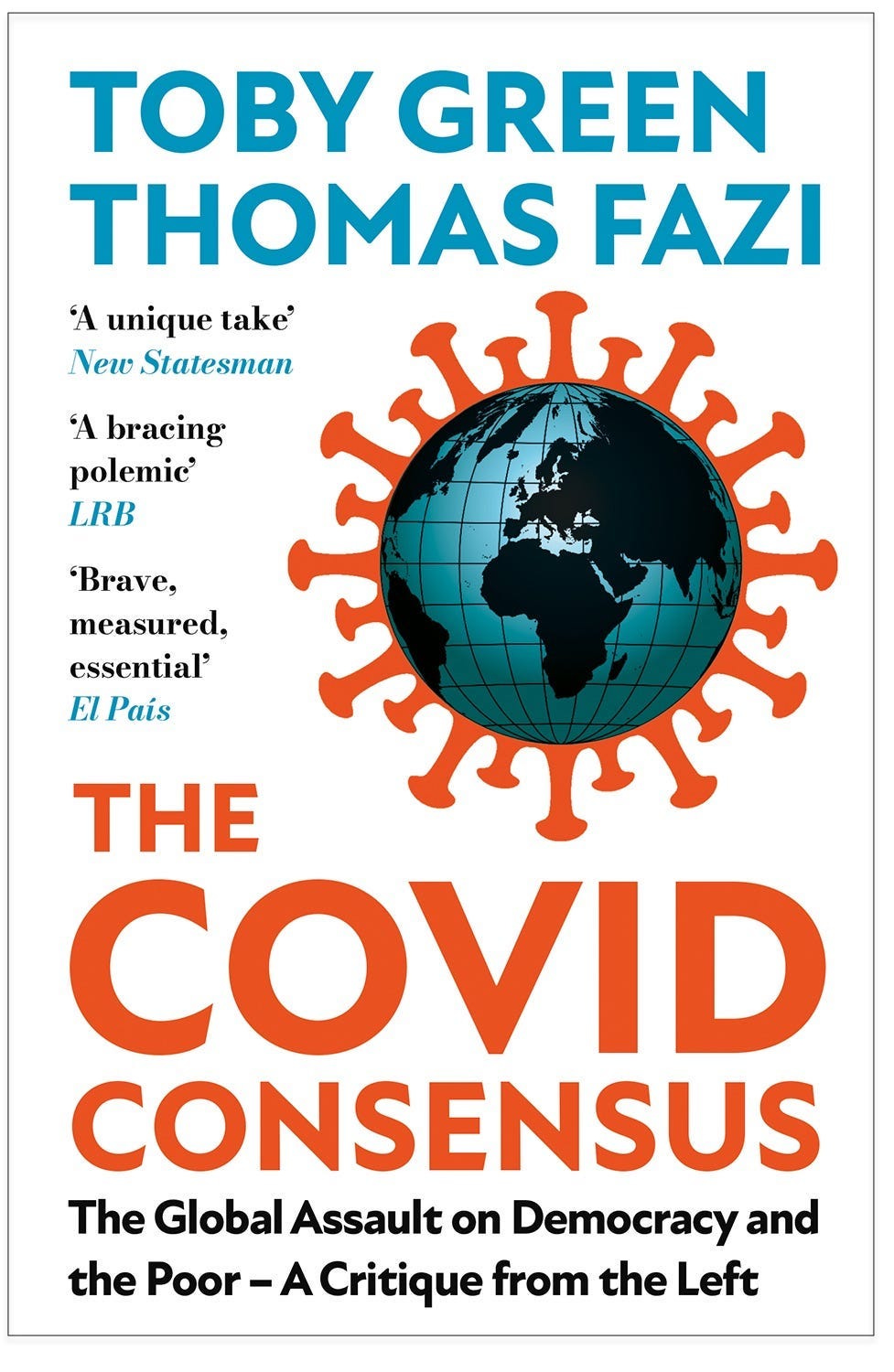
Latest book: The Covid Consensus: The Global Assault on Democracy and the Poor—A Critique from the Left (co-authored with Toby Green)


Leave a comment