

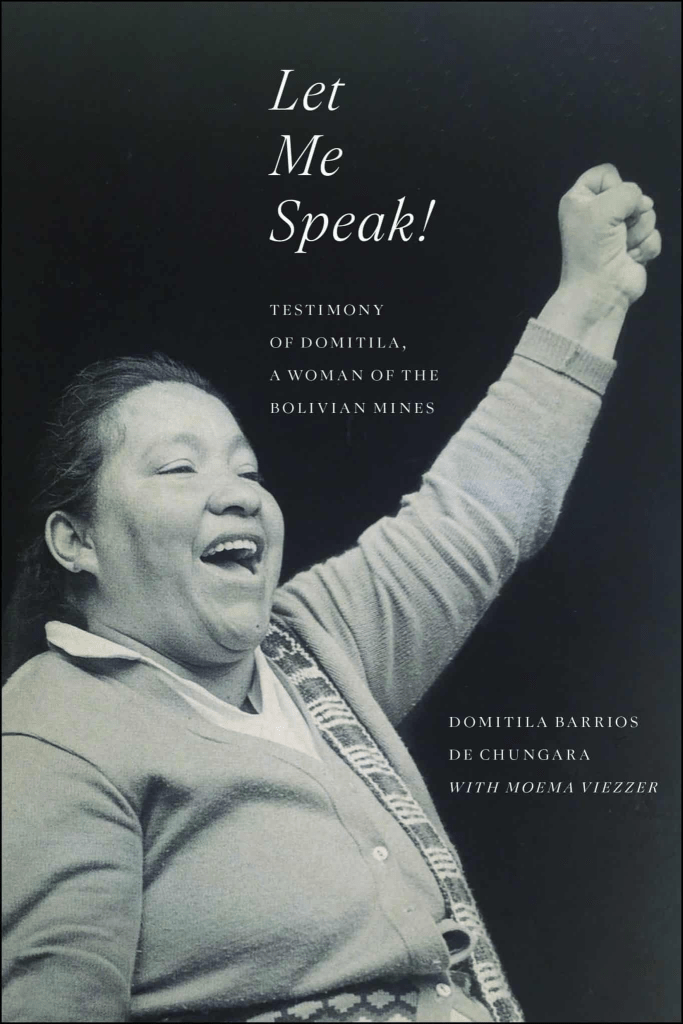
| “This is a remarkably articulate report with astute political commentary . . . an important social document.”—Library Journal |
| First published in English in 1978, Monthly Review Press is now reprinting the story of Domitila De Chungara–an indefatigable fighter for the families of Bolivian miners, an everyday, singular rebel with an irrepressible sense of conviction and dignity. |
| “…an important and moving oral history in which Domitila speaks to us in her own powerful words about herself, her country, and her people . . .”—Two Thirds |
| In spite of every effort on the part of the military to intimidate her into submission and silence, the testimonios of Domitila De Chungara eventually reached the world stage, echoing in the halls of the U.N. At that point the mining company against whom she struggled endeavored to bribe her out of dire poverty–but, in an act of integrity that is especially striking in the times we live in, she balked in the face of their enticements. |
| “A most lucid and moving account of a working class woman’s life….lives have been changed by reading this book.” —The Guardian |
| Chungara’s account is enduring in its historical significance and continues to be cited in numerous journal articles in every field imaginable, from Sociology, History and Anthropology survey classes, to Latin American studies, Labor studies, Women’s studies, and it continues to be included in compendiums put out by scholars in all these fields. The new edition of Let Me Speak! includes never-before-translated testimonies, resulting in a fuller picture of both Chungara’s worldview, and the time and place in which she arose. This includes a discussion of her role in bringing down the Hugo Banzer dictatorship, and her work as an internationalist during the period of the García Meza dictatorship, from her position of exile in Sweden. |
| From The Introduction:”Today there are terrible people who might constantly talk about democracy but…were happily drinking their coffee, while they watched on television how Indigenous people and workers were killed. Now, however, these people like to babble about democracy and the rule of law, despite their never having done anything in the fight for the rule of law or democracy. Domitila’s book serves as an example, a living testimony, of what it means to fight for democracy; that is, democracy not only as the right to vote every five years, but also the right to associate, to think, to organize, and discuss fundamental issues, such as salary, rights, constitutional guarantees, and party politics, in one’s community. This is democracy as a continuous and daily affair….” Read more…. |


Leave a comment