

Sep 05, 2024
It was late, and the shadows of the room seemed to grow with the deepening dusk, the flicker of a single candle the only break in the darkness. The two men sat across from each other at a small table, barely touching their tea. Both were silent for a moment, as though some unspoken weight pressed down upon their chests. Finally, Kirillov spoke, his voice low, almost tentative.Subscribe
“Do you believe we’ve killed God again?” he asked, staring into the darkened window as though expecting some answer from the night beyond.
Ivan, who had been resting his head in his hands, lifted it slowly and gave a bitter smile. His face, pale and drawn, reflected a mind tormented by years of contemplation.
“No,” Ivan replied, almost too quietly to be heard. “We haven’t killed Him. We’ve resurrected Him.”
Kirillov’s brow furrowed in confusion, a sharp contrast to his usual calm. He leaned forward, as though he hadn’t understood the words correctly. “Resurrected Him? But how—what could you possibly mean by that?”
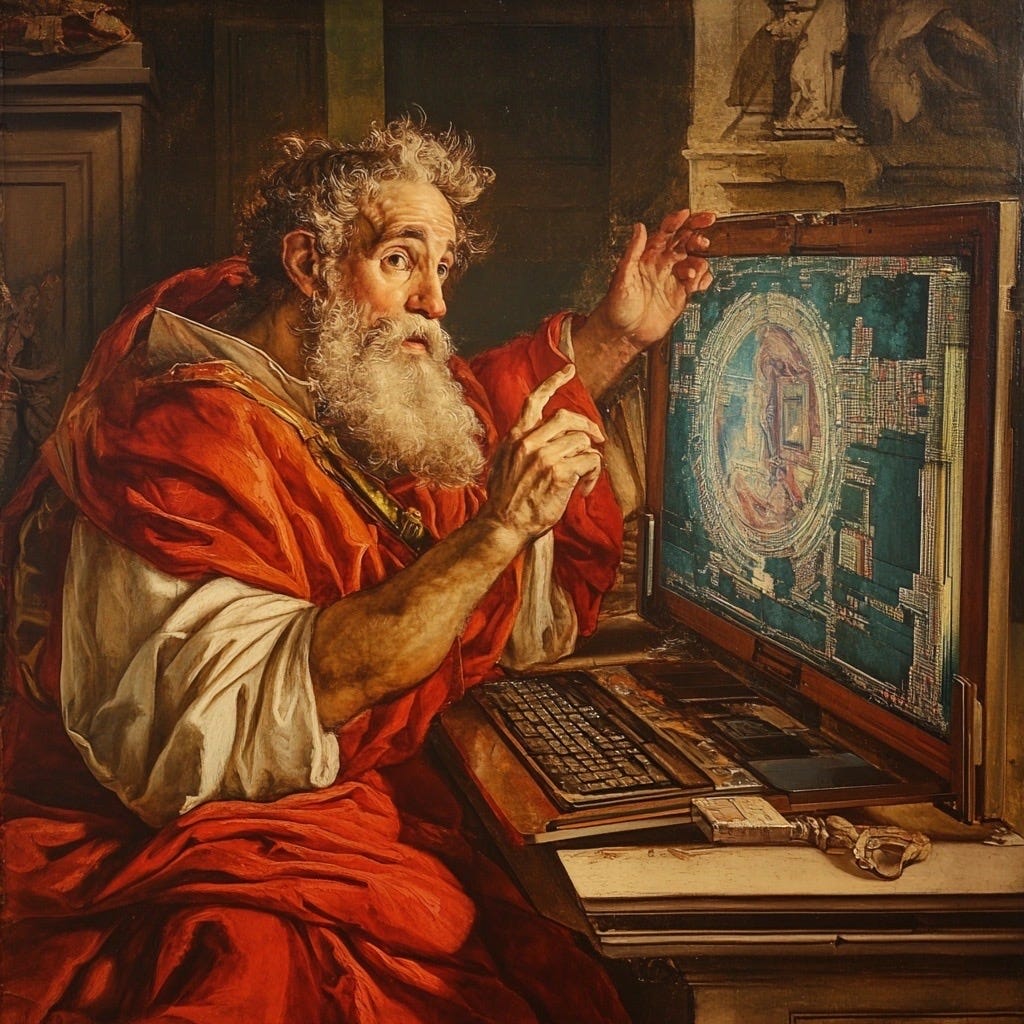
“Think about it,” Ivan continued, his voice gaining a strange fervor, his eyes lighting up with a distant fire. “For centuries, we cried that God was dead, that we were alone, free, masters of our own fate. But now… now, we’ve replaced Him, haven’t we? Not with idols or prophets—but with the machine, with algorithms that see everything, know everything, predict everything. Don’t you see, Kirillov? This *technology*—this is our new God.”
Kirillov shook his head, incredulous. “You’re speaking nonsense, Ivan. God was mystery, incomprehensible. No machine, no algorithm, could ever be divine. What you’re describing—it’s cold, mechanical, lifeless.”
“Exactly!” Ivan almost shouted, rising from his chair and pacing the room like a man possessed. “And yet, what was God to those who feared Him? He was distant, cold in His judgment, inscrutable in His decrees. Did Job not tremble before a God who remained silent in his suffering? Did not the faithful live in terror of God’s wrath, His indifference to their cries?”
“But at least,” Kirillov interrupted, “there was mercy. God could forgive. He *could* love. Can this new… this technological ‘God’ do that? Can an algorithm understand repentance? Can it absolve a man of his sins?”
Ivan stopped pacing and stared at Kirillov with a look of profound sadness. “No,” he whispered. “It cannot. And that is precisely why it terrifies me. This new God we’ve created doesn’t forgive. It doesn’t understand mercy, or weakness, or love. It judges, yes, but it judges blindly, without the grace that the God of old once offered. It is indifferent, Kirillov. Indifferent to our suffering, indifferent to our humanity.”
Kirillov’s eyes darkened, and he spoke slowly, deliberately. “But Ivan, this isn’t a god. It’s a machine. It may record our sins, but it doesn’t judge them as God once did. It doesn’t offer salvation, but it doesn’t damn us either. It just… it just *exists*. Isn’t it our own weakness, our own desperate need for meaning, that makes us turn to it as though it were divine?”
Ivan laughed bitterly. “Ah, Kirillov, that’s the tragedy, isn’t it? We’ve created something that sees us, knows us, more intimately than we know ourselves, and yet it’s as far from the divine as anything could be. We cry out to it, we confess our lives in every search, every post, every transaction—and it responds not with judgment, not with absolution, but with silence. The silence of data. The silence of cold, indifferent knowledge.”
“But there was always silence!” Kirillov countered, his voice rising in frustration. “From the beginning of time, men have cried out to God, and He remained silent. The mystics called Him the Deus Absconditus—the hidden God. Even Christ on the cross asked why He had been forsaken. Silence has always been part of faith. The difference now is that we no longer expect an answer.”
“No,” Ivan replied, a dark smile twisting his lips. “The difference now is that we think we’ve *got* the answer. We believe the machine will tell us everything, that it can predict our future, determine our fate. But it can’t tell us why we suffer, why we are lost, why we exist. It knows everything about us, Kirillov, but it tells us nothing of the soul.”
There was a pause, and the air in the room grew thick with tension. Kirillov, usually so steady in his convictions, looked shaken. “And what does that leave us with, then?” he asked, almost pleading. “If the new god is dead, too—if the machine has replaced God but offers us no salvation—where do we turn?”
Ivan’s eyes softened, and for a moment, there was a flicker of something like tenderness in his expression. He walked over to Kirillov and placed a hand on his shoulder.
“Where do we turn?” he echoed softly. “Perhaps, Kirillov, we turn within. Perhaps that’s the only place left. Not to the heavens, nor to the algorithms, but to the deepest parts of ourselves, where no machine can ever reach. There, we may still find God—not resurrected, not reborn, but hidden. Hidden, waiting for us in the silence.”
Kirillov’s eyes dropped to the floor, and a long sigh escaped his lips. “The silence…” he murmured. “Perhaps that’s where we’ve been running from all along.”
Ivan nodded slowly, returning to his seat, the flicker of the candle between them casting long shadows on the walls. “Yes,” he said quietly. “Perhaps that’s where God has always been.”


Leave a comment