

Some observation related to the new Delimitation bill, and what the popular arithmetic counter against it from the southern states are missing.
Apr 17, 2026
A lot of the opposition to the delimitation bills introduced yesterday is caught up in the wrong argument, even if the frustration behind it is understandable. While it makes sense why popular political parties are choosing to attack the bill this way, for people and political organizations aligned with “minority” and working class interests, the new bill is an ideal context to bear open how the current electoral setup has been failing them.
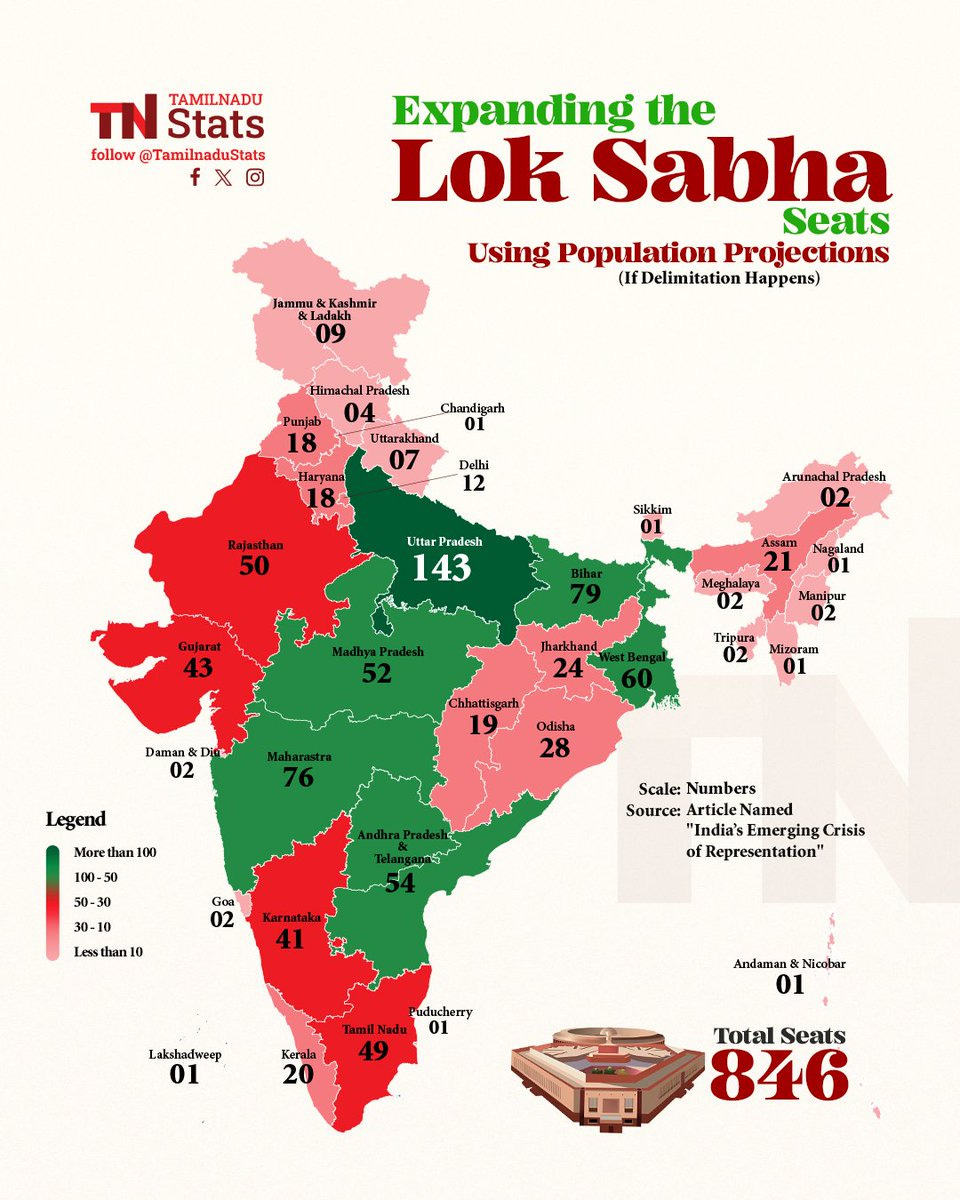
The southern states’ case rests on the claim that they are being punished for good governance and successful population control, that proportional representation in the Lok Sabha is structurally unfair to states that did the work. As we are seeing, this has real political energy, especially given that Center-State fiscal relations are already strained. But the seekers of constitutional defense are, ironically, constitutionally confused. The Lok Sabha represents individual citizens, not states. The principle that your vote carries the same weight as mine, regardless of where we live, is not a technicality; it is the foundational democratic claim and is not a conspiracy against the South. If you want state-level interests structurally protected, that is what the Rajya Sabha was designed for. The problem is that the Rajya Sabha has been so thoroughly defanged by anti-defection laws and by the expanding definition of money bills that it no longer functions as a genuine federal chamber. The South’s frustration regarding the dissolution of federalism is real, but it is being aimed at the wrong institution through the wrong logic. Regional representation politics, untethered from a question of who that representation actually serves, tends to be a horizontal competition between political parties dressed in the language of people’s rights. On the federal question — yes, India needs a Rajya Sabha that functions as a genuine federal chamber, not just a party-political mirror of the Lok Sabha. The US Senate model, where each state gets equal representation regardless of size, seems reasonable, but, in practice, goes too far for India’s demographic realities, even though the direction is right. The upper house needs real blocking power, and its members need structural incentives to represent their states rather than their party whips. That is the conversation the South’s frustration should be channeling, rather than arguing that UP’s citizens deserve fewer votes per head.
The genuinely serious objections to these bills are structural and are barely being discussed. We are redrawing India’s constituency map using 2011 census data, eighteen years old by the time elections are held under it in 2029. Worse, Parliament has now given itself the power to decide by simple majority when any future delimitation occurs and which census it uses. There is no automatic constitutional trigger anymore. Every future government can time it to its own electoral advantage. The delimitation being carried out today could govern Indian elections for three decades, based on data that was already stale when the exercise began. Will this nullify any electoral advances possible through the realization of a caste census, which some states are considering or have considered? It surely looks probable that the BJP’s ardent enthusiasm for this constitutional amendment arises out of the need to make any potential caste census and its implications futile. If the bill is enacted, it is even likely that the BJP would be willing to roll out the caste census, as the political order would have been set for the next few decades.
It is also important to imagine what an expanded parliamentary function would look like if the bill is enacted. Expanding the Lok Sabha to 850 members without touching parliamentary procedure, committee structure, or speaker accountability is clearly not a democratic advance. India’s Parliament already cannot give its existing members adequate floor time. Consequential legislation is routinely passed in hours without committee scrutiny. The abrogation of Article 370, which unilaterally stripped a region of its constitutional status, split it into two Union Territories, and placed eight million people under an extended communications blackout, took Parliament four hours. No committee. No advance notice to the opposition. This is the Parliament that 850 seats are supposed to make more deliberative. The opposition barely secures its fair share of parliamentary time as it is. A 57 percent increase in membership with no change to sitting days, committee architecture, or Speaker accountability will not produce more voice. It will produce more bodies and more legitimating noise around the same concentration of executive power.
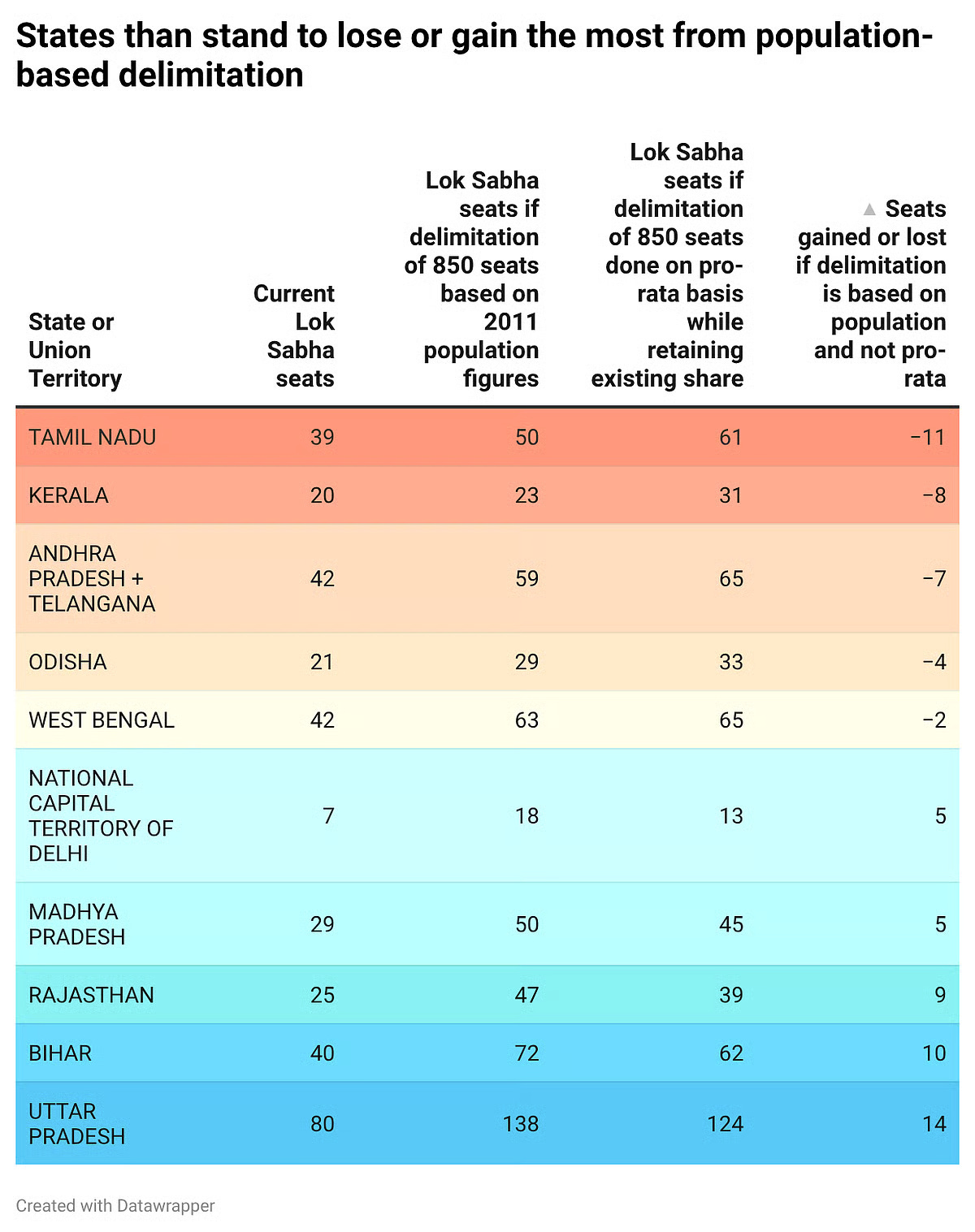
But the deeper problem is one neither regional politicians nor political parties want to confront: the electoral system itself. The debate, as it stands, is entirely about the arithmetic of representation. The critique is bound only to questions like how many seats and which states gain. What it never asks is what this representation does once achieved. The formal equality of the vote tells us nothing about whose interests the resulting MP actually advances. The MP that emerges from that constituency is not a neutral aggregate of all those interests. They emerge from a political economy of funding, party machinery, caste networks, and capital access that systematically selects for the representation of certain dominant interests over marginalized yet numerically large and dispersed caste-working class ones. Liberal electoral democracy does not resolve this and just invisibilizes it in the name of regional constituent representation.
The problems with the territorially aggregated electoral system are acutely visible in the functioning of the current reserved constituencies. Although reserved constituencies suggest a measure of political justice, the reality of politics is a stark contradiction that offers no meaningful progress for the demands of marginalized groups. When an SC constituency returns an SC MP, we know almost nothing politically useful from that fact. We do not know whether that candidate won on the strength of Dalit mobilization or on the strength of dominant-caste or sectarian networks within the constituency that found an acceptable face. We do not know which fraction within the Dalit community drove that margin. We cannot hold that representative accountable to Dalit interests specifically because the constituency that elected them is a territorial aggregate, not a politically defined community. The formal designation of the seat as reserved produces the appearance of representation without the structure of accountability. This problem is more glaring for OBC communities, for whom no reserved constituency mechanism exists at all. An OBC candidate elected from a general constituency may have won entirely on caste consolidation, or entirely despite it, or on some combination of factors that the aggregate vote total renders permanently opaque. In neither case does the community retain a structured claim on the representative’s subsequent conduct. The comparison to proportionate systems is instructive precisely here because proportionality makes the representing unit visible. When a party or list is elected as the representative of a defined community of interest — whether constituted by caste, class, regional language, or some combination — the relationship between the electing community and the elected body becomes legible. Accountability becomes possible because the constituency is knowable. Under first-past-the-post territorial aggregation, that knowability is structurally foreclosed, and the representative’s escape from community interest into party machinery, capital patronage, or upper-caste consensus is not a failure of individual character but a predictable feature of the system’s design.
This is also why Ambedkar’s argument deserves to be back at the center of this conversation. His argument for proportionate communitarian representation, for a system where the actual demographic composition of society was structurally reflected in its legislative institutions, rather than mediated through the distortions of first-past-the-post territorial constituencies, was not simply an argument about Dalit interests. It was a critique of what formal electoral equality actually produces in a society where social inequality is this deep and this organized. In a majoritarian electoral system, the largest identitarian bloc wins. Hindutva’s electoral dominance is not a distortion of Indian democracy but needs to be seen as a logical outcome of it, which nationalist leaders of the time wanted when they were hell-bent on being against proportional reservations. A movement that can successfully narrate the interests of the Hindu upper caste as the interests of all Hindus, and then organize that aggregated majority against a constructed minority threat, is playing the game of liberal electoralism with extraordinary sophistication. The answer isn’t more seats or regional seat protection. The answer is a democratic architecture that disaggregates the majoritarian bloc by making visible, and structurally representing, the specific and genuinely divergent interests within it.
The Muslim League’s demand for proportionate communitarian representation during nationalist movements and its opposition to simple-majority territorial representation were not, at their structural core, religious demands. It was a precise recognition: that in a first-past-the-post system built on aggregate population constituencies, a Muslim minority dispersed across the subcontinent could never achieve proportionate political weight regardless of regional concentration, and that a polity where a permanent demographic majority controlled legislative and executive institutions would not, in practice, protect minority political interests through the ordinary workings of electoral competition. The Pakistan demand, in its earliest political-theoretical articulation, was a response to this arithmetic. Ambedkar, who had no sympathy for the League’s later trajectory, nonetheless recognized the legitimate democratic logic in the demand for minority political protection against majoritarian arithmetic. The League’s demand and Ambedkar’s demand were answered differently — one through partition, the other through reservation — and both answers have proven structurally inadequate to the underlying problem they sought to address.
The South’s demand for protection against demographic majoritarianism and the marginalized community’s demand for genuine political inclusion are structurally the same argument, and both are pointing beyond the liberal electoral imagination that currently contains them. Both are pushing against the logic of an unreconstructed numerical majority. A system that combines individual voting rights with a genuinely empowered federal upper house and a proportionate chamber built on community representation would not be a departure from democratic principles. It would be its fulfillment under conditions of deep structural inequality. It would also be the most durable institutional defense against what we are watching: the consolidation (or a dictatorship) of a Hindu oligarchical order that has mastered the arithmetic of liberal electoral democracy with extraordinary sophistication, precisely because that arithmetic — the territorial aggregate, the majoritarian headcount, the invisibilisation of intra-majority divergence — is its natural terrain. The solution requires moving beyond a system in which the only political units are the territorial constituency and the headcount majority. It requires taking seriously what Ambedkar argued: that a democracy adequate to India’s actual social formation cannot be built on formal equality alone. It requires proportionate structural inclusion as a constitutional principle, not a temporary concession. Until that conversation is central to how we debate bills like the ones introduced today, we are rearranging the seats on a ship whose navigational logic we have refused to question.


Leave a comment