

The Voice of Hind Rajab is unwatchable because it shows you no violence. It forces you to imagine. And feel.
May 11, 2026
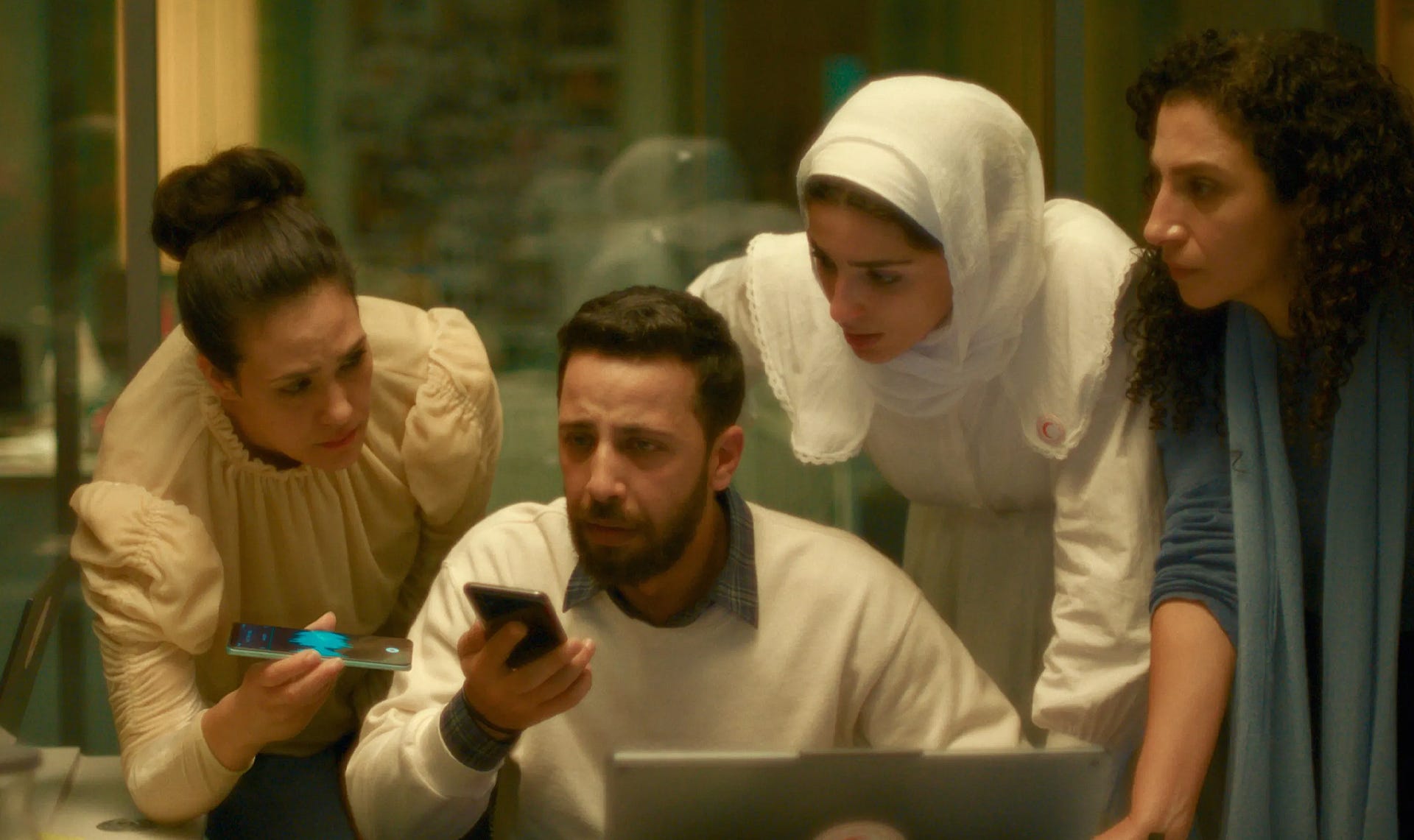
Imagine that you work in an organization tasked with rescuing people caught in violent situations not of their making. You sit in an office surrounded by computers, telephones, projectors, maps, and other such paraphernalia. Your paramedic colleagues are in the danger zone, risking their lives operating ambulances.
You receive a phone call from a child in distress. You piece together the facts. The child is a six year-old girl. She’s in a car with six others. The car has come under intense fire from soldiers in a tank. Everyone in the car is dead, except, miraculously, the child. Can you do something, anything, to save her?
This is the setting of the docu-fiction film The Voice of Hind Rajab (dir. Kouther Ben Hania, 2025). The action takes place on 29 January 2024 at the office of the Palestinian Red Crescent Society in Ramallah. The child is Hind Rajab. She is in Gaza, in a neighbourhood that the Israeli army has asked to be evacuated.
Her call is received by Omar, and soon others in the office, including his superiors, get involved in trying to save the girl. Through the film, we never see the main protagonist, the child Hind Rajab. But we hear her voice. Her actual voice, not an actor’s.
Rescuing Hind Rajab is not straightforward. The Red Crescent ambulance is only eight minutes away from the child, but cannot move until the Israeli army gives an official green signal to move on a designated route. The paramedics in the ambulance have to wait several hours before they can move. If they take matters in their own hands and move without the green light, they risk joining the ranks of the over two dozen murdered paramedics whose photographs are up on a wall in the office in Ramallah.
Meanwhile, when the Israelis don’t jam the phone signals, the workers in the office have to overcome their own distress to keep talking to Hind Rajab, attempting, as best they can, to keep her calm and assure her that help will soon be on its way.
They can hear bursts of gunfire on the phone. The director reminds us that we are listening to the real Hind Rajab’s voice and real gun shots by filling the screen with a spectrogram with the timestamp on it. Towards the end of the film, in desperation, the workers in the office put out the audio recording, as well as some videos of them talking to Hind Rajab, on social media. Hoping, despite the history of over seventy years, that some decision-maker on the Israeli side will miraculously grow a heart.
None of this is fiction. Our heart reaches out to the workers who try everything in their power to save the child, who is terrified, but also remarkably composed. Day turns to night as the workers try to negotiate the red tape involved. They cannot communicate directly with the Israeli army. They go through the International Red Cross, and when that fails, the Palestinian Authority’s Ministry of Health, as well as any other string they can pull.
As minutes slip into hours, we witness the workers in the office unable to keep their frustration, anger, anxiety, fear and a million other emotions in check. You sympathize with Omar, who wants to cut through red tape; you sympathize with his superior, Mahdi, who doesn’t want to get the paramedics killed; your heart goes out to Rana, who tries her best to appear calm as she speaks to Hind Rajab; and you marvel at Nisreen, who is able to get an uncommunicative Hind Rajab to start communicating again.
And then, suddenly, after nightfall, the ambulance is given the green signal. We see the ambulance’s location move on the map, till it is within a few meters of the car in which Hind Rajab is trapped. Our heart races as they are seconds away from rescuing the child.
Then a burst of gunfire. And then silence.
Nine people were murdered by the Israeli army in this incident: six members of Hind Rajab’s family, the child herself, and two paramedics. The Voice of Hind Rajab is harrowing precisely because it doesn’t show you any of this violence. We only hear a voice, a child’s voice, full of fear and desperation. The film is unwatchable because it shows you nothing. It forces you to imagine. And feel.
The film won the Grand Jury Prize at the Venice Film Festival. It was nominated for the Oscars and the Golden Globe. It has won over a dozen prestigious awards. Internationally famous film artists such as Brad Pitt, Joaquin Phoenix, Alfonso Cuarón, Rooney Mara, Jonathan Glazer, Dede Gardner and Michale Moore have backed the film by coming on board as executive producers. Despite all this, the film has struggled to get a decent release in many countries.
This is hardly surprising. The documentary No Other Land (dirs. Basel Adra, Hamdan Ballal, Yuval Abraham and Rachel Szor, 2024) suffered a similar fate. The US media played its role in suppressing the murders of Hind Rajab and others – a study shows that while five major US print/online publications ran a total of 207 different stories on a pseudo-scandal involving Harvard University’s first black president in a one-month period, the same publications covered the murder of Hind Rajab in only five stories over a similar period.
In India, the Central Board of Film Certification (CBFC) has blocked the release of the film by not certifying it. The film’s Indian distributor was reportedly told by a CBFC member that the film risked ‘breaking up the India-Israel relationship’.
I asked you above to imagine yourself as a humanitarian worker trying to rescue Hind Rajab. Now imagine that Hind Rajab is not one of the tens of thousands of people killed by Israel in the ongoing genocide, but a child you know. Someone you have held in your arms, played and laughed with, someone you have showered with kisses, someone who has clung to you, someone whose very existence makes your universe smile.
Imagine that child trapped in a car with six corpses as a tank approaches.
This article was first published on leftviews.in, on May 6, 2026.


Leave a Reply