

A Comparative Survey of Economic, Political, Sociological, and Cultural Theory
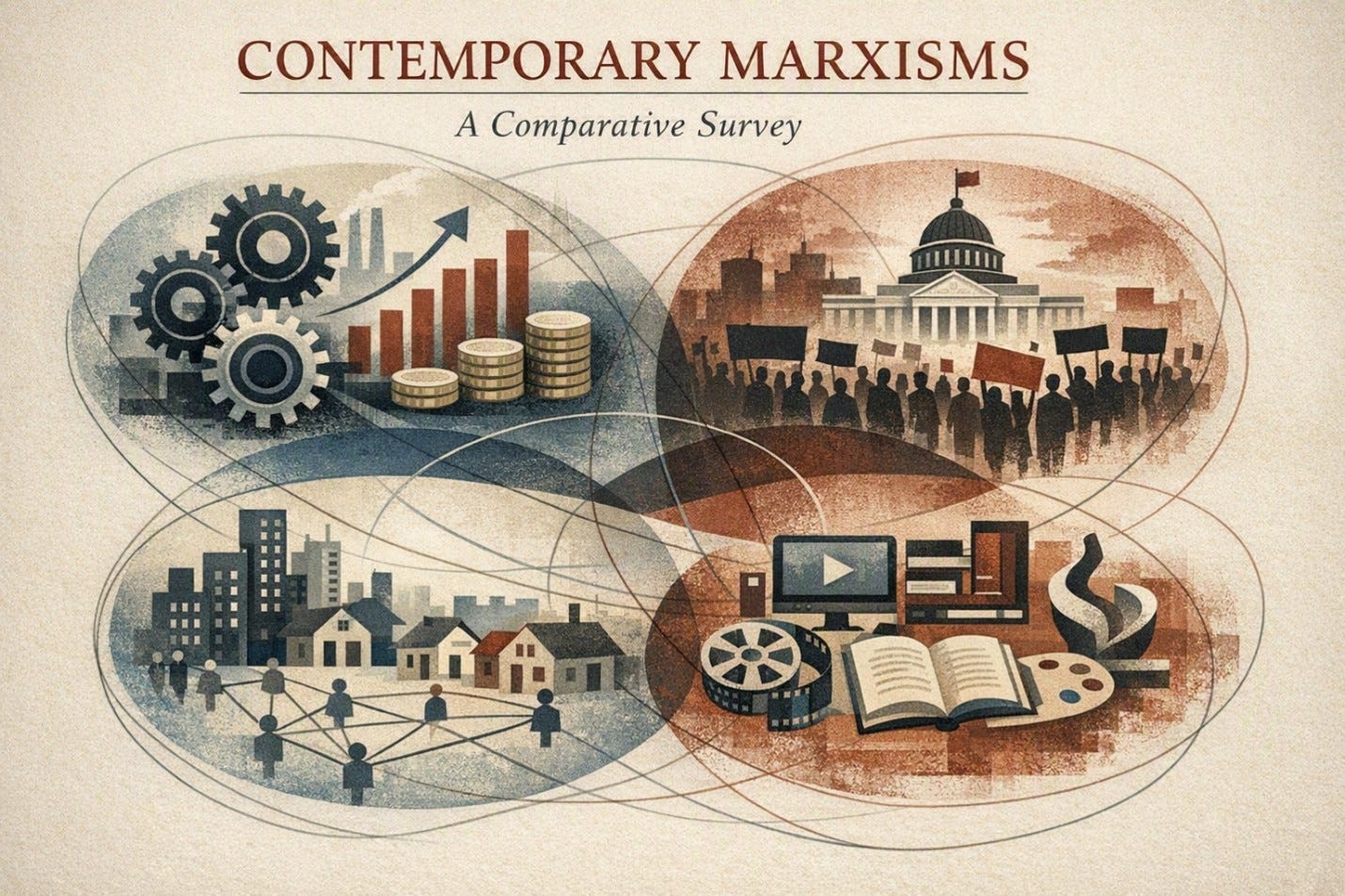
Tony Teso, Tempest Collective
July 2026
Abstract
Marxism has not had a single institutional or intellectual home since Marx’s death in 1883, and the research programs that invoke his name today share little beyond a critique of capital as self-expanding value and a refusal to naturalize market outcomes. This article surveys thirty-seven currents of contemporary Marxist thought across four domains: economics, political theory, sociology, and cultural criticism, comparing each domain’s schools on their terms before drawing out arguments that cut across all four: an unresolved dispute over how far the labor theory of value can be stretched or must be abandoned; a lively disagreement about whether class retains explanatory priority over race, gender, and status; competing answers to whether state power should be seized, eroded, or abolished; and sharply divergent diagnoses of the present, from renewed profitability crisis to capitalist realism’s foreclosure of the political imagination. The article argues that this fragmentation is not a failure of the tradition to cohere but an accurate reflection of an ambiguity already present in Marx’s own unfinished project and that the most honest description of “Marxism” today is a federation of overlapping, frequently mutually critical research programs rather than a unified doctrine or discipline.
Keywords: Marxism; political economy; critical theory; class analysis; value theory; state theory; cultural criticism; social reproduction
1. Introduction
This article combines four companion surveys of contemporary Marxist economic, political, sociological, and cultural theory into a single account and asks what, if anything, holds the resulting picture together. Each domain was surveyed independently and updated against current scholarship; here they are merged under continuous section numbering, cross-references between domains are resolved rather than left as pointers, and a new discussion section (Section 6) draws out arguments that recur across all four domains rather than staying confined to one.
The organizing premise is that Marxism today is best understood not as a single tradition with internal factions but as a loose federation of research programs that share an object of critique: capital as self-expanding value and the refusal to treat market relations, state power, class position, or aesthetic judgment as natural or ahistorical, without sharing a method, a scale of analysis, or, often, even a common reading of Marx’s own texts (Marx [1867–1894] 1990–1991). Four questions recur across the domains surveyed here and structure the discussion in Section 6: how far Marx’s labor theory of value can be stretched, reformulated, or must be abandoned; whether class retains analytical and political priority over race, gender, and status or is better treated as co-constituted with them; whether state power is best seized, eroded through institutions, or abolished outright and who the responsible political agent is once an undifferentiated industrial proletariat can no longer be assumed; and how the present moment of capitalism, financialized, digitized, and ecologically constrained, should be diagnosed and named.
Section 2 surveys nine currents in economic theory: Analytical Marxism, World-Systems Analysis, the Monopoly Capital/Monthly Review school, Temporal Single-System Interpretation and law-of-value Marxism, the Régulation School and Social Structure of Accumulation theory, Autonomist Marxism and cognitive-capitalism theory, ecological/metabolic-rift Marxism, Social Reproduction Theory, and financialization theory. Section 3 surveys eleven currents in political theory: post-Marxism and radical democracy; neo-Gramscian international political economy; strategic-relational state theory; Political Marxism; autonomist political theory; communization theory; left accelerationism; degrowth communism; neo-Leninism and the party form; Real Utopias; and the state-practiced Marxism of the Chinese party-state. Section 4 surveys nine currents in sociology: class structure analysis, British Cultural Marxism, racial capitalism, the critical-theory lineage running through recognition and forms-of-life debates, Marxist urban sociology, digital labor theory, surplus population theory, world-systems labor studies, and social reproduction sociology. Section 5 surveys eight currents in cultural theory: the Frankfurt School’s culture-industry thesis, Fredric Jameson on postmodernism, Terry Eagleton’s ideology criticism, Slavoj Žižek’s Lacanian ideology critique, Mark Fisher’s capitalist realism, Sianne Ngai’s materialist aesthetics, postcolonial Marxist critique, and McKenzie Wark’s media theory. Several schools recur across domains. Social Reproduction Theory appears in both Section 2 and Section 4, treated economically and sociologically, respectively; world-systems analysis appears in both Section 2 and Section 4; Erik Olin Wright’s work spans Sections 3 and 4. These are cross-referenced rather than repeated in full.
2. Economic Theories of Contemporary Marxism
Marxist economics disagrees, often sharply, on how literally to take Marx’s labor theory of value, on what actually causes capitalist crises, and on what scale of analysis—the workplace, the nation, or the world-system—is appropriate. The nine currents below are ordered roughly by their degree of commitment to the classical value-theoretic apparatus, from Analytical Marxism’s explicit reformulation to financialization theory’s retention of value categories applied to a new object.
2.1 Analytical Marxism (Rational Choice Marxism)
Key figures: G.A. Cohen, Jon Elster, John Roemer, Erik Olin Wright, Adam Przeworski (the informal “September Group,” active from the late 1970s)
Key works: Cohen (1978); Roemer (1982); Elster (1985)
Analytical Marxism applies the tools of analytic philosophy, formal logic, and rational choice/game theory to Marx’s substantive claims, deliberately discarding Hegelian dialectics as, in Elster’s (1985) phrase, largely “obscurantist.” Members insisted on stating Marx’s theses with the same rigor demanded of any social-scientific claim, coining the term “no-bullshit Marxism.”
Roemer’s (1982) central contribution reformulates exploitation without relying on the labor theory of value: exploitation is redefined game-theoretically via a hypothetical “withdrawal test” that asks whether a group would be better off withdrawing from the economy, taking with it its per capita share of alienable assets. Class position is determined by the differential ownership of productive assets rather than by one’s role in the labor process itself.
Internal splits and trajectory
The school did not so much fracture as dissolve into its members’ individual trajectories. Cohen moved toward normative political philosophy, ultimately arguing in Rescuing Justice and Equality (Cohen 2008) for an egalitarianism only loosely tied to historical materialism. Roemer moved toward designing market-socialist institutions (“coupon socialism”), while Wright developed “real utopias” research on concrete alternatives to capitalism, discussed as a political current in Section 3.10. By the 2000s, Analytical Marxism functioned less as an active research program than as a permanent methodological challenge inside Marxist economics: any claim about exploitation, crisis, or class now has to reckon with the rigorous standard it set.
2.2 World-Systems Analysis
Key figures: Immanuel Wallerstein (d. 2019), Giovanni Arrighi (d. 2009), Samir Amin (d. 2018), Christopher Chase-Dunn
Key works: Wallerstein (1974–1989); Arrighi (1994); Amin (1976)
World-systems analysis treats capitalism, since roughly the “long sixteenth century,” as a single historical social system rather than a collection of national economies (Wallerstein 1974–1989). The system is structured into core, semi-periphery, and periphery zones connected by unequal exchange, with the core extracting surplus from peripheral production. Arrighi’s (1994) “systemic cycles of accumulation” trace successive hegemonic powers: Genoese, Dutch, British, and American, each rising on productive/commercial expansion and ending in a phase of financialization that signals hegemonic exhaustion.
Internal splits and contemporary status
Amin (1976) pressed a more explicitly Marxist, anti-imperialist reading, advocating the “delinking” of peripheral economies from the world market; Wallerstein’s own approach owed as much to Braudelian historical sociology as to Marx and treated the system’s eventual crisis and transition as structurally open rather than determined by class struggle alone.
Institutionally the school has weakened since Wallerstein’s death: the Fernand Braudel Center he directed lost prominence, and the journal Review ceased publication in 2016. Conceptually, though, its core apparatus remains in active use—particularly for analyzing persistent global inequality and global value chains (see Section 4.8) and for debating whether China’s rise constitutes a hegemonic transition on the Arrighi model.
2.3 Monopoly Capital and the Monthly Review School
Key figures: Paul Baran and Paul Sweezy (founders); Harry Magdoff; John Bellamy Foster and Robert McChesney (contemporary leadership).
Key works: Baran and Sweezy (1966); Foster and McChesney (2012); Foster (2010)
Baran and Sweezy (1966) argued that as capitalism shifted from price competition among many small firms to oligopoly among giant corporations, the economy developed a chronic tendency to generate more surplus than could find profitable investment outlets, a “surplus absorption problem” that produced an underlying stagnation tendency, held off only by countervailing forces: wasteful sales effort and advertising, a permanent military-industrial complex, and, from the 1970s on, financialization.
Foster (2010) has extended this into a theory of “monopoly-finance capital,” in which financial expansion becomes the dominant mechanism absorbing surplus once traditional stagnation-fighting tools reach their limits, an analysis he and McChesney (2012) used to explain the 2008 crisis as the predictable rupture of a decades-long “stagnation-financialization” pattern rather than a one-off banking failure. Foster is also the central figure bridging this school to eco-Marxism (Section 2.7), having revived Marx’s concept of the “metabolic rift” as a way of extending monopoly-capital analysis to planetary ecological limits.
Critiques
Value-theory Marxists (Kliman, Anwar Shaikh, and others in the TSSI-adjacent camp) criticize the school’s underconsumptionist logic for downplaying the rate of profit and overaccumulation dynamics central to Marx’s own crisis theory, arguing “surplus absorption” substitutes a Keynesian-flavored demand problem for Marx’s supply-side analysis of profitability.
2.4 Temporal Single-System Interpretation (TSSI) and Law-of-Value Marxism
Key figures: Andrew Kliman, Ted McGlone, and Alan Freeman; related but distinct: Duncan Foley and Gérard Duménil (“New Interpretation”); Michael Heinrich (critical interlocutor); and Michael Roberts (contemporary popularizer/empiricist)
Key works: Kliman and McGlone (1999); Kliman (2012); Heinrich (2012)
This school defends the internal logical consistency of Marx’s value theory, including the Law of the Tendency of the Rate of Profit to Fall (LTRPF), against the long-standing “transformation problem” critique and Okishio’s theorem, which purported to show that technical change cannot reduce the rate of profit if the real wage is held constant. Kliman and McGlone’s (1999) response is that values and prices must be determined sequentially, in historical time, within a single interdependent system, rather than simultaneously across two separate value and price systems as the standard (Sraffian/simultaneist) reading assumes (see Sraffa 1960); on this reading, the alleged inconsistencies dissolve, and Okishio’s result no longer applies.
Kliman’s (2012) The Failure of Capitalist Production attributes the long post-1970s downturn and the 2008 crisis to a secular fall in profitability that 1980s–1990s restructuring never fully reversed, a direct rival explanation to the Monthly Review school’s surplus-absorption story.
Internal splits
The “New Interpretation” of Duménil and Foley accepts the single-system premise but not the temporal one, producing a distinct and long-running technical dispute with Kliman over how to treat the value of money and constant capital. Heinrich (2012), from the German “New Marx Reading” (Neue Marx-Lektüre) tradition, goes further and argues the LTRPF was never a settled, non-contradictory part of Marx’s own analysis, a claim Kliman rejects at length; the Kliman-Heinrich exchange, from roughly 2013 on, is one of the more visible live debates in contemporary Marxist economics.
2.5 Régulation School and Social Structure of Accumulation Theory
Key figures (Regulation, France): Michel Aglietta, Robert Boyer, Alain Lipietz
Key figures (SSA, United States): David Gordon, Samuel Bowles, Thomas Weisskopf
Key works: Aglietta (1979); Boyer (1990); Gordon, Edwards, and Reich (1982)
Both schools share a starting premise: capital accumulation is inherently crisis-prone but can be temporarily stabilized by historically specific bundles of institutions, a “regime of accumulation” paired with a “mode of regulation” (Aglietta 1979; Boyer 1990), or a “social structure of accumulation” (Gordon, Edwards, and Reich 1982). The canonical example is postwar Fordism: mass production and mass consumption, Keynesian demand management, and a capital-labor accord that together sustained a long boom until the institutional package broke down in the 1970s.
Both traditions have been used since to periodize the neoliberal era as a new, more unstable, and finance-led regime/SSA. Compared with TSSI or Monopoly Capital, both schools are more openly institutionalist and interdisciplinary and less committed to defending the labor theory of value in its strict quantitative form.
2.6 Autonomist Marxism, Post-Operaismo, and Cognitive Capitalism
Key figures: Mario Tronti, Antonio Negri, Michael Hardt, Paolo Virno, Maurizio Lazzarato, Carlo Vercellone, Yann Moulier-Boutang, Silvia Federici (autonomist-feminist)
Key works: Hardt and Negri (2000); Lazzarato (1996); Moulier-Boutang (2011)
Italian operaismo (“workerism”) and its post-operaista successors invert the classical base-superstructure model: working-class struggle is treated as the motor of capitalist restructuring, with capital innovating and relocating production largely in reaction to workers’ refusal of factory discipline. Hardt and Negri’s (2000) Empire generalized this into a claim that a decentered, networked global sovereignty (“Empire”) has superseded the older nation-state-based imperialism, a thesis developed further as a political theory in Section 3.5.
The “cognitive capitalism” and “immaterial labor” strand (Vercellone; Moulier-Boutang 2011; Lazzarato 1996) argues that knowledge, communication, and affect have become central productive forces and that value production diffuses beyond the factory into society at large, the “social factory.” Critics, particularly from the more orthodox value-theory camps, argue the “end of labor-time as the measure of value” thesis is empirically overstated.
2.7 Ecological Marxism and Metabolic Rift Theory
Key figures include John Bellamy Foster, Paul Burkett, Brett Clark, and Fred Magdoff; internationally, Jason W. Moore is noted as dissenting.
Key works: Foster (2000); Foster, Clark, and York (2010); Moore (2015)
Foster and collaborators revived and generalized a concept from Capital, Volume 3 (Marx [1867–1894] 1990–1991): Marx’s discussion of soil-nutrient depletion under industrial agriculture as a “metabolic rift” between town and country (Foster 2000). In their hands it becomes a general claim: capital accumulation systematically ruptures the metabolic exchange between society and nature, a dynamic they extend to climate change and biodiversity loss (Foster, Clark, and York 2010).
The Foster–Moore split
Jason Moore (2015), while also working from Marx, explicitly rejects the metabolic-rift framing as reproducing a Cartesian society/nature dualism. Drawing on world-systems analysis, Moore’s “world-ecology” framework (and his preferred term “Capitalocene”) argues that “Cheap Nature,” cheap labor, food, energy, and raw materials are internal to capital accumulation from the outset, not an external domain that capital subsequently damages.
2.8 Social Reproduction Theory: Value and Crisis
Key figures: Lise Vogel (foundational), Tithi Bhattacharya, Nancy Fraser, Cinzia Arruzza, Silvia Federici
Key works: Vogel (1983); Bhattacharya (2017); Fraser (2022); Arruzza, Bhattacharya, and Fraser (2019)
Social Reproduction Theory argues capitalist production depends on a vast quantity of unwaged reproductive and domestic labor that is structurally necessary to capitalism but systematically excluded from value accounting in Marx’s own framework, which centers the wage relation (Vogel 1983; Bhattacharya 2017). Vogel’s originally marginal 1983 book gained foundational status only after its rediscovery and extension in the 2010s.
Fraser’s (2022) recent work generalizes the argument: capitalism depends on, and simultaneously undermines, three “non-economic” background conditions, social reproduction, nature, and political power, producing what she calls a “boundary crisis.” Section 4.9 addresses the sociological dimension of this school, focusing specifically on the household and gendered division of labor.
2.9 Financialization Theory
Key figures: Costas Lapavitsas, Michael Roberts, Gerald Epstein
Key works: Lapavitsas (2013); Roberts (2016)
Lapavitsas (2013) argues that from the 1980s to the 1980s–1990s on, finance shifted from primarily mediating industrial accumulation to directly extracting surplus from households via consumer credit, mortgage debt, and fee income, a process he terms “profiting without producing.” Michael Roberts (2016), a prolific contemporary Marxist economist, synthesizes law-of-value/LTRPF-style profitability analysis with financialization and world-economy forecasting.
The MMT debate
Most Marxist economists in this camp are sharply critical of Modern Monetary Theory, arguing that MMT treats money as purely a creature of state fiscal operations while ignoring the class relations of production that make continued profit-driven accumulation—not simply the availability of state-issued currency—the actual constraint on economic activity under capitalism.
2.10 Comparative Summary: Economic Theories
The table below summarizes each school’s stance on three cross-cutting questions: how much weight it gives Marx’s labor theory of value, what it identifies as the primary driver of crisis, and what scale or unit it treats as the basic object of analysis.
School
Theory of Value
Primary Crisis Driver
Unit of Analysis
Analytical Marxism
Rejects/reformulates LTV via game theory (Roemer)
No unified theory; exploitation from unequal asset ownership
Individual rational agents / class as strategic position
World-Systems Analysis
Backgrounding stresses unequal exchange between zones
Hegemonic cycles, systemic chaos at transitions
The capitalist world-economy as a single unit since c.1500
Monopoly Capital / Monthly Review
Retained but secondary to market structure
Surplus absorption problem under monopoly: stagnation-financialization
The monopoly-stage economy (US-centered, global reach)
TSSI / Law-of-Value Marxism
Strict defense of Marx’s LTV, single-system temporal
Falling rate of profit (LTRPF)
Aggregate capital in historical time
Régulation / SSA
Downplayed; institutionalist
Breakdown of regime of accumulation / mode of regulation
National-historical accumulation regimes (e.g., Fordism)
Autonomist / Cognitive Capitalism
LTV strained by immaterial, hard-to-measure labor
Capital’s dependence on, and attempt to capture, social cooperation
Class composition and the ‘social factory’
Ecological / Metabolic Rift
Value theory extended to nature as unpriced input
Metabolic rift between accumulation and ecological reproduction
Society-nature metabolism (or ‘world-ecology’)
Social Reproduction Theory
LTV critiqued for excluding unwaged reproductive labor
Crisis of care: reproduction squeezed by production’s demands
Household and reproductive labor alongside the wage relation
Financialization Theory
Retained; finance as direct, non-productive extraction
Profiting without producing; household/finance-led instability
Banks, households, and financial circuits
2.11 Cross-Cutting Axes: Economic Theories
Commitment to the labor theory of value
Strict defenders (TSSI, Heinrich’s rigorous reading, and Anwar Shaikh) treat Marx’s quantitative value theory as defensible and load-bearing. Reformulators (Roemer’s Analytical Marxism) keep the concept of exploitation but detach it from labor-value magnitudes entirely. A third group, world-systems analysis, autonomist/cognitive-capitalism theory, and regulation/SSA, effectively sidelines strict value quantification in favor of institutional, systemic, or class-composition analysis.
Theory of crisis
Four distinct crisis logics recur: underconsumption/surplus-absorption (Monopoly Capital); the falling rate of profit and overaccumulation (TSSI, Roberts); institutional or regulatory breakdown (Régulation/SSA); and crises in “background conditions” outside conventional economic accounting, including care, ecology, and political authority (Fraser, eco-Marxism). These are not fully reconcilable: profit-rate theorists and underconsumptionists have argued directly against one another since the 1970s.
Method, agency, and scale
Structuralist approaches (world-systems analysis, Monopoly Capital) explain outcomes primarily through system-level position and institutional logic. Autonomist Marxism inverts this approach, treating working-class struggle itself as the primary motor of capitalist change. The schools also operate at markedly different scales, from world-systems analysis’s five-century world economy to social reproduction theory’s household; part of what looks like disagreement between schools is really a difference in the level of the system being described.
3. Political Theories of Contemporary Marxism
Where Marxist economics splits mainly over value theory and crisis mechanics, Marxist political theory since the 1970s has split mainly over three linked questions: what the capitalist state actually is and whether it can be used or must be smashed; who or what is the agent capable of ending capitalism once the industrial proletariat no longer looks like a unified, self-evidently revolutionary subject; and what relationship, if any, a post-capitalist politics should have to liberal-democratic institutions and procedures.
3.1 Post-Marxism and Radical Democracy
Key figures: Ernesto Laclau, Chantal Mouffe
Key works: Laclau and Mouffe (1985); Mouffe (2000); Mouffe (2018)
Laclau and Mouffe’s (1985) Hegemony and Socialist Strategy broke explicitly with classical Marxism’s assumption that the working class has a privileged, structurally guaranteed revolutionary role. Drawing on post-structuralist discourse theory, they argue political identities are not given by economic position but are discursively constructed through chains of equivalence linking distinct struggles against a common adversary. Hegemony is the always-contingent, never-permanent process by which one such articulation comes to stand in for the whole of “the people.”
Because all social identity is contingent rather than economically determined, they call their position “post-Marxist.” Their strategic upshot is “radical democracy,” deepening existing liberal-democratic institutions through pluralist coalition-building, not abolishing them. Mouffe’s (2018) more recent work extends this into an explicit call for “left populism” as an electoral strategy.
Critiques
Critics on the Marxist left argue post-Marxism’s abandonment of a structural anchor in class leaves “the people” too elastic a category to generate a coherent political strategy and that left-populist electoral projects built on this model (Podemos, Syriza) have struggled to translate discursive hegemony into durable transformation of state or economic structures.
3.2 Neo-Gramscian International Political Economy
Key figures: Robert W. Cox, Stephen Gill, Kees van der Pijl
Key works: Cox (1981); Gill (1990); van der Pijl (1984)
This school extends Gramsci’s (1971) concept of hegemony, leadership secured through consent and civil-society institutions, not just coercion, from the national to the international scale. Cox’s (1981) foundational move was to treat world orders as resting on a “historical bloc” of state forms, production relations, and ideas, with hegemonic world orders organized around a dominant class fraction’s ability to present its interests as universal, transmitted through international institutions, transnational think tanks (Gill 1990), and an emergent transnational capitalist class (van der Pijl 1984).
Contemporary applications extend this framework to contested US hegemony and the rise of China as a possible counter-hegemonic project. Compared with classical Marxist theories of imperialism, the neo-Gramscian approach puts more weight on ideology, consent, and civil society and less on strictly economic mechanisms of extraction.
3.3 Strategic-Relational State Theory
Key figures: Nicos Poulantzas (foundational, d. 1979), Bob Jessop (contemporary development)
Key works: Poulantzas (1978); Jessop (2008); Jessop (2016)
Poulantzas (1978) rejected both the “instrumentalist” view of the state as a simple tool wielded by the ruling class and the crude structuralist view that the state’s function is mechanically fixed by capital’s needs. Instead, he defined the state as “the material condensation of a relationship of forces among classes and class fractions,” an institutional terrain that is structurally selective, but whose actual outputs are the contingent result of struggle conducted partly inside the state apparatus itself.
Jessop (2008, 2016) has developed this into the “strategic-relational approach” (SRA), formalizing how state structures privilege certain strategies and actors over others across different time horizons and extending the framework to theorize the shift from the Keynesian welfare state to a post-Fordist “Schumpeterian competition state” and multi-scalar governance.
3.4 Political Marxism
Key figures: Robert Brenner, Ellen Meiksins Wood, George Comninel
Key works: Brenner (1976); Wood (1999); Wood (1995)
Political Marxism insists that capitalism’s origin and dynamics must be explained through historically specific class and property relations rather than through trans-historical forces like trade expansion or technology. Brenner’s (1976) originating argument was that English capitalism emerged from a specific outcome of class struggle over agrarian property relations, the dispossession of the peasantry and the rise of market-dependent tenant farming, not from the mere growth of trade or towns common to many pre-capitalist societies.
Wood (1999) radicalized the political implications: because capitalism’s origin was a contingent, historically specific class outcome, capitalism and liberal-democratic political forms are not necessarily bound together. Indeed, she argues the separation of “economic” and “political” power characteristic of capitalism is itself historically distinctive and worth denaturalizing (Wood 1995).
3.5 Autonomist Political Theory: Empire, Multitude, and Biopolitics
Key figures: Antonio Negri, Michael Hardt
Key works: Hardt and Negri (2000); Hardt and Negri (2004); Hardt and Negri (2009); Hardt and Negri (2017)
Building on the workerist inversion described in Section 2.6, Hardt and Negri’s (2000) Empire trilogy argues sovereignty itself has been reorganized: a decentered, deterritorialized “Empire” without a single imperial center has superseded the old system of competing nation-state imperialisms. Their proposed revolutionary subject is the “multitude” (Hardt and Negri 2004), not a unified class-in-itself like the classical proletariat but a plural, irreducibly heterogeneous set of singularities that can nonetheless act in common, organized horizontally rather than through a vanguard party.
Critiques
Critics argue the multitude concept is too diffuse to specify actual strategy or organization and that claims about the decline of the nation-state and interstate imperial rivalry have aged poorly against continued great-power competition in the 2020s.
3.6 Communization Theory
Key figures: Théorie Communiste (collective, Marseille, founded 1975); Gilles Dauvé; Jacques Camatte; Endnotes (journal collective, UK/US, founded 2008)
Key works: Dauvé and Martin ([1974] 1997); Endnotes (2010, 2015)
Communization theory rejects the historical workers’ movement’s assumption of “programmatism,” which posits that revolution progresses through a transitional stage before achieving communism. Instead, it argues communism, if it happens at all, must be produced immediately and directly within revolutionary struggles themselves (Dauvé and Martin [1974] 1997): the abolition of wage labor, commodity exchange, value, and the state cannot be postponed to an after-the-revolution program because the organizational forms of programmatism are themselves internal to, and reproduce, the capital relation.
Endnotes (2010, 2015) has extended this analysis to gender, race, and the changed composition of struggle in deindustrialized economies, developing the surplus-population argument treated sociologically in Section 4.7.
3.7 Left Accelerationism and Post-Work Politics
Key figures: Nick Srnicek, Alex Williams, and Aaron Bastani (popularizer)
Key works: Srnicek and Williams (2013); Srnicek and Williams (2015); Bastani (2019)
Left accelerationism argues the left should not retreat from technology and large-scale planning but should instead seize and repurpose capitalism’s technological and organizational infrastructure toward postcapitalist ends, full automation, a drastically reduced working week, and universal basic income (Srnicek and Williams 2015). Their strategic model is explicitly Gramscian and long-term.
Critiques
Reviewers have flagged internal tensions in the automation argument and accused the project of Eurocentrism of covertly reproducing the same technocratic imagination it claims to supersede.
3.8 Degrowth Communism
Key figures: Kohei Saito
Key works: Saito (2020); Saito (2023)
Saito (2023) uses previously under-examined material in the ongoing Marx-Engels-Gesamtausgabe critical edition to argue that the later Marx was moving away from the productivist vision often attributed to him and toward a vision of communism as deliberate, democratically planned economic contraction. Politically this points toward radically democratic economic planning and expanded commons rather than either orthodox state-planning communism or market-based green growth environmentalism. Capital in the Anthropocene (Saito 2020) sold roughly half a million copies in Japan.
Critiques
Reviewers determine that the philological case suggesting the mature Marx had fully arrived at “degrowth communism” is overstated when compared to the textual evidence, and they argue that the diagnosis of capital’s contradiction with ecological limits is stronger than the account of the political power required to achieve degrowth in the face of capital’s resistance.
3.9 Neo-Leninism and the Party Form
Key figures: Jodi Dean; Bruno Bosteels; Slavoj Žižek (overlapping interlocutor)
Key works: Dean (2012); Dean (2016); Dean (2019)
Against both post-Marxist pluralism and horizontalist/autonomist rejection of organization, Dean (2012) argues that the diffuse, leaderless, prefigurative forms of recent left movements generate powerful crowds and moments of collective energy but cannot, by their structure, convert that energy into durable political power. Her remedy is an explicitly Leninist recovery of the revolutionary party as the necessary organizational form that can discipline, sustain, and direct collective political will over time (Dean 2016, 2019).
3.10 Real Utopias and Democratic Institutional Experimentalism
Key figures: Erik Olin Wright (d. 2019)
Key works: Wright (2010); Wright (2019)
Emerging out of Analytical Marxism (Section 2.1) and continuous with the class-structure sociology treated in Section 4.1, Wright’s (2010) later work proposes a strategic typology of anticapitalist approaches, ruptural, interstitial, and symbiotic, and favors combining interstitial and symbiotic strategies: an “eroding” rather than smashing of capitalism through the patient development of concrete institutional alternatives (Wright 2019).
3.11 State-Practiced Marxism: Socialism with Chinese Characteristics
Key figures/institution: Chinese Communist Party theoretical apparatus; associated with Xi Jinping Thought on Socialism with Chinese Characteristics for a New Era (formalized 2017–2018)
Distinct from the preceding academic currents, this is Marxism as the official, continuously updated state ideology of a major world power, worth including precisely because it is the one contemporary “Marxist political theory” actually organizing the exercise of state power over more than a billion people. Its framework retains core Marxist-Leninist vocabulary while integrating a substantially marketized, globally integrated economy under continued party-state direction, justified as the current necessary “primary stage of socialism.” Western academic Marxists across the currents surveyed here are themselves sharply divided on how to characterize this system as a genuine (if authoritarian) socialist project, as state capitalism, or as a distinct hybrid form, and that unresolved disagreement is itself a live fault line in contemporary Marxist political theory.
3.12 Comparative Summary: Political Theories
The table below summarizes each current’s stance on the state, its proposed agent and strategy for political change, and its relationship to liberal-democratic institutions and procedures.
School
View of the State
Agent / Strategy
Relation to Liberal Democracy
Post-Marxism (Laclau/Mouffe)
Terrain of hegemonic contestation, not a fixed class instrument
Chains of equivalence built via discourse: ‘left populism’
Radicalize and deepen democracy from within, not abolish it
Neo-Gramscian IPE
Part of a transnational ‘historical bloc’ tying state, capital, and civil society
Counter-hegemonic bloc-building across classes and borders
Contest hegemony inside existing institutions and civil society
Strategic-Relational State Theory
‘Material condensation of a relation of forces’; structurally selective, not neutral
Struggle within and over state institutions and their selectivity
The state form is contested terrain; there is no simple abolition/seizure binary
Political Marxism (Brenner/Wood)
Analytically secondary to historically specific class/property relations
Class struggle over agrarian and later capitalist property relations
Capitalism and liberal-democratic form are historically contingent
Autonomist Political Theory
Sovereignty is decentered into ‘empire,’ a nation-state in relative decline
The multitude’s constituent power and biopolitical self-organization
Bypasses representative democracy for horizontal, networked self-rule
Communization Theory
The state is internal to the capital relation; must be abolished, not seized
Immediate abolition of value/wage/state within struggles themselves
Rejects liberal democracy and transitional ‘workers’ states’ alike
Left Accelerationism
State’s planning capacity to be repurposed for post-work transition
Hegemonic long-march strategy using technology and policy demands
Works through existing electoral/state institutions
Degrowth Communism (Saito)
The state is needed for planned, democratic de-growth of production
Municipalism, commons-based associations, mass consciousness shift
Compatible with, but must radically deepen, democratic participation
Neo-Leninism / Party Form (Dean)
State power must be seized and held by an organized revolutionary party
The disciplined communist party as necessary organizer of the people
Skeptical of liberal-democratic proceduralism as sufficient vehicle
Real Utopias (Wright)
One of several sites (state, market, civil society) for ‘eroding’ capitalism
Incremental, experimental institution-building
Works fully within and through liberal-democratic institutions
State-Practiced Marxism (PRC)
Party-state as the vanguard and permanent guiding institution
Centralized party leadership over a mixed, state-directed economy
Explicitly rejects Western liberal-democratic pluralism as a model
3.13 Cross-Cutting Axes: Political Theories
Seize, erode, or abolish the state?
Neo-Leninism and state-practiced Marxism both aim to seize and hold state power through a disciplined party. Real Utopias and left accelerationism aim to gradually erode or repurpose state power through existing institutions. Communization theory and autonomist theory treat the state as internal to the capital relation and therefore something to be dissolved or bypassed rather than captured.
Who is the agent of change?
Classical class-based agency is most clearly retained in neo-Leninism, Political Marxism, and state-practiced Marxism. Post-Marxism replaces it with a discursively constructed “people.” Autonomist theory offers the plural, horizontal “multitude.” Left accelerationism and Real Utopias are comparatively agnostic about a unified subject.
Time horizon and relation to liberal democracy
Real Utopias, left accelerationism, and post-Marxism all work explicitly within and through liberal democratic institutions. Neo-Leninism and state-practiced Marxism are openly skeptical of liberal-democratic proceduralism as an adequate vehicle for fundamental change. Communization and autonomist theory reject the liberal-democratic/authoritarian-socialist binary altogether as posed on capital’s own terrain.
4. Sociological Theories of Contemporary Marxism
Marxist sociology must explain not just capital accumulation or state power but also how class actually appears in lived social life, in culture, race, gender, the city, the household, and the platform and whether class remains the master category through which those other dimensions should be understood.
4.1 Neo-Marxist Class Structure Analysis
Key figures: Erik Olin Wright (d. 2019)
Key works: Wright (1978); Wright (1985); Wright (1997)
Wright’s sociological project, distinct from but continuous with his Real Utopias political work (Section 3.10), was to rescue Marxist class analysis as an empirically operationalizable variable comparable to Weberian stratification research. His signature move was the concept of “contradictory class locations” (Wright 1985): many positions in the modern economy simultaneously occupy exploiting and exploited positions rather than falling cleanly into “bourgeoisie” or “proletariat.” Later refined in Class Counts (Wright 1997) using a multidimensional exploitation model drawing on Roemer’s asset-based exploitation theory (Section 2.1), Wright’s framework became the basis of large, internationally comparative survey research.
4.2 British Cultural Marxism and the Birmingham School
Key figures: E.P. Thompson, Raymond Williams, Stuart Hall (Centre for Contemporary Cultural Studies, Birmingham)
Key works: Thompson (1963); Williams (1958); Williams (1977); Hall et al. (1978)
Against economistic and structuralist Marxism, this current insists class is not a position mechanically generated by the economy but something “made” through lived experience, culture, and active struggle. Thompson’s (1963) famous formulation treats class as a historical relationship and process, not a structure that simply exists prior to consciousness. Williams (1977) developed “cultural materialism,” treating culture itself as a material practice bound up with, but not reducible to, economic relations.
Hall, drawing more directly on Gramsci (1971), led the Birmingham Centre in analyzing how hegemony operates through popular culture and media (Hall et al. 1978, on the racialized 1970s British “mugging” panic, remains foundational for both cultural sociology and critical race scholarship). Hall’s later turn toward theorizing race and identity as irreducible to class positions directly opened onto the racial-capitalism current below.
4.3 Racial Capitalism
Key figures: Cedric J. Robinson (foundational, d. 2016), Ruth Wilson Gilmore, Robin D.G. Kelley, Jodi Melamed
Key works: Robinson (1983); Gilmore (2007); Kelley (2017); Melamed (2015)
Robinson’s (1983) founding argument was that capitalism did not create racism as an incidental byproduct that could in principle be stripped away to reveal a race-neutral class system underneath; rather, capitalism emerged from and remained continuous with the racialized social hierarchies of feudal Europe, so capitalism has always been “racial capitalism” from its origin. Robinson counterposed a “Black radical tradition” of resistance with its own intellectual and political genealogy.
Gilmore’s (2007) contemporary elaboration defines racism functionally as “the state-sanctioned and/or extralegal production and exploitation of group-differentiated vulnerability to premature death” and traces how the US carceral state manages surplus population, land, capital, and labor together as a racialized fix for capitalist crisis. Kelley (2017) and Melamed (2015) have extended the framework globally; it became one of the most widely cited frameworks in Anglophone sociology following the 2020 Black Lives Matter uprisings.
4.4 Critical Theory After Habermas: Recognition, Redistribution, and Forms of Life
Key figures: Axel Honneth, Nancy Fraser, Rahel Jaeggi (third-generation Frankfurt School and interlocutors)
Key works: Honneth (1995); Fraser and Honneth (2003); Jaeggi (2014); Jaeggi (2018)
Honneth (1995), Habermas’s successor as director of the Institute for Social Research, relocated critical theory’s normative foundation from communicative rationality to a theory of recognition: social suffering is best explained as struggles for recognition rather than primarily as struggles over material distribution. Fraser’s influential rejoinder in their published exchange (Fraser and Honneth 2003) insists recognition and redistribution are two distinct, mutually irreducible dimensions of justice. Jaeggi (2014, 2018), in the same broad lineage, has pushed critical theory back toward a reconstructed concept of alienation and toward evaluating whole “forms of life” as capable of internal failure.
4.5 Marxist Urban Sociology and Spatial Political Economy
Key figures: David Harvey, Neil Smith (d. 2012), Neil Brenner
Key works: Harvey (1973); Harvey (1985); Smith (1984), and Brenner and Schmid (2012)
Harvey’s (1985) central contribution is the “spatial fix”: capital facing a crisis of overaccumulation resolves it temporarily by investing surplus capital into the built environment, which absorbs surplus but also fixes capital in place, generating new contradictions later. Smith’s (1984) “uneven development” and “rent gap” theory of gentrification explains urban reinvestment as driven by the gap between current and potentially capitalized land values, reframing gentrification as a systematic process of dispossession by displacement. Brenner and Schmid (2012) have more recently argued urbanization should be studied as a “planetary” process extending into logistics corridors and extractive hinterlands worldwide.
4.6 Digital Labor and Platform Capitalism
Key figures: Christian Fuchs, Nick Dyer-Witheford
Key works: Fuchs (2014); Fuchs (2019); Dyer-Witheford (1999); Dyer-Witheford (2015)
Fuchs (2014) extends Marx’s value theory to digital platforms, arguing that unpaid “prosumer” activity on social media generates value captured by platform owners through targeted advertising, alongside a global division of waged digital labor running from underpaid content moderators to cobalt miners. Dyer-Witheford’s (2015) related “cyber-proletariat” framework tracks how digital technology has simultaneously created a globally dispersed technical workforce and intensified surveillance and control over labor generally.
4.7 Surplus Population and Wageless-Life Theory
Key figures: Michael Denning, Endnotes (journal collective)
Key works: Denning (2010); Endnotes (2010, 2015)
Denning (2010) argues that the classical Marxist starting point of “free” wage labor mistakes a historically privileged special case for the general condition of capitalism worldwide: for most of the world’s dispossessed population, permanent or semi-permanent wagelessness, not wage employment, has been the actual, typical relationship to capital. Endnotes (2010, 2015) develops a related but more structural argument: contemporary deindustrialization produces populations that are not merely part of a reserve army cyclically drawn back into employment but “absolutely redundant” to capital’s current labor requirements, feeding directly into the communization-theory strategic conclusions of Section 3.6.
4.8 World-Systems Labor Studies and Global Commodity Chains
Key figures: Beverly Silver, Giovanni Arrighi (see also Section 2.2), Gary Gereffi, Jennifer Bair
Key works: Silver (2003); Gereffi and Korzeniewicz (1994)
Silver’s (2003) Forces of Labor uses a large historical database of labor unrest events to argue that working-class militancy has not simply declined under globalization but has relocated, tracking the geographic relocation of specific industries to new production sites, where new working classes are formed and, in time, develop new bargaining power. Global commodity chain analysis, developed by Gereffi and Korzeniewicz (1994) and taken in a more explicitly world-systems direction by Bair, maps how production of a single commodity is fragmented across firms and countries with sharply unequal shares of value capture.
4.9 Social Reproduction and Materialist Feminist Sociology
Key figures: Lise Vogel, Tithi Bhattacharya, Silvia Federici, Cinzia Arruzza (see also Section 2.8)
Key works: Federici (2004); Bhattacharya (2017)
Where Section 2.8 covered this school’s account of value and crisis, its sociological contribution is a structural account of the family and gendered division of labor: the household is analyzed not as a private, pre-social sphere but as an institution actively organized to secure the unpaid renewal of labor power on which waged production depends. Federici’s (2004) account of the early modern witch hunts reads them as a violent disciplining of women’s reproductive labor and bodies coinciding with capitalist primitive accumulation. Contemporary work in this vein studies globalized care chains and the disproportionate reproductive burden placed on racialized and migrant women, linking this school directly to racial capitalism (Section 4.3).
4.10 Comparative Summary: Sociological Theories
The table below summarizes each current’s conception of class, the weight it gives culture and ideology as opposed to structural position, and the primary scale at which it works.
School
Conception of Class
Role of Culture/Ideology
Primary Scale
Class Structure Analysis (Wright)
Multidimensional structural position (exploitation + domination assets)
Secondary class boundaries are the main object of measurement
National labor-market structure, cross-nationally compared
British Cultural Marxism
Class as lived experience and relationship, made in struggle and culture
Central: culture is a terrain where class is actively made
National working-class communities and popular culture
Racial Capitalism
Race and class co-constitutive; capitalism has always been racialized
Central: racial hierarchy is ideological infrastructure for extraction
Global (slavery, colonialism) and urban/carceral (contemporary US)
Critical Theory Heirs (Honneth/Fraser/Jaeggi)
Displaced or supplemented by status/recognition and ‘forms of life’
Central: misrecognition and distorted forms of life as independent harms
Interpersonal/intersubjective and institutional norms
Marxist Urban Sociology
Class expressed spatially: uneven development, dispossession by displacement
Secondary; built environment as materialized capital circulation
The city, scaling to ‘planetary urbanization’
Digital Labor Theory
Extended to unpaid/unwaged digital ‘prosumers’ and platform workers
Central: attention, data, and communication as sites of exploitation
Global platforms and digital infrastructure
Surplus Population Theory
Class redefined around dispossession/wagelessness, not wage labor itself
Secondary focus on structural redundancy to capital’s labor demand
Global informal settlements and deindustrialized zones
Global Labor Unrest / Commodity Chains
Working class reconstituted wherever production relocates
Secondary focus on structural bargaining power
World-economy, tracked via commodity chains over centuries
Social Reproduction / Materialist Feminism
Class inseparable from gender and the unwaged reproduction of labor power.
Central: family, care, and gender ideology as structuring institutions
Household, care regimes, and their articulation with the wage
4.11 Cross-Cutting Axes: Sociological Theories
Structure versus culture and experience.
Class Structure Analysis and global commodity chain research treat class largely as an objective structural position. British Cultural Marxism and critical theory’s recognition insist current class and social suffering are constituted through lived experience and struggles for standing, not simply read off structural position.
Is class still the master category?
Racial capitalism and social reproduction theory both argue race and gender are co-constitutive with class from capitalism’s origin. Class Structure Analysis and global labor studies retain class as the primary organizing variable, treating race and gender chiefly as stratifying factors within a still-fundamental class structure.
Agency versus redundancy
World-systems labor studies retain a relatively optimistic account of working-class agency even as it migrates geographically. Surplus population theory poses a sharper challenge: if large populations are absolutely redundant to capital’s labor needs, the classical sociological account of class formation through shared workplace experience may not describe a growing share of the world’s dispossessed at all.
5. Cultural Theories of Contemporary Marxism
Marxist cultural theory asks what class relations do inside works of art, criticism, media, and everyday taste—not just how culture reflects the economy, but how it produces consent, forecloses imagination, or occasionally opens a crack in both.
5.1 The Frankfurt School’s Culture Industry Thesis: Legacy and Extensions
Key figures: Theodor Adorno and Max Horkheimer (foundational, 1940s); contemporary extensions across media and platform studies
Key works: Adorno and Horkheimer ([1944] 2002); Adorno (1991)
Adorno and Horkheimer’s ([1944] 2002) founding argument was that mass-produced culture under capitalism is not a neutral marketplace of styles but an industrialized apparatus that manufactures conformity, flattens genuine aesthetic difference into interchangeable variations, and trains audiences in passive consumption while presenting itself as individual choice. Genuine art, in their account, retained critical power only to the extent that its difficulty and negativity resisted this logic of easy consumption.
The thesis remains a live reference point: contemporary media scholars regularly reapply it to algorithmic recommendation systems and streaming-platform content strategy, arguing these represent an intensification of the culture industry’s basic logic, now automated and personalized rather than centrally produced.
5.2 Fredric Jameson: Postmodernism as the Cultural Logic of Late Capitalism
Key figures: Fredric Jameson (1934–2024)
Key works: Jameson (1981); Jameson (1991)
Jameson’s (1991) central and most widely cited claim is that postmodernism is not simply one artistic style among others available for an artist to choose but the necessary cultural expression of “late capitalism”—multinational corporate organization, global finance, and consumer-driven, media-saturated economies. Highlighting this link helps the audience appreciate the relevance of economic changes to cultural phenomena, fostering a sense of importance in understanding these connections.
His proposed critical response was “cognitive mapping”: art and criticism’s task is to develop new representational strategies, letting people situate their own position within an otherwise unrepresentable global system. Jameson died in September 2024 at age 90; Postmodernism (1991) remains Duke University Press’s all-time bestseller and permanently reshaped how literary criticism, architectural theory, and film studies discuss art produced after roughly 1970.
5.3 Terry Eagleton: Ideology and Literary Criticism
Key figures: Terry Eagleton
Key works: Eagleton (1976); Eagleton (1983); Eagleton (1991); Eagleton (2011)
Eagleton (1976) has worked to keep a rigorous, historically grounded Marxist literary criticism in circulation across five decades, arguing literary form itself, not just explicit political content, encodes ideological work. His widely used Literary Theory (Eagleton 1983) remains a standard survey text. From the 1990s on Eagleton became one of the most visible critics of postmodern and poststructuralist relativism from within the Marxist tradition (Eagleton 1991, 2011), arguing that the poststructuralist dissolution of stable meaning was itself an ideological symptom of political defeat and disorientation on the left.
5.4 Slavoj Žižek: Lacanian Ideology Critique
Key figures: Slavoj Žižek
Key works: Žižek (1989); Žižek (2010)
Žižek (1989) fuses Hegelian dialectics, Lacanian psychoanalysis, and Marxist critique into an account of ideology that departs sharply from a “false consciousness” model. For Žižek, ideology operates at the level of unconscious fantasy structuring desire and enjoyment beneath and often despite conscious belief. A signature and much-imitated method is reading Hegel, Marx, and Lacan through analysis of film, advertising, jokes, and popular culture (Žižek 2010). His recurring claim that contemporary capitalist culture presents itself as “post-ideological” is, on his account, itself the most successful ideological operation of all.
5.5 Mark Fisher: Capitalist Realism and Hauntology
Key figures: Mark Fisher (1968–2017)
Key works: Fisher (2009); Fisher (2014); Fisher (2018)
Fisher’s (2009) “capitalist realism” names the pervasive contemporary sense that capitalism is not one economic system among historically available others but simply the horizon of the thinkable. Capitalist Realism has sold over a quarter million English-language copies. His related concept of “hauntology” (Fisher 2014, adapted from Derrida 1994) describes a culture unable to produce genuinely new cultural forms, instead recycling its own past because the sense of a radically different future has been foreclosed.
Fisher died by suicide in January 2017; his unfinished “Acid Communism” project, published posthumously (Fisher 2018), has become an influential touchstone since, and his concepts have seen a marked resurgence in the 2020s, particularly among younger audiences encountering his work through internet culture rather than academic channels.
5.6 Materialist Aesthetics: Sianne Ngai’s Aesthetic Categories
Key figures: Sianne Ngai
Key works: Ngai (2005); Ngai (2012); Ngai (2020)
Ngai (2012) argues the grand aesthetic categories inherited from Kant and Romanticism no longer capture how aesthetic judgment operates under contemporary hypercommodified capitalism and proposes three minor but pervasive categories: the zany (frantic, precarious performance bound up with affective and service labor), the cute (an aesthetic of vulnerability and consumability mixing tenderness with latent aggression), and the interesting (an aesthetic of information and circulation). Her later Theory of the Gimmick (Ngai 2020) extends the method to a fourth category, reading the gimmick as an aesthetic register of capitalist value uncertainty.
5.7 Postcolonial Marxist Cultural Critique
Key figures: Aijaz Ahmad, in critical dialogue with Edward Said, Gayatri Spivak, and Homi Bhabha
Key works: Ahmad (1992); Ahmad (1995)
Ahmad’s (1992) In Theory mounted an influential and controversial Marxist critique of postcolonial studies itself, arguing that its leading figures had uncritically hitched anti-colonial critique to poststructuralist method, producing an academic discourse that dissolved class and material history into questions of discourse and hybridity. He specifically challenged Jameson’s own claim that “third-world” literature could be read as “national allegory,” arguing this too flattened enormous historical and class variation within postcolonial societies (Ahmad 1995).
5.8 McKenzie Wark: Media Theory and the Vectoralist Class
Key figures: McKenzie Wark
Key works: Wark (2004); Wark (2007); Wark (2019)
Wark, working in a lineage running through the Situationist International (Debord [1967] 1994) rather than primarily through Frankfurt School or Althusserian sources, argues that classical Marxist categories built around industrial capital no longer adequately describe a social order increasingly organized around the ownership and control of information itself. To clarify, Wark’s media/vectoralist theory introduces a new mode of production focused on information flow control, challenging traditional Marxist frameworks. A Hacker Manifesto (Wark 2004) proposed a “hacker class” counterposed to a “vectoralist class” that owns and controls the vectors along which information and data flow and are monetized. Capital Is Dead (Wark 2019) pushes the argument further, provocatively suggesting contemporary information capitalism may already have mutated into something worse than capitalism proper.
5.9 Comparative Summary: Cultural Theories
The table below summarizes each current’s core method, its stance on postmodern and digital culture specifically, and how these debates on agency, class, and diagnosis of the present remain crucial for understanding cultural dynamics.
School
Core Method
Stance on Postmodern/Digital Culture
Cultural Agency
Frankfurt School Culture Industry
Dialectical critique of standardized commodity culture
Sees continuity: streaming/algorithms as the culture industry intensified
Pessimistic: the culture industry manufactures false needs and passivity
Jameson: Postmodernism
Historicist ‘cognitive mapping’ of cultural forms to economic stages
Postmodernism is late capitalism’s own cultural logic, not a style choice
Guardedly hopeful: cognitive mapping can restore critical orientation
Eagleton: Ideology/Literary Criticism
Close reading informed by historical materialism
Skeptical of postmodern relativism as itself an ideological symptom
Literature can expose, and criticism can decode, ideology’s work
Zizek: Lacanian Ideology Critique
Psychoanalytic (Lacan) fused with Hegelian dialectics
‘Post-ideological’ culture is itself a new, more effective ideology
Limited; fantasy structures desire beneath conscious belief
Fisher: Capitalist Realism
Cultural diagnosis via hauntology and ‘lost futures’
Digital/retro culture recycles the past because the future feels foreclosed
Bleak but not fatalistic; names the trap to loosen its grip
Ngai: Materialist Aesthetics
Categorical analysis of everyday aesthetic judgments
New aesthetic categories fit the platform-era effect and labor
Descriptive categories reveal, rather than resolve, contradiction
Postcolonial Marxist Critique (Ahmad)
Historical-materialist critique of theory’s own class position
Rejects postmodern/poststructuralist ‘postcoloniality’ as commodification
Recovers class and nation as necessary, not optional, categories
Wark: Media/Vectoralist Theory
Situationist-inflected media and information theory
A new mode of production organized around the control of information flows
New class antagonism (hacker vs. vectoralist class) opens new agency
5.10 Cross-Cutting Axes: Cultural Theories
Continuity or rupture with the culture industry thesis
The Frankfurt School tradition and its contemporary platform-studies extensions treat digital culture as intensifying a logic already present in mid-century mass media. Wark argues that information capitalism represents a sufficient structural break that inherited categories may not suffice without substantial revision.
Pessimism versus openings for agency
The culture-industry thesis and Fisher’s capitalist realism are both frequently read as diagnostically bleak, though Fisher explicitly intended naming the trap as a first step toward loosening it. Wark’s hacker-class/vectoralist-class antagonism and Jameson’s cognitive mapping both propose more definite, if modest, openings for critical or creative agency.
Relation to identity, race, and postcolonial critique
Ahmad’s critique poses the sharpest version of a tension running through this domain: how far should cultural Marxism accommodate categories developed largely outside the Marxist tradition, and how far do those categories illuminate versus displace class and material history as explanatory anchors—the cultural-theoretic version of the class/race co-constitution debate treated in Section 4.3?
6. Discussion: Cross-Domain Synthesis
The preceding four sections were assembled independently, each answering to its own disciplinary literature. Read together, however, several arguments turn out not to be confined to a single domain at all but to recur in different vocabularies, with different stakes, across economics, political theory, sociology, and cultural criticism. This section draws out five such arguments.
6.1 Value and Its Discontents: From Labor-Time to Aesthetic Judgment
The economic survey’s central axis, how far the labor theory of value can be stretched before it stops doing useful work, turns out to have direct analogs well outside economics. TSSI and law-of-value Marxism (Section 2.4) insist the classical quantitative apparatus remains defensible; autonomist and cognitive-capitalism theory (Section 2.6) argue immaterial, hard-to-measure labor strains it; digital labor theory (Section 4.6) extends it to unpaid platform “prosumers”; and Ngai’s materialist aesthetics (Section 5.6) can be read as documenting, at the level of everyday aesthetic judgment, exactly the value uncertainty these theoretical debates are arguing about in the abstract. Her “gimmick,” the aesthetic judgment we make when something seems to be working too hard and not hard enough to produce value, names, in miniature, the same difficulty that TSSI, autonomist theory, and Wark’s vectoralist-class analysis (Section 5.8) are all wrestling with at the level of political economy. The persistence of this argument across four disciplinary vocabularies suggests it is not primarily a technical dispute internal to economics but rather a genuine, unresolved feature of value as Marx left it: adequate to industrial commodity production and increasingly strained by everything that follows.
6.2 Race, Gender, and the Question of Class’s Priority
A second recurring fault line concerns whether class retains explanatory and political priority over race, gender, and status or must be treated as co-constituted with them from the outset. Racial capitalism (Section 4.3) and social reproduction theory (Sections 2.8 and 4.9) both take the co-constitution position with respect to sociology and economics; post-Marxism’s discursively constructed “people” (Section 3.1) take a structurally similar position with respect to political strategy, replacing class-based agency with pluralist coalition. Ahmad’s postcolonial Marxist critique (Section 5.7) takes the opposite position regarding culture, arguing that discourse-centered postcolonial theory itself displaces class and material history. Political Marxism (Section 3.4) and class structure analysis (Section 4.1) anchor the class-priority position most firmly. That the same disagreement resurfaces in economics (does value theory need to account for unwaged reproductive labor), sociology (is race secondary to or co-constitutive with class), political theory (is “the people” a class category or a discursive one), and cultural theory (does postcolonial critique clarify or obscure capitalism’s material history) suggests this is Marxism’s single most consequential internal division, more consequential, arguably, than the value-theory dispute in Section 6.1, because it bears directly on political strategy and coalition-building.
6.3 The State, the Party, and the Question of Agency
The political survey’s seize/erode/abolish axis (Section 3.13) has a structural echo in how the other three domains handle agency. Economically, structuralist schools (world-systems analysis, Monopoly Capital) place causal weight on system-level positions, echoing the state-centered structuralism of strategic-relational state theory (Section 3.3). In contrast, autonomist economics (Section 2.6) locates it in working-class struggle itself, echoing the multitude in autonomist political theory (Section 3.5). Sociologically, surplus population theory’s account of populations “absolutely redundant” to capital (Section 4.7) directly motivates communization theory’s rejection of programmatic, party-based strategy (Section 3.6): if a growing share of the dispossessed cannot be organized through shared workplace experience, the party-form strategy of neo-Leninism (Section 3.9) and the state-practiced Marxism of Section 3.11 are addressing a working class that, on the surplus-population account, decreasingly exists in the form those strategies presuppose. Culturally, this same tension appears as the question of whether meaningful agency survives at all under capitalist realism (Section 5.5) or the culture industry (Section 5.1), a cultural-diagnostic version of the same problem the political survey poses institutionally.
6.4 Diagnosing the Present: Crisis, Closure, and Capitalist Realism
Each domain offers its own diagnosis of the current conjuncture, and these diagnoses are not obviously compatible. Economically, the dominant diagnoses are a renewed profitability crisis (TSSI, Roberts, Section 2.4) or a stagnation-financialization trap (Monopoly Capital, Section 2.3), both economic-structural accounts of why the system is in trouble. Culturally, Fisher’s capitalist realism (Section 5.5) offers a different kind of diagnosis entirely: not that capitalism is failing on its own terms, but that alternatives to it have become unimaginable regardless of its economic performance, a foreclosure of political imagination rather than a crisis of profitability. These two diagnostic modes are in some tension: if capitalism is in a structural profitability crisis, as Section 2.4 argues, the cultural inability to imagine alternatives (Section 5.5) becomes a puzzle requiring its own explanation, exactly the puzzle post-Marxism’s radical democracy (Section 3.1) and left accelerationism (Section 3.7) are, in different ways, trying to solve by proposing routes back to political imagination through coalition-building or technological repurposing, respectively. Degrowth communism (Section 3.8) and ecological Marxism (Section 2.7) again offer a third diagnostic register, locating the present crisis in capital’s metabolic relationship to nature rather than primarily in profitability or political imagination. The surveys do not resolve which diagnosis is correct; read together, they suggest the honest position is that capitalism’s current crisis, if it is one, is simultaneously economic, ecological, and imaginative, and no single domain’s account fully explains the other two.
Finally, the domains operate at starkly different scales, and this is not incidental. World-systems analysis (Sections 2.2 and 4.8) and neo-Gramscian international political economy (Section 3.2) work at the scale of centuries and the entire capitalist world-economy. Régulation/SSA theory (Section 2.5) and strategic-relational state theory (Section 3.3) work at the scale of national accumulation regimes across decades. Autonomist theory (Sections 2.6 and 3.5) and Marxist urban sociology (Section 4.5) work at the scale of the workplace, the labor process, and the city. Social reproduction theory (Sections 2.8 and 4.9) operates at the household level. Cultural theory, particularly Ngai’s aesthetic categories (Section 5.6) and hauntological analysis of specific cultural artifacts (Section 5.5), works at the scale of the individual object, gesture, or judgment. Much of what looks like disagreement between the schools surveyed here is, on inspection, a difference in the level of the system being described rather than a first-order disagreement about capitalism’s nature, though, as Sections 6.1 through 6.4 suggest, real first-order disagreements remain even after controlling for scale.
Finally, the domains operate at starkly different scales, and this is not incidental. World-systems analysis (Sections 2.2 and 4.8) and neo-Gramscian international political economy (Section 3.2) work at the scale of centuries and the entire capitalist world-economy. Régulation/SSA theory (Section 2.5) and strategic-relational state theory (Section 3.3) work at the scale of national accumulation regimes across decades. Autonomist theory (Sections 2.6 and 3.5) and Marxist urban sociology (Section 4.5) work at the scale of the workplace, the labor process, and the city. Social reproduction theory (Sections 2.8 and 4.9) operates at the household level. Cultural theory, particularly Ngai’s aesthetic categories (Section 5.6) and hauntological analysis of specific cultural artifacts (Section 5.5), works at the scale of the individual object, gesture, or judgment. Much of what appears to be disagreement between the schools surveyed here is, on inspection, a difference in the level of the system being described rather than a first-order disagreement about capitalism’s nature. Though as Sections 6.1 through 6.4 suggest, real first-order disagreements remain even after controlling for scale.
7. Conclusion
There is no unified Marxism today in economics, politics, sociology, or culture, and arguably there has not been one since the interwar period. What exists instead, across all four domains surveyed here, is a set of research programs that share a critique of capital as self-expanding value and a refusal to naturalize market outcomes, class position, state power, or aesthetic judgment but that disagree, often irreconcilably, about how literally to take Marx’s value theory; whether class retains priority over race and gender; whether state power should be seized, eroded, or abolished; and how to diagnose a present that is simultaneously financialized, racialized, digitized, and ecologically constrained.
This fragmentation reflects a tension already present in Marx’s own unfinished project: the pull between the analytical rigor and parsimony of a strict, classical theoretical core and the expanding explanatory ambit later theorists have tried to give it, covering ecological limits, unwaged and gendered labor, digital and immaterial labor, racial hierarchy, and aesthetic judgment under conditions Marx himself never encountered. The thirty-seven currents surveyed in this article are best read not as competitors converging on a single correct account of capitalism but as a live, ongoing, and often mutually critical argument, conducted simultaneously in academic and activist registers, across four disciplines that rarely cite one another directly, about what, exactly, a materialist critique of capitalism should explain and what political consequences follow once it does.
References
Adorno, Theodor W. 1991. The Culture Industry: Selected Essays on Mass Culture. Edited by J. M. Bernstein. London: Routledge.
Adorno, Theodor W., and Max Horkheimer. (1944) 2002. Dialectic of Enlightenment: Philosophical Fragments. Translated by Edmund Jephcott. Stanford, CA: Stanford University Press.
Aglietta, Michel. 1979. A Theory of Capitalist Regulation: The US Experience. Translated by David Fernbach. London: New Left Books.
Ahmad, Aijaz. 1992. In Theory: Classes, Nations, Literatures. London: Verso.
Ahmad, Aijaz. 1995. “The Politics of Literary Postcoloniality.” Race & Class 36 (3): 1–20.
Amin, Samir. 1976. Unequal Development: An Essay on the Social Formations of Peripheral Capitalism. New York: Monthly Review Press.
Arrighi, Giovanni. 1994. The Long Twentieth Century: Money, Power, and the Origins of Our Times. London: Verso.
Arruzza, Cinzia, Tithi Bhattacharya, and Nancy Fraser. 2019. Feminism for the 99%: A Manifesto. London: Verso.
Baran, Paul A., and Paul M. Sweezy. 1966. Monopoly Capital: An Essay on the American Economic and Social Order. New York: Monthly Review Press.
Bastani, Aaron. 2019. Fully Automated Luxury Communism: A Manifesto. London: Verso.
Bhattacharya, Tithi, ed. 2017. Social Reproduction Theory: Remapping Class, Recentering Oppression. London: Pluto Press.
Boyer, Robert. 1990. The Regulation School: A Critical Introduction. New York: Columbia University Press.
Brenner, Neil, and Christian Schmid. 2012. “Planetary Urbanization.” In Urban Constellations, edited by Matthew Gandy, 10–13. Berlin: Jovis.
Brenner, Robert. 1976. “Agrarian Class Structure and Economic Development in Pre-Industrial Europe.” Past & Present 70: 30–75.
Cohen, G. A. 1978. Karl Marx’s Theory of History: A Defense. Princeton, NJ: Princeton University Press.
Cohen, G. A. 2008. Rescuing Justice and Equality. Cambridge, MA: Harvard University Press.
Cox, Robert W. 1981. “Social Forces, States and World Orders: Beyond International Relations Theory.” Millennium: Journal of International Studies 10 (2): 126–155.
Dauvé, Gilles, and François Martin. (1974) 1997. Eclipse and Re-emergence of the Communist Movement. London: Antagonism Press.
Dean, Jodi. 2012. The Communist Horizon. London: Verso.
Dean, Jodi. 2016. Crowds and Party. London: Verso.
Dean, Jodi. 2019. Comrade: An Essay on Political Belonging. London: Verso.
Debord, Guy. (1967) 1994. The Society of the Spectacle. Translated by Donald Nicholson-Smith. New York: Zone Books.
Denning, Michael. 2010. “Wageless Life.” New Left Review 66: 79–97.
Derrida, Jacques. 1994. Specters of Marx: The State of the Debt, the Work of Mourning, and the New International. Translated by Peggy Kamuf. New York: Routledge.
Dyer-Witheford, Nick. 1999. Cyber-Marx: Cycles and Circuits of Struggle in High-Technology Capitalism. Urbana: University of Illinois Press.
Dyer-Witheford, Nick. 2015. Cyber-Proletariat: Global Labor in the Digital Vortex. London: Pluto Press.
Eagleton, Terry. 1976. Criticism and Ideology: A Study in Marxist Literary Theory. London: New Left Books.
Eagleton, Terry. 1983. Literary Theory: An Introduction. Oxford: Blackwell.
Eagleton, Terry. 1991. Ideology: An Introduction. London: Verso.
Eagleton, Terry. 2011. Why Marx Was Right. New Haven, CT: Yale University Press.
Elster, Jon. 1985. Making Sense of Marx. Cambridge: Cambridge University Press.
Endnotes. 2010. “Misery and Debt.” Endnotes 2.
Endnotes. 2015. “An Identical Abject Subject?” Endnotes 4.
Federici, Silvia. 2004. Caliban and the Witch: Women, the Body and Primitive Accumulation. New York: Autonomedia.
Fisher, Mark. 2009. Capitalist Realism: Is There No Alternative? Winchester, UK: Zero Books.
Fisher, Mark. 2014. Ghosts of My Life: Writings on Depression, Hauntology and Lost Futures. Winchester, UK: Zero Books.
Fisher, Mark. 2018. k-punk: The Collected and Unpublished Writings of Mark Fisher (2004–2016). Edited by Darren Ambrose. London: Repeater Books.
Foster, John Bellamy. 2000. Marx’s Ecology: Materialism and Nature. New York: Monthly Review Press.
Foster, John Bellamy. 2010. “The Age of Monopoly-Finance Capital.” Monthly Review 61 (9): 1–13.
Foster, John Bellamy, Brett Clark, and Richard York. 2010. The Ecological Rift: Capitalism’s War on the Earth. New York: Monthly Review Press.
Foster, John Bellamy, and Robert W. McChesney. 2012. The Endless Crisis: How Monopoly-Finance Capital Produces Stagnation and Upheaval from the USA to China. New York: Monthly Review Press.
Fraser, Nancy. 2022. Cannibal Capitalism: How Our System Is Devouring Democracy, Care, and the Planet, and What We Can Do About It? London: Verso.
Fraser, Nancy, and Axel Honneth. 2003. Redistribution or Recognition? A Political-Philosophical Exchange. London: Verso.
Fuchs, Christian. 2014. Digital Labor and Karl Marx. New York: Routledge.
Fuchs, Christian. 2019. Rereading Marx in the Age of Digital Capitalism. London: Pluto Press.
Gereffi, Gary, and Miguel Korzeniewicz, eds. 1994. Commodity Chains and Global Capitalism. Westport, CT: Praeger.
Gill, Stephen. 1990. American Hegemony and the Trilateral Commission. Cambridge: Cambridge University Press.
Gilmore, Ruth Wilson. 2007. Golden Gulag: Prisons, Surplus, Crisis, and Opposition in Globalizing California. Berkeley: University of California Press.
Gordon, David M., Richard Edwards, and Michael Reich. 1982. Segmented Work, Divided Workers: The Historical Transformation of Labor in the United States. Cambridge: Cambridge University Press.
Gramsci, Antonio. 1971. Selections from the Prison Notebooks. Edited and translated by Quintin Hoare and Geoffrey Nowell Smith. London: Lawrence & Wishart.
Hall, Stuart, Chas Critcher, Tony Jefferson, John Clarke, and Brian Roberts. 1978. Policing the Crisis: Mugging, the State, and Law and Order. London: Macmillan.
Hardt, Michael, and Antonio Negri. 2000. Empire. Cambridge, MA: Harvard University Press.
Hardt, Michael, and Antonio Negri. 2004. Multitude: War and Democracy in the Age of Empire. New York: Penguin.
Hardt, Michael, and Antonio Negri. 2009. Commonwealth. Cambridge, MA: Harvard University Press.
Hardt, Michael, and Antonio Negri. 2017. Assembly. Oxford: Oxford University Press.
Harvey, David. 1973. Social Justice and the City. Baltimore: Johns Hopkins University Press.
Harvey, David. 1985. The Urbanization of Capital: Studies in the History and Theory of Capitalist Urbanization. Baltimore: Johns Hopkins University Press.
Heinrich, Michael. (2004) 2012. An Introduction to the Three Volumes of Karl Marx’s Capital. Translated by Alexander Locascio. New York: Monthly Review Press.
Honneth, Axel. (1992) 1995. The Struggle for Recognition: The Moral Grammar of Social Conflicts. Translated by Joel Anderson. Cambridge, MA: MIT Press.
Jaeggi, Rahel. (2005) 2014. Alienation. Translated by Frederick Neuhouser and Alan E. Smith. New York: Columbia University Press.
Jaeggi, Rahel. (2013) 2018. Critique of Forms of Life. Translated by Ciaran Cronin. Cambridge, MA: Harvard University Press.
Jameson, Fredric. 1981. The Political Unconscious: Narrative as a Socially Symbolic Act. Ithaca, NY: Cornell University Press.
Jameson, Fredric. 1991. Postmodernism, or The Cultural Logic of Late Capitalism. Durham, NC: Duke University Press.
Jessop, Bob. 2008. State Power: A Strategic-Relational Approach. Cambridge: Polity.
Jessop, Bob. 2016. The State: Past, Present, Future. Cambridge: Polity.
Kelley, Robin D. G. 2017. “What Did Cedric Robinson Mean by Racial Capitalism?” Boston Review, January 12, 2017.
Kliman, Andrew. 2012. The Failure of Capitalist Production: Underlying Causes of the Great Recession. London: Pluto Press.
Kliman, Andrew, and Ted McGlone. 1999. “A Temporal Single-System Interpretation of Marx’s Value Theory.” Review of Political Economy 11 (1): 33–59.
Laclau, Ernesto, and Chantal Mouffe. 1985. Hegemony and Socialist Strategy: Towards a Radical Democratic Politics. London: Verso.
Lapavitsas, Costas. 2013. Profiting Without Producing: How Finance Exploits Us All. London: Verso.
Lazzarato, Maurizio. 1996. “Immaterial Labor.” In Radical Thought in Italy: A Potential Politics, edited by Paolo Virno and Michael Hardt, 133–147. Minneapolis: University of Minnesota Press.
Marx, Karl. (1867–1894) 1990–1991. Capital: A Critique of Political Economy. 3 vols. Translated by Ben Fowkes and David Fernbach. London: Penguin Classics.
Melamed, Jodi. 2015. “Racial Capitalism.” Critical Ethnic Studies 1 (1): 76–85.
Moore, Jason W. 2015. Capitalism in the Web of Life: Ecology and the Accumulation of Capital. London: Verso.
Moulier-Boutang, Yann. (2007) 2011. Cognitive Capitalism. Translated by Ed Emery. Cambridge: Polity.
Mouffe, Chantal. 2000. The Democratic Paradox. London: Verso.
Mouffe, Chantal. 2018. For left populism. London: Verso.
Ngai, Sianne. 2005. Ugly Feelings. Cambridge, MA: Harvard University Press.
Ngai, Sianne. 2012. Our Aesthetic Categories: Zany, cute, and Interesting. Cambridge, MA: Harvard University Press.
Ngai, Sianne. 2020. Theory of the Gimmick: Aesthetic Judgment and Capitalist Form. Cambridge, MA: Belknap Press.
Poulantzas, Nicos. 1978. State, Power, Socialism. Translated by Patrick Camiller. London: New Left Books.
Roberts, Michael. 2016. The Long Depression: How It Happened, Why It Happened, and What Happens Next. Chicago: Haymarket Books.
Robinson, Cedric J. 1983. Black Marxism: The Making of the Black Radical Tradition. London: Zed Press.
Roemer, John E. 1982. A General Theory of Exploitation and Class. Cambridge, MA: Harvard University Press.
Saito, Kohei. 2020. Capital in the Anthropocene [Jinshinsei no ‘shihonron’]. Tokyo: Shueisha.
Saito, Kohei. 2023. Marx in the Anthropocene: Towards the Idea of Degrowth Communism. Cambridge: Cambridge University Press.
Silver, Beverly J. 2003. Forces of Labor: Workers’ Movements and Globalization Since 1870. Cambridge: Cambridge University Press.
Smith, Neil. 1984. Uneven Development: Nature, Capital, and the Production of Space. Oxford: Blackwell.
Sraffa, Piero. 1960. Production of Commodities by Means of Commodities: Prelude to a Critique of Economic Theory. Cambridge: Cambridge University Press.
Srnicek, Nick, and Alex Williams. 2013. “#Accelerate: Manifesto for an Accelerationist Politics.” Critical Legal Thinking, May 14, 2013.
Srnicek, Nick, and Alex Williams. 2015. Inventing the Future: Postcapitalism and a World Without Work. London: Verso.
Thompson, E. P. 1963. The Making of the English Working Class. London: Victor Gollancz.
van der Pijl, Kees. 1984. The Making of an Atlantic Ruling Class. London: Verso.
Vogel, Lise. 1983. Marxism and the Oppression of Women: Toward a Unitary Theory. New Brunswick, NJ: Rutgers University Press.
Wallerstein, Immanuel. 1974–1989. The Modern World-System. 3 vols. New York: Academic Press.
Wark, McKenzie. 2004. A Hacker Manifesto. Cambridge, MA: Harvard University Press.
Wark, McKenzie. 2007. Gamer Theory. Cambridge, MA: Harvard University Press.
Wark, McKenzie. 2019. Capital Is Dead: Is This Something Worse? London: Verso.
Williams, Raymond. 1958. Culture and Society, 1780–1950. London: Chatto & Windus.
Williams, Raymond. 1977. Marxism and Literature. Oxford: Oxford University Press.
Wood, Ellen Meiksins. 1995. Democracy Against Capitalism: Renewing Historical Materialism. Cambridge: Cambridge University Press.
Wood, Ellen Meiksins. 1999. The Origin of Capitalism: A Longer View. London: Verso.
Wright, Erik Olin. 1978. Class, Crisis and the State. London: New Left Books.
Wright, Erik Olin. 1985. Classes. London: Verso.
Wright, Erik Olin. 1997. Class Counts: Comparative Studies in Class Analysis. Cambridge: Cambridge University Press.
Wright, Erik Olin. 2010. Envisioning Real Utopias. London: Verso.
Wright, Erik Olin. 2019. How to Be an Anticapitalist in the Twenty-First Century. London: Verso.
Žižek, Slavoj. 1989. The Sublime Object of Ideology. London: Verso.
Žižek, Slavoj. 2010. Living in the End Times. London: Verso.


Leave a Reply