

The parliament and the courts may be institutions of the state; but streets and maidans are institutions of the people.
Jul 22, 2026
Published in the Mumbai Mirror, 23 July 2026
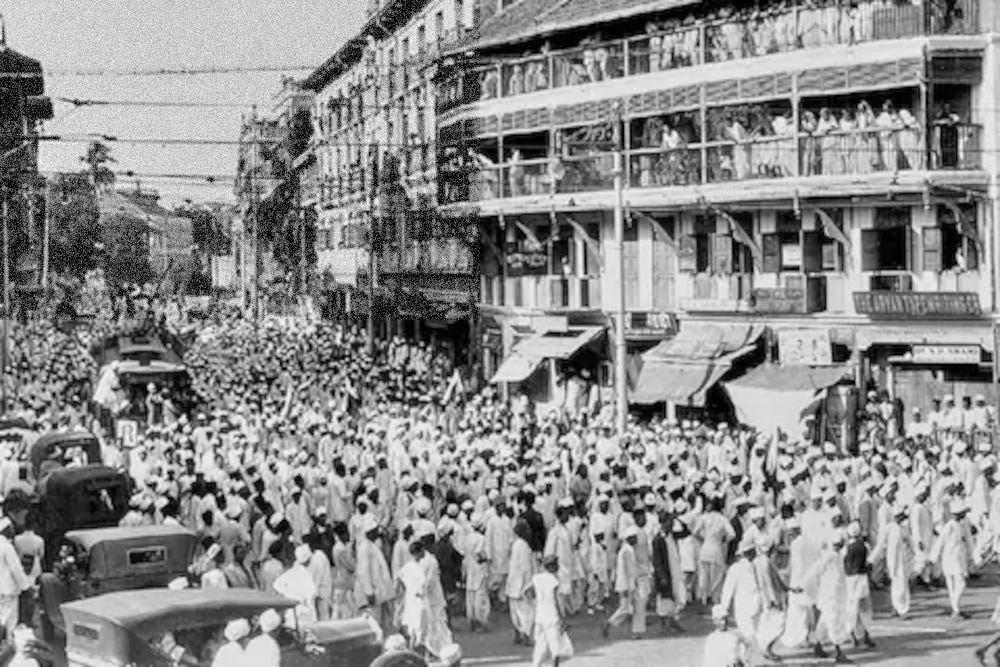
On the morning of 7 April 1930, thousands of people gathered near the Congress House in Girgaon. Ten satyagrahis led the crowd in a disciplined procession through the streets of Bombay – a column of people almost a quarter mile long. It was led by journalist Ali Bahadur Khan and Khurshid Nariman, the latter carrying a huge national flag. They marched along Lamington Road and Tardeo Bridge, and were greeted by people everywhere. At Panalal Terrace, people showered flowers on them.
When they arrived at Mahalaxmi Racecourse, they were greeted by an “imposing display of armed police.” However, they were not stopped, dispersed or arrested. Two satyagrahis fetched water from the sea, and they manufactured salt. A day earlier, on 6 April 1930, MK Gandhi had scooped a fistful of salty mud at Dandi, defying the salt laws of the British Empire, launching a nation-wide civil disobedience movement.
In the evening, more than 50,000 people gathered at Chowpatty beach in a “spectacular demonstration showing Bombay’s response to the call of the nation.” The various speakers called on people to defy the salt law, uphold national unity, and embrace non-violent struggle. Later in the evening, some protestors in Bhuleshwar set fire to foreign cloth. The police arrived and lathi charged them. Around that time, Khurshid Nariman and Ali Bahadur Khan, and several others were arrested.1
This is one episode from the country’s long struggle for freedom – a struggle waged in large part on the streets and maidans of its cities. Mumbai’s public grounds have a long history of being the principal sites for political action. August Kranti Maidan hosted the first session of the Indian National Congress (1885) and the Quit India Movement was launched from there (1942). Nardulla Tank Maidan and Shivaji Park were significant in the Samyukta Maharashtra movement, and Hutatma Chowk commemorates the 105 people who were killed during that agitation. Mumbai’s labour movement found its voice in Nare Park and Kamgar Maidan, which were also sites for numerous strikes and agitations. It was in these places that people fought for their hard won rights and freedoms. It was in these places where ties of civic commonality were forged.
In fact, most freedoms we take for granted can be traced to movements that were expressed and experienced in urban public spaces. What we call International Labour Day marks the memory of the events of the Haymarket Square in Chicago in 1886, where industrial workers protested for an 8 hour working day. What we call International Women’s Day marks the memory of movements and demonstrations of women activists and workers in the public spaces of New York, Vienna and Petrograd. In recent times, some of the most prominent movements have been centred around public spaces: economic inequality (Zuccotti Park), pro-democracy (Tahrir Square), anti-austerity (Syntagma Square).
For this reason, power systems have always tried to discipline public spaces and to use them as settings for legitimising their domination. In Mumbai, as in many other cities in India, maidans and streets have been depoliticised, commercialised, or functionally restricted. In 1997, the property owners in Nariman Point and Churchgate asked the High Court to stop the ‘disruption’ and ‘noise pollution’ due to protests and marches. The Court agreed, and ordered that all protests must terminate at Azad Maidan.2
After another recent Court ruling for ‘regulating’ protest activities, the government carved out an official ‘protest site’ within Azad Maidan for all of Mumbai. More perniciously, the Mumbai Police enforces a continuous ban on assemblies of more than 5 people through preventive orders, to “prevent breach of peace or disturbance to public tranquillity”. Since these orders can only be issued for 15 days, they are therefore re-issued every 15 days. In effect, public protests require prior police permission (which is often denied), and prohibitory orders give the police powers to arrest protestors for ‘unlawful assembly’. In other words, citizens are free to protest – provided the government allows it, and only in a designated enclosure away from the eyes and ears of those in power.
The destruction of democratic public spaces does not necessitate actual erasure; their use can be disciplined through policing, privatisation, surveillance, and restricting access. True public spaces offer not only everyday uses, but also the possibility of political expression, debate and dissent. They are places where the public goes to define what the ‘public’ means. The parliament and the courts may be institutions of the state; the streets and maidans are institutions of the people. This is where people grasp the connections between their personal and immediate troubles with the public issues of society.
The student protesters that gathered at Jantar Mantar and marched to Parliament have made this connection. Last week in Mumbai, more than 50 solidarity protesters were picked up by the Mumbai Police for ‘unlawful assembly’ from various locations.3 One may disagree with the demands of protestors, or their politics; but no one can deny them the right to agitate and occupy public space to make their demands.
In the words of an eloquent 19th century abolitionist: those who profess to favour freedom and yet deprecate agitation are people “who want crops without plowing up the ground; they want rain without thunder and lightning. They want the ocean without the awful roar of its many waters.” History shows that urban spaces have always been arenas of social struggle, and social reform is an outcome of this contradictory process. More often than not, dominant interests prevail; but each time they are defeated, new freedoms are born.
Hussain Indorewala is a teacher and urban researcher. Views are personal.
From the Bombay Chronicle, 8 April 1930. Also see Jim Masselos (2007), The City in Action: Bombay Struggles for Power, Oxford University Press.
Subscribe to Hussain Indorewala
Launched a year ago
Teacher, writer and urban researcher from MumbaiSubscribe


Leave a Reply