

Why did Indian Prime Minister Jawaharlal Nehru call NATO “one of the most powerful protectors of colonialism”?
Feb 24, 2026
The following is the transcript of a lecture that I delivered to an audience at the University of Portsmouth in February 2026. It looks at the history of NATO and its relationship with the Third World.
Introduction
It is difficult to have conversations about NATO and decolonisation in much of the West. In Poland, where I am from, I could not imagine a university hosting a space prepared to have a serious discussion on the subject. But it is a conversation that has become urgent — not least because of the increasingly alarming signals emanating from the centres of Western power.
Thanks for reading! Subscribe for free to receive new posts and support my work.
At the Munich Security Conference in February 2026, US Secretary of State Marco Rubio delivered what was the most brazen defence of the Western colonial tradition that I have encountered from a political figure in my lifetime. In fact, it took considerable effort to find anyone in the modern historical record approaching the language he used. He said that for five centuries, the West had been expanding — its missionaries, its pilgrims, its soldiers, its explorers pouring out from its shores to cross oceans and settle new continents. Notice the white supremacist twist: the story is told from the perspective of the intrepid explorer, not from the African bodies chained in the belly of his ship.
What is most remarkable is where Rubio situates the beginning of decline for this golden era of Western civilisation: in 1945, with the defeat of Nazi Germany. From that point, he argued, the great Western empires entered into terminal decline, “accelerated by godless communist revolutions and by anti-colonial uprisings.” This speech was delivered in Germany and received a standing ovation — a telling indicator of the direction of Western civilisation today.
But I want to suggest two points of agreement with Rubio. The first is that this period of imperial decline is indeed terminal. There is no reclaiming these past glories, no return to a world of hegemony, plunder, and enslavement. The second is that it was indeed the so-called godless communist revolutions and anti-colonial uprisings that had the greatest impact in bringing that decline about.
A Warning
What, then, is this European civilisation that Rubio defended? To answer that question, I begin with a warning issued some 126 years ago — one that illustrates how clearly the nature of the colonial system was understood by those outside its centre, however much it remained obscured for those within the imperial metropole. A tremendous cultural and informational apparatus has long ensured that the crimes of imperialism are consigned to the category of policy blunders or errors of judgement rather than recognised as systematic strategies. But those systematic strategies were apparent to their subjects and victims.
In 1900, the great American scholar W.E.B. Du Bois addressed the first Pan-African Congress in London with a document entitled To the Nations of the World. In it, he warned: “If the black world is to be exploited and ravished and degraded, the results must be deplorable, if not fatal, to the high ideals of justice, freedom, and culture, which a thousand years of Christian civilisation have held before Europe.” Du Bois was not endorsing the dubious history of white Christian civilisation. I think he was making two parallel appeals. First, he was appealing to the general pride in European civilisation. Second, he was appealing to the ethos of the bourgeois revolutions — the French Revolution and its proclamations of equality and democracy, principles that were never extended to the colonised or the enslaved. His warning was clear: if you do not follow through on your moral commitments, these actions will become fatal to your own project.
These sentiments echoed solemnly and furiously fifty years later — two world wars later —in the writing of the Martinican poet and politician Aimé Césaire. In Discourse on Colonialism, a short book I always recommend reading and rereading, he wrote: “Before they were its victims, Europeans were Nazism’s accomplices. They tolerated that Nazism before it was inflicted on them. They absolved it, shut their eyes to it, legitimised it, because until then, it had been applied only to non-European peoples.”
We move, then, in a way that is striking, from Du Bois’s language of appeal — which somehow still believed in the possibility of recovering within Europe the ideals of the Enlightenment and universalising them — to what is a judgement, an indictment. Elsewhere, Césaire concluded that “at the end of the road that is Europe, there is Hitler” — that there is no saving this civilisation.
The Core-Periphery Relationship
Why was it that Europe and the so-called West could not live up to its professed ideals of democracy, equality, and justice? I approach this question from within the methodological tradition of Marxism, of dialectical and historical materialism, which examines the contradictions in the international system on the basis of material realities.
In Western readings of Marxism, the primary conflict in society is understood as one between the worker and the capital owner. Marx tells the story of the English enclosures, where the peasants were evicted from their feudal estates — from the land that constituted both their means of production and subsistence — creating a landless proletariat forced into the streets of London and Manchester, surviving only by selling their labour in exchange for a wage.
This is true in the English context. But there is a broader contradiction that Marx himself hinted at, one that is frequently omitted. In chapter thirty-one of the first volume of Capital, Marx wrote that we find the “rosy dawn of the era of capitalist production” not in the factories of Manchester but in “the discovery of gold and silver in America, the extirpation, enslavement, and entombment in mines of the Aboriginal population, the beginning of the conquest and looting of the East Indies, the turning of Africa into a warren for the commercial hunting of black skins.” These, he wrote, “were the chief momenta of primitive accumulation.”
Marx never fully theorised the mechanisms by which this functioned at the international level, nor the political forces capable of mounting a serious challenge to capitalism from the periphery. But these insights sparked an entire body of work that became known as Third World Marxism — a tradition generally excised from the Western intellectual canon. These are thinkers like Vladimir Lenin, whose work on imperialism gave empirical contours to our understanding of these mechanisms; Mao Zedong in China; Amilcar Cabral, who led the anti-colonial struggle in Southern Africa; and more contemporary scholars like Utsa and Prabhat Patnaik in India and Ali Kadri in Lebanon, all of whom developed methodologies for understanding how the international system was structured.
Nor was this system a mystery to its architects. Lenin, in his work on imperialism, cites Cecil Rhodes, who, having met with working-class people in the east of London, concluded that “imperialism is a bread and butter question”. He meant that unless the wealth extracted from the colonies could be redirected to mollify the domestic working class, revolution would follow. And there is a remarkable statement from 1885 by Jules Ferry, Premier of France, who laid out what is essentially the contemporary understanding of imperialism. Europe, he said, needs colonies for three reasons — to access raw materials, to have markets for the sale of manufactured goods, and to invest surplus capital.
This aligns closely with the work of the Patnaiks, who have shown that imperialism deploys strategies of income deflation and resource price deflation that have been instrumental to the rise of capitalism in the core. The case of the Indian textile industry illustrates the mechanism. India possessed a robust tradition of textile manufacturing, which the British colonial system sought to eradicate through what might be called a double drain. The first drain forced India to export raw materials — cotton, indigo, jute — at artificially depressed prices, lowered through colonial taxation, land revenue systems that pushed peasants into cash crop production, and outright violence. The second drain took those raw materials to the factories of Manchester, converted them into finished goods, and sold those goods back to India at inflated prices. Significant tariffs on the export of Indian manufactured goods, which did not apply to raw materials, destroyed India’s indigenous manufacturing capacity. These two forms of drain existed in a vicious cycle: India’s colonial taxation regime left no funds for development, and the colony was forced to pay for the import of overpriced British goods with the export of underpriced Indian raw materials and labour. This is what we now call unequal exchange.
That system continues to structure the world. According to recent studies conducted by Jason Hickel and his colleagues, the annual drain of wealth from the Global South to the Global North amounts to approximately ten trillion US dollars per year — through interest on debt payments, underpayment for wage labour, underpayment for resources, etc. Hickel has calculated that this amount would be sufficient to provide a decent standard of living for every person in the Global South, including universal healthcare, education, modern housing, sanitation, electricity, heating and cooling, refrigerators, washing machines, public transit, computers, and mobile phones. It is easy to see why the beneficiaries of that system would go to extreme lengths to preserve it — including by waging world war.
The Second Thirty Years’ War
Understanding the nature of the two world wars is critical to understanding NATO. In Western historiography, the First and Second World Wars are treated as almost entirely distinct conflicts, connected at most by the brutal peace imposed on Germany at Versailles. But many historians — I am thinking here of the Italian historian Domenico Losurdo in particular — have used the term “Second Thirty Years’ War” to connect the world wars into a continuum of conflict driven by the imperatives of the core-periphery relationship: colonial expansion, the division of the world, and a desire on Hitler’s part to reject the Jacobin tradition in favour of a renewed racial hierarchy. In a broader sense, it is inappropriate to call these conflicts world wars. They were imperialist wars, led principally from Europe, that drew in the rest of the world through relationships of exploitation and subordination that European colonialism had created.
The Manifesto of the Communist International to the Workers of the World, published in 1919, captured this with remarkable clarity: “The colonial populations were drawn into the European war on an unprecedented scale. Indians, blacks, Arabs, and Malagasy fought on the territories of Europe for the sake of what? For the right to remain the slaves of Britain and France.” Much the same can be said about the Second World War.
Before turning to the question of NATO, I would like to interrogate three claims commonly made about the second part of this Second Thirty Years’ War: the Second World War.
The first claim is that Hitler was an enemy of the Western world. On the contrary, as Césaire and Frantz Fanon argued, Hitler was an expression of it. The effort to carve the Nazi project out of the broader colonial tradition is an effort to exculpate the rest of that tradition from its crimes — to posit a singular evil that overshadows everything that came before and after. In fact, the Nazi project was a product of the very same colonial logic that produced British colonialism, Belgian colonialism (which claimed over ten million Congolese lives), and, most precisely, the United States itself.
The US, unlike the European maritime empires, was a project of land-based settler colonial expansion grounded in the doctrine of manifest destiny, deploying ideas of racial supremacy to justify the conquest of living space. Methodologically, that idea is indistinguishable from the notion of Lebensraum — or living space for the German people, the master race. Hitler explicitly admired how the United States had, as he put it, “gunned down the millions of Redskins to a few hundred thousand” and “keeps the modest remnant under observation in a cage.” A fascinating study, Hitler’s American Model, documents how the Nazi Party deployed its leading lawyers to the United States to study Jim Crow and racial segregation, which became critical to the legal justifications for the Nuremberg Laws.
Hitler’s project enjoyed tremendous support in the West. Hitler himself hoped Germany could be “a bulwark of the West against Bolshevism.” As late as 1938, Winston Churchill said that if he had to choose between communism and Nazism, he would not choose communism. In 1941, on the eve of Operation Barbarossa, future US President Harry Truman expressed his hope that the Germans and the Soviets would exhaust each other. Until the last moment, the Western leadership hoped the Nazi state and the Soviet Union would destroy each other, creating conditions for the West to preserve its colonial holdings. It was for this reason that the Soviet Union’s attempts to form an anti-fascist coalition — including its offer to send a million troops to halt the German invasion of the Sudetenland in 1938 — were repeatedly rebuffed.
The second claim is that the West defeated Hitler. The combined losses of the United States and Britain in the Second World War numbered around 400,000. The Soviet Union lost 27 million lives and exhausted the vast majority of the Wehrmacht’s brigades. China, often ignored entirely in European historiography, waged a fourteen-year war against Japanese fascism that claimed 35 million lives. Both played the decisive role in defeating fascism — a fact widely acknowledged throughout the West, including by its political and military leadership, until the ideological imperatives of the Cold War began to chisel away at that narrative.
The third claim is that Nazism was a unique evil. Certainly, elements of its methodology were unprecedented in scope, scale, and speed. But fundamentally, the views of the Nazi leadership were the views of colonisers who regarded the colonised as subhuman — much as colonisers everywhere regarded their subjects. In a sense, Nazism was a continuation of earlier German imperial policies. Germany does not acknowledge this, but the very first recorded use of the term “concentration camp” to describe a site of torture, extermination, medical experimentation, and forced labour was in modern-day Namibia, where the Germans perpetrated the first genocide of the twentieth century against the Nama and Herero peoples.
The attempt to cleave Nazism from the broader colonial tradition serves to exculpate the rest of the West — including what came immediately after: the US war on Korea, which destroyed some twenty per cent of the North Korean population and ninety-eight per cent of its buildings; Vietnam, where three to four million lives were lost; Indonesia, where one to four million perished; or the French and British colonial administrations that operated concentration camps in Algeria and Kenya, killing millions in their wars to preserve colonial rule.
The Post-War Order and NATO’s Founding
Why go through all this history? Because 1945 is the moment Marco Rubio situates as the start of the West’s decline — the beginning of its shame, its unwillingness to act boldly, its self-subjection to international law and supranational structures. Given the surge in revisionism and fascism in Western societies, I believe there is a recognition, at least subliminal, that the political project represented by Nazism was not an aberration but the highest expression of the colonial and imperial system the West had built and inherited. Its defeat by communism was a profound humiliation for the West, one that gave enormous prestige to revolutionary projects around the world. That accelerated the second threat Rubio identifies: anti-colonial revolts. This was the period in which Britain and all the European empires began to lose their colonial holdings.
But 1945 also marked the beginning of a new configuration. Where the preceding decades had seen radical inter-imperialist wars fought over the division of colonial spoils, the era of US hegemony — for the United States emerged largely unscathed from the war — produced a coming together of the former imperialist powers into what the Egyptian scholar Samir Amin called the collective imperialism of the “Triad”, which began to centralise its institutions. NATO was a critical part of that project.
NATO was not the only military treaty signed after the war. There was also the Southeast Asian Treaty Organisation (SEATO) and the Central Treaty Organisation (CENTO). If you look at a map, all three sat on an arc encircling the Soviet Union — all part of a strategy of economic and military containment of communism. The other two no longer exist.
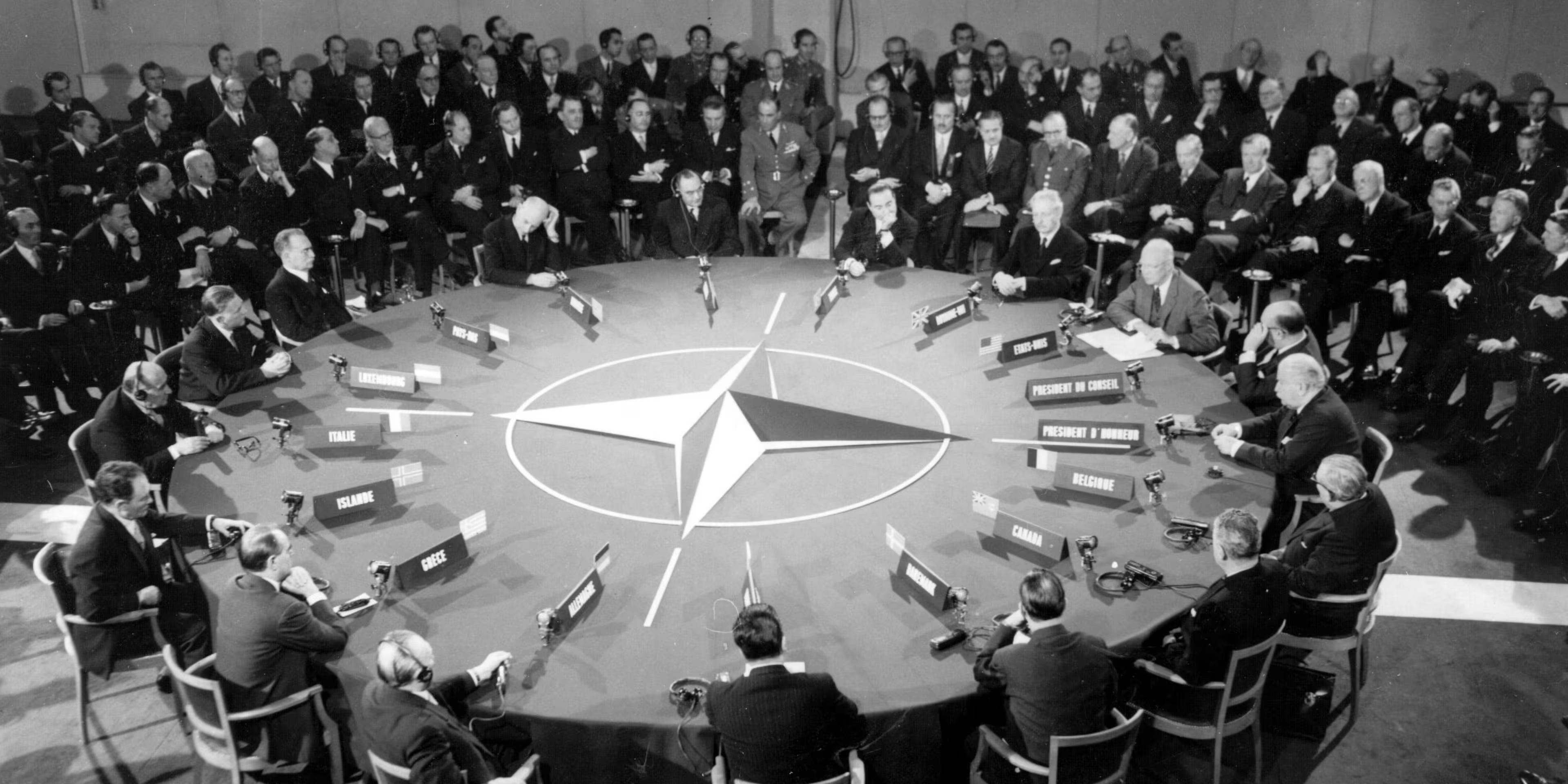
So why was NATO founded, and why does it persist? The most succinct answer comes from a quote attributed to Hastings Ismay, NATO’s first Secretary General. NATO, he said, was founded “to keep the Soviets out, the Americans in, and the Germans down.” There are two dimensions to unpack here.
The first is endogenous to Europe. Ismay surely could not have meant that NATO was prepared to defend against a Soviet invasion, because no such invasion was on the books. The Soviet Union was industrially exhausted. It lost 27 million lives. It had to rebuild. It was reluctant to engage in conflict, not least because the US possessed nuclear weapons, while the Soviets would not acquire the bomb until 1949. Even when war raged in Korea, it was the Chinese who came to the aid of the Korean anti-colonial forces, not the Soviets, who were careful not to overstep.
What “keeping the Soviets out” really meant was preventing communism from asserting itself within the political body of European countries — at that time, a very real prospect. In Italy and France, it was the communist partisans who had led the fiercest resistance to fascist rule. The communist parties had tremendous prestige after the war and were, in some cases, poised to win power. Through NATO, the United States launched a decades-long campaign to prevent this. Most famously, Operation Gladio — uncovered by the Italian parliament in 2001 — saw the US implement a “strategy of tension” by fuelling and arming violent right-wing groups to commit terrorist attacks that were later pinned on the left, generating an atmosphere of fear around the prospect of a communist takeover. Tens of millions of dollars were funnelled into right-wing parties to counter communists and socialists who were surging in democratic polls. Declassified documents available in the CIA Reading Room reveal that the United States even contemplated a military invasion of Italy should the Communist Party come to power. This was the very real threat NATO posed within Western Europe — a politics that came to be secured by the presence of US military bases across the continent. “Keeping the Americans in” referred to that proliferation of US military power across Europe.
And “keeping the Germans down” was always about preventing German rapprochement with Moscow, seen as a critical threat to US control over the broader Eurasian landmass. These three elements, at least where Europe and the West were concerned, had to do with asserting hierarchy within a collectivised system of imperialism.
In the international dimension, the picture was in many ways more alarming. Keeping in mind the core-periphery relationship, consider three voices from the Global South. Jawaharlal Nehru, Prime Minister of India, speaking at the Afro-Asian Solidarity Conference at Bandung in 1955, said that “NATO today is one of the most powerful protectors of colonialism.” Amilcar Cabral, leader of the anti-colonial movement in Southern Africa, observed that “Portugal would never be able to launch three colonial wars in Africa without the help of NATO, the weapons of NATO, the planes of NATO, the bombs of NATO.” And Fidel Castro, in the wake of the wars in Iraq and Afghanistan and during the intervention in Libya, declared in 2011 that “NATO’s brutal military alliance has become the most perfidious instrument of repression in the history of humanity.”
Why would leaders in the Global South maintain this position over so many decades? Let’s return to the founding of NATO itself. Among its earliest members was Portugal’s openly fascist and colonial Estado Novo regime led by António Salazar. In Cabral’s accounts of waging the war of liberation from Portuguese colonialism, weapons and equipment from every NATO member state were found on the battlefield. A pooling of resources became available to help member states preserve their colonial possessions. Another example: when the United States sought German rearmament within NATO, it confronted French opposition — for understandable reasons. It overcame that opposition by promising France support in its war in Algeria in exchange for its consent to German rearmament. There are many more such examples. In the refugee camps of the Western Saharan people, which I visited a couple of years ago, there is a museum to their national liberation struggle constantly updated with military equipment seized from the Moroccan forces occupying Western Sahara. Once again, the weapons come from across the NATO bloc.
Of course, two current examples must be emphasized. If we look at the genocide in Gaza, all thirty-two NATO member states with the exception of Canada, the Netherlands, Spain, and Belgium provided weapons to support the destruction, with some — including Britain and Germany — increasing their support during the war. NATO bases around Europe were used to deliver these supplies. Once again, an anti-colonial rebellion was being quelled by collective power of the NATO bloc. And as of today, NATO infrastructure is facilitating the largest military buildup in West Asia since the Gulf War, seemingly in preparation for war against Iran — a state that is also structurally positioned in opposition to imperialism.
There is, then, a close interrelationship between NATO’s role in preserving capitalism within Europe and its role in preserving the foundational conditions of capitalism in the periphery — conditions of insecurity and instability that allow wages, incomes, and resource prices to be deflated, sustaining the process of unequal exchange.
After the Cold War
If the threat of communism was the reason for NATO’s founding, why did NATO persist after the collapse of the Warsaw Pact? When you study the documents of the early 1990s, quite the opposite picture emerges: with the collapse of the Soviet Union, NATO finally found its purpose.
In the 1980s, Soviet Premier Mikhail Gorbachev had proposed building a common security architecture for Europe — part of his vision for a “Common European Home”. This was carried forward in the Conference for Security and Cooperation in Europe, which took place in 1991 and issued the Charter of Paris for a New Europe — a document that set out blueprints for a common security architecture including the Soviet Union, grounded in principles of sovereignty and mutual respect.
The United States rejected this. In February 1990, President Bush called German Chancellor Helmut Kohl and said: “To hell with that. We prevailed. They didn’t. We can’t let the Soviets clutch victory from the jaws of defeat.” A few months later, he told France’s François Mitterrand: “No organisation will replace NATO as the guarantor of security in Europe.” The US was not prepared to cede that ground.
And so began the process of NATO expansion, the rationale for which was articulated in the Defence Planning Guidance, a document written by Paul Wolfowitz and leaked to the New York Times in 1991. (After revision by Dick Cheney, this document became known as the Bush Doctrine, which would later guide the dismantling of Afghanistan and Iraq.) The document stated that the principal goal of US foreign policy in the post-Soviet era was to prevent any state from ever rising to the stature of the Soviet Union again — an explicit commitment to preventing states from developing.
All of this was cloaked in paternalistic language that echoes in what some today call Europe’s vassalisation — a phenomenon I would argue is not new but dates back decades. It is clearly visible in the debates on NATO enlargement, one of whose principal cheerleaders was Joe Biden, then a senator. In the 1997 Senate debate, he declared that “Europeans have proven incapable, left to themselves, of settling their differences peacefully,” and that the United States must play a leading role.
The real motivation for this process was captured most clearly by Zbigniew Brzezinski, architect of the containment strategy against the Soviet Union, who wrote in 1997 that “America is not only pursuing its larger Eurasian geostrategic goals but is also representing its own growing economic interest in gaining unlimited access to this hitherto closed area” — the area that the existence of a socialist state had foreclosed to imperialist accumulation. “At stake,” he wrote, “are geopolitical power, access to potentially great wealth, the fulfilment of national and religious missions, and security. The particular focus of the contest, however, is on access.” Until the collapse of the Soviet Union, he said, access to that region had been monopolised by Moscow.
It has to be noted that Brzezinski also said that the key piece on this chessboard would be found in Ukraine.
Thanks for reading! Subscribe for free to receive new posts and support my work.


Leave a Reply