
August 3, 2026
FacebookTwitterRedditBlueskyEmail

Boreas, the god of the North Wind, blows Odysseus across the Mediterranean. 4th-century BCE pot, Thebes. Ashmolean Museum, Oxford University.
Now Washington, like Xerxes, crosses seas,
Assured the world must bow before its might;
But nations rise beyond its old decrees,
And build without permission – or its light.–V.P.
In the London Review of Books, Emily Wilson, the renowned translator of Homer’s Odyssey from Greek to English in 2017, made her views plain about Christopher Nolan’s film The Odyssey. Nolan, who won an Oscar for Oppenheimer (2023), had read Wilson’s translation and borrowed from it. But Wilson felt that the interpretation had done an injustice to Homer’s original (‘I would be ashamed to have written any part of this script’, she writes). To be fair, Wilson acknowledges – as any translator would – that each translation or rendition is an adaptation. She did not like Nolan’s film (apart from it being a respite, in an air-conditioned hall during a heatwave). That much is clear. What her review, which has been widely read, circulated as well as criticised, does not interrogate, however, is not whether Nolan is faithful to Homer, but what Nolan is telling us about our own times.
Between his The Dark Knight trilogy (2005-2012) and The Odyssey, Nolan has made it clear that he distrusts concentrated power (government surveillance in The Dark Knight and political persecution in Oppenheimer). Homer’s saga was a perfect place to lay out his own version of the damage being wrought in our age: the world was held together by Zeus’s law or xenia (a sacred, reciprocal guest-host relationship), to treat strangers as one would expect to be treated, which Odysseus violated – as Nolan suggests – with the Trojan Horse. That violation, rather than his other smaller acts of disrespect for the gods (such as the blinding of Poseidon’s son the Cyclops shepherd Polyphemus), destroyed the balance and brought the anger of the gods against the world. The balance had to be restored, for which Odysseus first returns home, kills the suitors who have entrapped his wife Penelope, places his son, Telemachus, on the throne of Ithaca, and then goes into a lifelong exile towards the western lands.
The comparison should never have been between Homer’s original text and Nolan’s film, but it should have been between Nolan’s film and an earlier attempt by Hollywood to depict the Homeric tragedy. In 1954, the Italian director Mario Camerini released a big budget film, Ulysses, starring Kirk Douglas (fresh off his box office success with The Bad and the Beautiful, 1952). Paramount Pictures, which produced the film, selected Camerini despite his role in Italian fascist cinema (he made The Great Appeal, 1936, a propaganda film for the Italian colonial wars in Africa). Camerini’s film followed the overall plot line of Homer’s Odyssey, generously translated at that time into English by the classicist and publisher E. V. Rieu during World War II, first for his family as a way to distract them from the bombs falling on London, and then for the English-speaking audience as a way to remind them of the great classical heritage that had been torn asunder by the European wars. Kirk Douglas treated Odysseus’s trial as that of a man who had to overcome obstacles to triumph. The violation of xenia was not the core theme, nor was the disorder occasioned by that violation and by the scale of the bloodshed. Camerini’s Odysseus is animated not by guilt, but by a manly sense of duty. This was a Cold War film, with Douglas as the great American hero who would overcome trials to triumph. As in Homer, Camerini’s Odysseus does not go into final exile but merely takes his throne as is his right and rules as if there was nothing of the absolute collapse of civilisation.
Nolan does not share Camerini’s politics or his era. Camerini’s Odysseus is triumphant, while Nolan’s is exhausted and remorseful. Guilt is Nolan’s central motif: the guilt of Oppenheimer for the atom bomb’s creation and the guilt of Odysseus for the violation of xenia. There is an overpowering feeling in Nolan’s films that the Western world faces an existential challenge of leadership, that it is the West that has broken an older equilibrium, and that now disaster is before us. It is as if the liberal ‘rules-based international order’ has been so significantly eroded that the West can no longer exercise leadership over the world. Nolan’s Odysseus is not merely the West in general. He is the United States after three decades of unrestrained power: victorious, disoriented, pursued by the consequences of his own violence, and unable to imagine a world that he does not organise. Matt Damon’s Odysseus sits with Calypso (the ‘burner of ships’) and racks his memory to understand what has happened and what he must do. The medicine to help him recover, the lotus flower, is also the medicine that blinds him from action. It is when he tosses that aside (the methamphetamines, the oxycontin, the far right of a special type) that Odysseus knows his mission.
The West has violated its own order, Nolan suggests. Ithaca’s people are worried about the Sea People, who might invade at any time. ‘Our civilisation is under attack’, says Penelope to Odysseus, who says to her that their ‘Bronze Age civilisation’ will return. He comforts her, but what does he know who does not even know the nature of the threats. The contemporary Sea People are the Russians, the Chinese, the Iranians, and all those whose refusal to submit to Western power is interpreted as barbarism at the gates. Nolan’s Odysseus does not leave Ithaca to battle them. He goes into exile as an act of contrition, leaving Telemachus to restore xenia, which in Nolan’s political imagination becomes the liberal ‘rules-based international order’.
But the problem is not merely that the United States violated an otherwise benign order. That order was built to preserve Western privilege, with its rules enforced against adversaries and suspended for allies. Nolan can imagine the hegemon’s guilt, but not the emancipation of those who have lived beneath its power. His Odysseus can confess, surrender the throne and disappear into the West, but the world must still be repaired by his son. This is the limit of the Western liberal imagination: it can contemplate contrition and even abdication, but it cannot imagine an equilibrium made by the peoples who were once treated as marauders beyond Ithaca’s walls.
As I watched Nolan’s Odyssey, I wondered what he might have made of Aeschylus’s The Persians. Written after the Battle of Salamis in 480 BCE, the play does not simply celebrate a Greek victory. It enters the Persian court, listens to the grief of the defeated and presents Xerxes as a ruler broken by the hubris of imperial expansion. A contemporary adaptation would require an inversion. Despite the play’s title, it is Washington that now occupies the structural position of Xerxes: crossing seas with enormous armies, confident that superior force can compel distant peoples to submit. Iran and the other states that refuse this submission stand outside the imperial imagination, not as invaders of civilisation but as evidence that the age of unilateral Western power is ending. Nolan gives us an Odysseus who feels guilty and retreats. Aeschylus might have given us something more useful: an empire forced to recognise its limits and a world that no longer waits for Ithaca’s permission to rebuild itself.
Vijay Prashad is the Director of Tricontinental: Institute for Social Research. His most recent book (with Grieve Chelwa) is How the International Monetary Fund Suffocates Africa (from Inkani Books).

Worst cruise ever.
Jul 31, 2026
Today’s Substack is for the estimated fourteen people out there who have not seen The Odyssey. If you’re one of them, I’m sure you have your reasons. Maybe you’re just now emerging from a coma. (Congratulations! Although you picked a bad time.) Or maybe your schedule does not permit you to sit through a movie requiring roughly the same time commitment as graduate school. Fine, but you still need to know what happens in The Odyssey, because EVERYBODY is talking about it. It is, by far, the single most important cultural event of the past two or even three weeks.
Which is why today I am presenting, in its entirety, the screenplay for The Odyssey, which was written by famous director Christopher Nolan based on a story by the ancient Greek screenwriter Homer, who spent 2,700 years in development meetings but tragically died before seeing the film get made. Speaking of dying, here’s a:
SPOILER ALERT: All of Odysseus’s men get killed in the movie. You should skip over this spoiler alert if you’d rather not know that.
But enough preamble. It’s time for the complete, unedited screenplay of the film that launched a thousand tedious think pieces…

We’re on a beach. A giant wooden horse is half-buried in the sand. Sitting nearby is a Greek warrior named Sinon. Suddenly he sees a group of mounted Trojan warriors in full body armor galloping toward him. Sinon jumps up and stands in front of the wooden horse. The Trojans shoot arrows into him.
SINON: Hey! Why did you do that?
TROJAN WARRIOR LEADER: We’re very irritable because this armor is insanely hot, for beachwear. We can fry eggs on ourselves. What is this enormous wooden horse doing here?
SINON: It’s a gift from the Greeks.
TROJAN WARRIOR LEADER: You mean the same Greeks who have spent the past ten solid years trying to figure out a way to get inside the walls of Troy so they can pillage the city and kill us all?
SINON: Yes. But don’t worry! There’s nobody hiding inside.
TROJAN WARRIOR LEADER: Well OK then! We’ll take it.
(He throws a spear into Sinon.)
SINON: You’re welcome. (Dies.)
The scene shifts to Odysseus’s royal palace, ten years later. Odysseus’s wife, Penelope, is weaving a funeral shroud for her father-in-law, Laertes, although she’s been weaving it for so long now that what’s left of him could probably be enshrouded with a tea cozy. In the next room dozens of hairy, sweaty suitors with poor personal hygiene are gnawing on haunches of meat. Prince Telemachus, who is Odysseus’s and Penelope’s pouty Gen Z son, enters, pouting.
PENELOPE: Why the pouty face, son?
TELEMACHUS: Dad has been gone for 20 years. Maybe he’s dead!
PENELOPE: No, he’s just running a little late. Remember he had to do all those Bourne movies, except the one starring Jeremy Renner.
TELEMACHUS: OK, but meanwhile these suitors are eating all our meat haunches. Plus they’re gross. The palace smells like a sack of unlaundered jockstraps.
PENELOPE: Don’t worry, son. When Odysseus returns, he’ll beat the living shit out of them in a climactic scene.
TELEMACHUS: I can’t wait!
PENELOPE: Well it’s going to be a few more hours. Meanwhile we need to jump backward ten years, because confusing timelines are the hallmark of Christopher Nolan films.
The scene shifts to Troy, ten years earlier. We see the interior of the wooden horse, which is inexplicably well lit. Odysseus and his men are jammed together in a sweaty, smelly, nightmarishly claustrophobic mass.
ODYSSEUS: This is definitely the last time we book with Airbnb.
(Everybody enjoys a hearty Greek laugh.)
ODYSSEUS: But seriously, men, it’s time to pillage Troy.
They exit the horse and engage in a lengthy battle scene, during which Odysseus shoots several hundred arrows, every single one of which kills a Trojan soldier. After the battle Odysseus and his men gather back on the beach.
ODYSSEUS: Well, we finally won the Trojan war. It’s time to go home!
SOLDIERS: Sir, do we have to keep wearing these helmets?
ODYSSEUS: What’s wrong with our helmets?
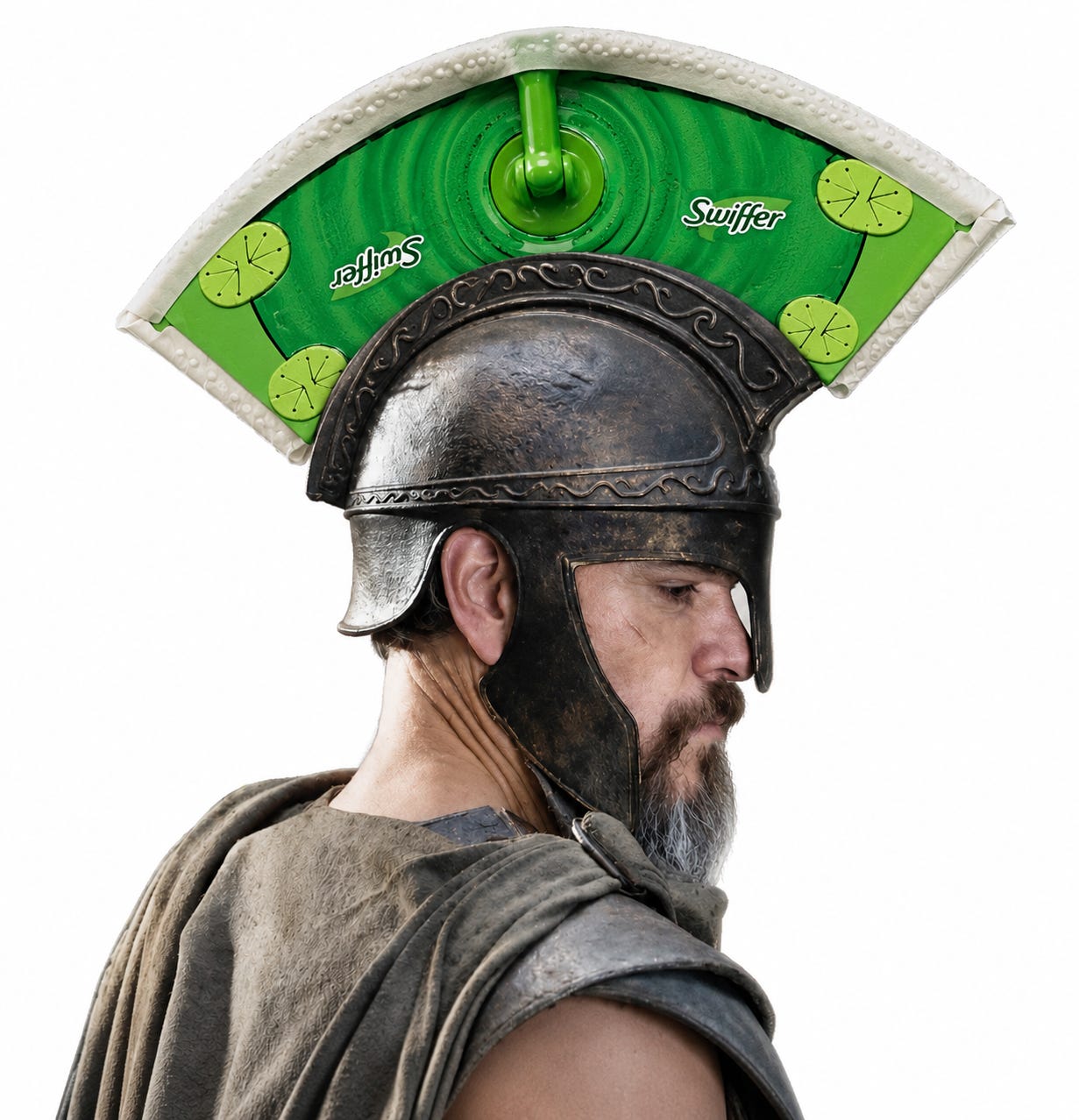
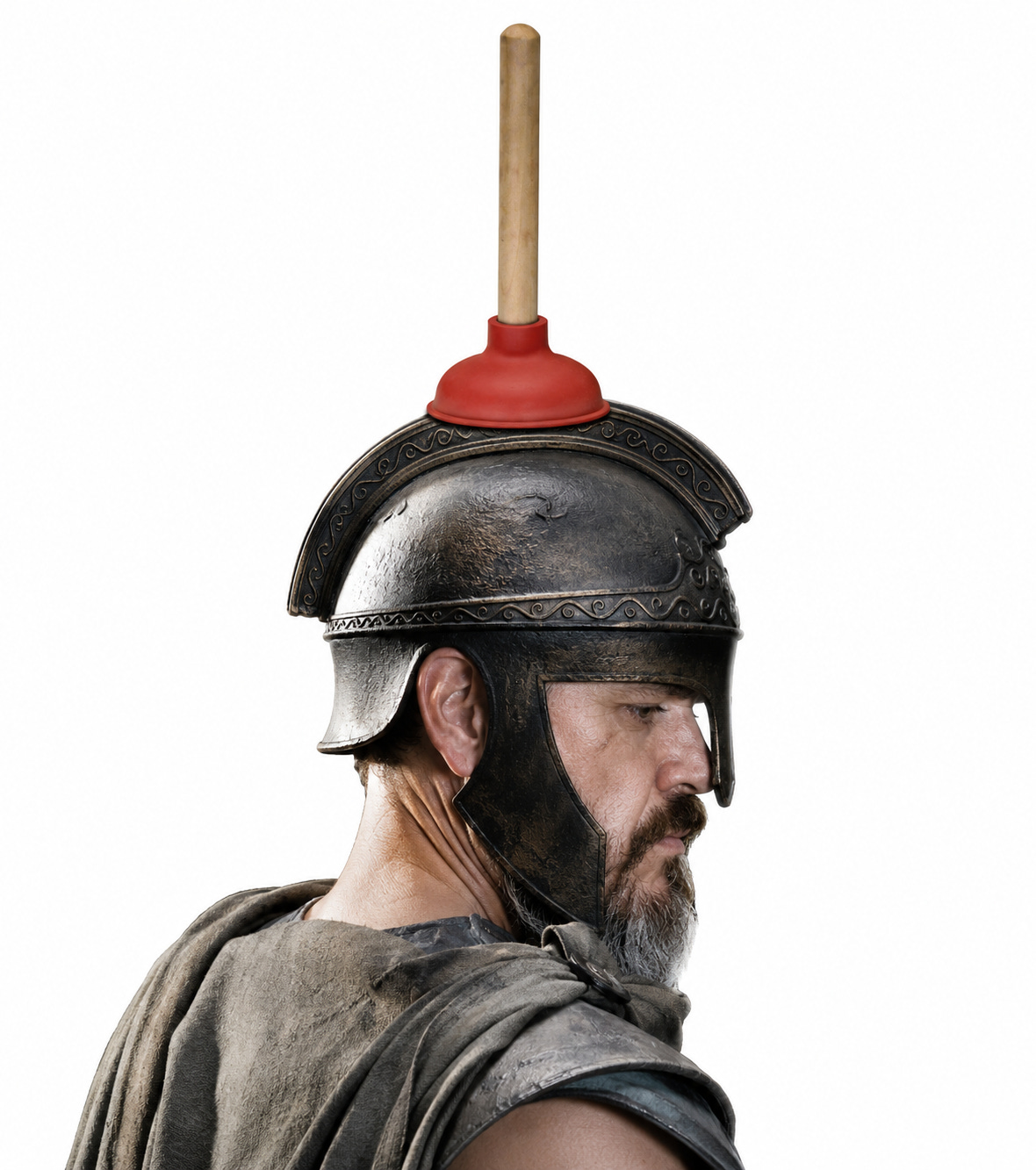
SOLDIERS: It looks like we have brooms on our heads.
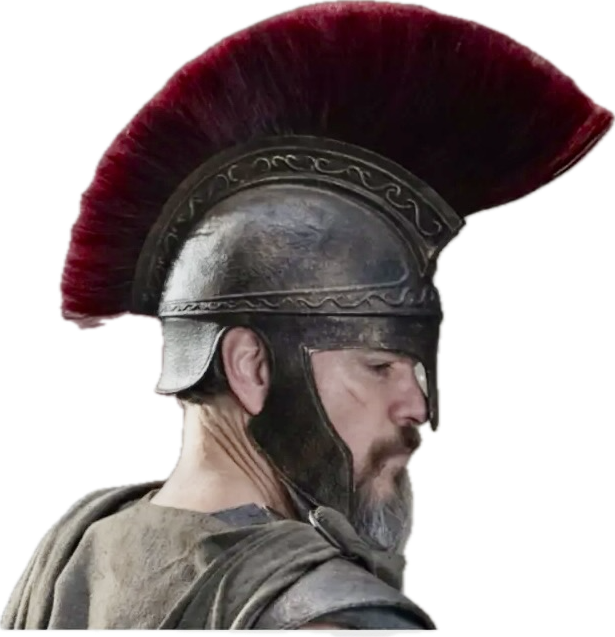
ODYSSEUS: They’re not brooms! They’re horsehair crests, which make us appear larger and more intimidating in battle, according to Google AI.
SOLDIERS: With all due respect, sir, nobody is going to be intimidated by men wearing headgear festooned with what appear to be janitorial implements, as illustrated by the examples below:
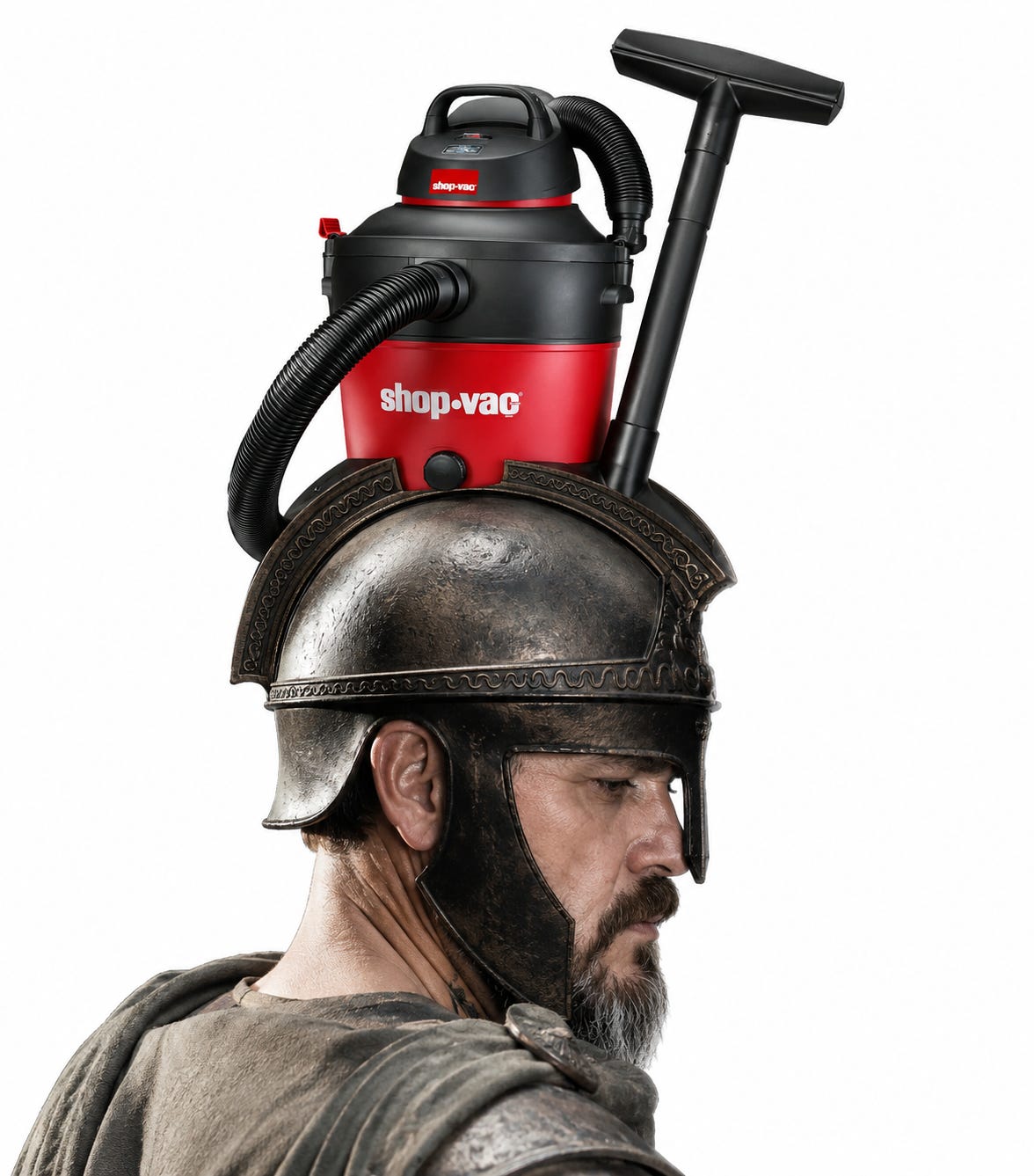
ODYSSEUS: Well I’m the leader, and I say we keep the helmets. Now let’s get into this large rowboat and proceed home via a route that has us stopping on various islands, all which will be inhabited by homicidal supernatural creatures.
SOLDIERS: Good thing we have these scary broom hats.
ODYSSEUS: What was that?
SOLDIERS: Nothing, sir.
The scene shifts back to the palace, ten years later. Penelope is still weaving the shroud. The suitors are still gnawing on haunches. Telemachus is still pouting.
TELEMACHUS: Mom, when will Dad ever get home?
PENELOPE: Oh shut up.
The scene shifts to an island where Odysseus and his men have stopped to search for food. Odysseus, leading the way, comes to the entrance of a dark creepy cave that might as well have a sign saying DANGER DANGER MONSTER LAIR DO NOT ENTER!!
ODYSSEUS: OK men, let’s all just walk right into this cave.
SOLDIERS: Sir, should we maybe post somebody outside as a lookout?
ODYSSEUS: Nah.
Odysseus, with his men following, enters the cave, which gets darker and creepier. Suddenly they hear scary noises outside. They turn and look fearfully toward the cave entrance.
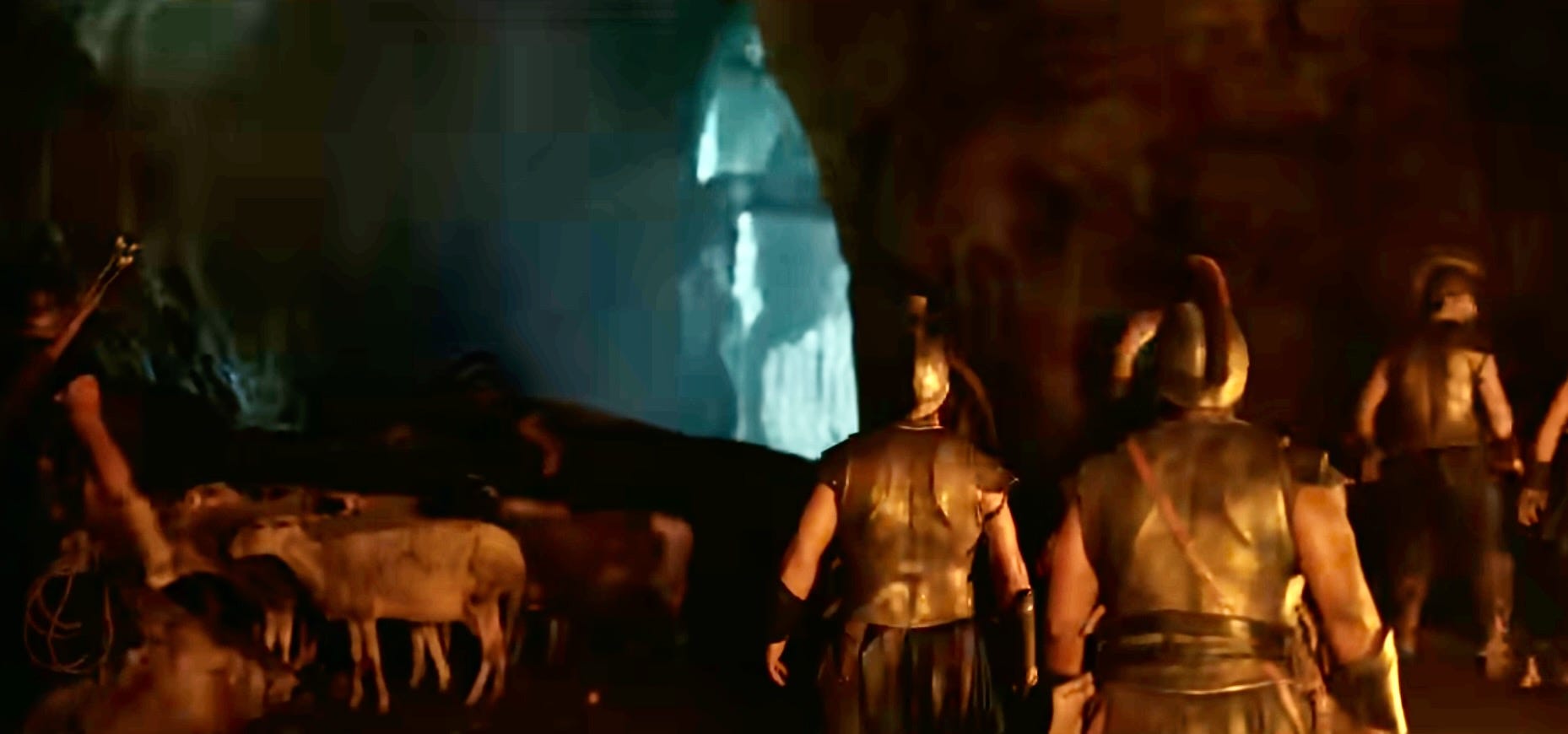
As the scary noises grow louder the tension in the cave becomes unbearable. And then there it is, looming in the entrance, a horrific apparition:
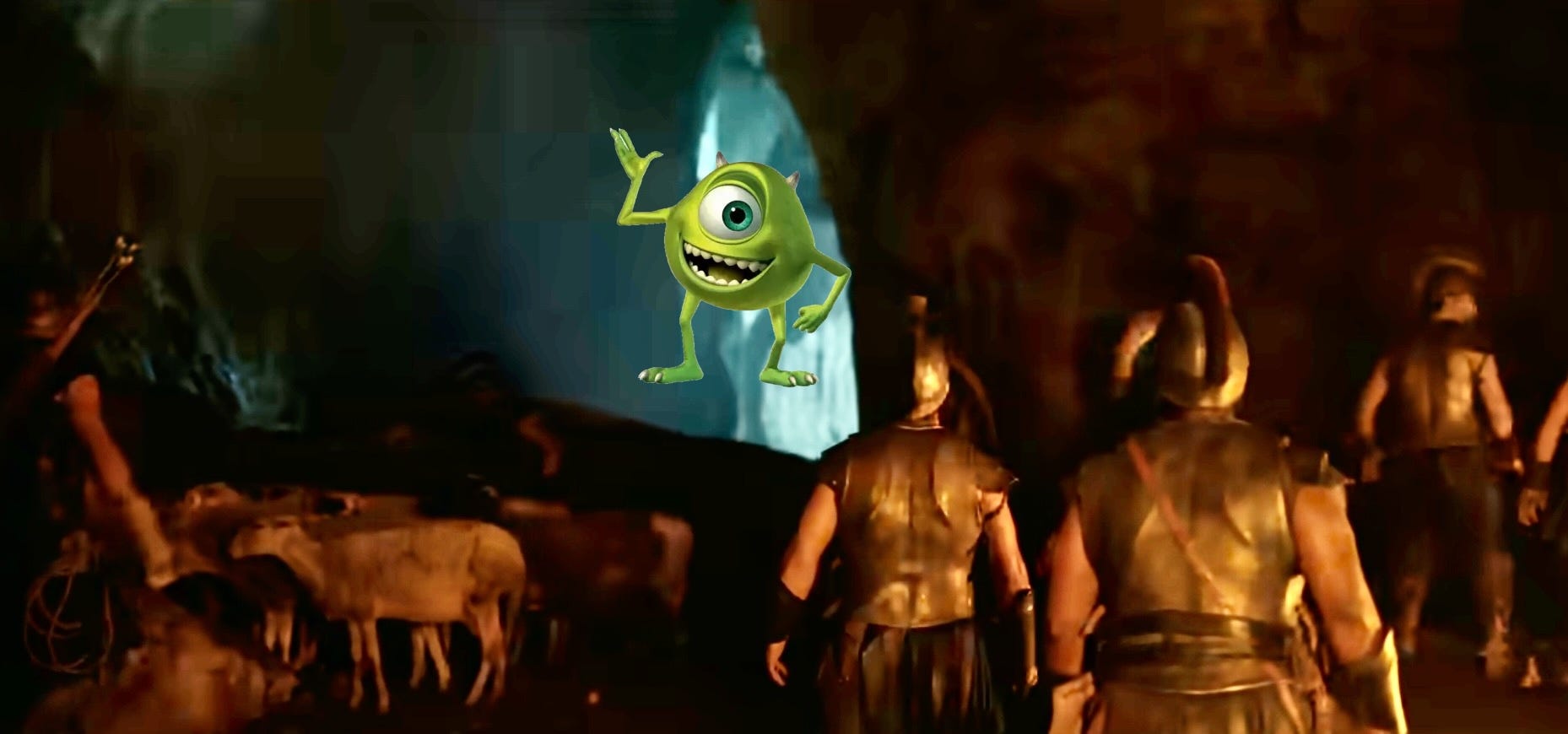
ODYSSEUS: Uh-oh! A cyclops! Try not to let it snatch you up and munch on you like a human corn dog, men!
Despite Odysseus’s warning, several men get eaten by the cyclops, which then lies down and falls asleep.
ODYSSEUS: This is our chance, men. We’ll poke out its eyeball with a sharp burning stake.
SOLDIERS: Won’t that upset it?
ODYSSEUS: Nah.
As everybody in the movie theater cringes, Odysseus and his men poke out the cyclops’s eyeball. This puts the cyclops in a testy mood. Nevertheless Odysseus and his men finally escape, although the cyclops kills a bunch more of them as they flee back to the boat. Frantically they shove off and head back out to sea.
ODYSSEUS: OK, lesson learned. No more creepy caves! Instead let’s find an island that has a creepy foreboding forest where we can look for food.
SOLDIERS: Sir, maybe looking for food on these creepy islands isn’t such a great idea. Couldn’t we just stay on the boat and catch fish, which abound in the Mediterranean Sea, and eat them?
ODYSSEUS: Nah.
They land on another creepy island and Odysseus leads his men into a foreboding forest, where they encounter a race of giant homicidal knights, who hack many of them to pieces as they flee back to their boat. Frantically the survivors put out to sea again.
ODYSSEUS: Whew! That was a close one! Fortunately we escaped with a loss of only about three-quarters of the men. Time to find yet another creepy island where we can look for food.
SOLDIERS: Sir, maybe we should…
ODYSSEUS: Nah.
They land on a creepy island where a witch named Circe turns Odysseus’s men into pigs. Odysseus persuades Circe to turn them back into humans, which, given future plot developments, is maybe not the optimum outcome for them. Back on the boat, they prepare to face their next deadly peril: sailing past the Sirens.
ODYSSEUS: Everybody put beeswax in your ears so you won’t hear the Sirens, whose song drives men insane. Also, tie me to the mast so I can listen to them.
SOLDIERS: Won’t that drive you insane?
ODYSSEUS: Nah.
The men tie Odysseus to the mast. As the boat nears the Sirens, Odysseus hears their voices.
SIRENS (singing): “She wrecked the car, and she was sad, and so afraid that I’d be mad, but what the heck…”
ODYSSEUS: No! Not “Honey,” by Bobby Goldsboro! MAKE IT STOP!!
SIRENS: OK, then how about this one? (Singing:) “Someone left the cake out in the rain…”
ODYSSEUS: NOOOOOOOOOOOOOO
Finally the boat makes it past the Sirens, only to encounter a whirlpool and a sea monster, which eats several men. At this point Odysseus is running seriously low on men.
ODYSSEUS: OK, I talked to some dead people in Hades, and the plan now is, we’ll sail to an island that has cows on it, but we can’t eat them because they belong to a god, so basically we’ll just sit around starving.
The remaining men look like they might be about to say something.
ODYSSEUS: Whatever it is, nah.
They sail to the island, where the starving men eventually break down and eat the cows, which angers the gods, so when Odysseus and his men try to sail away a terrible storm destroys the boat and kills everybody except Odysseus, who is left clinging to some floating wreckage.
ODYSSEUS (pensively): I started this voyage with hundreds of men under my command, and now they’re all dead. I wonder… should I maybe have made some different tactical decisions?
He stares into the distance for a few moments.
ODYSSEUS: Nah.
The scene now shifts back to the palace, where the weaving, gnawing and pouting continue.
TELEMACHUS: Mom, I just thought of something.
PENELOPE: What is it, son?
TELEMACHUS: What if the reason Dad hasn’t come home is that he’s been hanging out for years on a private island with Charlize Theron?
PENELOPE: Don’t be ridiculous. She’s 50 years old! Whereas I’m only 43 and have had very little work done, despite what you may read on social media.
TELEMACHUS: But what if Charlize Theron is in excellent physical shape, and wearing some kind of slinky fishnet outfit?
PENELOPE: No, your father would never… How slinky is it?
TELEMACHUS: It’s pretty slinky.
The scene shifts to a beach where Odysseus, now gray and grizzled, is being fed lotus petals by Charlize Theron.
ODYSSEUS (chewing thoughtfully): Charlize Theron, it just now occurs to me to ask you this question: How long have I been on this island?
CHARLIZE THERON: Seven years.
ODYSSEUS: Whoa, no wonder I’m grizzled! Well it’s been great hanging out, and thanks for all the petals, but I really should be getting home to my beloved wife whatshername. My plan for getting there is to make a small crude raft with no provisions, lie down on it and just float away.
CHARLIZE THERON: That should definitely work.
Odysseus makes a raft and floats back to his kingdom, but nobody recognizes him because he’s grizzled and wearing a hoodie. He goes to the palace, where all the suitors have gathered for the climactic scene. Penelope stands before them holding Odysseus’s bow.
PENELOPE: I will marry whoever can string this bow!
TELEMACHUS: Mom, that seems like a pretty random way to…
PENELOPE: Shut up.
One by one, the suitors try to string the bow, but they can’t.
ODYSSEUS (from inside his hoodie): Let me try.
Everybody laughs, but Odysseus strings the bow. He plucks the bowstring.
BOW: Twang.
PENELOPE (perking up): I know that twang!
SUITORS: It’s Odysseus! Let’s kill him! We outnumber him 108 to one, so it shouldn’t take long!
A climactic fight scene ensues, lasting approximately an hour but feeling more like two. The suitors attack Odysseus with arrows, swords, spears, daggers, catapults, guillotines and a primitive Bronze Age taser, but he eventually manages to kill or maim them all. Finally, battered but victorious, surrounded by bloodied bodies, he turns to Penelope.
ODYSSEUS: Honey, I’m home!
PENELOPE: You big goof! I’d hug you, but you literally have arrow shafts protruding from your torso.
ODYSSEUS: Ha ha! I’ll have those looked at. Then we’ll leave forever on a sailboat.
TELEMACHUS: Can I go too?
ODYSSEUS: No, you have to stay here and be the king.
TELEMACHUS: But I was hoping the three of us could spend some quality…
ODYSSEUS AND PENELOPE: Oh, shut up.
In the final scene Odysseus and Penelope board a ship, and, as Telemachus waves poutily from the shore, they sail away forever. Setting aside the massive number of hideously gruesome and largely unnecessary fatalities that occurred over the course of the plot, it’s a happy ending: The two lovers, reunited at long last, are literally sailing into the sunset. As the film ends, Penelope leans close to Odysseus and whispers softly in his ear.
PENELOPE: We need to talk about Charlize Theron.
ODYSSEUS: Shit.
The right hates The Odyssey because of its ‘wokeness’ – but it missed an even bigger threat to its worldview

The new film extols the value of a rules-based world order. That’s far more radical than any casting decision
- Peter Swallow is Labour MP for Bracknell, and the chair of the all-party parliamentary group on classics. Before his election, he was a classics teacher and academic
Mon 3 Aug 2026 03.00 EDTShare827
For years, a small but vocal corner of the extremely online right has looked to the ancient world to justify its polluted brand of politics. The classicist Donna Zuckerberg (sister of Facebook founder Mark) wrote a book about it way back in 2018 called Not All Dead White Men – a deep dive into the corners of the internet where misogynists pretend ancient philosophy can justify their hatred of minorities.
You would think that these self-appointed guardians of the ancient world would be excited about a blockbuster retelling one of its greatest pieces of literature, the Odyssey. Especially when Christopher Nolan’s film has been getting rave reviews, “the vast majority … written by men”, as the Guardian’s Catherine Shoard has pointed out. The Odyssey is an action-packed thriller with a fight scene every five seconds. In many ways (and I don’t mean this as a criticism of Nolan; I loved the film for all its flaws), it’s a movie designed to appeal to their tastes. And yet.
javascript:false
Many rightwing commentators have been railing at the film’s perceived “wokeness” for months – since well before it hit cinemas. Nolan’s biggest crime seems to have been casting Lupita Nyong’o, a black woman, as Helen of Troy, the entirely mythical daughter of Zeus. In other versions of her myth, she was born out of a swan’s egg alongside her mortal sister Clytemnestra and her two brothers, who were either gods or mortals depending on which one you read. I can see why they’re worried about inaccuracy …
There have been plenty of other criticisms from keyboard warriors concerned about a lack of historical accuracy in a film adaptation of an entirely fictional myth. Having a PhD in classics means I agree with them that Corinthian helmets aren’t historically accurate to the film’s bronze age setting; having a sense of proportion and an understanding of artistic licence means I don’t really care.
Elon Musk has, perhaps predictably, emerged as the loudest critic, even calling Nolan an “anti-White racist” and suggesting he might use Grok to create an AI-powered Odyssey movie “that is historically accurate and true to the art of Homer”. But as ridiculous as that all is, the right shouldn’t hate Nolan’s Odyssey for its inaccuracies. They should hate it because of what it has to say about the very real, very Homeric concept of xenia.
Xenia, which Nolan translates as “Zeus’s law”, was an ancient custom that governed how people were supposed to treat strangers. Zeus’s law is absolutely original to Homer. In fact, it’s a pretty fundamental part of the poem. When I taught GCSE students about the Odyssey, xenia was one of the first concepts I’d teach them. In Homer’s Odyssey, as in Nolan’s film, it drives how different civilisations and cultures are supposed to interact with one another in society. People (and monsters such as the Cyclops) who break Zeus’s law are punished; those who uphold it (such as Odysseus’s son, Telemachus) are rewarded.
But Nolan’s take on xenia is unmistakably modern. To me, it feels like an allegory for the fraying, rules-based international system. Whether it’s state sovereignty being undermined by Russia, international maritime law under threat from China or Donald Trump’s disdain for global multilateral cooperation on everything from trade to defence to the climate crisis, the rules-based order established after the second world war is under threat.
At the end of the movie – spoilers – Odysseus and Penelope see their entire bronze age Greek civilisation collapsing. This is based on an actual historical event, the Mycenaean collapse. In Nolan’s retelling, it happens because the people of the sea are raiding and warring, breaking Zeus’s law.
The message for a modern audience is, again, not subtle: society will collapse if we abandon our rules-based international order. If Nolan’s film really is “woke”, this is why – because it’s fundamentally a film about the value of multilateralism produced for an increasingly nationalistic world. Musk and co seem to have missed this message. But it’s the real reason why they should hate the film. It pushes back against everything the hard right are trying to achieve and instead makes clear that a commitment to international diplomacy isn’t a nice-to-have – it’s a prerequisite to civilisation.

And, yes, for all those complaining, that’s not in the original poem. Nolan’s film is a reimagining. But here’s the truth about classics. Nobody gets to decide how all those wonderful ancient stories get retold, rewritten for new times or redeployed to make new arguments or share new perspectives. No one person gets to own the ancient world. Especially not Elon Musk.
- Peter Swallow is Labour MP for Bracknell, and the chair of the all-party parliamentary group on classics. Before his election, he was a classics teacher and academic
At this dangerous time
We hope you appreciated this article. Before you close this tab, we want to ask if you could support the Guardian at this dangerous time for journalism in the US. For the next several days only, we are offering 50% off our most impactful monthly support option.
According to a leading global watchdog, American democracy is now more imperiled than at any point since the 1960s, marked by a precipitous decline in press freedom – driven by mounting pressure from the Trump administration in the form of threats, criminal investigations, politicized regulation, frivolous lawsuits and, for public media, catastrophic funding cuts.
Meanwhile, organizations that are supposed to be independent like the FBI and the FCC, our radio and television regulator, have also been targeting press freedom under Trump-aligned leadership, with the FBI raiding a reporter’s home and the FCC threatening ABC’s TV licenses after Jimmy Kimmel made a joke about Melania Trump.
The response from some ultra-wealthy and corporate media owners, keen to appease the president, has been chilling: CBS News has been taken over by a Trump ally; CNN may be taken over by the same billionaire; Jeff Bezos has continued to impose cuts and editorial interventions at the Washington Post; and multiple outlets have settled multimillion-dollar lawsuits from the administration to protect their business interests.
Democracy is best served by a robust, thriving free press. But when that freedom is under attack, it falls to a determined few news organizations to ensure the full truth still reaches the public. Owned neither by a billionaire nor a corporation, the Guardian remains dedicated to covering this administration with uncompromising moral and factual clarity – and to keeping trustworthy journalism paywall-free for the world.
Despite the risks of maintaining our fierce independence, what sustains us – and fills us with deep gratitude – is the unwavering support we’ve seen from readers. It is no exaggeration to say that we are here because of you: a majority of our funding comes directly from people like you responding to messages like this. Your support not only powers our work, but more importantly, it safeguards the financial independence that underpins our editorial freedom and courage.
We know our requests for support are not as welcome as our reporting, but without them, it’s simple: our reporting wouldn’t exist. Of course, we understand that some readers are not in a position to support us, and if that is you, we value your readership no less.
But if you are able, please support us today. All gifts are gratefully received, but for the next several days only, we are offering a 50% discount for six months off our most impactful monthly support option. (Among the great benefits you get in return: you’ll see far fewer annoying fundraising messages like this.) It takes just 37 seconds to set up. Thank you


Leave a Reply