

Explore four reasons why India’s film industry has increasingly aligned with political messaging under Modi, while Hollywood has not produced a comparable wave of Trump-focused mainstream films.
Deep Sharma | Fascism in India
Jun 27, 2026
If you look at India over the past decade, the steady appearance of films that flatter the worldview of Narendra Modi’s India is growing faster than audiences can track.
Some are hagiographical biopics, some act like patriotic thrillers, some are historical revenge dramas. But taken together, they all tend to perform a similar function:
- Elevate hyper-muscular nationalism,
- Portray minorities or dissenters as threats,
- Sanctify state power,
- And turn the BJP’s anxieties and propaganda messaging into mass entertainment.This work uncovers the mechanics of fascism in India under Modi. Subscribing is free, and it ensures this documentation continues
These pro-Modi films work perfectly to make a political worldview of exclusion feel natural, support the Hindutva movement and present Modi as a civilisational leader all at once.
Donald Trump, for all his money, influence, and authoritarian instincts, never quite enjoyed that luxury in America.
Despite Hollywood’s enormous cultural reach, there has been no comparable flood of big-budget mainstream films built around his political worldview — not on this scale, and not with the state machinery visibly behind them.
Yet when we look at the two countries side by side we observe that in India, increasing numbers of pro-government films have become a recurring feature of Indian mainstream cinema scene after 2014. While in the United States, despite Hollywood’s enormous cultural reach, there has been no comparable organised wave of big-budget, mainstream films built around Trump’s political worldview.1
This contrast between two countries tells us something about India, and it tells us something about America. And the analysis reveals something about how propaganda festers and adapts to the conditions surrounding it.
The answer is not that America is immune to propaganda — because it is not. It is because India has more favourable conditions for propaganda cinema:
- A more vulnerable film industry,
- A pre-conditioned environment and audience influenced by mass propaganda
- A leader easier to mythologise,
- And an entertainment class that has quickly learned how to please and flirt with an authoritarian regime.
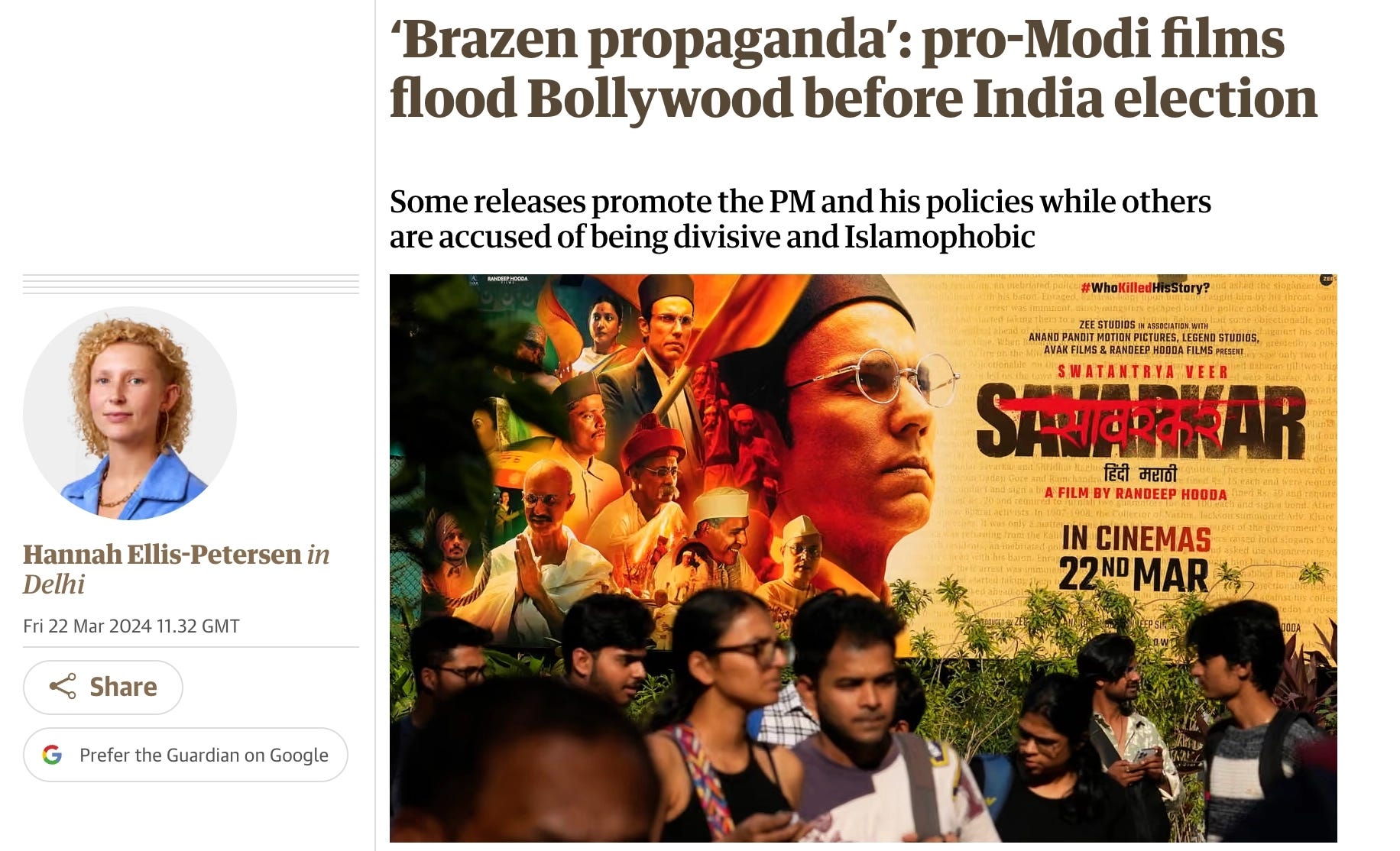
Vulnerability to state pressure: Bollywood vs. Hollywood
In the United States, the government does not certify movies before release. A film can offend the president, portray the nation as corrupt, or ridicule religion without needing state permission to exist. It may face market pressure or organised online outrage, but it does not move through a formal political approval system.
Vice is a good example. The film offered a deeply critical portrayal of former U.S. Vice President Dick Cheney without needing government approval before its release.
India is different. Filmmakers work inside an environment where state institutions, political sentiment, and organised pressure can all shape what reaches the screen.
Sometimes the pressure is formal. In 2021, the Income Tax Department conducted raids across multiple locations linked to filmmaker Anurag Kashyap and actress Taapsee Pannu — both outspoken critics of the Modi government — during the period they had publicly supported the farmers’ protests against government policy. The raids came weeks after Pannu had explicitly said she would not stay quiet.
In 2023, the BBC’s offices in Delhi and Mumbai were raided by tax officials days after they aired a two-part documentary examining Modi’s record on 2002 Gujarat pogrom — a documentary the Modi regime had already blocked inside India using emergency powers.
More often, the pressure is not official. In December 2022, Deepika Padukone wore a saffron-coloured bikini in a song for the film Pathaan. Saffron is the colour the BJP’s political symbol lotus and also of the Hindutva movement more broadly. BJP Minister Narottam Mishra declared the costume “objectionable” and the song “shot with a dirty mindset”.
And in November 2017, amid the controversy over Padmaavat, a bounty of approx £800,000 was publicly announced for the beheading of actress Deepika Padukone and director Sanjay Leela Bhansali over alleged distortion of historical facts by a BJP leader.
The lesson lands either way: make the wrong kind of film, and the state will find a way to make you feel it. Make the right kind, and you will find the doors unusually open.
The most effective propaganda systems do not need to censor everything. They teach people to censor themselves before anyone has to ask.
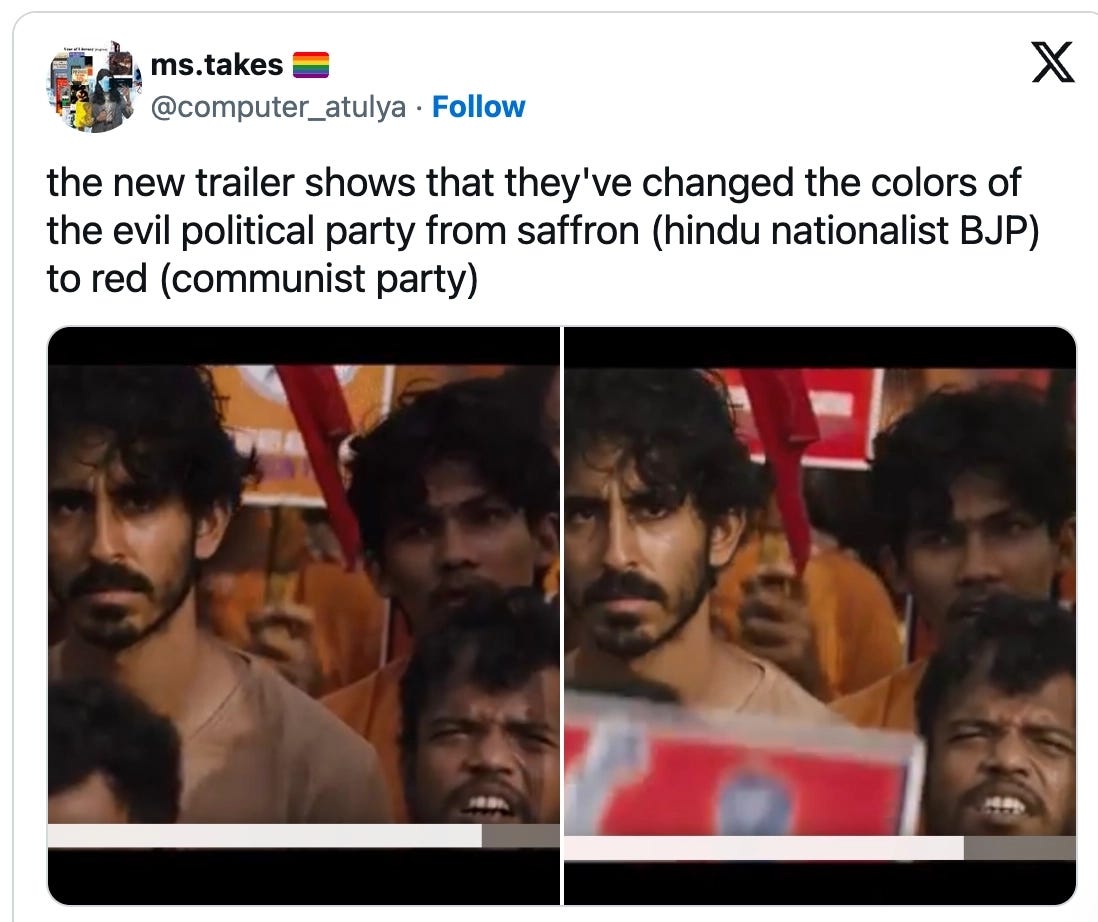
The story of Monkey Man (2024) makes this visible.
Dev Patel spent nearly a decade developing a film set in a fictionalised India, where a corrupt nationalist leader exploits Hindu mythology to oppress minorities, lower castes, and the transgender community. The production was already bruising — shoot relocated to Indonesia after COVID closed Indian borders, constant equipment failures, Patel breaking his hand and having a surgeon insert a screw into the bone before returning to the set the next day.
When Netflix bought the global rights for $30 million — three times the film’s budget — Patel’s struggles should have been over. Instead, Netflix executives quietly decided to shelve the film rather than risk government scrutiny.
The film was eventually rescued by filmmaker Jordan Peele, who bought it from Netflix through his production company, and convinced Universal to give it a global theatrical release.
To please Hindutva sensitivities, Universal spent weeks digitally altering the film’s visuals — changing saffron-coloured political banners to a neutral red, trimming scenes that showed religion and politics merging — hoping a highly sanitised and trimmed version might survive Indian censors.
But none of it mattered. The Central Board of Film Certification simply never scheduled a screening. No formal ban. No list of required cuts. Just bureaucratic inaction, held indefinitely, until the release date passed.
Monkey Man went on to earn standing ovations at SXSW and grossed $12m in its opening weekend, but never saw light of the day in the country whose marginalised people it sought to defend.
Mass media echo chambers: how WhatsApp, Prime-Time news support propaganda movies
A propaganda film is at its most effective when it arrives in a pre-conditioned environment already prepared to receive it.
- Its villains have already been identified on prime-time news (Muslims, anti-nationals, internal enemies)
- Its fears have been rehearsed on WhatsApp thousands of times (infiltrators, love-jihad)
- Its moral universe has already been explained by politicians (Hindus good, Muslims bad)
The film simply gives all of that a much larger screen with a musical score.
In Modi’s India, cinema exists inside a media atmosphere already saturated with aggressive nationalism. Television anchors, YouTube channels, WhatsApp forwards, partisan influencers, and political operatives circulate the same broad themes, day after day: the nation is under siege; Muslims are dangerous or suspect; secular liberals are fraudulent elites; and only one leader is decisive enough to be trusted with the country’s survival.
By the time a movie hits theatres, pro-Modi news anchors are already echoing the exact talking points of political leaders. This creates a seamless loop from the campaign trail to the evening news. The anchors quickly become the film’s fiercest defenders, turning their prime-time slots into a weapon to attack anyone who calls out the propaganda.
The Quint’s 2024 investigation documented the pipeline directly: BJP leaders and office-bearers actively promoted these films, attended special screenings, gave endorsements, and in some cases BJP-led state governments declared them tax-free — a direct financial subsidy dressed up as cultural appreciation.
Modi is easier to mythologise than Trump
The ideological world around Modi and India offers filmmakers an almost perfectly cinematic structure for propaganda films. Most of these films present –
- A once glorious civilisation and its betrayal.
- Heroes and traitors.
- Internal and external enemies.
- A sleeping majority waiting to be awakened.
- Swelling music and scenes of national restoration.
And at the centre of it all, a righteous leader who embodies discipline, sacrifice, spiritual austerity, and national renewal.
Modi’s political image is unusually cinematic and feeds directly into his mythology.
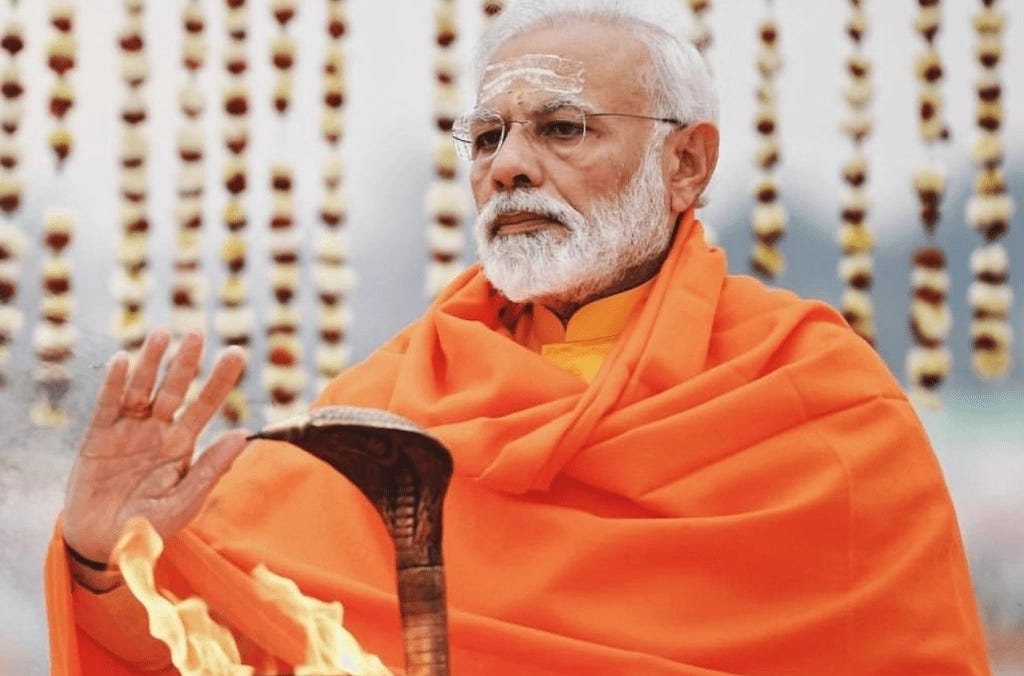
A devout, lonely man. The renouncer who left his household and his wife to serve the country. The ascetic. The man who supposedly owns little (at least officially). He often performs religious rituals at temples in saffron robes, symbolically bringing him closer to saints and sages. The man strategically placed near mountains — in a meditating pose. He is, in the grammar of the films, a vessel rather than a person: the nation’s will made flesh.
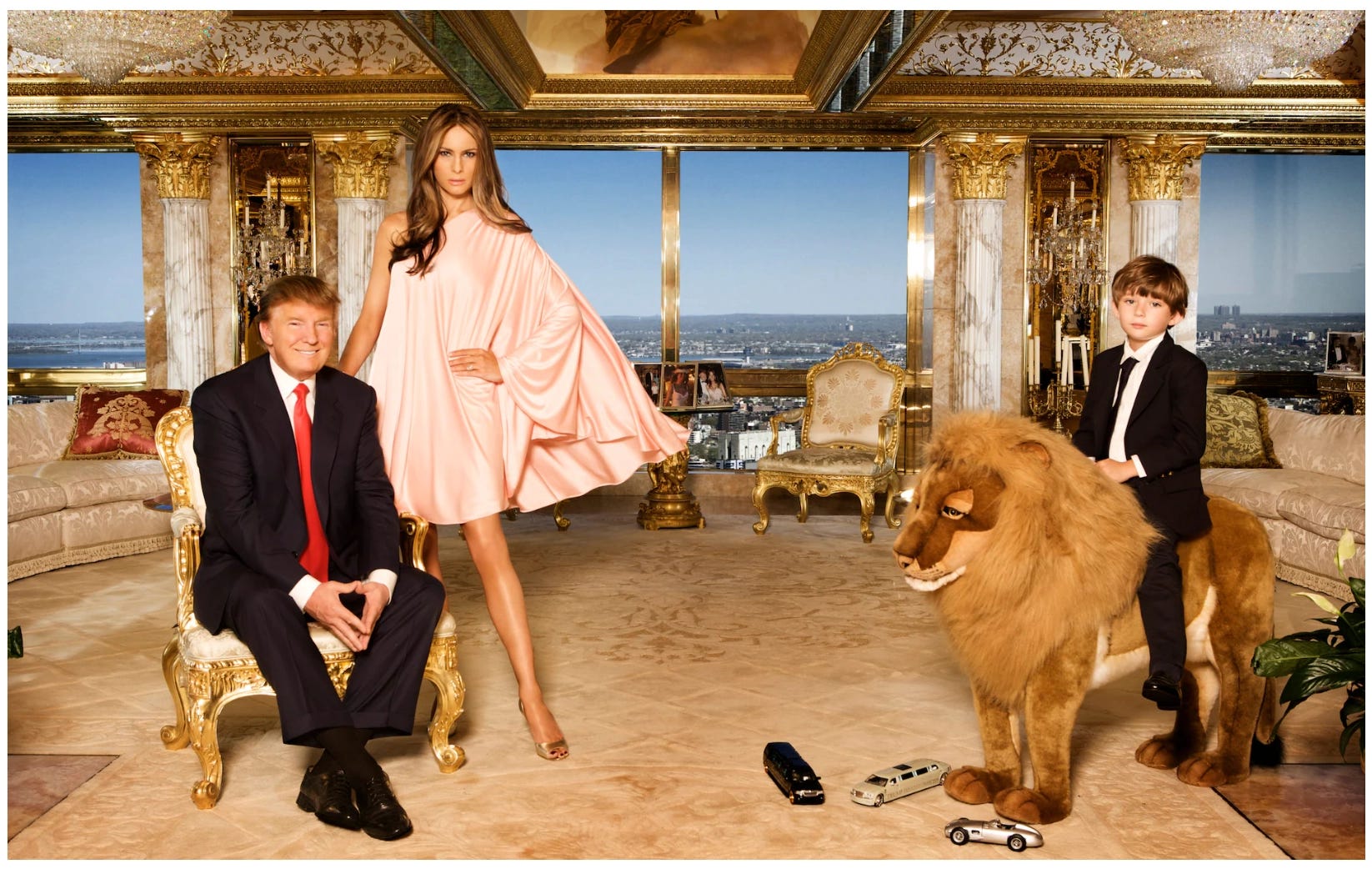
This ascetic framework completely breaks down when applied to Trump. He is a celebrity billionaire and former reality television host. He has been married three times. His remarks about women cannot be repeated in polite company. His political persona is built on life lived in luxury, excess, and the assertion that the system is corrupt because it has not yet given him what he deserves.
Trump still moves millions of Americans, but it is very hard to turn his persona into the story of a selfless warrior-ascetic defending a wounded civilisation.
Bollywood compliance vs. Hollywood resistance to authoritarianism
In the United States, the entertainment industry’s resistance to Trump has been visible, sustained, and often loud. Actors, directors, and producers have spoken out, donated money to opposing causes, and made films that treat his movement with open hostility.
At the Golden Globes, Meryl Streep used her Cecil B. DeMille acceptance speech to call out Trump’s behaviour, particularly his public mocking of a disabled reporter, turning an award stage into a moment of direct political rebuke. On late-night television, and at the Oscars, Jimmy Kimmel has routinely folded Trump into live comedy and monologues, at one point reading out a Trump Truth Social post directed at him and responding on air: “Isn’t it past your jail time?” At another Golden Globes event, actor Mark Ruffalo spoke sharply on the red carpet, calling Trump “the worst human being” and a convicted felon.
This is not universal — Jon Voight, Sylvester Stallone, Dennis Quaid, and Dinesh D’Souza have aligned themselves with Trump — but they are the minority exception.
(Veteran actor Robert De Niro received a passionate standing ovation from the crowd after using the Tony Awards stage to openly criticise Donald Trump.)
In India, resistance by Bollywood elites is marginal.
The Bollywood industry’s accommodation of Modi has been notable — and in many cases, too eager. Akshay Kumar, one of the country’s biggest stars, gave Modi a soft “non-political” interview ahead of the 2019 elections and has appeared reliably as the face of government-friendly patriotism ever since.
Amitabh Bachchan, who once carried the weight of an entire era of Indian political disillusionment in his films, has said almost nothing about anything political since 2014. He praised demonetisation. He attended the Ram Mandir inauguration in Ayodhya, built on the site of the demolished Babri Masjid, and did not comment. Anupam Kher has been among the most vocal BJP supporters in the industry.
(Video: Too many Bollywood actors queued to post birthday wishes for Modi.)
Those who have spoken up have paid for it in ways that work as a cautionary message for others.
Anurag Kashyap, one of India’s most critically acclaimed directors, was a fierce critic of the Modi government. In 2019, after his parents began receiving threat calls and his teenage daughter was threatened with rape online by accounts that endorsed Modi and his cult. Kashyap deleted his Twitter account and said he would rather not speak at all than speak in fear. He came back months later, called the government “clearly fascist,” and has since spoken at intervals, each time at personal cost.
Providing a stark example of servility within Bollywood, in a recent viral video, Indian veteran actor Sunil Shetty recently praised PM Modi’s charisma, stating: “As much as I love my country, I love that man… This is the magic of that man — there must be something in him.” Then he goes into detailing how his 15-month-old granddaughter unpromptedly offers spiritual sweets to a photo of Modi kept next to religious idols.
5:24 PM · Jun 26, 2026 · 44K Views
280 Replies · 268 Reposts · 829 Likes
Tax breaks and mandatory viewings: how the state subsidises propaganda
Goebbels, in Nazi Germany did not formally nationalise German theatre. His propaganda ministry provided annual subsidies — increasing every year, quietly binding theatre owners to Berlin through state financial dependence. His ministry also retained direct control of several “Reich theatres,” venues that could always count on special attention from the minister himself. 2
The way pro-Modi films receive support from the Indian state follows a similar pattern.
When The Kashmir Files was released in 2022, multiple BJP-governed states declared it tax-free within days, lowering ticket prices and expanding its reach through official policy. In Madhya Pradesh, police personnel were granted paid leave to watch the film. In Assam, government employees were given a half-day holiday, with attendance informally expected to be proven through ticket receipts.
Modi praised the film to the BJP parliamentary party, calling it a revelation of long-suppressed truth. When The Sabarmati Report arrived in 2024, Modi did not merely endorse it from a distance. He attended a special screening inside Parliament House, attended by his Home Minister, Defence Minister, and dozens of NDA MPs.
Goebbels called it “setting the signals” — by which he meant: telling a nation, repeatedly and from every available platform, who the enemy is, what has been stolen, and who alone can restore it. He did not need to say these things directly. He funded the theatres that would say them for him.
And at that point, the propaganda films no longer create belief — It only stabilises it.
If this work matters to you, here’s how to keep it going:
Become a paid subscriber —every paid subscription directly funds the research behind this work.
Share this piece —on social media or with someone who’s trying to understand what is happening in India.
Press the heart button —it tells the algorithm to show this piece to more readers.
Fascism is reshaping the lives of 1.4 billion people in India right now. Your support ensures this documentation continues.
You may also be interested in:

Why Fascism still attracts millions around the world
Deep Sharma | Fascism in India
·
May 30
The psychology of fascism: why utopian promises still work
Deep Sharma | Fascism in India
·
Jun 13
This is not to ignore films such as 2000 Mules, The Deep Rig, Patriot Purge, or Sound of Freedom, all of which were embraced by parts of the Trump movement. But these were documentaries, television productions, or independently produced films. They do not amount to a sustained wave of major Hollywood studios, leading actors, and mainstream commercial cinema producing dramatic feature films that reinforced Trump’s political worldview in the way increasingly seen in Modi’s India.
See Peter Longerich, Goebbels: A Biography (2015), p. 261
Subscribe to Fascism in India
By Deep Sharma · Launched 4 months ago
This publication uncovers the mechanics of fascism in India under Modi. Subscribing is free, and it ensures this documentation continues.


Leave a Reply