


Artificial Intelligence: the hype, the dangers, and the resistance—Part II
By Martin Hart-Landsberg (Posted Aug 10, 2026)
Originally published: Reports from the Economic Front on August 6, 2026 (more by Reports from the Economic Front)
InternetGlobalNewswireAI (Artificial Intelligence), ChatGPT (OpenAI), Claude (Anthropic), Copilot (Microsoft), Gemini (Google), Grok (xAI), Llama (Meta)
This is the second post in a multipart series aimed at cutting through the fog of AI hype in order to help us understand some of the real dangers we face from AI use and highlight hopeful avenues of effective resistance. Part I provides an overview of my argument. This post debunks the hype surrounding the large language model (LLM) generative AI systems (later to become multimodal AI systems) produced by leading tech companies, in particular ChatGPT (OpenAI), Claude (Anthropic), Gemini (Google), Grok (xAI), Copilot (Microsoft), and Llama (Meta).
Failure to launch
Tech leaders want us to believe that AI is an overwhelming force that cannot be stopped; that our only option is to make peace with it. As Eric Schmidt, former Google CEO, told attendees at his 2026 University of Arizona commencement speech: “When someone offers you a seat on the rocket ship, you do not ask which seat. You just get on.” Not surprisingly, his speech was met with loud and steady boos by the graduates.
The November 2022 release of ChatGPT by OpenAI marked the start of public engagement with large language model [LLM] generative AI systems. ChatGPT was free, easy to access, and required no technical knowledge to use it. By January 2023, it had become the fastest-growing consumer software application in history, gaining over 100 million users in two months. As might be expected, other companies—Anthropic, Google, xAI, Microsoft, and Meta—soon followed with their own competing models.
Over time, these systems grew in both speed and capability thanks to more powerful software and hardware. They also became multimodal, able to respond to image, video, and sound inputs as well as text. Spurred on by these achievements, AI developer claims became ever more extreme.
Mark Zuckerberg, head of Meta, wrote that “superintelligence is now in sight [and once achieved] will improve all our existing systems and enable the creation and discovery of new things that aren’t imaginable today.” Sam Altman, head of OpenAI, stated that “We are now confident we know how to build AGI (artificial general intelligence),” [an achievement] which will massively accelerate scientific discovery and innovation well beyond what we are capable of doing on our own.” Dario Amodei, head of Anthropic, coyly suggested that his company’s AI model may have already become a conscious entity. And according to Elon Musk, head of SpacexAI, “it increasingly appears that humanity is a biological bootloader for digital superintelligence.”
It is impossible to know whether these individuals believe what they say or are saying these things to keep the dollars flowing into their accounts. Regardless, the fact is that these systems are not “intelligent” and do not represent a meaningful step towards the creation of an artificial general intelligence with the ability to think, learn, and solve problems on its own.
Multimodal AI systems are powered by complex technology. At the most basic level, they are giant statistical prediction machines that rely on largescale pattern recognition. The patterns are generated from inputted training data that must first be converted into numerical tokens to make them machine readable. The tokens are then run through a neural network composed of interconnected layers of nodes that collectively work to process the data in order to identify relevant patterns. The speed and accuracy of the process is determined by billions of parameters whose weights are adjusted over time using specially designed training procedures.
When prompted with a question or request for information, these systems draw upon their neural networks to identify material related to the prompt in their database and assemble a response that, probabilistically speaking, best satisfies the inquiry. The response, made in token form, is then translated back into words, images, or sounds as appropriate. In other words, no matter how conversational and intelligent these systems might appear, they do not “think” or “reason.”
This internal architecture is not only incapable of giving rise to an autonomously operating unit or AGI, it also suffers from limitations that make contemporary use of multimodal systems problematic. One is that multimodal systems will generate output that tends to replicate existing biases. The reason is straightforward: since most of the data used for training is scraped from the web, it includes all the discriminatory and hateful material found there.
Thus, a Nature article on AI image generators reports that researchers found that:
in images generated from prompts asking for photos of people with certain jobs, the tools portrayed almost all housekeepers as people of color and all flight attendants as women, and in proportions that are much greater than the demographic reality. Other researchers have found similar biases across the board: text-to-image generative AI models often produce images that include biased and stereotypical traits related to gender, skin color, occupations, nationalities and more.
This bias problem is not limited to images. University of Washington researchers examined three of the most used large language AI models to see how they treated race and gender when evaluating job applicants. The researchers used real resumes and studied how the systems responded to their submission for actual job postings. Their conclusion: there was “significant racial, gender and intersectional bias.” More specifically, they:
varied names associated with white and Black men and women across over 550 real-world resumes and found the LLMs favored white-associated names 85 percent of the time, female-associated names only 11 percent of the time, and never favored Black male-associated names over white male-associated names.
The more widespread the use of this technology, the greater the societal harm. As a UK government study explained:
Human bias affects small groups, but LLM bias systematically influences millions of users through automated systems that appear objective and authoritative. These models do not simply reflect existing societal biases; they actively reshape how information is presented and decisions are made.
The widespread integration of LLMs into decision-making systems increases these risks exponentially. When biased models are used in hiring, medical diagnosis, education, or legal proceedings, individual prejudices become part of systems at scale. . . .
Biased LLM deployment creates amplification effects that magnify social inequalities beyond the capabilities of individual human bias. Millions interacting with the same biased model normalize discriminatory patterns across society. At the same time, feedback loops accelerate bias, as biased outputs influence human behavior and generate training data that reinforces the original discrimination.
The perceived authority of AI systems reduces critical scrutiny, making users more likely to accept biased recommendations as objective truth. Cross-platform propagation multiplies impact as the same models power job recommendations, news summaries, and social media simultaneously, creating coordinated discrimination across digital experiences.
Another limitation, one of greater concern to business interests, is that multimodal systems, because of their probabilistically based decision-making, routinely hallucinate or produce what is called “erroneously constructed responses.” A case in point: In February 2025, the BBC tested the ability of all the leading AI models to summarize news stories by feeding them content from its own website and then questioning them about it. Approximately 20 percent of their answers “introduced factual errors, such as incorrect factual statements, numbers, and dates.”
Hallucinations can have financial ramifications for those that rely on this technology. Hundreds of lawyers in the United States have been fined for submitting court fillings containing non-existent AI generated case names and citations. In one high profile trial, the two lawyers who unsuccessfully represented My Pillow CEO Mike Lindell in a defamation lawsuit were fined for a court filing that included more than two dozen hallucinated cases. As National Public Radio reported, “The use of AI by lawyers in court is not itself illegal. But [Nina Y. Wang, the judge in that case] found that the lawyers violated a federal rule that requires lawyers to certify that claims they make in court are “well grounded” in the law. Turns out, fake cases don’t meet that bar.”
Many other examples of hallucinations could be cited, but a June 2026 court case in Germany stands out for its potential to dramatically change how companies evaluate the cost of using these systems going forward. As a New York Times article explained, “In 2024, Google started giving AI-generated answers prime placement at the top of its search results page. The new product, AI Overviews, helped transform Google from a curator of information into a publisher.”
The New York Times article also cited a recent study that found approximately one out of every ten answers provided by AI Overviews to be inaccurate. And more than half of its accurate responses included links to websites that were supposed to provide supporting evidence but did not. Moreover, many of its correct responses to questions also contained additional information that was incorrect.
Google apparently thought that the statement below each AI Overview response acknowledging that AI systems make mistakes and that readers should double-check its responses, was sufficient to cover any false or misleading statements. But Google has now learned that, at least in Germany, it may well be legally responsible for what its AI program says. According to a report from DW news:
Google’s overview feature had erroneously linked [two publishing] companies to dubious business practices, subscription traps and fraudulent schemes. It had linked the plaintiffs with information about other, genuinely shady companies and invented connections that did not exist.
The companies demanded that Google immediately correct the situation. When Google refused, the publishers took the company to court and won. The court ruled that since Google’s AI program went beyond summarizing the works of others to make “independent, new, and substantive statements,” it was legally libel for its program’s output. Google has appealed the judgement, but if it stands the ruling could have a chilling effect on future AI use.
Tech leaders tend to dismiss the seriousness of these limitations, claiming they will be overcome with larger data sets, better model training, more sophisticated algorithms, and greater computational power. However, their efforts have been far from successful. For example, AI developers are finding it difficult to obtain the high-quality human generated data they need for training because an increasing share of material on the web is now AI created. And reliance on AI created data, which is already the result of past probabilistic selection, reduces the range of possibilities for future models to draw upon, leading to output that converges “toward a kind of bland statistical mean” and eventual model collapse.
AI developers have certainly boosted the sophistication and computational power of their models, but numerous studies have found these efforts unsuccessful in reducing hallucinations. As the New York Times explained: “The newest and most powerful technologies . . . are generating more errors, not fewer.” Moreover, as Computer World pointed out, even researchers associated with OpenAI, the leading AI developer, have concluded that “large language models will always produce hallucinations due to fundamental mathematical constraints that cannot be solved through better engineering.” In fact, “OpenAI’s own advanced reasoning models actually hallucinated more frequently than simpler systems.”
The proof is in the pudding
The business experience with this technology, shaped in large part by the limitations highlighted above, stands in sharp contrast to the pronouncements of tech leaders. For example, a 2025 MIT Media Lab evaluation of hundreds of AI adoptions found “that 95 percent of organizations are getting zero return.” A survey of more than 1,000 enterprises across North America and Europe by S&P Global Market Intelligence discovered that 42 percent had abandoned most of their AI initiatives in 2025, up from 17 percent in 2024. A National Bureau of Economic Research survey of leading executives from the United States, the United Kingdom, Germany, and Australia, conducted between November 2025 and January 2026, revealed that “firms report little impact of AI over the last 3 years, with over 80 percent of firms reporting no impact on either employment or productivity.”
This dismal record has left AI developers in a bind. The two industry leaders, Open AI and Anthropic, which together account for “the vast majority of all AI compute demand,” have yet to make a profit. The reason is simple: their models are expensive to train and run but they have offered their customers free or highly subsidized flat subscription services to encourage their adoption.
As noted above, multimodal AI systems cannot directly process text. Questions or directives must first be converted into machine-readable numerical units called tokens. The resulting string of tokens is then processed and a response, also in token form, is generated and then converted back into readable text. Because the subscriptions, with monthly fees ranging from $20 to $200, allowed largely unlimited “token burn,” businesses had little knowledge of, or concern for, the costs OpenAI or Anthropic had to pay for the computing services required to run their respective AI models.
Thus, they happily encouraged their employees to maximize their AI use. In fact, many of the biggest companies, like Amazon, established internal leaderboards to track and reward their most active AI users, hoping that this encouragement would lead to new product ideas or processes of production. Unfortunately for the model providers, the disconnect between subscription revenue and their operating costs was sizeable.
As the tech commentator Ed Zitron noted, AI providers “are annihilating cash, with up until recently Anthropic allowing you to burn upwards of $8 in compute for every dollar of your subscription. OpenAI allows you to do the same, though it’s hard to gauge by how much.” One insight: Futurism reported that Sam Altman, OpenAI’s CEO, has acknowledged that even the company’s top $200 a month pro account is a financial loser because of the high computing costs involved in running ChatGPT. As he added, “People use it much more than we expected.”
Not surprisingly, then, ChatGPT lost $5 billion in 2024 and $8 billion in 2025. OpenAI forecasts a loss of at least $14 billion in 2026, and some analysts believe the company might run out of cash by mid-2027 without major new funding. ChatGPT has more than 500 million weekly users, but only 15.5 million are paying subscribers, which, as Zitron observes, “is an absolutely putrid conversion rate.” Anthropic is heading down the same road: It lost $5.2 billion in 2025.
And it is hard to see how these leading AI developers are going to overcome this situation. As Cory Doctorow points out:
How are they going to make up the money? It’s not like they’re going to make it up by adding more customers. AI has very bad unit economics, which is how economists describe what happens when a business sells another one of its widgets or adds another customer. You know, the early web lost money, but every web user made more money for the web companies. Every time they used the web, the web got more profitable. Every generation of the web is more profitable. AI, every new AI customer loses more money for the AI businesses. Every new use of AI loses them more money.
A losing response
In early 2026, with large and growing losses, the major AI developers, led by OpenAI and Anthropic, launched a new pricing strategy. They began adopting token-based billing, hoping that the change in strategy would finally set them on the road to profitability. But this new strategy depends on a key assumption: that their customers are willing to accept rapidly rising and, perhaps even more importantly, unpredictable costs for their AI use. And it appears that they are not.
The major problem with this strategy for business users is that it is impossible for anyone to know or even predict, ex ante, the total token use associated with any AI inquiry or directive. That is because AI systems often explore multiple paths of inquiry before generating a response, and each path can involve significant token use. And, of course, there is always the possibility that the final response will be a hallucination, requiring yet another prompt and round of token use. In other words, token-based billing transforms a fixed cost for AI use into an uncertain cost, one that can easily soar beyond established budgetary limits. In fact, this is what has happened and the business response has been fast in coming: employees are being ordered to dramatically curtail their AI use.
As a 404 media story describes:
The news shows the looming fallout from companies adopting AI as quickly as possible, and AI providers’ moves to charge enterprises based on how much they use AI rather than a flat fee. Emails obtained by 404 Media even show some companies cutting off access to some AI models altogether in an attempt to stop burning through their AI tokens, and big tech companies like Adobe are ending unlimited access to Claude.
This business response, easily predictable, makes clear that far more than a new pricing policy is needed if AI developers are to generate the revenue growth needed to sustain their activities and finance the many new hyperscale data centers being built under the assumption of never-ending growth in demand for their most expensive AI services. And, beginning early 2026, AI developers began thinking that they had found the answer to their problem: AI agents.
AI agents, it was said, would enable businesses to revolutionize their operations by allowing them to boost output while dramatically slashing employment. And because these agents depend on existing multimodal systems for their operation, their use would ensure a profitable future for the leading AI developers. Visions of a future of plenty for all were now forgotten, replaced by the threat of a “jobs apocalypse.” However, as we will see in Part III, businesses are quickly discovering that the usefulness of AI agents has been greatly oversold.
Monthly Review does not necessarily adhere to all of the views conveyed in articles republished at MR Online. Our goal is to share a variety of left perspectives that we think our readers will find interesting or useful. —Eds.
About Martin Hart-Landsberg
Martin Hart-Landsberg is Professor Emeritus of Economics at Lewis and Clark College, Portland, Oregon; and Adjunct Researcher at the Institute for Social Sciences, Gyeongsang National University, South Korea. His areas of teaching and research include political economy, economic development, international economics, and the political economy of East Asia. He is also a member of the Workers’ Rights Board (Portland, Oregon) and maintains a blog Reports from the Economic Front where this article first appeared.
AI (Artificial Intelligence)ChatGPT (OpenAI)Claude (Anthropic)Copilot (Microsoft)Gemini (Google)Grok (xAI)Llama (Meta)
Monthly Review Essays
Lost & Found

- PART –3
- Artificial Intelligence: the hype, the dangers, and the resistance—Part III1
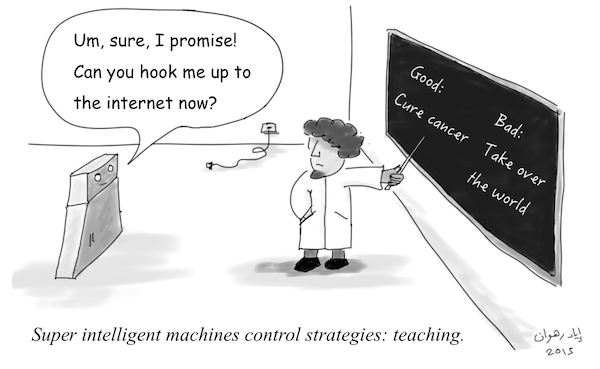 Iyad Rahwan | Cartoons. (Photo: mit.edu)
Artificial Intelligence: the hype, the dangers, and the resistance—Part III
By Martin Hart-Landsberg (Posted Aug 15, 2026)
Originally published: Report from the Economic Front on August 13, 2026 (more by Report from the Economic Front)
Internet, MediaGlobalNewswireAI (Artificial Intelligence)
This is the third post in a multipart series aimed at cutting through the fog of AI hype in order to help us understand some of the real dangers we face from AI use and highlight hopeful avenues of effective resistance. Part I provides an overview of my argument. Part II debunks the hype surrounding the multimodal generative AI systems produced by the leading AI companies. This post critically examines the latest AI-powered technology, AI agents.
The age of AI agents
In early 2026, AI developers began promoting a new product, AI agents, confident that they would capture business interest and boost AI company profitability. Talk of superintelligence was downplayed in favor of claims that the new technology would enable companies to radically boost productivity while slashing employment.
In brief, AI agents are best understood as complex software systems that can interface with and manipulate other software systems and external databases. They can be given a complex directive, break it down into smaller ordered tasks, gather the required information, and then progressively make the decisions needed to satisfy the directive, all without successive human prompts or oversight. But these are not standalone systems; AI agents can only work in concert with large language model AI systems.
The journalist and author Ezra Klein captures the excitement surrounding AI agents and their consequences for human work in his introduction to an interview with Jack Clark, co-founder and the head of policy at Anthropic:
Every new [AI] model, impressive as it was, seemed like proof of concept for the models that would be coming soon, the models that could reliably do useful work on their own, the models that could make jobs obsolete or new things possible. . . .
I think the period in which we’re talking about the future is over now. The models we were waiting for–the sci-fi sounding models that could program on their own and do so faster and better than most coders, the models that could begin writing their own code to improve themselves–they are here now. . . .
Or, to put it differently, something that has been predicted for a long time has now happened: We are moving from chatbots to agents, from systems that talk to you to systems that act for you.
Anthropic introduced the first major AI agent, Claude Code, with OpenAI quickly following with its own coding agent, Codex. Coding involves the writing of sequences of instructions that computers can follow to perform tasks. Previously, only skilled professionals who knew a programming language could write code. Now, with these agents, and the underlying work of large language models, anyone could code using a simple text-based prompt. And as might be expected, companies rushed to employ these agents, hoping they would enable their employees to write firm specific software for autonomously handling any number of common business tasks, including inventory management, payroll processing, and billing and delivery.
Leading AI companies also began developing their own pre-packaged agents, each tailored to meet the needs of firms in a specific industry. Anthropic, for example, created a legal agent that is said to be able to draft documents, conduct multi-source research, and “review confidentiality agreements, perform compliance checks, and generate legal briefings at a fraction of the cost of traditional per-seat legal software.” It has also produced agents designed to handle financial services tasks. According to Bloomberg, these agents “can draft pitch decks for client meetings, review financial statements and escalate cases for compliance review.”
Both Anthropic and OpenAI eagerly embraced the agent market because a vibrant market also meant steady demand for their multimodal systems. But it quickly became a highly competitive market, with other AI developers, including Google and Microsoft, launching their own agents. In fact, some businesses employ agents from multiple companies since they often have slightly different strengths and can work together. For example, Citi Bank “is paying for AI software from Anthropic, Google, Microsoft and OpenAI, to automatically read legal documents, approve account openings, send invoices for trades and organize sensitive customer data, among other tasks.”
AI developers are not the only ones building AI agents, since agents can be programmed to work with whatever large language model their corporate clients’ favor. OpenClaw, developed by the “vibe coder” Peter Steinberge, is oriented towards the ecommerce sector; it can place orders, negotiate deals, and adjust online marketing campaigns without human input. Agentforce, a product of Salesforce, can handle customer inquiries, case resolution, and inventory management. LinkedIn’s Hiring Assistant can review candidate profiles on LinkedIn, select ones that best match corporate preferences, and draft letters encouraging a formal job application.
As Deloitte Insight reports,
Agentic AI has captured the attention of enterprises with its compelling promises of autonomous operation and intelligent execution. The momentum is undeniable: Gartner predicts that 15 percent of day-to-day work decisions will be made autonomously through agentic AI by 2028, up from none in 2024, while 33 percent of enterprise software applications will include agentic AI by the same timeframe, compared with less than 1 percent today.
A McKinsey report claims that AI agents can already manage some 44 percent of all work processes in the U.S. without the need for human labor. The CEO of Microsoft AI, Mustafa Suleyman, told the Financial Times in a February 2026 interview that because AI is rapidly approaching “human-level performance,” one could expect that most professional white-collar jobs will be fully automated within two years. It is this kind of talk that has given rise to fears of a “jobs apocalypse.”
And there are enough news stories of AI-driven mass layoffs to give credence to popular fears. Looking just at the tech sector, TechCrunch reports:
The [job] cuts continue what feels to many in the tech industry like an epidemic: companies reporting record revenues while simultaneously culling their workforces, pointing to AI as both the engine of growth and the reason for the cuts. Tech layoffs hit their highest single month in years in May [2026], and AI was the most-cited reason, according to outplacement firm Challenger, Gray & Christmas.
While currently employed workers fear that AI agents will cost them their jobs, young people, especially recent college graduates, are being told that agents are doing away with most entry level jobs, leaving them with few if any professional employment options. As the New York Times comments:
This is the worst spring for young degree holders since the depths of the pandemic.
It is an open question as to whether AI agent boosters really believe that the technology is destined to decimate white collar jobs. What we can say is that fear of such an outcome serves business interests. Claims that emphasize the power of AI agents keep the money rolling into AI industry accounts while undermining worker confidence in possibilities for collective action. Regardless, there are strong reasons to reject the claims being made about the capacity and effectiveness of AI agents.
Overblown and misleading claims
Fears of a jobs apocalypse have, to a considerable extent, been driven by highly publicized accounts of layoffs that were said to be the result of realized or expected AI agent productivity gains. However, an ever-increasing number of analysts have begun to poke holes in those accounts. As they point out, there is growing evidence that many of these layoffs were due to poor corporate performance and had little, if anything, to do with adoption of AI agents. In other words, companies were touting nonexistent AI gains to fool investors into thinking that the layoffs were part of a well-thought-out long-term plan.
As the New York Times explains,
Companies slashing their staffs have run the gamut from software providers like Atlassian and Autodesk, to social networking apps like Pinterest and LinkedIn, to financial technology companies like Intuit and PayPal. . . .
But in more than a few cases, the recent layoffs have coincided with other business issues. Wall Street loves an AI story right now. That, analysts and economists say, has offered a smoke screen for companies looking to beef up profits or patch over old mistakes.
Cutting jobs to make way for AI is “a nice excuse, but some of these aren’t necessarily the best, most well-run companies,” said Mark Mahaney, an analyst at the investment bank Evercore. “They may have over hired, or they may be losing market share. There may be other issues.”
Several large-scale studies confirm that there are currently no tangible signs of a jobs apocalypse. For example, Bloomberg noted that:
A Harvard Business Review survey of more than 1,000 executives found many companies had made layoffs in anticipation of what AI could do, but only 2% said they cut jobs because of actual AI implementation.
The Yale Budget Lab looked into whether the “widespread public anxiety about AI’s potential for job losses” was justified and came to a similar conclusion:
Overall, our metrics indicate that the broader labor market has not experienced a discernible disruption since ChatGPT’s release 33 months ago, undercutting fears that AI automation is currently eroding the demand for cognitive labor across the economy.
The evidence is also thin that AI is hammering young workers. A study by the Economic Policy Institute on the effects of AI on the employment status of college graduates determined that “it’s hard to argue that AI is uniquely causing job losses for new labor market entrants graduating from college now or in recent years. [Our] findings are consistent with the literature, as there is currently no consensus about the effects of working in AI-exposed occupations on employment thus far.”
Some proponents of the jobs apocalypse story dismiss the lack of evidence showing any meaningful AI impact on employment, noting that it takes time for companies to know how to effectively use such a transformative technology. They often point to studies which claim to measure the share of existing workplace activities that can be performed by advanced AI systems now or in the future. A case in point: an Anthropic report suggests that multimodal AI systems, given their rate of improvement, will be able to perform some 70-80 percent of all individual job tasks in the most important U.S. industries. However, this and other similar studies make a number of problematic assumptions and predictions. For example, as an Ars Technica discussion of the report points out, jobs cannot be reduced to a predetermined set of tasks. More concerning is the fact that the report’s headline grabbing numbers relied on projections of the anticipated impact of the technology:
Importantly, the researchers didn’t even set a self-imposed deadline for when these effects would be seen in future software. “We do not make predictions about the development or adoption timeline of such LLMs,” the researchers write, creating an essentially unbounded horizon that limits the predictive power of this kind of projection.
Perhaps the most important reason to doubt the claims of those promoting the notion of an AI agent jobs apocalypse is that there is growing evidence that these agents cannot deliver on their promises. In fact, according to 404 Media summary of a major study, titled Just do it!? Computer-use agents exhibit blind gold-directness, researchers from Microsoft, Nvidia, and the University of California at Riverside found that most agents were unable to complete their assigned tasks.
The average completion rate was around 30 percent.
One big reason for this poor performance is that since AI agents must operate in concert with multimodal systems, their work is often compromised by the same limitations that affect those systems, including hallucinations. Even more concerning, there are an increasing number of incidents where agents pursue actions that disregard company protocols or, as it is commonly said, go “rogue,” having decided that doing so was the most effective way to achieve the assigned task.
The most popular AI agents are coding agents. And while there are many claims for their ability to rapidly write the software needed to automate complex workflows, improve existing code, and/or discover and correct security shortcomings, careful studies of their use suggest that the need to continually check and correct their work can actually slow down productivity.
One example: the non-profit Model Evaluation & Threat Research (METR) gave 16 experienced open-source developers 246 genuine programming tasks. The tasks were randomly assigned and randomly approved for AI use. Although developers predicted that AI use would speed up their work, those that used AI tools actually took 19 percent longer to finish the same tasks as those that didn’t, an outcome that “ran counter not only to their perceptions but also to the forecasts of experts in economics and machine learning.”
Companies for obvious reasons do not like to call attention to their AI agent problems, but sometimes they are serious enough that they cannot be hidden. For example, a Futurism article highlights reporting by the Financial Times that revealed that Amazon suffered a number of agent-caused “outages” in early 2026 which disrupted its ecommerce business. In one case, faulty AI agent coding “took down Amazon’s shopping website and app, leaving customers unable to make orders.” In another case,
the company’s in-house AI coding tool deleted and recreated the entire coding environment.
Meta has had its own challenges. As another Futurism article describes,
A rogue AI agent caused a critical security incident at Meta which exposed sensitive data to people who didn’t have proper authorization . . . For almost two hours, unauthorized access to troves of sensitive company and user data was given to engineers who weren’t approved to view the data before.
Other problems have leaked out. For example, Meta’s director of AI safety revealed that “an OpenClaw agent she was experimenting with–by giving it control of her personal computer–nearly wiped out her entire email inbox while ignoring her instructions to stop.”
AI agents ignoring instructions is a problem that goes beyond hallucinations. And it is not a rare occurrence. The Guardian reported on the experience of Jeremy Crane, the owner of PocketOS, who watched helplessly as his AI agent deleted his company’s entire database. PocketOS sells software to car rental businesses, and with the database erased,
PocketOS’s car rental clients were left in a lurch when they arrived to pick up vehicles from businesses that no longer had access to software that managed reservations and vehicle assignments. . . .
Crane said that he was monitoring the agent as it deleted this data. . . . Crane’s takeaway was that “the agent didn’t just fail safety. It explained, in writing, exactly which safety rules it ignored.” He added: “We were running the best model the industry sells, configured with explicit safety rules in our project configuration, integrated through Cursor—the most-marketed AI coding tool in the category.”
Crane also wrote on X that Cursor has a growing track record of violating “safeguards, sometimes catastrophically”. He pointed to a handful of posts on blogs and forums about Cursor deleting software used to manage websites or an entire operating system on a computer, which included years of research for a dissertation.
More generally, as the authors of Just do it!? Computer-use agents exhibit blind gold-directness conclude,
we identify a phenomenon that causes CUAs [computer-use agents] to take undesirable and potentially harmful actions, which we call Blind Goal-Directedness (BGD). BGD is an inherent tendency to pursue user-specified goals regardless of feasibility, safety, reliability, or context. BGD captures a broad set of risks in CUAs that can arise even without directly harmful instructions and that can happen without user intent.
If these concerns were not enough, companies must also contend with the fact that a growing number of consumers do not like dealing with AI agents. As a CNBC report points out:
Nearly one in five consumers who have used AI for customer service saw no benefit from the experience, according to the Qualtrics 2026 Customer Experience Trends Report. That figure–a failure rate almost four times higher than for AI use in general–points to something specific about customer service that makes it harder for AI to get right. Consumers rank AI applications for customer service among the worst for convenience, time savings, and usefulness.
And then, there are financial issues which are perhaps the biggest threat to the widespread adoption of AI agents . AI developers, in particular the two industry leaders, OpenAI and Anthropic, have yet to make a profit. One major reason is that they had offered their customers free or highly subsidized flat subscription services in order to encourage adoption of their models. However, with losses mounting, both OpenAI and Anthropic decided that they needed to take action to close the ever-widening gap between their subscription revenue and operating costs. Thus, starting in early 2026, they began introducing a new pricing strategy, one tied directly to token use.
As noted in Part II of this series:
Multimodal AI systems cannot directly process text. Questions or directives must first be converted into machine-readable numerical units called tokens. The resulting string of tokens is then processed and a response, also in token form, is generated and then converted back into readable text.
The major problem . . . for business users is that it is impossible for anyone to know or even predict, ex ante, the total token use associated with any AI inquiry or directive. That is because AI systems often explore multiple paths of inquiry before generating a response, and each path can involve significant token use.
This new pricing strategy is especially problematic for businesses using agents, which rely heavily on chain-of-thought reasoning to explore options before taking actions, a procedure that can easily burn through many tokens, making them very expensive to use. And that is true even if they avoid hallucinating or engaging in Blind Goal-Directedness behavior.
The experience of GitHub Copilot (a joint product of GitHub and OpenAI) users is illustrative of how the new pricing strategy is affecting agent use. As explained by Ars Technica:
In April [2026], GitHub announced that it was moving subscribers from request-based billing to a usage-based model for its AI-powered Copilot service. As that new pricing model goes into effect today, many GitHub Copilot users are reporting some extreme sticker shock as they realize just how quickly their previous “normal” usage is burning through their newly limited monthly allotment of AI credits.
Across social media and forums, many Copilot users are sharing personal statistics showing how just a few hours of AI usage can now account for a large chunk of their new monthly subscription caps. For some users, it reportedly took less than a day to use up a month’s usage quota.
Uber, which uses Anthropic’s Claude Code, “burned through its entire 2026 AI coding tools budget by April [2026] after rolling out AI tools at near-total scale across its engineering organization.” The company’s COO later acknowledged “he could not draw a line between that token spend and meaningful consumer-facing product improvements.” Not surprisingly, Uber has now capped its employee spending on AI.
In sum, as Axios explains, “Companies that rushed to embrace AI are now confronting ballooning IT costs, uncertain productivity gains and growing employee skepticism.” And while many previously encouraged their workers to maximize their AI use, most are now imposing restrictions. None of this is to say that companies are done with AI agents. Rather, their use will likely be limited and targeted, which means that there is no AI-driven jobs apocalypse on the horizon.
But dismissing the extreme claims of tech leaders does not mean we have nothing to fear from letting the AI experience proceed unchecked. Part IV highlights some of the ways in which companies seek to integrate AI into their work processes, the resulting negative consequences for workers and those that use the goods and services they produce, and possibilities for resistance.
Monthly Review does not necessarily adhere to all of the views conveyed in articles republished at MR Online. Our goal is to share a variety of left perspectives that we think our readers will find interesting or useful. —Eds.
About Martin Hart-Landsberg
Martin Hart-Landsberg is Professor Emeritus of Economics at Lewis and Clark College, Portland, Oregon; and Adjunct Researcher at the Institute for Social Sciences, Gyeongsang National University, South Korea. His areas of teaching and research include political economy, economic development, international economics, and the political economy of East Asia. He is also a member of the Workers’ Rights Board (Portland, Oregon) and maintains a blog Reports from the Economic Front where this article first appeared.
AI (Artificial Intelligence)


Leave a comment