“Where the mind is without fear and the head is held high;
Where knowledge is free;
Where the world has not been broken up into fragments by narrow domestic walls;
Where words come out from the depth of truth;….
Where the mind is led forward by thee into ever-widening thought and action
Into that heaven of freedom, my Father, let my country awake.”
Every August, every Independence Day season, this poem is dragged out of its devotional register and made to do political work in India, mostly because nobody has written anything better since, but this year it earns the dusting-off more than most.
Tagore wrote these lines around 1900, tucked into Naivedya and later into Gitanjali as a prayer, but we saw them become a manifesto in the past few weeks in New Delhi and India’s digital public-sphere. Read those lines again, juxtaposing them against the visuals from Jantar Mantar and its counterparts online, and you will see each word, each verb, and each adverb in the stanza come alive, blooming with myriad meanings. That’s perhaps why this August 15 is going to be a special one for us; it comes at a time when Indians have refreshed the idea and function of freedom after a long, forced lull.
The slogan or word—azadi or freedom—has meant different things to different Indian generations. This season, the students reclaimed it without the weight of older ideological baggage. Interestingly, they used it the way one would use a word just discovered, not passed on by the elders, and organised across caste and class and party lines that people twice their age have spent careers failing to bridge, and they did it, largely, without asking permission to be funny. That combination—fearlessness plus a straight face that keeps cracking into a grin—is what is worth talking about this Independence Day. It is a new form of civil disobedience. On that cue, Gen Z has updated Gandhi in a clever way (what a comic tragedy for the Right, which has been focussing on the wrong target, Nehru, this whole time).
The template the students handed the rest of us—parents, editors, grandparents, the whole tired apparatus of people who are meant to know better—was simply this: be free. Be unafraid. Be willing to look a little ridiculous while you say something true.
That said, freedom of that kind runs into a specific difficulty in this era, and it isn’t political in the obvious sense. It’s epistemic. Knowing what’s true has become one of the harder freedoms to exercise, because the line between fact and its algorithmically optimised impersonation has been sanded down almost to nothing. A genuine forwarded video, an AI-generated quote, and WhatsApp uncle’s confident falsehood now reach us with the same visual polish as a peer-reviewed study. They all look the same on a 4-inch screen, and many seem stuck in that fog, still trusting formats that used to signal credibility and no longer do. The students seemed to cut through it. Whether that’s a permanent talent or a generational accident of timing, nobody yet knows. A society doesn’t get to coast on one good instinct. It has to keep re-earning its clarity, year on year, like you’d re-earn a muscle.
That process of rebuilding needs a lot of alertness, understanding, and discipline. Nehru, in The Discovery of India, called it a “scientific temper”. This was not a demand that every citizen study physics; it was an insistence that everyone refuse to accept claims without testing them, and be willing to revise a conclusion when better evidence turns up. This means questioning as a form of citizenship. Critical thinking, reasoned scepticism, and a productive irreverence towards things revered merely because they are established form the pillars of such a disciplined approach that makes freedom or azadi a real and present possibility.
If you want to know what happens to a country when that discipline gets neglected at the institutional level, Aashima Dogra’s new Frontline piece, “How to Build a Scientific India”, is essential reading this week. She lays out academic freedom, evidence-based policymaking, social inclusion, and transparent governance as the four pillars any genuinely scientific nation needs, and then, pillar by pillar, shows how India has let each one erode. It isn’t a comfortable read. It’s a necessary one, and it belongs on your list this Independence Day week.
Now let me digress a little bit and talk about a man who died this week having spent 60 years trying to build, in his own way, what Dogra is (or Nehru was) asking for.
M.P. Parameswaran died at his home in Thrissur on August 11 at the age of 92, and if you have never heard the name outside Kerala, that is itself a small scandal, because few Indians did more to translate the idea of scientific temper out of Nehru’s prose and into the daily lives of people. He was born in 1935 into a conservative dominant-caste household in Kiralur, was given the caste suffix “Namboothiri” at birth, and dropped it himself while still in college—not, he later said, as an act of ideological theatre, but because caste consciousness had simply never felt central to how he thought. That instinct—to discard what didn’t serve the argument, however comfortable it might be to keep—turned out to define the rest of his life.
He trained as an electrical engineer in Thiruvananthapuram, then went to Moscow for a doctorate in nuclear engineering, and came back in the late 1950s to a job at the Bhabha Atomic Research Centre that most Indian scientists of his generation would have killed for. He kept it for 18 years. Then, in 1975, he walked away from it because he’d come to believe the laboratory was too small a room for the question that actually interested him: what good is knowledge if it never reaches the people who need it most? He called it a transfer from one kind of work to another that he found more satisfying. He gave the rest of his life to the Kerala Sasthra Sahithya Parishad, and the KSSP, in turn, gave a country and a language a working model of how popular science should work in society.
I owe the KSSP something myself. My own early education in how to think—not what to think, which is a different and lesser gift—came through its school wing, the Science Forum, in classrooms and evening sessions where the whole premise was that a 10-year-old could ask a real question and expect a real answer, not a pat on the head. Parameswaran was, in that indirect but very real sense, a teacher of many like me, as he was to two or three generations of Keralites who never met him in person and would recognise his name today mostly from the spines of the small, cheap, beautifully lucid science booklets the KSSP has been printing since the 1960s.
Parameswaran’s politics were harder to keep tidy than his science writing. He was a Communist Party member for more than 30 years, and his membership ended when he kept thinking past the point where the party wanted him to stop. From the 1990s he developed what he called the Fourth World theory, “one concept of a post-capitalist society”, formulated after reflecting on the failures of 20th-century socialist experiments and the dominance of global corporate capitalism. It was an attempt, as he put it, to find where Karl Marx’s own writing on decentralising industry might meet Gandhi’s gram swaraj (village self-rule). These writings led to his expulsion from the CPI(M) in 2004. He kept working anyway. He kept arguing anyway. That, more than any single position he held, might be the most instructive part of his biography: a man capable of being wrong in the eyes of the institution that had shaped him, and choosing curiosity over vindication.
History will judge him kindly.
Parameswaran’s death in these times especially comes as a kind of concentrated reminder of everything that connects science to dissent, and dissent to the health of a democracy. He believed scientific temper was essential to a society capable of questioning power, testing claims, and thinking for itself, and that idea, in its own way, was also in the background of the movement that unfolded at Jantar Mantar.
Which returns me to where I started. Frontline’s latest issue on the protests has just hit the stands, and if you read one thing this fortnight, let it be this issue. Also, check out this package of stories from our archives, brought together around the idea of “freedom”. It spans politics, culture, social affairs, literature, and much more. The pieces, together, ask a question worth asking in an Independence Day week that has actually earned its stakes this year: what does a free mind look like when you’re the one who has to build it rather than inherit it?
Wishing you a free, breathe-easy fortnight ahead, and a very happy Independence Day to our beautiful, contradictory, still-becoming country.
Jinoy Jose P.
Digital Editor,Frontline
M.P. Parameswaran: The Scientist Who Let Marxism and Physics Argue With Each Other
He wrote 29 books in Malayalam and two in English, published more than 300 articles, and was honoured for both his science writing and his literacy work, and none of that, in the end, is likely to be what people in Kerala’s villages remember first.
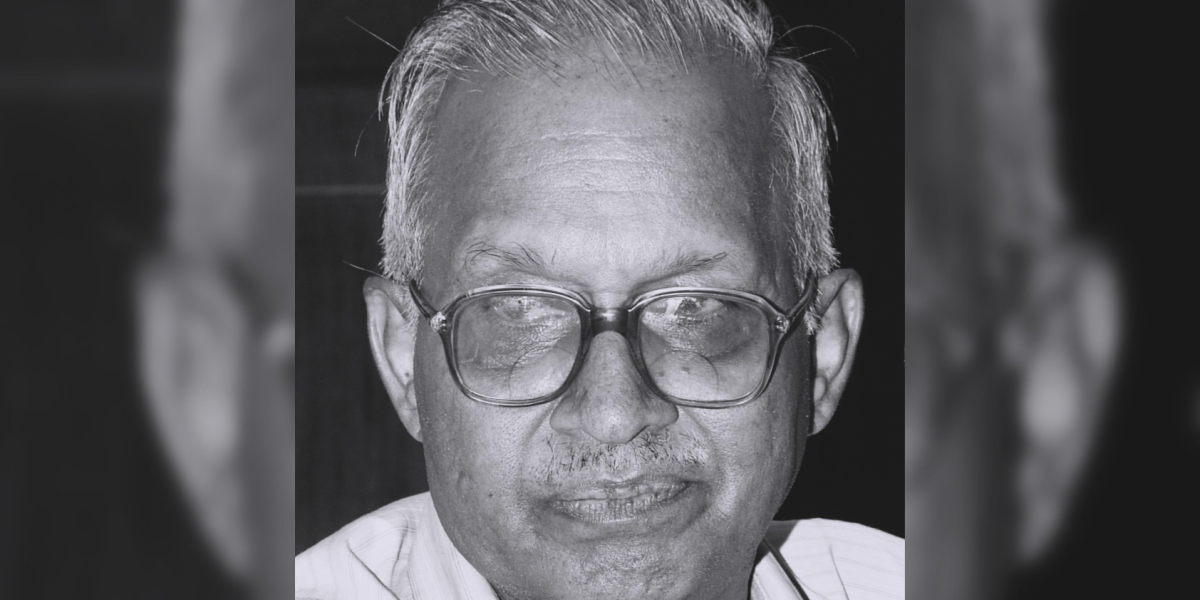
Indian nuclear engineer and educationist M.P. Parameswaran (January 18, 1935-August 11, 2026). Photo: Wikimedia Commons, Canva
Science and politics rarely sustain each other for long. A scientist who wanders into political conviction is expected, sooner or later, to make a choice – either the conviction stays decorative, a personal opinion held softly alongside the real work of the laboratory, or it takes over entirely and the science is the first casualty, reduced to slogans, or worse, bent to fit whatever the party of the day needs it to prove. The 20th century saw no shortage of cautionary examples in both directions: scientists who kept their politics so private that their work said nothing about the world they lived in, and scientists who let politics dictate their science until the science stopped being trustworthy at all. What almost never happens is a scientist who lets the two disciplines actually argue with each other for an entire working life, each one correcting the other’s excesses, neither one permitted to simply win.
M.P. Parameswaran died in Thrissur at 91 after spending close to 60 years being exactly that rare and mostly unrewarded thing. He trained as a nuclear engineer inside a state institution built on the premise that scientific progress and centralised planning were more or less the same project, and he carried that training into a Marxist party built on a closely related premise, and then spent the second half of his life refusing to let either institution’s assumptions go unexamined.PlayNextUnmute
He questioned his own party’s model of development with the same instruments he had been trained to question a reactor’s safety margins, and he questioned the scientific establishment’s faith in bigger projects with the same moral seriousness he brought to questions of class and equality. It is this refusal to let either science or politics simply defer to the other that makes the shape of his life worth tracing carefully, because almost nothing about it follows the expected pattern, and the places where the pattern breaks are exactly the places worth lingering over.
He began, after all, inside the most confident institution Indian science had to offer. Bhabha Atomic Research Centre (BARC) took him in 1956, straight out of an engineering degree from Kerala, at a moment when the country was placing its long-term stake on centralised power generation and heavy industrial capacity, and a doctorate from the Moscow Power Engineering Institute in 1965 should have set the remaining decades of his career on a fairly predictable rail. Instead, in 1975, with two decades of BARC service behind him and a stable position that most engineers of his generation would have guarded for life, he resigned and went to work full-time for a people’s science movement that was, at that point, still a delicate and largely unfunded experiment in taking scientific literacy to villages, panchayats and reading rooms.
It is worth sitting with how strange that decision looks from outside, because a man who understood the physics of a reactor chose to spend the rest of his working life explaining, to farmers and schoolteachers, why their monthly electricity bills were calculated the way they were, and what a decentralised power grid might look like if it were built around their needs rather than around a state’s appetite for large projects.
That choice, more than any single essay or slogan he later produced, is the key to reading everything he wrote afterward, because the recurring argument running through his work over five decades was about scale, and about who gets to decide how large a project, an institution, or an economy is allowed to grow before the people living inside its consequences lose any real say in the matter.
Advertisement
We can see this argument take shape with unusual precision if we read his 1979 essay on the Silent Valley hydroelectric project alongside the piece he wrote 11 years later on Kerala’s power shortage, because together they form something like a single continuous thought interrupted by a decade. In the first, writing while the state was preparing to submerge one of the last untouched stretches of tropical evergreen forest in the Western Ghats under a reservoir, Parameswaran made an argument that a lesser scientist might have been tempted to soften into pure sentiment about nature, and instead sharpened into something closer to an audit. The electricity a dam would generate could be seen in exact figures, entered into a ledger, defended in front of a planning committee. The evolutionary history of an undisturbed forest, the genetic diversity accumulated across millions of years, the water systems and species relationships nobody had yet finished cataloguing, could not be entered into that same ledger at all, not because they were worthless but because no accounting method then in use had been built to hold them.
His point was that a cost-benefit calculation which excludes everything it cannot easily price is not really a complete calculation, however precise its arithmetic looks on the page, and that decisions of this size could not be left safely inside the narrow professional competence of engineers and electricity boards alone.
By 1990, with Silent Valley already saved and largely settled as a public memory, he turned the same instinct on the electricity board itself, and the resulting position reads less like an environmentalist’s plea and more like an engineer furious at incompetence dressed up as necessity. Kerala’s power shortage, he argued, was overwhelmingly a crisis of mismanagement rather than a crisis of insufficient generating capacity – the state was losing something close to 27% of its electricity to transmission and distribution failures alone, and Parameswaran calculated that fixing even a fraction of that loss, alongside honest pricing of consumption and the renovation of ageing hydel stations, would deliver more usable power than another decade of large new projects.
New capacity mattered too, he conceded, but it belonged well down a list that began with using what already existed more intelligently. It is the same mind at work in both issues: suspicious of grand projects justified by numbers that leave out the inconvenient parts of reality, and consistently more interested in getting existing systems to work honestly than in building new monuments.
That suspicion of scale eventually collided head-on with the party he had belonged to for 33 years. When the Soviet Union collapsed, Parameswaran did something his party did not expect from a cadre of his standing, which was to treat the collapse as genuine evidence rather than as an embarrassment to be managed and explained away. His conclusion, worked out across a series of essays that culminated in what he called the theory of the Fourth World, was that 20th century socialism had never actually broken from capitalism’s underlying definition of progress – it had simply promised to deliver the same unlimited material abundance more fairly, and had built the same faith in centralised planning and continuous economic expansion into its own foundations, right down to measuring its success against how quickly it could catch up with American consumption levels.
Advertisement
His alternative imagined society reorganised around small, largely self-reliant local communities, production kept close to where it would be consumed, technology deliberately redirected to make the small resilient rather than to make the large more dominant, and democracy practised as something closer to a daily habit of participation than a right exercised once every five years at the ballot box.
The Communist Party of India (Marxist)’s Kerala State Committee, in a statement issued in February 2004, judged this a departure from Marxism-Leninism serious enough to warrant expulsion, and their central fear deserves to be stated on its own terms rather than dismissed, because it was not a frivolous objection: a politics built primarily around neighbourhood consensus and decentralised decision-making, they argued, risked dissolving organised class struggle into a fog of local agreement, leaving unclear who would actually own large-scale industry or adjudicate conflicts of interest once the state itself had been allowed to thin out. Critics sympathetic to Parameswaran made a gentler version of the same point – that the economic architecture of the Fourth World remained sketched rather than built, and that his expectation of an eventual harmony between individual and community interest carried a trace of utopianism that a scientist of his training might have been expected to interrogate more sharply.
The party later left a door open for his return, on the simple condition that he ask to be readmitted. He never asked, and he went on working with the Sasthra Sahithya Parishad as though the argument had only ever been a disagreement about doctrine, never a reason to stop the actual work. Very few figures anywhere match him precisely, though the type recurs faintly across the century in scientists who refused to let party loyalty outrank what they had actually observed.
He wrote 29 books in Malayalam and two in English, published more than 300 articles, and was honoured for both his science writing and his literacy work, and none of that, in the end, is likely to be what people in Kerala’s villages remember first.
Advertisement
What they will remember, more likely, is a man who sat in panchayat halls for 50 years after leaving one of the country’s most prestigious scientific institutions, explaining patiently why a household’s power bill was higher than it needed to be, and insisting, in essay after essay and argument after argument with his own party, that no project is too large to be questioned by the people who will have to live with it.
Advertisement
This article went live on August eleventh, two thousand twenty six, at four minutes past nine at night.
The Wire is now on WhatsApp. Follow our channel for sharp analysis and opinions on the latest developments.
Musings of a people’s science activist
M.P. PARAMESWARAN
Eric Hobsbawm concluded his book, Age of Extremes: The Short Twentieth Century with the following paragraph. ‘We do not know where we are going. We only know that history has brought us to this point and – if readers share the argument of the book – why. However, one thing is plain. If humanity is to have a recognizable future, it cannot be by prolonging the past or the present. If we try to build the third millennium on that basis, we shall fail. And the price of failure, that is to say, the alternative to a changed society, is darkness.’1
This darkness could be barbarism or even extinction! As early as 1972, the Club of Rome in its report, The Limits to Growth, warned that the average quality of life would decline sometime during the 21st century and pleaded for a profound, proactive societal innovation in order to avoid an increase in the ecological footprint of humanity beyond the carrying capacity of planet earth. The study, repeated in 1992 and 2002, reaffirmed the same conclusion.
The sceptical environmentalist, Bjorn Lomborg, evidently did not agree with the report. He concluded his frighteningly referenced book of the same title with the following words: ‘Thus, this is the very message of the book: children born today – in both the industrialized world and developing countries – will live longer and be healthier, they will get more food, a better education, a higher standard of living, more leisure time and more possibilities, without the global environment being destroyed.’2
However, a vast majority of the scientific community does not agree with this simplistic linear extrapolation of the past. We cannot follow that path any more. Global warming is real, climate change is real, resource depletion is real, pollution accretion is real, shrinkage of fresh water sources is real, struggles for control over diminishing resources are increasing – all these are real. That human beings are ingenious enough to solve the problems resulting from their own actions is nothing but a modern superstition.
There are many things that we cannot change. We cannot alter the radioactivity in the fission products from spent nuclear fuel; we cannot bring back the Himalayan or Alpine glaciers; we cannot rebuild the polar ice cap; we cannot manufacture coal, petroleum or natural gas; and we cannot instantaneously switch over to solar energy for everything. There are ever so many problems that science and technology cannot solve or will take too long a period to do so.
In the 2002 study, The Limits to Growth, Meadows and Meadows stated: ‘The limits are real and close and in some cases below our current levels of throughput. But there is just enough time, with no time to waste… just enough environmental resilience and enough human virtue to bring about a planned reduction in the ecological foot print of human kind: a sustainability revolution to a much better world for the vast majority.’3
Yes, just enough time. Or is it already too late? But better later than never.
We realize that each day we are getting more trapped. We have been trying to convince society, especially the politicians and intellectuals, that ‘tomorrow will be too late’, but without much success. It was during the long years of public debate, that often became polemical, about the Silent Valley Hydro Electric Project and later, on the critical importance of not just preserving but nurturing our forests, that the question of ‘sustainable development’ was brought centre-stage. What is development? Is it mere growth? No, development is not mere growth, we argued. It is the improvement in the physical-biological and also socio-cultural quality of life that constitutes human development. We argued that beyond a certain stage of growth there could be development with or without growth.
The seeds of the concept of the Fourth World had already been sown in my mind during 1962-65 when I was a doctoral scholar in Moscow. After passing out from the Trivandrum Engineering College as an electrical engineer in 1956, and a short stint of training in the Tata Hydro Electric Company, I joined the first batch of the atomic energy establishment, Trombay Training School. The successful launch of the first Sputnik by Soviet Union on 4 October 1957, six months ahead of the USA, made such an impression on me that I decided to go to the USSR rather than the US for higher studies. I began to learn Russian earnestly. It was only five years later, in 1962, that I could realize my dream. In October 1962, I joined the Moscow Power Institute as a PhD student. That I was awarded a PhD degree three years later is a routine story. But what I learnt of life there – of socialism and communism, of the paradise built and the signs of its decay that were already visible – was to have a profound impact on my later life.
What I saw in the USSR at that time was far beyond my expectations – no starvation, no poverty, and no unemployment. Every child, as well as every ill person, was well looked after, and everyone had a home with access to gas and electricity. Everything, including travel, was inexpensive. The minimum income level was about three times the subsistence level – or the poverty line, in our language. Science and technology and productive forces were growing rapidly and the country had already overtaken the US in space and nuclear technology. No citizen had to worry about the future, nor about the future of their children or grandchildren. Lifelong security was ensured by the society and not through personal accumulation of wealth; there was no necessity for that. Yes, the USSR at that time appeared a real paradise on earth.
I had not visited the US at that time. Was it a better paradise? That depends on one’s concept of paradise. If Indra’s swarga is one’s concept of paradise, USA was a better one, but not for all – not for the unemployed, the old or the ailing.
Unfortunately, the people of Soviet Union were taught that the success of socialism lay in overtaking capitalist USA in per capita consumption of everything. Even as early as the early sixties, symptoms of the disease which was to later kill the Soviet Union, and defeat the first socialist experiment, were already visible.
There was a craze for ‘foreign’, especially American, goods; there was a black market in the dollar-rouble exchange. The Soviet concept of development or progress was anything but socialistic, no different from the capitalist concept of abundance. As against the ambitious goal for ‘upbringing of socialist persons’ (Vospitaaniye Sotsialeecheskaya Cheloveka), circumstances had moulded them into persons with capitalistic aspirations.
There was tangible alienation of the people from the Bolshevik party. There was visible degradation in the ethics of communist party members. Dictatorship of the proletariat had become the rule of the party. It soon degenerated into the rule of the party elite. The absence of democracy made internal correction difficult. The governmental bureaucracy had increasingly becoming obstructionist, corrupt and inefficient. Marxist philosophy become unpopular among students of Soviet universities.
Discussions with party comrades in the institute revealed that were they aware of these problems; they even assured me that they were striving to rectify them. But they failed and probably were bound to fail in the absence of democracy.
I hoped for a socialist experiment – with democracy, a concept of development based on quality of life, accepting freedom for different nationalities – to succeed in India. I wished very much that the children of India too would enjoy their childhood as Soviet children once did. I wanted people of India to be rich in goods necessary both for their physical as well as cultural well-being. I also knew that without an active and creative democracy this could not be achieved. One has to start with strengthening democracy, with more and more people participating. It was also clear that in the contemporary world of scientific and technological revolutions, democratic participation is possible only on the basis of ‘knowledge’.
It is as clear as daylight that the human species has chosen a wrong path for development, one which will invariably lead to an economic catastrophe. This can even result in the reversion of the species to something that may be called a post-capitalistic barbarism. The trauma of this fall might even lead to a virtual extinction of the species. The only redeeming factor is that humans can foresee this impending catastrophe and do something about it. If only we fully internalize the possibility of such a catastrophe and start preparing ourselves to face it from now itself, we may be able to survive, both as a species and as a civilization.
‘Business as usual’ will not suffice. We have to make drastic changes in world outlook, in economics and in politics. One may call it socialism of the 21st century or solar socialism or solar democracy. Indications of such a society are discernible in the Communist Manifesto and in Hind Swaraj. Both argue for de-urbanization, horizontally networked local economies, wisdom to distinguish between pseudo needs manufactured by capitalism (greed) and real needs, inter- and intra-generational equity and emancipation from all forms of alienation.
The campaign initiated by the KSSP as part of its Golden Jubilee activities has as its governing theme: ‘Let’s Strive for Another Kerala’. The development path being followed by Kerala during the past two decades, though one of ‘high growth’, has not been inclusive. As in other parts of the country, inequality here too has increased as the earlier development path of Kerala, distinguished for its focus on human and social development, has given way to a growth-centric one conforming to the national path.
Every new system – slavery, feudalism and capitalism – initially grows within the womb of the older system. Socialistic societies can be and have to be nurtured within the womb of capitalism till they grow strong enough to emerge. Kerala had an excellent opportunity to embark on such an experiment – the massive People’s Plan Campaign that was initiated in 1996. The left unfortunately lost the plot because it did not consciously attempt to develop socialistic societies – in economy, in world outlook, and in culture.
The term ‘Kerala Model’ highlighted the achievements in social development, whose parameters are high longevity, low infant mortality rate, low birth rate, high level of literacy and so on. It is generally believed that there is a strong correlation between economic development and social development. The Kerala experience seems to complicate such a simplistic causal relationship. And there is a reason for it. The relationship between social development and economic development is mediated through consumption of goods and services. Goods and services are produced, exchanged and consumed because they have some use value, useful to the promotion of quality of life. Such a correlation can be established only if we define consumption and quality of life independently. The UNDP definition, however, privileges per capita income. We can define social development differently using two indices, both being expressed independently of income. One is the physical-biological quality or material quality of life (PQL) and the other, spiritual or non-material quality of life (SQL).
We may define a physical-biological quality of life, using three indicators.
(i) Effective expectation of the community, which is the regular life expectation less the average lifetime integrated morbidity period, morbidity being defined as the condition under which any individual is incapacitated from participating in the societal processes in a normal manner due to physical or mental ill-health.
(ii) Liberation from heavy manual labour with the use of labour saving machines and from boring and repetitive, non-creative labour by restructuring the labour process or, to put it differently, the degree to which productive labour becomes a pleasure and not a punishment.
(iii) Sustainability, meaning thereby to ensure that future generations too can enjoy an equally high quality of life. As Marx succinctly put it: ‘…all simultaneously existing societies taken together, are not owners of earth. They are simply its possessors, its beneficiaries and have to bequeath it in an improved state to succeeding generations as pari patres familias…’ (good heads of the household). The lesser the use of non-renewable resources, the greater the reliance on renewable resources and the lesser the overall throughput of material resources for the same effective life expectation and liberation from boring, tiresome manual labour, the higher is the PQL of society.
We may define the spiritual (non-material) quality of life (SQL) of a society using, again, three parameters.
1. Social quality: the lesser the crime rate, like murder, robbery, rape, violence against women and alcoholism, the higher the social quality of life of that community. One can, to begin with, give a measure to this quality as the ratio of ‘total state expenditure on health care plus education divided by total expenditure on military, police, judiciary and administration.’ The higher the ratio, the higher the social quality of life of that society.
2. Cultural quality: This is more difficult to define. Tentatively one may define this using three parameters (a) the average number of years of education, (b) average number of hours spent in reading and, finally, (c) the average level of participation/attendance in cultural and sports activities.
3. Economic quality: Though we wanted to keep income out from our quality of life consideration, inequality in income has to be taken into account. This can be expressed simply in terms of the gini coefficient. The lower the gini coefficient of a society, the higher is its economic quality – absolute incomes are immaterial.
It is generally believed that high income will lead to high PQL and SQL, because it allows society to consume more. It is seldom asked: What do they consume? Goods consumed by people or produced in a society have got three types of use values.
a) Welfare value: food, medicine, cloths, housing for example, have welfare values. If these are in short supply, both PQL and SQL will come down. There is a class of goods and services like a grinder, microwave oven, induction heater, cycle, and so on, which add to the comfort of living and also increase the socially available leisure time.
b) Vanity values: There is a class of goods and services like, for example, gold ornaments, expensive clothes, exotic food and private cars which do not improve either PQL or SQL. In order to produce these goods, society as a whole has to put in more labour. This reduces the socially available leisure time and hence will lead to a reduction in SQL.
c) There is a third category of goods which are detrimental to societal well being – narcotics/alcohol, weapons of mass destruction, among others. Increased manufacture and use of these goods reduces the quality of life of humans at a global level.
Theoretically, it should be possible to restructure global society such that wars and war efforts become unnecessary. Consumption of narcotics and alcohol too should be consciously reduced. Their production and the labour thereof, can be progressively reduced to zero, thereby increasing socially available leisure time as against socially necessary labour time. Further, both society and the individuals can further decide to reduce their own vanity consumption (according to their own definition of vanity goods) and thus further reduce the socially necessary labour time.
Capitalism cannot survive without constantly accumulating capital, and for this both production and exchange of goods have to continuously increase. The variety and demand for welfare goods being necessarily limited, the only way to expand production is through expanded production of vanity goods and through creating a feeling that they are welfare goods. A new economic (call it Human Economy?) theory has to be evolved using categories like socially available leisure time, value of leisure, welfare value including comfort value, vanity value, destructive value, physical and spiritual quality of life and so on. Such an economics will demand the understanding of a number of additional categories, which are necessary for working out an internally consistent social organization.
The categories like development, growth, progress, equity, sustainability are all known. Even the concept of social security is understood. But there are certain other important aspects which require a deeper understanding. They are rurbanism, wastage index, dehumanization index, and local economy.
Rurbanism: Agriculture has been under threat the world over since long. The new phenomenon of global warming only makes the threat graver. All of this originates from one tendency: urbanization leading to extremely uneven distribution of population or centres of consumption, while all the resources such as soil nutrients, water and sunlight – the essential elements of primary production – are evenly distributed in character. Drawing on the observations of the well-known soil chemists of the 19th century like Justus Von Liebeg and others on the disruption of soil metabolism, Karl Marx concluded that cities like London, on the one hand, extract nutrients from the soils of far off villages and countries in the form of foodgrains and fibres and destroy its health and, on the other, accumulate them in the form of human excreta and urban waste, polluting the river Thames and causing a health havoc to city dwellers. Marx and Engels argued that no socialism or communism is possible without restructuring cities like London. In the Communist Manifesto, as an important post-revolution programme, they therefore recommended a ‘combination of agriculture with manufacturing industries and a gradual abolition of the distinction between town and country by ensuring a more equitable distribution of population over the country.’
This proposition has wide ramifications. It means saying ‘no’ to the hegemony of large-scale industries; a strengthening of local economies; increase in local employment and production; reducing the quantum of travel and transport necessitated by large towns and concentration of production; higher participation of citizens in running the affairs of the society and a deepening of democracy; in short, creating an economy of ‘networks of associated producers’ through broad-based control over the means of production, and so on.
Today, a village need not mean the ancient type of villages without roads, electricity, telephones, schools, hospitals, theatres and so on. We can have all these and still remain a village centred society with relatively evenly distributed population. Kerala continues to exemplify this. It remains a rural-urban continuum with a spread out population, and a bulk of its agriculture distributed evenly. However, capitalistic notions of development, strongly shared even by the left, privilege urbanization, industrialization and world class metropolitan cities as the goals and means of development. Such notions also include increasing the tertiary sector, including those from speculative trading, real estate business, ravaging the soil, the rivers and forests, as a sign of progress. Any dependence on the primary sector is taken as a sign of underdevelopment. All these together are destroying the natural advantages which Kerala once enjoyed.
I believe that none of this will lead to any improvement in the quality of life of the citizens. Rather, a reduction in the daily travel necessitated by the requirement of earning a livelihood, reduction in a disruption of families because of economic activities, reduction in the dependence on food materials transported from far off places alongside associated risk of transport breakdowns – all these will improve the quality of life. A situation when a larger number of goods with welfare values are produced locally and more and more local employment is generated, reducing the average job-related travel distance of citizens, is a far more desirable goal.
One can define a Citizen Travel Index, based on the average daily or annual time spent for travel by a citizen, to eke out a livelihood. A reduction in this can be taken as an improvement in the quality of life. Similarly, one can define a Material Haulage Index, based on the distance travelled by a commodity from the point of production to the point of consumption, with weightage given both for quantity and value – expressed finally in terms of total dollar/rupee – kilometres of consumption.
A high Travel Index and a high Haulage Index indicate advancement in the wrong direction – towards a decreasing quality of life. The two can be, if necessary, combined into a Wastage Index. Globally the Wastage Index is increasing. Soon we will reach a point of discontinuity with nowhere to go!
In any society, resources spent on education, health care, transport, communication, energy, culture etc. improve the quality of life of the society. A high level of social insecurity, on the other hand, denotes a poor quality of life. This necessitates larger and larger resources to be spent on the so-called ‘state’ – on police, jails, judiciary, defence and administration. The ratio of such expenses – which may be collectively called repressive expenses or control expenses – to the total expenses of the government (as different from the state) may be taken as the level of underdevelopment and may be called as ‘Dehumanization Index’.
A new economy – one can call it an ‘adiabatic economy’ – will have to be developed. Local (different levels of localness) economies will have to become self-reliant based on their own renewable and non-renewable resources and annual supply of solar energy and rainwater. The capability of labour power has to be continuously upgraded to help local societies graduate from self-reliance to self-sufficiency. This should be the meaning and result of ‘development of productive forces’. It should help the local to become powerful enough to withstand the onslaught of the global, to make small not only beautiful but also powerful. Today, the development of productive forces is consciously geared to make the large powerful, to force small producers to part with their means of production and thus lead to the increasing corporatization of the world.
In my view, all these ideas are reflected, to a greater or lesser extent, in the recent campaign initiated by the KSSP. The idea was to impress the people on the need for social control over land use in the backdrop of ongoing destructive developments such as the digging or filling up of rice fields, mining of rivers, levelling of hills and quarrying of rocky lands. The real estate mafia, supported by a sand mafia, a clay mafia, land levelling and land filling mafia as component parts, has became invincible. Ironically, this grouping is more powerful than the liquor mafia. The booming construction industry does not contribute any use value. More than half of the new flats are reported to be unoccupied; others are under occupied.
People have to mount a campaign to force the government to enact and implement strict laws prohibiting any family from owning more than one dwelling unit. Policies have to be put in place that will attract investment in avenues compatible with the ideas and practice of sustainable development such as in renewable energy, recycling of wastes, non-polluting technologies, etc. Agriculture today warrants new sources of nutrients and water. Whatever nutrients we take away from the soil in the form of crops and wastes have to go back, so wrote Von Liebeg and other soil scientists. They also pointed out that adding chemical fertilizers does not help. That is why Marx, Gandhi and Mao argued that all excreta – animal and human – as well as all agricultural waste should go back into the soil.
A decade and half ago, the KSSP carried out an experiment: a sangha swapna or collective dreaming exercise. About sixty leading activists of one panchayat – Madakkathara village panchayat in Thrissur district – sat together to articulate their hopes and aspirations about the nature of their panchayat 25 years thence. At the end of the dreaming conclave they came up with a written report on their development perspective. They shared this dream with about 2000 citizens, took inputs from them and finally prepared a 25-year perspective plan. This perspective plan envisaged the following.
1. Full utilization of all cultivable land to yield maximum possible production in a sustainable manner.
2. To recycle all the locally generated organic waste.
3. To procure all the biodegradable waste from the neighbouring municipal corporation and convert it into organic manure to improve soil nutrients.
4. To have complete and scientific management of water as part of the command area of Peechi irrigation system.
5. To go for large-scale precision agriculture and thereby increase the efficiency of utilization of organic fertilizers and water.
6. To develop integrated animal husbandry of milk and meat animals like cow and goat; waste to food converters like pigs, poultry and fish and thus become self-sufficient in milk, meat, eggs and fish to ensure food self-sufficiency.
7. To ensure opportunities for economic activities (self as well as wage employment) for all those willing to work so that livelihood related long distance travel is reduced to a minimum and so also transportation of goods of consumption.
8. To set up industries to manufacture as many items of daily use as possible within the panchayat, as well as to share with neighbouring panchayats items requiring large-scale production.
9. To boycott all transnational, corporate products, wherever a near equivalent ‘local’ product can be produced,
10. To stop consuming goods which have only vanity values or destructive values.
11. To provide reasonable housing for all citizens of the panchayat, which requires only a small increase in the number and quality of dwellings.
12. To provide good quality education (regular and vocational) for 12 years, so that people acquire all the knowledge and skills, including fluency in the use of English language and computers, to live in a global 21st century.
13. To ensure neighbourhood schooling system of the highest quality so that children can go on foot or on cycle to schools, making the school bus system redundant.
14. To provide pedestrian walkways and cycle paths.
15. To provide high quality integrated health care services for all citizens free of cost and thus de-commercialize health care services.
16. To reduce inequalities in income, expenditure, education, housing, and in other spheres.
17. To ensure a high degree of social security for all citizens so that they do not have to amass wealth by hook or crook to ensure their long-term family security, and to develop a strong faith in the community.
18. To strengthen neighbourhood democracy so that nobody can upturn the achievements of the community.
19. To reduce their carbon footprint continuously to zero by embarking upon an ambitious programme for carbon sequestration and food production through massive cultivation of food growing timber trees like jackfruit, bread fruit, mango, coconut, and so on.
20. To produce all the energy required by the panchayat through rooftop solar photovoltaic systems (ranging from 1 kw to 3 kw per household), both for households as well as public and other institutions, thus doing away with cooking gas and coal as well as electricity from thermal stations.
21. To become, effectively a self sufficient village republic of the 21st century – linked to other panchayats, horizontally and not hierarchically.
Such were their dreams. However, the highly splintered and mutually inimical political groups (in all parties) ensured that this dream was not realized. The situation is the same throughout Kerala – citizens are not free to dream and act. Political parties of all kinds are afraid of dreaming citizens!
The campaign for ‘Another Kerala’ calls for the people to dream about a new Kerala, a different Kerala, panchayat by panchayat, town by town. There are thousands of citizens – academics and lay people, cultural activists and political activists, workers and peasants – who feel deeply that the future shall not be a continuation of the present
The campaign enjoins them to dream boldly, to think deeply, to plan scientifically, and to act with determination for a better tomorrow, for a different Kerala, for a different India and for a different world.
Nobody can stop me from dreaming.
Footnotes:
1. Eric Hobsbawm, Age of Extremes. Viking, 1995, p. 585.
2. Bjorn Lomborg, The Skeptical Environmentalist. Cambridge University Press, 2001, pp. 351-52.
3. Donella Medows, Jorgan Sanders and Dennis Meadows, Limits to Growth: The 30 Year Update. Earth Scan, Asian Edition, 2005.
We felt that VS articulated environmental questions more vigorously than MP, and that Vijayan Mash possessed greater ideological clarity. I still remember those disagreements because they were disagreements born of serious political and intellectual engagement.
MP was important precisely because he made us argue. His attempt to rethink Marxism after the collapse of the Soviet Union, and to imagine a more democratic, decentralised and ecological society, was controversial, but it came from an extraordinary willingness to question even the ideological world he had inhabited for decades.
What saddens me now is what happened to much of the political inheritance around him. In the years that followed, many who had once drawn inspiration from MP shifted their loyalties completely towards Pinarayi Vijayan.
The left-liberal, socialist-democratic and fiercely questioning convictions that I associated with MP seemed to disappear from much of that ecosystem. Even KSSP, which had once represented an uncompromising tradition of questioning power, appeared to me to compromise on critical questions when confronted with the growing might of Pinarayism.
There is a painful irony in it. A man who spent his life teaching people to question power left behind admirers who, in many cases, seemed increasingly comfortable with power.
But that cannot diminish MP himself, his scholarship, his courage, his contribution to Silent Valley and the people’s science movement, or his lifelong engagement with nuclear disarmament, peace and ecological justice.
Today, I mourn him not as a saint and not as an ideological comrade, but as one of the great minds who shaped the Kerala I grew up in. I think of that schoolboy holding Sindhuvinte Kadha and failing to understand what he was reading.
Some books wait for us to grow up. Some people do too. MP was one of them. The older I became, the more I understood the questions he was asking. And perhaps that is his most enduring gift: not a doctrine, not a political camp, not even the Fourth World, but the courage to keep asking why.
Why should a forest be sacrificed for development? Why should technology escape democratic scrutiny? Why should an ideology stop questioning itself? Why should power ever be beyond challenge?
In a time when so many who once inspired us have become comfortable with power, I will remember MP for the uncomfortable questions he left behind.
K A Shaji’s Post
The Fourth World, the Fourth Political Theory, the Matrix and the BRICS
Image: George Manuel on Canadian stamp, recognizing his leadership for the rights of First Nations’ and all Indigenous peoples.
Four is the sacred number in Mvskoke (Creek Indian) Cosmology. The ceremonial Square ground has, of course, four sides.
Four Mothers Society was an intertribal spiritual leadership group in Indian Territory with members from the four largest tribes: Cherokee, Choctaw, Chickasaw and Creek/Seminole.
Lakota people pray toward the Four Directions.
There are even Four Horsemen of the Apocalypse.
Are we in the Fourth World (4W) yet?
“The Fourth World emerges as each people develops customs and practices that wed it to the land as the forest is to the soil,” writes George Manuel. (p.7) He envisioned empowered First Nations communities, using technology to enhance their lives while keeping their spiritual connection to each other and the land they lived on.
George Manuel (1921-1989), a Shushwap/ Secwepemc First Nation activist from Alberta, Canada, formed a lot of his ideas while communing with “Third World” activists in Tanzania in the 1970s. Tanzania has been the most forward-thinking African country for many decades, neither blindly accepting nor rejecting the European colonial order. For example, Tanzania uses Kiswahili as the primary language to teach math and science, as opposed to teaching such subjects in English or French, as most other African nations do. Manuel would be pleased with this development–processing the “Western” science through your own culture instead of vice versa.
For Manuel, peace is maintained between cultures when “each respects the wholeness of the other.” (p. 7) Manuel himself was raised for 12 years by his traditionalist grandfather, then forced into a Catholic boarding school determined to beat his grandfather’s language and teaching out of him.
For George Manuel, his experience in Tanzania inspired his vision of a Fourth World future where “the nation-state would learn to contain within itself many different cultures and life-ways, some highly tribal and traditional, some highly urban and individual.” (p.6).
We might call this optimistic vision, 4W
The Fourth Political Theory, or 4PT
The Fourth Political Theory is Alexandr Dugin’s proposal for the future. Dugin, a Russian academic credited with being “Putin’s Brain,” levels harsh criticisms at the rising global Anglo-U.S. world order.
Born and raised under (1) Communism, after the rise and fall of (2) fascism/nazism, and seeing the “final” victory of (3)U.S.-led capitalism, Dugin seeks a 4th way, what he calls The Fourth Political Theory.
Dugin wants communities to enjoy their own cultures and identities. These cultures can be as large as Russian-Orthodox civilization, or as small as a few mountain villages, and still celebrate their uniqueness.
Dugin cites the 1999 movie, The Matrix, several times in his book, The Fourth Political Theory. For him, the Matrix celebrates the triumph of the sacred flesh-and-blood man over the machine world which attempts to reduce the human soul to binary code.
The Mother of the Matrix, Sophia Stewart, explained this in her story, the Third Eye, on which the Matrix and Terminator movie franchises are based. Stewart credits her visionary sight to her Cherokee grandmother, who was a spiritual seer. She admits that The Matrix is her translation of the Bible into science fiction, and a critique of transhumanism.
One way the West tries to dismiss Dugin is to associate him with right-wingers who admire him. Dugin criticizes nazism several times in The Fourth Political Theory, but some white nationalists still read him anyway. Many far right-wingers use the “red pill blue pill” analogy from the Matrix, which was created by Sophia Stewart, a Black Cherokee writer. You can’t blame a media creator, necessarily, for the other people who like them.
Dugin himself spoke in favor of Russia’s Special Military operation in Ukraine. This made him persona non grata in the West, but his ideas live on. Dugin is an international celebrity. Recently, a South African diplomat referred to the emergence of a “Multipolar World,” a term straight out of Alexandr Dugin’s other writings.
Where does Dugin stand on Africa and the BRICS?
It is possible that the BRICS (Brazil Russia India China South Africa) is the next immediate manifestation of the Fourth Political Theory–an economic alliance that now includes over half the world’s people and does not require anyone to give up their culture, language or even their currency. (Click here to see Dugin address a Conference in South African in 2024)
Is BRICS also a manifestation of The Fourth World (an Indian/First Nations reality) as well as the Fourth Political Theory (4PT)? The BRICS nations seem opposed to a one-size-fits-all global world order, which leaves some room for Indigenous peoples to maneuver.
On the End Times, Manuel’s 4th World (4W) and Dugin’s 4PT may differ:
“In a Christian framework, victory means to make it to the day of reckoning. In an Indian framework, every day is the day of reckoning.”(p.11) In other words, there is no inevitable Armageddon, no returning messiah, according to Manuel.
Dugin offers this cryptic advice (p. 183): “The end times will not realize themselves on their own…We will wait for the end in vain. The end will never come if we wait for it, and it will never come if we do not.”
References:
Earnest Gouge, Craig Womack, Totkv Mocvse/New Fire, University of Oklahoma Press, 2000.









Leave a comment