


14/Aug/2026
5 min read


In ‘The Resistible Rise of Arturo Ui’, Brecht shows us where fascism comes from and how. He also suggests that process is not irreversible.
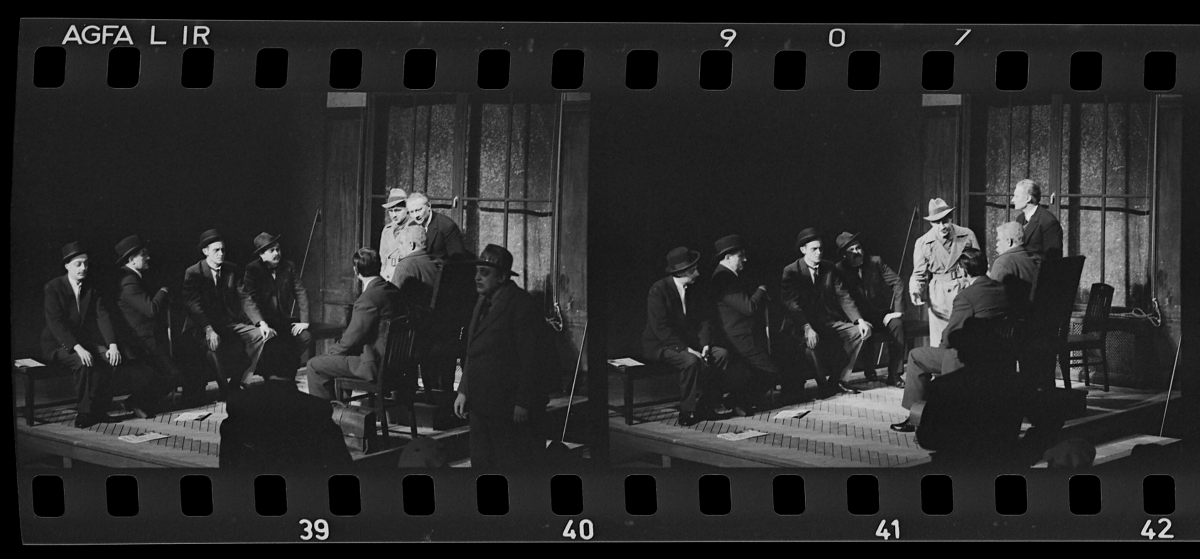
A scene from a stage performance of ‘The Resistible Rise of Arturo Ui’ in Paris, June 1960, text by Bertolt Brecht. Photo: Wikimedia Commons/Roger Pic
Bertolt Brecht had no illusions about what Hitler might want to do to him. As early as in 1923, the Munich premiere of his play In the Jungle was disrupted by Nazi provocateurs who blew whistles and lobbed stink bombs at the actors to shut down the show. By 1930, Hitler’s flunkies were bold enough that they could break up – in Berlin, of all places – the very first performance of Brecht’s satiric opera The Rise and Fall of the City of Mahagonny, labelling it ‘degenerate’ and ‘un-German’. And when in 1932, the Weimar Republic allowed itself to be so intimidated by Nazi rowdies that it banned the film Kuhle Wampe (‘Who Owns the World?’) co-written by him, Brecht saw that as another straw in the wind.
Then came Hitler’s anointment as Chancellor, on January 30, 1933. Exactly four weeks later, on February 28, Brecht fled Germany. A fire had gutted the Reichstag the night before. Brecht wasn’t to return to Germany until 1949 – four years after Hitler killed himself – his Thousand-Year Reich collapsing around him in a heap.PlayNextMute
Current Time 0:03
/
Duration 2:04FullscreenBackward Skip 10sPlay VideoForward Skip 10s
Advertisement
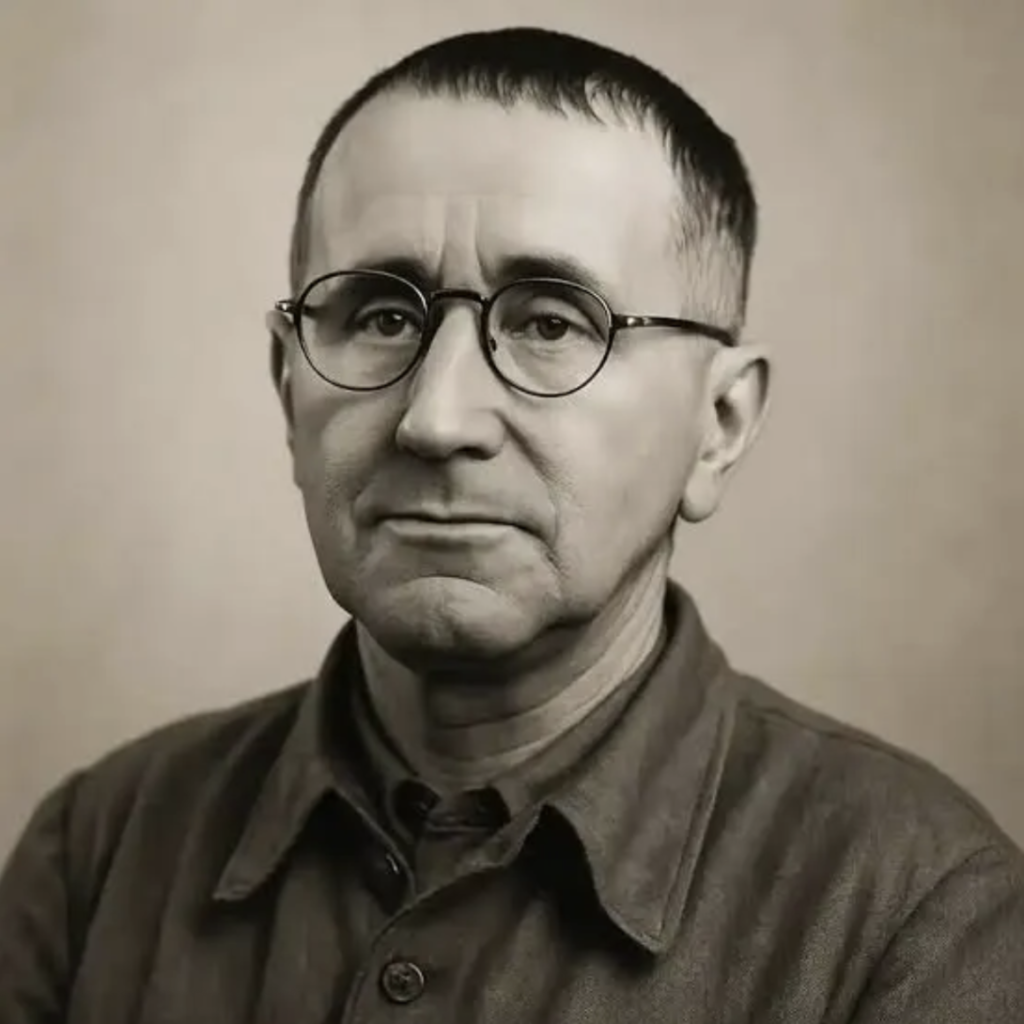
Bertolt Brecht: February 10, 1898 – August 14, 1956.
In exile, Brecht drifted from Prague to Vienna to Zurich to Stockholm to a couple of Danish islands to Helsinki before he settled on a plan to move to the US. While waiting for his American visa in 1941 and over a mere three weeks’ time, he wrote The Resistible Rise of Arturo UI. The timing is significant: Brecht had earlier worked on a satiric prose piece titled, simply, Ui, written in the style of a Renaissance historian, purportedly about a machine politician of Padua named Giacomo Ui.
Later, he heavily reworked and expanded those early ideas into a fully realised verse play. Both the Ui’s were modelled on the same rogue – Adolf Hitler – but the narrative was now transposed from Italy’s Padua to the ‘gangster city’ of Chicago. Chicago’s Al Capone had, in any case, fascinated Brecht for years, and he hoped to be able to stage The Resistible Rise of Arturo Ui, soon after he had settled in the US. This masterpiece, however, didn’t debut on the stage until November 10, 1958, a good two years after Brecht died, in Stuttgart.
The American premiere took another five years to come. Ultimately, Christopher Plummer and Madeleine Sherwood starred in the Broadway production on November 11, 1963.
The Plot
Teetering on the edge of financial ruin in 1930s Chicago, the Cauliflower Trust frantically searches for a way to save their green-goods business. Small-time thug Arturo Ui, desperate for a toehold in the city’s political economy, offers help by way of a protection racket, but his dodgy reputation puts the trust off. Instead, the trust seeks help from politician Dogsborough – an elderly man with a clean reputation who has significant influence over the city council – by way of an attractively-priced loan from the council.
Advertisement
Dogsborough demurs at first, unsure if the trust leaders wouldn’t steal the money. The trust greases his palm via a devious stockyard deal (which makes Dogsborough willy-nilly a trust partner), and Dogsborough eventually helps in securing the funding the trust was eyeing. The cash is duly embezzled, of course. Ui gets to know about the whole murky deal, and blackmails Dogsborough in order to gain influence over the trust’s business. A compromised Dogsborogh obliges but the scandal around the loan bursts into the open, and Dogsborough faces a court trial for skulduggery.
Arturo Ui has the principal witness against Dogsborough killed, and next stakes his claim to be hired for the protection of the trust’s business. One prominent trust member objects, and soon his warehouse is burnt to the ground in an ‘accidental’ fire. Ui and his gang are accused of arson and put on trial, but soon enough, it’s clear to everyone that the witnesses, the judge and even the press covering the proceedings are under Ui’s thumb. An innocent man is framed as the arsonist, but Ui’s personal physician bumps him off before he can respond to his arraignment.
Now that Ui is assured of total control of the cauliflower trust’s business, his highest-ranking associates – Roma, Givola and Giri – fiercely wrangle for the boss’s favours. Ui takes Givola’s and Giri’s side and ditches his oldest comrade Roma, who is brutally killed along with his men. Next Ui turns his attention to the green-goods business of the neighbouring city of Cicero. However, Dullfeet, who leads the trust in Cicero, refuses to collaborate and runs a spirited press campaign against Ui. Dullfeet is assassinated, and Ui manipulates the final vote on his proposal to annex the Cicero trust to Chicago’s.
Arturo Ui becomes the unchallenged king of the green-goods business of the entire region. The petty hooligan mutates into a business tycoon.
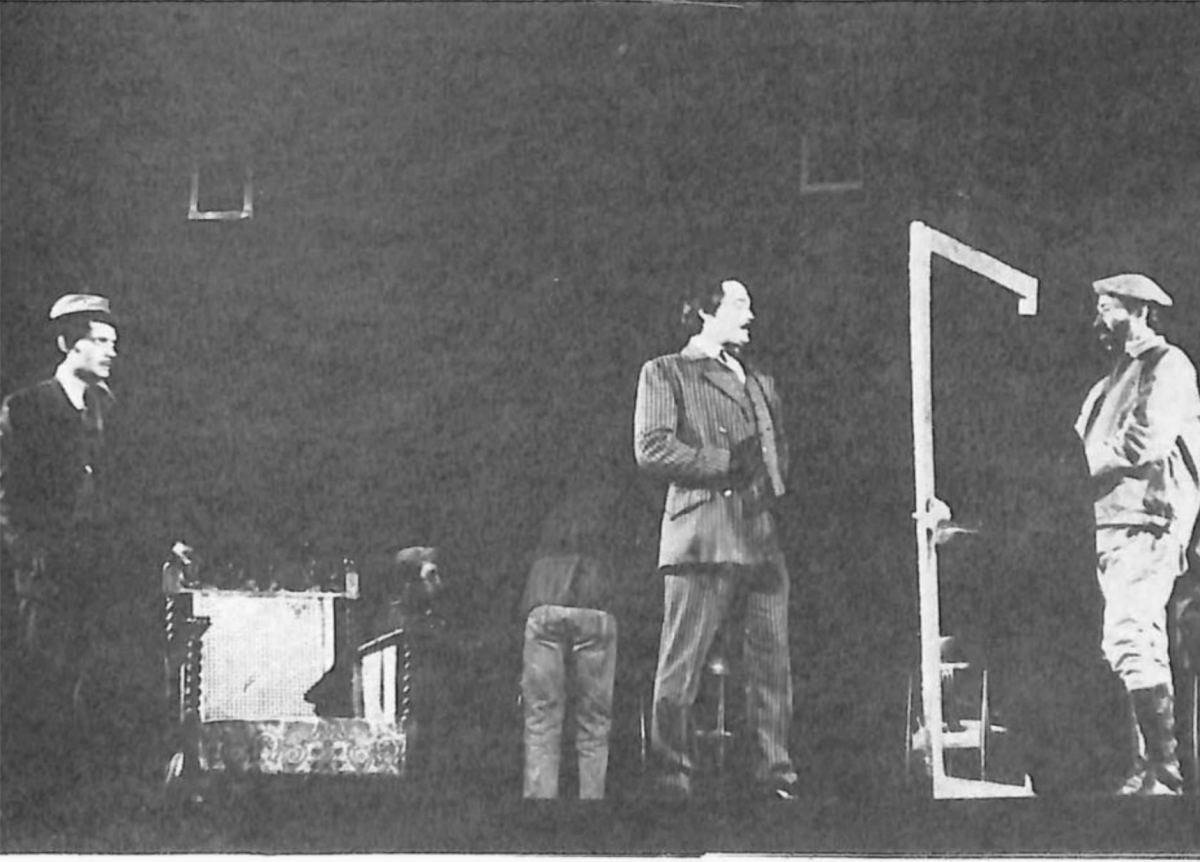
Theatre Unit’s production of Arturo Ui in 1978 in Kolkata. Photo: Author provided
‘Parable Play’
The Resistible Rise of Arturo Ui is a thinly-veiled allegory of Hitler’s rise to power, mirroring the outlandish events leading up to his chancellorship and the freaky circumstances that made those events possible. The protagonists are exact analogues to characters from 1930s Germany (also Austria): Givola is Goebbels, Giri is Goering, Ernesto Roma is Ernst Rohm, General von Hindenburg has become Dogsborough (by way of a clever pun on Hund, German for dog, and Burg, meaning town), Dullfeet ia a proxy for Engelbert Dollfus, Austria’s Chancellor assassinated by the Nazis in 1938, and of course, Arturo Ui is Adolf Hitler.
Advertisement
In the same vein, the fire in the green grocer’s warehouse is the surrogate for the Reichstag fire, the Dock Aid Scandal for the Eastern Aid Scandal, the Cauliflower Trust for the Prussian Junkers caught up in that scandal, the murder of Ernesto Roma is a proxy for The Night of the Long Knives (Hitler’s violent elimination of Ernst Rohm and the powerful SA in June-July 1934), and Cicero’s fate is a surrogate for the Anschluss, Hitler’s coercive 1938 annexation of Austria.
We have one of the world’s worst tyrants seeming to mimic a gangland takeover of a prized business enterprise as he arrogates absolute power to himself. But Brecht chooses not to leave the parallels between real events in 1930s Germany and the imagined story of gangster warfare in the Depression-era American metropolis to the viewer’s imagination, either. He interposes posters, banners and other stage props between scenes that track those real events the play is mimicking. Thus, as scene 4 ends and the actors exit the stage, a sign appears that reads:
In January 1933, Hindenburg appoints Hitler Chancellor in return for a promise to prevent the exposure of the Osthilfe (Eastern Aid) scandal, in which Hindenburg himself is implicated.
Brecht calls his play The Resistible Rise of Arturo Ui, and subtitles it A Parable Play. The parable concerns itself with the message that if we choose to cut a rogue some slack, any slack, the result will likely be an abomination like Hitler. Equally, there’s the other message: that Hitler’s rise was not irresistible; that if the forces opposed to the thug had made determined choices and were both clear-eyed and resolute enough that they would stick with those choices, Nazi hegemony was not ineluctable.
Advertisement
This is remarkable because Brecht wrote the play after the Nazis had actually overrun much of western and central Europe. Even more significantly, Brecht is known to have first considered the title The Irresistible Rise… (Der unaufhaltsam Austieg…), but he ultimately settled for The Resistible Rise… (Der aufhaltsam Austieg..). He was scarcely inclined to grant Hitler his vaunted claim of inevitability.
The dramaturgy
The Resistible Rise of Arturo Ui is a savage satire on the rise of Nazism, but while it’s grotesquely funny in most parts, it is equally terrifying in some others – in places, it’s funny and chilling at the same time. Not an insignificant part of the comic element derives from the fact that Brecht wrote the play in blank verse: this indeed is the only fully blank-verse play he wrote. The tone verily apes that of high tragedy in places, often with purposefully hilarious results, as below:
Ui: If I may say what moves me in
This hour and at this shameful sight – a white-
Haired man insulted while his friends look on
In silence – it is this. I trust you, Mr
Dogsborough. And I ask: Is this the face
Of guilt? Is this the eye of one who follows
Devious ways? Can you no longer
Distinguish white from black? A pretty pass
If things have come to such a pass!
When Ciceronians are about to ‘vote’ on Ui’s purported ‘proposal’ to absorb the Cicero trust into Chicago’s, Ui makes a grand speech a la Frank Antony haranguing grieving Romans at Caesar’s funeral:
Friends, countrymen!
Chicagoans and Ciceronians! When
A year ago, old Dogsborough, God rest
His honest soul, with tearful eyes
Appealed to me to protect Chicago’s green-
Goods trade, though moved, I doubted whether
My powers would be able to justify
His smiling confidence. Now Dogsborough
Is dead……………
Ui holds forth on how he achieved that mission fully, and how Dullfeet – the leader of the Cicero trust whom Ui’s men have lately murdered – later requested Ui to extend his protection to Cicero as well. But Ui, ever the honest broker, was willing to accept that assignment only if Cicero’s traders wanted him “pursuant to their free decision/Freely arrived at”.
The city has to elect me in full freedom.
I want no grudging ‘Why not?’, no teeth-gnashing
‘We might as well’. Half-hearted acquiescence
Is poison in my books. What I demand
Is one unanimous and joyful ‘Yes’
Succint and, men of Cicero, expressive.
For confirmation of his bona fides, Ui next turns to Chicagoans who, he believes knows and trusts him well, and asks:
Who is for me?
And just in passing let me add: If anyone’s
Not for me he’s against me and has only
Himself to blame for anything that happens.
Now vote.
Intimidation has seldom been more reassuring, or more solicitous of the potential victim’s precarity. It’s hard not to hear echoes here from George W. Bush’s famous line: “Either you are with us, or you are with the terrorists”.
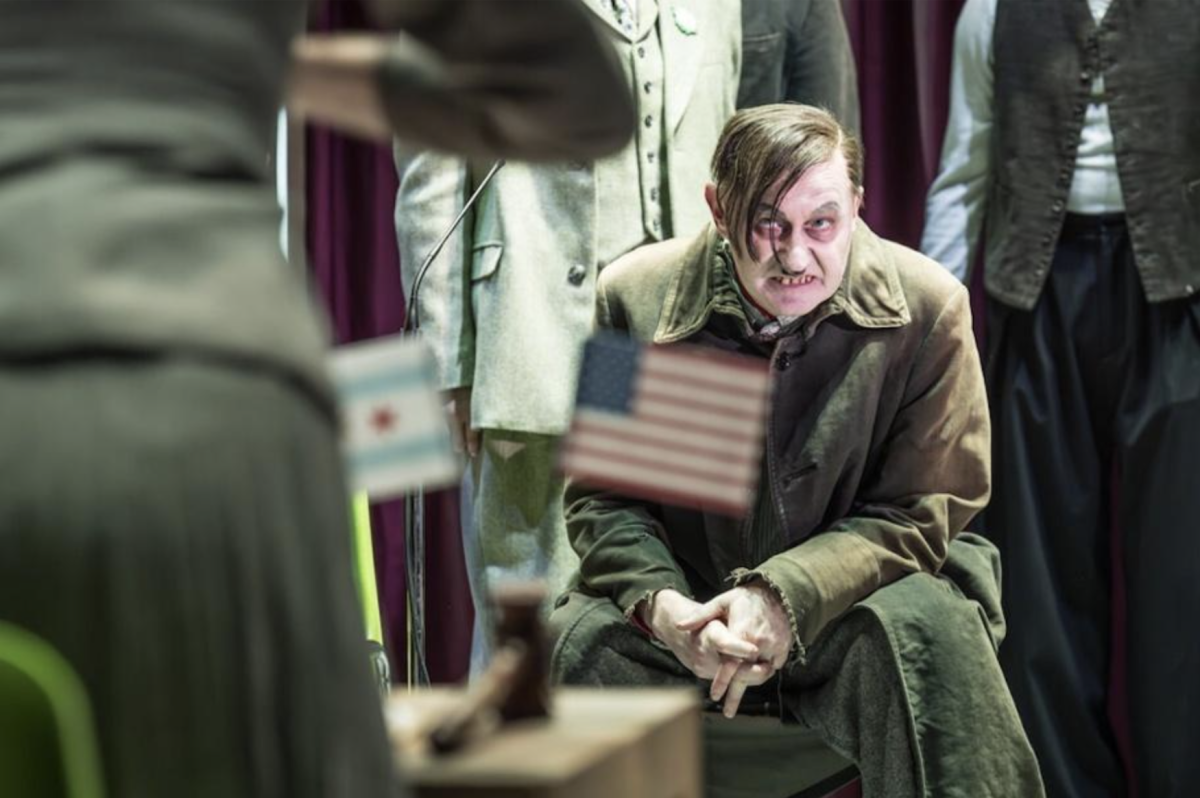
Arturo Ui in Swan Theatre, Stratford-Upon-Avon, May 2026.
This play cheerfully, and repeatedly, draws from Shakespeare. The very prologue reminds viewers of the affinities that bind Ui to Richard III: “Doesn’t he make you think of Richard the Third?” In Scene 15, in a direct throwback to Banquo’s ghost visiting a deeply troubled Macbeth, the ghost of the betrayed and murdered Ernesto Roma haunts a paranoid Ui in his sleep.
The day will come when all whom you struck down
And all you will strike down will rise, Arturo…..
Scene 12 explicitly parodies another classic of world literature, Goethe’s Faust – the celebrated ‘Garden Scene’ from that great tragic play, to be exact. But while the original is a tenderly romantic episode involving lovely young Gretchen and the man she dearly loves, Brecht’s Arturo Ui manifestly, cynically seduces Betty Dullfeet so that she won’t fly off the handle when Ui kills her husband soon after this scene.
In The Resistible Rise of Arturo Wi, when Brecht mines high tragedy, Shakespeare’s or Goethe’s, his object is the same: to strip Ui of his flaunted dignity, and make the point that the grand historical destiny that tyrants like Hitler lay claim to is nothing more than plain, bloody thuggery. Brecht’s witty pastiche of the elevated verse of a Macbeth or a Faust effortlessly mocks the Nazi project, highlighting its affinity with the sordid underworld of amoral gangsters. Overall, the verse here is cleverly harnessed to the demands of Brecht’s Epic Theatre, which operates by alienating or distancing the audience from the action so that they may consciously accept or reject the stage action rather than identifying with it subliminally.
An elaborate prologue that sets out the entire storyline and prefigures the disaster that will issue from it, together with the periodic stage signs tying the stage action to momentous historical events (discussed above) serves to accentuate that distancing.
The centrepiece
In Scene 6, Arturo Ui, mindful that his public speaking could do with some serious brushing-up “when I get into politics”, engages a classically trained (but bankrupted) Shakespeare actor to teach him how to walk, stand, sit and speak in public while projecting a persona oozing power. The actor has Ui practice to perfection Frank Antony’s famous “Friends, Romans, countrymen…” speech from Julius Caesar (which Ui will soon put to good use) and, equally importantly, to jettison his ordinary, unremarkable gait and pick up the telling Nazi goose-step instead.
This scene reminds the audience that Hitler, indeed, honed his oratorical and related skills through punctilious training with a professional actor. However, today, it also puts us in mind of a George Bush preening himself before a consequential 9/11 speech, and Narendra Modi cultivating his public persona with meticulous care under several professionals’ watchful eyes.
What’s extraordinary about this sequence is that UI emerges from it magically transformed, from a petty, insecure, common criminal into the goose-stepping Nazi overlord whose one scowl can send shivers down your spine. Scene 6 is a stroke of genius.
Has the world moved on from Ui?
While Brecht situates The Resistible Rise of Arturo Ui smack in the middle of 1930s Chicago/Germany, the themes that criss-cross the narrative speak to the anxieties and precarities of the mid-2020s with equal salience. Those themes relate to militarism, corporate greed, egregious political corruption, the crime-politics nexus and rapidly-escalating moral degeneracy across societies.
With far-right populism swamping institutions and protocols of democracy with ever-increasing impunity in the United States, India and much of the rest of the world, those themes have seldom been more pertinent for the public discourse. The virtual takeover of state power by Big Money, for example, in Modi’s India and Trump’s US, the concomitant rise of strongmen heads-of-state, and the steady erosion of constitutional guardrails against authoritarian excess: such phenomena chillingly presage the resurgence of fascism, albeit in a new avatar.
Ever alive to that danger, Brecht was putting his future audiences on notice when he added an epilogue to his play, apparently after 1945. It’s true, he tells us that the world did finally put Ui/Hitler “where his kind belongs”, but
There’s no time for bunting and champagne,
For the bitch that bore him is in heat again.
As Narendra Modi’s unabashed advocacy of the Adani business empire gets paired off with big media’s wholesale abdication of fourth-estate responsibilities, we can hardly pretend we were not warned.
Anjan Basu can be reached at basuanjan52@gmail.com.
Advertisement
This article went live on August fourteenth, two thousand twenty six, at nine minutes past five in the evening.
The Wire is now on WhatsApp. Follow our channel for sharp analysis and opinions on the latest developments.


Leave a Reply