

01/Aug/2026
5 min read


While the bitter resentments the different communist parties harboured through the 1960s and 1970s against one another scarred the Indian Left, the pockmarks looked ugliest in Bengal.
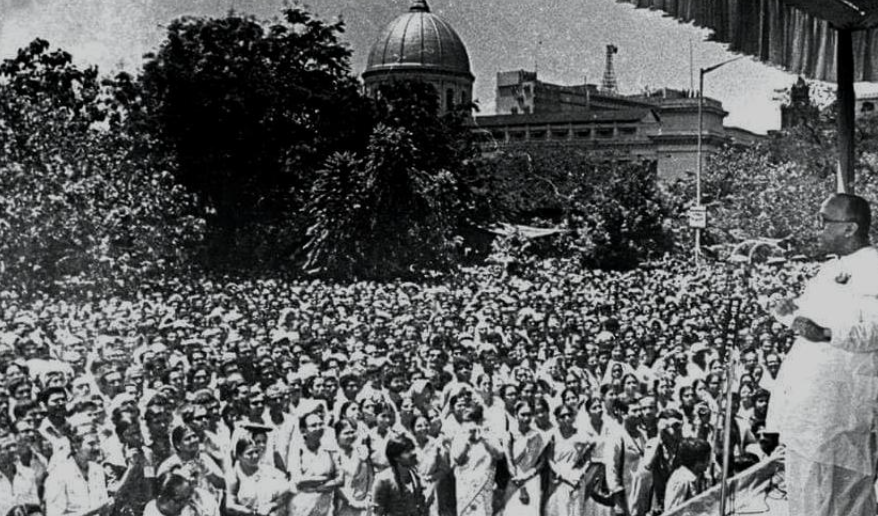
‘The Left in Bengal today is demoralised, dispirited, disoriented, and in large measure isolated from what is, or should have been, its political base by rights.’ Photo: Public domain.
Ours was a family of old-school communists. My father’s elder brother spent between 11 and 12 years in jail, some five of them before 1947 as a Congress socialist/early communist, and the rest in independent India where he happened to be one of the principal organisers of the Kisan Sabha in West Bengal and, indeed, across the country. During the Tebhaga movement, he was a fugitive from the law for many months before being arrested and imprisoned for several years. The author Manik Bandopadhyay is known to have modelled one of his best-known later stories on my uncle’s run-ins with the police during 1948-49. He was a communist legislator for many years but never looked to receive anything from the party except his measly whole-timer’s pay and continued to donate his legislator’s allowance to the party till the end. And, of course, he turned down the freedom-fighter’s pension, though it was not difficult to see that he could do with a little cash in his hand. It didn’t help that as a child of a once-prosperous family of zamindars, he had had a relatively comfortable early life. But, as all of us could clearly see, he couldn’t care less.
His younger brother, my father, was a brilliant student, besides being exceptionally gifted in a half-dozen other things than academics, and so potentially had some attractive career options but chose to be a teacher because teaching was his passion. He was a leader of the state’s teachers’ movement, guided and led every progressive social and cultural initiative including sports’ tournaments, classical music concerts, book and literary fairs, and youth festivals in the town and the district he lived in, went to jail as a leader of the 1966 ‘food movement’ that rocked West Bengal, and was an outstanding teacher and a talented writer by all accounts. He didn’t join the party very early but was always a communist, and was even persuaded to be the party’s candidate in the assembly elections one time when the party was in bad shape – and lost. Like his elder brother, the possibility – indeed, the inevitability – of radical social change was an article of faith with him. The implosion of ‘really-existing socialism’ was to him a crippling blow, but he managed to hold on to his faith nevertheless. Lucky for him, though, that he didn’t outlive the Soviet Union by very much.PlayNextMute
Current Time 0:15
/
Duration 2:04Fullscreen
Advertisement
Advertisement
Why am I going over these details from the lives of two men who never managed to write their names into history books? Am I not aware that this is not good form, for they are family? Am I doing this because I believe the trajectories of these two brothers’ lives were exceptional in many ways? To suggest that they deserved better than the oblivion that has swept over their names and their lives?
No, I am not, believe me. I am not, because though such men happened to have what looked like singular abilities, they were shaped by the time and place they lived in. I can’t, of course, claim to have known their growing-up or formative years first-hand, but I have known the West Bengal of the late 1950s through the 1970s well enough that I can say that men of my uncle’s (or father’s) description did not stand outside of or above their own time. They were not like everyone around them, of course, but not an insignificant number in the communities around them shared in their values, if not also their aspirations. So, in a very real sense, they were not outliers. Maybe the spirit of their time, the zeitgeist, happened to be present in them in a somewhat more distilled form than in some others, but they were verily men of their generation.
So what impels me to look back to that generation at this moment, to a generation now dead for many years? – Well, it is the urge to try and find out if there was any sense of inevitability about how Bengal’s progressivism evolved over the four decades or so since that generation passed on, to now reach the wasteland it finds itself in today. To frame my motivation in another way, it’s to find out if Bengal’s Left could have walked a different path to the one it happened to take over this period. That I think is not only a valid but also a very important question to examine today, at any rate for progressives everywhere.
Now, investigating that kind of a question pre-requires several things: an uncluttered view of the broad historical trends running through post-1947 India, a clear understanding of how the Left worldwide has pivoted to and also away from sundry ideological positions over this period, and finally, how those trends and those stances tie in with how the Bengal Left mutated since at least the early 1970s. And of course such an exploration would demand a highly sophisticated analytical skillset. The present writer cannot, no doubt, presume to meet any of those standards.
Advertisement
But that’s where his personal history comes in, for that history, he believes, bears witness to the profound changes that have come over Bengal’s Left since the 1970s. (‘Bengal’ here refers to West Bengal, of course.) That personal history does not surely hope to supersede a rigorous theoretical investigation, but having felt all those gigantic changes in its bones, it can hopefully lighten some of the darkness shrouding those changes. This, and this alone, is this writer’s defence of what he attempts here.
The pathologies
The Left in Bengal today is demoralised, dispirited, disoriented, and in large measure isolated from what is, or should have been, its political base by rights. That last pathology is most telling, because unlike in some other states, Bengal’s politics has been largely insulated from the tremors of the Mandal movement and so didn’t face headwinds from that direction. This isolation has very nearly made the Left politically irrelevant in a state which, incredibly, it ruled uninterrupted for more than thirty years in fairly recent past. And the isolation is deepened by the vacuity of its messaging (on, for example, the Nandigram land acquisition fiasco of 2007) and, more damningly, of its ideological positions on many critical questions.
But is the Bengal Left an outlier?
Yes and no, as the following paragraphs will hopefully show, though at some points it’s a tough call to decide where the particularities have had a greater impact than the broader, more universal trends.
Advertisement
There’s no question that the Left has been in retreat worldwide post the ascendancy of neo-liberalism and what goes by the moniker of globalisation. There’s also no doubt that the economic ‘liberalisation’ India embraced in 1991 was in essence economic (and, inevitably, also political) neo-liberalisation and an isolated and enervated Left was not an unlikely outcome of that process. Equally undeniably, some of Bengal Left’s woes arise out of the legacy of the Indian communist movement, indeed, out of the legacy of some of the international communism’s most important institutions of the twentieth century. While the first of these two factors is acknowledged widely, it’s the second that can do with some elaboration.
Growing up, I had the opportunity of observing from up close some of the Bengal Left’s legendary leaders of the 1960s and 1970s – at our place, at my uncle’s, occasionally also at semi-closed-door party caucuses, discussing politics or chatting casually about sundry things. The two impressions I carry from such exposures are: great respect for the simplicity and personal integrity of many of these individuals, the courage of their convictions and the enormous personal sacrifices they were making for the sake of those convictions, but also a sense of the doctrinaire dogmatism that seemed to guide their political strategising and their relations with potential allies.
This latter attribute was largely a legacy issue. Ideological dogmas were a feature of the international communist movement since the early twentieth century, often for understandable reasons. Proscribed in most countries and barely legal in some others, the movement was often obliged to draw strength from a sense of its own infallibility. Barred from open political action, communist activists wrangled endlessly, though perfectly sincerely, over theoretical rectitude, and strident polemics came to be front and centre of the communist discourse everywhere including India. Disagreements with other groups and factions on theory could, in these circumstances, easily morph into serious mistrust. Over time, festering mistrust legitimised open hostility to an ideological opponent. This was as true of pre-revolutionary Russian socialist politics when Bolsheviks and Mensheviks (and Social Revolutionaries) ran acrimonious polemical campaigns against one another as of inter-war Germany where communists identified social democrats as ‘social fascists’ who, they believed, had to be crushed before Nazism could be challenged in right earnest.
The Indian communist movement post its first major split in 1963-64 was a legatee of the same baleful tradition. As a young boy, I listened, rapt, as one or more of my childhood heroes, seated in my father’s humble study, excoriated the ‘other’ communist party with great passion. Ashok Mitra, communist intellectual and West Bengal’s longtime finance minister, recounts in his memoirs how, once on a flight to Delhi along with the formidable Jyoti Basu, he felt acutely embarrassed because Basu completely ignored the presence on the same flight of a very senior and well-respected leader of the ‘other’ party, obliging Mitra also to pretend he hadn’t seen him. With his poet’s sensitivity, Subhash Mukhopadhyay, arguably India’s best-known communist poet, poignantly captures the devastating sense of estrangement between two former comrades who happen to meet after many years. They had once been jailmates but now find themselves on opposite sides of the barricade. Here’s an excerpt from his poem Prison Tales from Mukhopadhyay’s 1972 anthology My Exiled Son:
Advertisement
We fell silent for a while,
perhaps neither of us wanting
to give anything away.
Then suddenly, as we began to let it all out
where we stood, on which side
we belonged now —
a monster wave
came screaming in, and in its two hands
picked us up high
and dashed us down in fury.
Suddenly, before our eyes
rose a sheer wall –
and leaning against the iron door outside
stood the dark night.
With a start, we realised
we stood once again
in two solitary cells
next to each other –
caught in our own web, back in the prison
that we had built ourselves.
While the bitter resentments the different communist parties harboured through the 1960s and 1970s against one another scarred the Indian Left, the pockmarks looked ugliest in Bengal, where sometimes internecine warfare came across as more real and urgent than avowed ‘class antagonism’. The state assembly elections of 1971, 1972 and 1977 provided testimony to that trauma, as did the years of the Naxalite insurgency when ideological contestation and liquidation often seemed to be interchangeable categories of political action. The Left Front government which catapulted to power in 1977 seemed to smooth over some of those blights, but the malaise runs deep enough that it undermines true unity of purpose to this day. As soon as the Left’s fortunes began to wobble in the state post its 2011 debacle, mutual recriminations and animosities reared their heads again. Prior to the 2026 assembly elections, even as the Left stared at an existential crisis, its constituents undercut one another in search of the ‘truly progressive’ image.
‘Comrade Stalin is dead, long live Stalinism!’
Illiberalism was unsurprisingly a feature of the party when a beleaguered Soviet Union made it axiomatic for communists to believe that disagreeing with the party line risked dismantling ‘truly-existing socialism’. To begin with, parts of the Bengal Left were ambivalent on this to a degree, at any rate some of the time: after all, Bengal had a truly big-tent progressive culture animated by democratic values which didn’t sit very well with regimentation. But the party apparatus demanded homogeneity and unquestioning obedience to the party’s diktat on everything including culture, and in this the Bengal Left stole a march on other states where a degree of autonomy in cultural questions was not unthinkable.
Subhash Mukhopadhyay’s ordeal with his Bengali popularisation, for young readers, of Marx’s Wage, Labour and Capital is a case in point. The 1954 book – facetiously entitled Bhuter Begar (literally: forced labour of ghosts) – presented in lucid, engaging prose the core of Marx’s theory of surplus value and remains a delightful read to this day. But the Bengal party was not amused, arguing that the popularised version was simplistic and the word ‘bhut’ (ghosts) was silly. Mukhopadhyay was ordered to withdraw the book from circulation.
Party bosses also frowned upon an appreciation written by Gopal Haldar, one of the party’s leading intellectuals, of Satinath Bhaduri’s masterpiece Jagori (‘the vigil’), Bengal’s first stream-of-consciousness novel foregrounding a young Bengali revolutionary on death row in a British Indian prison. Party apparatchiks decreed that Haldar’s review was soft on ‘individual terrorism’, an ideological anathema. Haldar didn’t react publicly to the edict, but the message had clearly gone out about the limits of what the party would put up with.
Sadly, the famed Bengal unit of the Indian People’s Theatre Association also fell victim to the party’s culture czars who didn’t take kindly to new representational techniques, nor to ‘decadent’ or ‘defeatist’ content. IPTA splintered as a result, setting the new Bengali theatre back by quite a bit.
Yet the watershed moment for the Bengal Left was really 1977. But that’s the story for another day.
Anjan Basu can be reached at basuanjan52@gmail.com
Read the concluding part of this essay.
Advertisement
This article went live on August first, two thousand twenty six, at forty-eight minutes past six in the evening.
The Wire is now on WhatsApp. Follow our channel for sharp analysis and opinions on the latest developments

.Why Did the Bengal Left’s Odyssey Run Out of Steam?
03/Aug/2026
5 min read
There are significant achievements the Left can look back to with pride. So why is it at its nadir in West Bengal today?
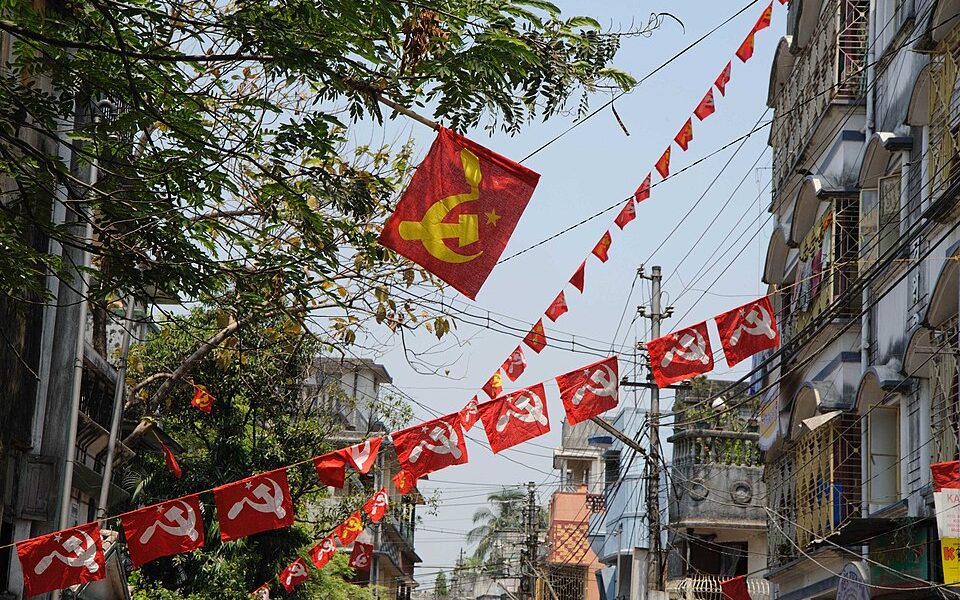
Communist banners in West Bengal.
Some years ago, I wrote for The Wire a tribute to Leon Trotsky on the anniversary of his death. Among reader mail, there was one from a postgraduate student of one of Kolkata’s (and the country’s) premier universities assailing the piece for ‘misrepresenting history’. I had, the student wrote, turned history on its head by referencing Stalin’s hounding of political opponents because all that was ‘a big lie’.
The fiery missive went on to commiserate with poor me for still believing in stuff that had been discredited ‘at least fifty years ago’. There was no effort in that mail to substantively engage with Trotsky’s politics so as to critique or refute it. Repudiation, it seemed, was all that mattered.
Advertisement
I recall that exchange (and a few similar others on different occasions) now because it tells me several things about Bengal’s once-proud Left. One, that often it not only had a closed mind on things, it actually liked to flaunt that attitude, secure in the belief that there was no second way of looking at something. And two, that there were only ‘us’ and ‘they’ – and, like George W Bush famously said, “whoever isn’t with us is with them, i.e., the enemy”.
When insularity becomes a virtue
The closed mind, I dare say, has been a bane of the Left in Bengal. On some issues, it’s true, the Left everywhere insisted on staying proudly hidebound at certain points in time. But overall, the movement has moved on and readjusted its sights to reality on many matters in course of time. The flawed – or, at best, mixed – legacy of Stalinism is generally recognised across worldwide Left today, but scarcely so in Bengal.
In the 1970s, when the two of us first read Isaac Deutscher together, my father struggled to come to terms with Stalinism’s whole picture, though he was too astute to hold on to his old beliefs around Stalin for long. But it’s fairly common even today – and my young correspondent was proof – to claim that the Soviet Union collapsed on itself because it had strayed from Stalinism’s straight and narrow path.
Even Prof Ashok Mitra, a brilliant mind and a wonderful polemicist and essayist, seemed to believe to the very end that, but for the accidental presidency of Mikhail Gorbachev, the sun wouldn’t have set on the USSR’s long day of glory. And even my fairly recent peek into a party office in suburban West Bengal discovered on its walls the holy tetrad of Marx, Engels, Lenin and, yes, Stalin. Maybe the office of another party of the Left adds another photo to the tetrad: Mao Tse Tung’s. We are all secular theists, thank you!
Advertisement
And not always secular, too, at any rate in the original meaning of that word. It’s quite common these days for proud Bengali leftists to be conspicuously religious. This comes with its expected concomitants. Someone I have known and respected for many years as a dedicated communist activist was visibly shocked when I happened to mention that, while at college, cheap beef rolls were our favourite snack. He didn’t have, he said, anything against beef rolls per se, yet he found it hard to reconcile to the fact that someone he liked should relish beef!
And the complete dyslexia that seems to have taken hold of much of the Bengal Left’s grey matter! Even back in the 1970s, I often overheard my father gently reproving young activists for having given up on reading anything other than newspapers. Study circles and book clubs were not unknown commodities when we were kids, even in our provincial backwaters, but such things had dropped out of sight by the seventies. Personal commitment was still not uncommon among activists, many of whom were still willing to stake their future on the victory of the cause, but literacy in the fundamentals of their embraced ideology was at a steep premium. Slogans – and some good intentions – were all that mattered.
1977, the true watershed
And then came 1977, and everything changed with it. I didn’t live in the state by then, but it was as though I could still caress the sense of hope that was suddenly washing over everything back home. Some canny analysts have done brilliant assessments of the stellar achievements of the Left Front government’s first few years in office. Equally sharp minds have probed its failures and showed where those failures came from. All that is beyond my remit in any case. I will only try to look at the Left’s three-decades-plus in power through the prism of what came after.
No sooner had the Left government been dislodged from power in 2011 than the winner – the Trinamool Congress (TMC) – assumed control of every lever of power at lightning speed. And not the levers of power alone: the TMC seemed successful in turning the page on the Left’s politics and ideology with astonishing swiftness. The Left resisted, of course, but only weakly at best.
Advertisement
And soon enough, the resistance’s back was well and truly broken. Left activists and members deserted the mothership in droves. From a distance, it seemed extraordinary that what till recently had looked unassailable was coming apart at the seams so incredibly rapidly. Even the Left’s hold over intellectual elites began to weaken dramatically.
So what went wrong?
Anti-incumbency did, of course, feed into the debacle, and thirty-four years of uninterrupted power couldn’t but have come at significant cost to clean government. Job creation inevitably lagged behind expectations and promises. In the later years of Left rule, graft and personal corruption of some ministers and party functionaries also began to emerge as important issues in the public domain.
Ever the old-school communist, Ashok Mitra complained in his memoir of some top leaders scoffing at old-world propriety in the matter of using government resources in non-governmental matters. He left the Cabinet, though the venerable Jyoti Basu, his chief minister, wanted him to stay on. Mitra felt the government was being pressured into making far too many compromises on the original principles of transparency and probity.
All that was true, but could hardly have tipped the scales in the Trinamool Congress party’s favour in 2011. There’s no question that most top Left leaders were not tainted by financial corruption, though retail corruption had been climbing steadily through the later Left years. At any rate, the kinds of scams dogging the TMC’s every step in recent years were unheard-of before 2011.
Advertisement
And yet the Left in power had corrupted the administration in ways that had not been known earlier. West Bengal had morphed into a party state, where the party apparatus came to be so thickly enmeshed with the government’s administrative machinery that the two became virtually indistinguishable.
From the state level down to the mohalla, the party decided on practically everything: job appointments, routine transfers, property disputes, resource allocations, distribution of relief in emergencies … the works. I have even known about family frictions being arbitrated by avuncular local leaders as a matter of course.
A friend seeking to register a property he had purchased was asked by the registering authority to ‘go sort it out’ with a local party apparatchik who was trying to decide who had the first right to buy that property — my friend or a cooperative society formed by party-affiliated local teachers. Securing a job transfer to a preferred location had to be first cleared by the party in many cases.
In some of the essays in his magnificent Field Notes from a Waterborne Land, the writer Parimal Bhattacharya documents the nexus between the party and the local administration in stark detail.
Where did this leave the party when power deserted it?
In the party state, the party minus state power has no leg to stand on. Besides, organised systems of distributing favours inevitably create privileged pressure groups even in the best of times. Here, many years of the same favour networks not only engendered corruption, however localised that may have been, but also made those networks the proxies of the party.
A time came when the proxies became the principals.
Add to that the cultural insularity that had taken hold of the party after years of uninterrupted, raw power. The intellectual arrogance that’s often a character trait of well-meaning activists believing in the infallibility of their mission served to harden that insularity. So, unknown to its leaders, the movement was eviscerated by the years in power. Which is why, once that power slipped from the party’s hands, its proxies jumped off the sinking ship and into the new power hierarchies without the slightest shilly-shallying.
Also read: Has the CPI(M) Forgotten its Strong Federal Roots?
What had been – or looked like – the Left’s carefully crafted networks of power overnight metamorphosed into the new party in power – the TMC. And since the TMC’s rhetoric was stridently populist and anti-establishment, there was, semantically speaking, not much to choose between the Left and the TMC also, at any rate to begin with.
So while power changed hands, there was nothing by way of a complete break with the past. West Bengal stayed a party state – with a new slate of leaders. There was serious political repression during the TMC’s first years in office, but since the Left’s once-famous cadre base had fractured overnight, there was no real organised resistance to that repression.
A depoliticised state
After the first few years under Left rule witnessed a great efflorescence of (mainly the visual) arts, including cinema, Bengal’s culture fell into a status-quoist rut. Virtually unchallenged political power and the Left’s customary intellectual arrogance hastened a process of large-scale depoliticisation of cadres. So when the Left government was dismantled in 2011 and the TMC stepped into its shoes, the transfer of power did not feel like the violent dislocation it might have been expected to be on every front.
In effect, much of the Left transitioned on to the TMC’s platform virtually seamlessly. The proud Bengal Left had been hollowed out of its politics, maybe not fully but substantially.
That’s mainly why supporters and activists of the Left quietly voted for the Bharatiya Janata Party (BJP) in large numbers, both in the 2019 and 2024 parliamentary elections and also, I suspect, in the recently concluded assembly elections. From all appearances, vast swathes of Left-leaning Bengalis are also reasonably happy – for the time being, in any case – to have the BJP in power in the state. In many ways, the TMC’s rule was no doubt a huge nuisance.
Yet it would have required a massive leap of faith some thirty or thirty-five years ago to imagine the present state of the Left’s psyche where the BJP’s politics becomes an acceptable option. It’s a fair guess that if my father or his brother were alive today, they would have died of shame.
This is the concluding piece in a two-part essay on Left politics in West Bengal. Read part 1.
Anjan Basu can be reached at basuanjan52@gmail.com
Advertisement
This article went live on August third, two thousand twenty six, at four minutes past six in the evening.
The Wire is now on WhatsApp. Follow our channel for sharp analysis and opinions on the latest developments.


Leave a Reply