

He transformed the study of modern India by bringing class, caste, gender and popular politics into the historical narrative while teaching generations to question neat conclusions and remain open to complexity

.
Published : Aug 15, 2026 17:55 IST – 9 MINS READ

Historian Sumit Sarkar, one of the most influential scholars of modern India, reshaped how generations understood nationalism, society, and history from the bottom up. | Photo Credit: By Special Arrangement
There are teachers whose lectures one remembers, and there are teachers who become part of the way one thinks. For many of us, Sumit Sarkar was the latter. It is difficult to separate what I learnt from him from what I understand history itself to be. More than 40 years after I first entered his classroom as an MA student at the University of Delhi, I still have the notes I took in his lectures. Their pages have yellowed, but the arguments have not. I return to them even now. His passing feels like not only the loss of one of the greatest historians of modern India, but also the disappearance of a particular intellectual presence: quiet, exacting, sceptical, immensely learned, and utterly without pomposity. He was slight, almost fragile in appearance, diffident in manner, often standing unobtrusively at the edge of a gathering. Yet intellectually, he towered. There was a disjunction between the modesty of the man and the scale of the historical imagination he possessed.
I was his student between 1985 and 1987. His lectures were unlike anything I had encountered before. He would arrive meticulously prepared and begin quietly. An argument would take shape, and just when one felt persuaded, he would introduce contrary evidence, a regional variation, an awkward social fact. Then another. Gradually, the apparently secure proposition with which we had begun would be dismantled, complicated, and reconstructed before us. History, in his classroom, was never the accumulation of information. It was the art of learning to distrust the obvious. There was pin-drop silence, no one wanted to miss a sentence. The range of reading behind those lectures was breathtaking, but it was never displayed for effect. His scholarship entered the classroom lightly. A statistic, a vernacular text, a regional movement or a minor contradiction could suddenly alter the argument. He taught us not to make the past tidy, but to recover its unevenness and suppressed possibilities.
Also Read | ‘It is a fear of history’
That method had already transformed the study of modern India. The Swadeshi Movement in Bengal, his first landmark monograph, enlarged both the archive and the meaning of nationalist politics. Literature, pamphlets, newspapers, associations, and popular action entered a story too often narrated through organisations and eminent leaders. Questions about nationalism’s social bases, cultural languages, exclusions, and relationship with popular initiative remained central to his work. For generations of students, however, Sumit Sarkar first arrived through Modern India, 1885-1947. My old copy cost Rs.26.50. Nearly everybody in our class possessed one, and nearly every line seemed to demand underlining.
Ostensibly a textbook, Modern India was anything but ordinary. Congress resolutions and constitutional negotiations remained important, but beside them appeared peasants, workers, Adivasis, lower-middle-class activists, caste movements, regional struggles, and anonymous crowds. Nationalism ceased to be simply what national leaders said or intended. One had to ask what happened when their language travelled into a village, a factory, a tribal region, or a local struggle over rent, forests, wages, or dignity. That was the power of his “history from below”. It was never a sentimental celebration of “the people”. Popular politics could be conservative and emancipatory, narrow and eclectic, dependent and autonomous. Nor did he replace leaders with masses. Rather, he explored the unstable relationship between them. Gandhi mattered profoundly, but so did people who invoked Gandhi while doing things Gandhi might never have sanctioned. Leadership could mobilise popular energies, restrain them, redirect them, and sometimes be overtaken by them. History lay in that relationship.
His Marxism was fundamental to him, but never doctrinaire. He constantly stretched its categories against historical evidence. Class mattered, but never by itself. Caste, religious identities, gender, cultural practices, and forms of consciousness could not simply be consigned to a secondary realm of “superstructure”. He was also a staunch feminist, not merely in his scholarship but in his deepest intellectual and political commitments. He had already begun creating spaces in which these questions could be investigated. This intellectual restlessness became even clearer in Writing Social History. Its essays remain models of what richly textured social history can accomplish. Clock time and disciplines of colonial modernity, constricted world of clerical labour, Ramakrishna Paramahamsa and the social milieus that made particular religious forms intelligible, Ishwar Chandra Vidyasagar and the limits as well as possibilities of reform—apparently disparate subjects became ways of asking how large transformations were lived in everyday worlds.

Swadeshi Movement in Bengal, on Bengal’s partition of 1905, and the nationalist movement that it spawned, was full of methodological innovations, using plays, novels, newspapers, and pamphlets. | Photo Credit: By Special Arrangement
Equally important was his capacity for self-questioning. Sumit Sarkar had been closely associated with the early Subaltern Studies project, yet he later became one of its sharpest internal critics when he felt that the subaltern, once located in the material histories of peasants and workers, was becoming detached from social relations through an excessive emphasis on discourse and representation. He recognised what the cultural and postcolonial turns had taught historians, but he also insisted that culture could not float free of society. He distrusted intellectual fashions in precisely the way he distrusted political orthodoxies. Perhaps no work demonstrates this openness more movingly than Modern Times: India 1880s-1950s. Instead of simply revising Modern India three decades later, he wrote the book anew. He acknowledged that not only the historiography but his own historical perspective had changed. How many scholars of his stature possess that capacity? To declare that one’s earlier work had become incomplete in the face of new knowledge, new questions and new historical possibilities was itself a measure of his intellectual openness.
Question the obvious
For Sumit Sarkar, history remained an unfinished conversation. Modern Times expanded the landscape to environment, economy, city and countryside, caste, languages, and literatures, new middle classes, sociability, theatre, cinema, music, dance, sports, and public culture. Its extraordinary bibliography revealed his inexhaustible curiosity and willingness to read across regions, disciplines and languages. The vernacular archive was never peripheral to him. It was alive with possibilities.
That openness mattered personally to me. When I wanted to work for my MPhil on Premchand and the relationship between literature and history, many considered the subject insufficiently historical. Sumit never did. He encouraged me to enter the vernacular and the literary. Later, when I began a PhD with him and then received a Commonwealth Scholarship to go to SOAS, he was delighted rather than possessive. His comments could be brief, but a few words could shift an argument, reveal a missing layer, or make one see a familiar source differently. His generosity towards students was often exercised without announcement. I remember an incident even before I formally became his student. Despite having done well as an undergraduate at Miranda House, I faced difficulty in securing admission to the MA because I had participated in a protest against a hostel fee increase. Sumit Sarkar, then head of the department, postponed admissions for three days while the matter was resolved and supported my application. He never made anything of it. His principles were firm; their performance was quiet.
Years later, when I joined the same department and was asked to teach the social history paper that I had once learnt from him, I felt deeply inadequate. How could one teach something one associated so completely with Sumit Sarkar? I soon realised that imitation was impossible. The most one could hope for was to preserve something of the intellectual ethic he embodied: prepare seriously, read widely, never underestimate students, question one’s own certainties, and never sacrifice complexity for a convenient argument.

Sumit Sarkar’s widely read history brought peasants, workers, Adivasis, caste movements, and regional struggles into an account of modern India long dominated by national leaders. | Photo Credit: By Special Arrangement
His scholarship and his citizenship were continuous with one another. After the demolition of Babri Masjid, his involvement in Khaki Shorts and Saffron Flags exemplified his uncompromising opposition to communalism. He could also be fiercely critical of the organised Left, as his position on Singur and Nandigram showed. At demonstrations, one often saw him standing quietly somewhere in the crowd, almost anxious not to be noticed. Yet he was there, during some of the darkest moments, including protests after the anti-Sikh violence and against communal mobilisation. Moral courage, for him, required neither volume nor self-display. This is perhaps what I shall remember most: the unusual unity between intellectual and personal modesty. In an academic world not innocent of vanity, he possessed astonishingly little of it. The twinkling eyes, gentle sarcasm, and shy smile could coexist with a razor-sharp judgement. He could have occupied a prestigious chair almost anywhere in the world. He chose instead to spend three decades teaching at Delhi University, shaping successive generations of students.
Also Read | History is not to glorify the past, but to understand it: Irfan Habib
After I joined the department, I saw younger students inhabiting a world of modern Indian history that Sumit Sarkar had helped create. By then, many questions had changed. Gender, caste, Dalit histories, environmental histories, visual and cultural histories had transformed our discipline. Yet the best of these new histories still carried something of the intellectual habit he had instilled. Who has disappeared from this narrative? What happens if we shift our scale? What lies beneath the declarations of leaders and institutions? Which contradiction have we smoothed away too quickly? Perhaps that is the deepest legacy a historian can leave, not merely interpretations that endure, but questions that continue generating other questions.
Today it is hard to imagine teaching modern Indian history without Sumit Sarkar. His books will remain on our reading lists, their margins filled by students not yet born when they were written. But those of us who sat in his classroom possess another inheritance. We remember the quiet figure entering with his sheaf of notes, the argument unfolding slowly, the moment when the seemingly certain became complicated, the sense that history had suddenly opened another door. I learnt my history from him. More importantly, he taught generations of us never to believe that history had finished teaching us.
His voice is no longer in the classroom. But in every hesitation before a neat conclusion, every return to the archive, every question asked of history’s silences, something of Sumit Sarkar remains. For those of us who learnt history from him, that conversation will never quite end.
Charu Gupta is a senior professor of modern Indian history at the University of Delhi. Her research focuses on gender, caste, sexuality, medicine, religious identities, and vernacular cultures in colonial north India. Her recent book, Hindi Hindu Histories, won the 2026 A.K. Coomaraswamy Prize for outstanding scholarship in South Asian Studies.

Not a question of bias: Sumit Sarkar
The historian defends the Towards Freedom project and warns of how Hindutva politics is reshaping India’s history, nationalism, and democratic memory.
Published : Mar 04, 2000 00:00 IST

Historian Sumit Sarkar defends the Towards Freedom project and its documentation of mass politics, communal violence and anti-colonial struggles in 1946. Credit: By Special Arrangement
Sumit Sarkar, Professor of Modern Indian History in Delhi University, spoke to Sukumar Muralidharan about his involvement with the “Towards Freedom” project, sharing his perceptions of the issues raised by the Indian Council for Historical Research’s (ICHR) decision.
When did you personally get involved in the “Towards Freedom” project, and what can you tell us about the procedures and principles you followed as an editor of the volume for the year 1946?
Our role in this project starts operationally only from 1989. The whole procedure that was laid down for us was that we would function as a board of editors. We met collectively and kept on doing so regularly as long as these manuscripts were being collected. As and when we submitted particular manuscripts, the ICHR would send them to Professor Gopal, who would make suggestions, and then we would have discussions, and we would modify whatever was needed. Finally, it would be sent to the publisher. I submitted my manuscript in 1995. None of us was doing this on a full-time basis, apart from Dr Basudev Chatterji. The minutes of the council in September 1998, the same council which we now hear set up some kind of review committee, states clearly that my manuscript had been received and transmitted to OUP (Oxford University Press) for publication. Contrary to all the charges that we made crores of rupees – the gap here between reality and fiction is so vast that one feels almost shy of exposing it. How can such absurd things be said? Not a paisa of ICHR money has passed through my hands.What essentially was the purpose of the project—to capture and portray the mood of the country as it was progressing towards independence?
Yes, and I think also the title chosen is rather significant. It is not a documentation of the history of the freedom struggle. It is “Towards Freedom”. That is to say, to document the last ten years leading to that peculiar combination of Freedom and Partition that we had.Also read:Equivocation and interpolation
Part of the logic of the volumes, which Prof. Gopal has expounded very well in his general introduction, is that we should bring out the diversities. And the significance of the anti-colonial movement lies not only in the struggle against the British, but in the progressive broadening of the movement—how, in other words, democratic, secular and some kind of federal and social justice aspirations enter the canvas—the background, in short, to the Constitution.
What was the broad thematic arrangement for your volume dealing with 1946, and is there any reason why it should prove controversial?
Well, if they want to make something controversial out of it, it is something else. But one thing we were all agreed on is that these are going to be publications of documents. So whatever our personal views, we would keep them out. We decided to keep ed itorial remarks to a minimum. There would be a general introduction by Gopal which is common to all the volumes, a special introduction again by Gopal for that particular year, and then a brief introduction by the volume editor. Naturally we cannot do an ything without some presuppositions and assumptions, with which people can disagree. But the whole point of these volumes was that since a massive amount of diverse publications was being presented and editorial comment is being kept to a minimum, people can judge for themselves.
Now I was editing the 1946 volume. Can you imagine a volume of that type without documentation of the communal riots from August 1946 onwards? The way our critics are arguing, no doubt I will hear it said that there is too much on the communal riots which had nothing to do with the freedom struggle. Of course, they were not part of the freedom struggle, but neither was British repression. So do we leave these out?
As for the arrangement, in my volume, it is broadly like this—it is divided into two parts, the first dealing with British India and the second with the princely states. The principle I followed to save public money in what are very massive volumes, wa s to exclude material which has already been published and is easily accessible.
In the part dealing with British India, the first chapter deals with the documentation of directly anti-British movements. The early part of 1946 is full of these, the most famous one being the Royal Indian Navy (RIN) rebellion, or mutiny as it is called . There is a great deal of documentation on that available. Our critics will not like this chapter because in these movements Communists were rather active. At least the British thought they were very dangerous. The RSS is nowhere on the scene. What can I do?
Then Chapter Two deals with political organisations, as many as we could get hold of. It suffers from some limitations, like the Muslim League documents are all in Pakistan and we have no access to them. There is quite a lot on the Congress, a bit on the Communists and the socialist groups, something on the RSS (Rashtriya Swayamsevak Sangh) and the Hindu Mahasabha.
The third chapter I think is about labour and peasant movements. Here the year 1946, up to about August, was a period of unprecedented labour movements, which even though not a part of the freedom struggle, were deeply feared by the British and met with their repression. We see the beginning of the Telengana movement and the Tebhaga movement in Bengal. These things are also part of “Towards Freedom”. What sort of freedom are we talking about—freedom can be of many sorts.There is the ideological agenda of the RSS and like-minded political groups to try and portray the Communists as non-participants in the freedom movement, perhaps even its adversaries. Do your selections in a way challenge that conception?
To the extent that the documents are there. Now the 1942 volume is not yet ready. When that is so, then a few other things will come out about the Communist role, which some people may find dubious. But in 1946 there was just no question about collaborat ion. In fact, the British felt threatened by the Communists. There is a lot of such documentation which one has to present. What can one do? It is not a question of bias. And in these movements, Communists as well as socialists and elements of the Congress are very much present.
It is not my fault after all that both in the direct struggle for freedom and the other kinds of anti-British activity, the RSS and the Hindu Mahasabha are conspicuous by their absence. These right-wing Hindu movements share with the Muslim League a part icular honour—they were the only groups that were never repressed by the British. At some period or the other, every other movement came under some kind of repression. The Communists first became legal in 1943. Immediately after Quit India, for instance, they were not repressed. But that is rather exceptional.
This is one kind of absence of the Hindutva forces from the movement towards freedom. The bigger absence of course is that they have no role in the broadening of the content of the freedom struggle.Essentially, then, your compilation was a threat to the conception of the Hindu nation that is now being constructed?
There are some fears that they would have. They might be afraid that their absence would be noticed in any kind of objective documentation of ‘‘Towards Freedom’‘. But there is in a sense a deeper agenda, which threatens not only ‘‘Towards Freedom’‘, but also all notions of intellectual and cultural freedom. Basically, what these people want to bring back are old-fashioned, discredited notions of what history is all about, that is, Indian history as divided neatly into Hindu and Muslim periods, defining periods by the religion of the rulers. That was the dominant way in which partly due to colonialism and partly on account of our own contributions, history was taught and studied for a long time. The national movement would then be understood like a story of cops and robbers, of great leaders and great villains.
Things have changed since the 1950s. And in this, the Marxists have made a signal contribution but not only Marxists… I think we need to make the point that relatively few, perhaps even a minority, of these eight volume editors would consider themselves Marxists…And you?
I must say that I am old fashioned enough to think it would be a badge of honour to be called a Marxist. But various scholars, all modern and liberal, have made major contributions. This is why modern Indian historiography, starting with D.D. Kosambi in the 1950s, is acknowledged the world over—wherever South Asian history is taught or studied—as quite on a par with or even superior to all that is produced abroad. And that is why Irfan Habib or Romila Thapar or R.S. Sharma are figures respected even in the most diehard anti-Communist American universities. They cannot be ignored if you are studying South Asian history.To return to the thematic arrangement of your volume, could you tell us what are the further contents?
Yes. Chapter Four in Part One deals with communalism. It documents the communal riots from August 1946 and the anti-communal mobilisation. Gandhi figures in a major way here. One could of course write a full volume on that, but I have already referred to his role in my Modern India as his finest hour. Apart from this, there is, ample evidence, of efforts being made by other groups to stop the communal bloodshed. There is for instance an area north of Noakhali with a very powerful peasant organisation, overwhelmingly Muslim, which stood guard and were able to block the spread of riots.Also read: ‘It is a fear of history’
The second part of the volume in some ways would be the most original part, focussing on the princely states. We see that in British India direct political agitation died down a bit after about February-March 1946, partly because the nationalists and the British had got involved in direct negotiations and partly because of the fratricidal riots. But a lot of things are happening in the princely states, in a much more feudal atmosphere. On this I have got a lot of rich material. These rulers were in many ways the bulwarks of the British empire. And without the struggles against them, sometimes under the leadership of movements like the States Peoples Conference, Indian unity would not have been achieved. It was not achieved just by federalism, though it certainly made a contribution. There was a combination of pressures from below, which the Congress and particularly Sardar Patel were able to utilise. So these movements are important for the free India that emerges in 1947.So this is a conception of history that goes beyond the “good king, bad king” comprehension to an understanding of the mass of the people as participants?
Yes, it is a much more total conception.Would you say that it is an idiom of history-writing that develops with the evolution of democratic ideas in society and that the effort to extinguish it represents a threat to democracy?
Absolutely. And academically, it can mean disaster. I would say that there has been a collective failure on the part of our community of historians, in the sense that not enough of these ideas have been effectively spread at what could be called the “lower” tiers of education and culture in general. At the school level, at the popular level and in the less endowed universities outside the metropolitan centres, the old views still exist and they are being reproduced. And of course over the last ten years they are being reproduced in a much cruder and offensive form through the media and the RSS propaganda machine.So you think there has been a disjunction between the profession of history writing and the way in which history is perceived?
I would suggest that as the Nehruvian dream began to fade, as Congress regimes moved away from the project for independent development and some kind of social justice—notably during the Emergency of course—we get the substitution of those commitments with rhetoric. More and more we are taught to look at the nation as something of a myth, as just a map, a cult or a flag. This of course the RSS takes over and develops much further. But what is the nation? Is it a map or a flag, or is it living, suffering, dying, struggling human beings? It is this kind of nationalism that I think is useful both for human beings and for history.So you think your project would contribute to the broadening and revival of that view of the nation?
I would hope so. But more accurately I would put it negatively. The Sangh Parivar fears it might do so. I make no great claims for how effectively it does so.
How to write history the way it should be written: A historian muses on forty years of scholarship
Sumit Sarkar, one of India’s most reputed historians of modern times, talks of breaking the mould.

In the early 1970s, some of us Bengali historians were struggling against the weight of a cultural and political inheritance: that of the Bengal Renaissance on the one hand, and of the nationalist movements on the other. Both had enjoyed a long period of unchallenged ascendancy in popular estimation and in Indian historiography – except in very reactionary circles.
Born in a family with generations of modern, liberal socio-religious reformism behind it, and overlaid by a new Leftist content that my father had added, I felt, in a spurt of youthful rebelliousness, that Leftist values and Brahmo liberalism did not sit well together. So, a lot of the essays on social reform probed the limits of the so-called Renaissance heritage quite severely. I now find it interesting that even then I did criticise Rammohun Roy for not doing more about caste – a point that I developed more forcefully in another essay, “The ‘Women’s Question’ in Nineteenth-Century Bengal”. Of course, given the prevailing indifference to issues of social justice of those times, my references were all too brief. “The Women’s Question” was a part of A Critique of Colonial India but has not been included in the present collection. It took issue with Renaissance emancipatory claims about gender at a time when gender was not yet central to mainstream history-writing, feminist historians having barely begun their journey.
Before you scroll further…
Get the best of Scroll directly in your inbox for free.
Along with those of Asoke Sen and Barun De, my writings provoked deep shock among Bengali Left liberals who felt – maybe with some justification – that this was iconoclasm of a totally unacceptable kind. A senior CPI activist even blamed me for betraying my father’s views on the Renaissance. Interestingly, without telling me, my father – Susobhan Chandra Sarkar, a towering teacher of history who had written much on the Renaissance himself – published a strong rejoinder rebuking the activist, justifying alternative readings of history, and saying that socialism should be a broad enough road on which many different people may travel together with ease.
This was also a time when “Cambridge School” historians had begun to question and problematise Indian nationalism.
With hindsight, I feel that they had a lot to offer, though I still believe that their blindness to popular anti-colonial struggles was a major and strange limitation. But they were practically the first historians to work with archival records and private papers, and they looked closely at local social contexts like caste. At the time, however, we found their cavalier attitude to Indian nationalism highly offensive. Since their writings emanated from a Western – worse, British – academic context, we all too easily slipped into branding them “neo-imperialist”.
Bipan Chandra (professor of history at JNU) and many others reacted against the Cambridge School by looking closely and respectfully at, and identifying profoundly with, the work of great nationalist leaders. I could not make myself go that way, and my article on Gandhian nationalism should make it evident. As the shining promise at the dawn of Independence began to dim by the late 1960s and early ’70s, and as a new wave of popular struggles began in various forms against the post-colonial ruling classes, I felt it was more important to explore the historical limits of mainstream nationalism, especially the class perspective of its leadership. The ongoing Vietnam War, and the residual excitement of May 1968, made quite a lot of us think for some time, independently and in isolation from one another, that the struggles of peasants and workers were more significant for national and social liberation than the leadership provided by the elites.
Already, Ranajit Guha had gathered around him a group of young scholars in England who were thinking on similar lines about how to re-vision Indian history. That was the nucleus of the Subaltern Studies collective, with which I, too, became associated for a while. When I visited Oxford for a year in 1976-77, I met the group, and I still remember the very exciting and stimulating discussions I had with Professor Guha at his Sussex home, where the two of us, once or twice, stayed up all night and I listened to him on the Indian peasantry, practically spellbound.
Advertisement
I was very fortunate to meet and strike up a friendship with EP Thompson and Dorothy Thompson that lasted till their death. I remember with enormous gratitude their great warmth and wonderful hospitality whenever my wife and I visited them thereafter. His magnum opus, The Making of the English Working Classes, had reached us, very belatedly, just before I went to Oxford and met him. That, and his later work, and the many discussions, political and historical, with him over the years inspired me as nothing else had ever done before or has since. The articles on Subaltern militancy and Adivasi struggles came out of those encounters.
As a teacher of history at Delhi University for thirty years, between 1974 and 2004, I thoroughly redesigned the course on social history.
It used to be focused on social reforms alone, but I brought in caste, adivasis, and other subaltern lives as well. With hindsight, I realise that this – especially the caste dimension – was really quite unprecedented for postgraduate history courses anywhere at the time. This was a great experience. My students and I explored these themes together through detailed ethnographic studies, Phule’s and Ambedkar’s writings, those of Periyar that had been translated, and whatever caste histories were then available. We also read a lot of social fiction together. I learnt much from my students, who came from diverse backgrounds and who often made my classes far richer by bringing in their own experiences and perspectives on social history and on the suggested readings. This was the blessed time before the semester system was arbitrarily imposed on the university and made such easy, prolonged, yet thoughtful classroom discussions over days and weeks impossible: something that had made us all grow intellectually. Perhaps the whole point of introducing the semester system was precisely to block that path.
Since the post-Mandal stormy agitations hit Delhi University most severely in the early 1990s, these discussions sometimes turned into extremely acrimonious debates among students and colleagues alike. But the classroom certainly gained in immediate relevance. My later writings on caste came out of that churning.
In another course on early modern Europe that I taught, I discussed some of the Annales writings. I was never completely convinced by their project of writing total history, but found the concept of histoire integrale, which imbues a very specific local community with a larger sense of historical depth, far more exciting.
We also studied early-modern German histories – especially by David Sabean and Hans Medick, among others – which explored the details of the everyday lives of ordinary people over a long duration.
Advertisement
The alltagsgeschichte tradition did not focus on individual lives but on broad patterns and habits of work and leisure. Carlo Ginzburg’s work, on the other hand, introduced us to the enormous excitement of microhistoria: a detailed study of an ordinary sixteenth-century Italian miller who, in a small way, preached doctrines that brought the wrath of the Inquisition upon him: a happy occasion for historians, as Inquisition officials recorded his life and beliefs in his own words and in the supplementary words of his fellow villagers, all ordinary men like himself.
In the early 1990s I read Peter Linebaugh and Marcus Rediker with great interest as they identified working-class lives, work, and resistance in unexpected places: on board ship – which now appeared as a global site of capitalist production – in piracy, and in sailors’ resistance to ship authorities. These confused the boundaries between social crime and insurrection and made us rethink both on new lines.
Sometime in the mid 1990s I went on the first and last academic leave of my life (though I continued to take my university classes). I joined the Nehru Memorial Museum and Library as a Senior Research Fellow, going back to my university after a year. But, in that year, reflections on many of my readings began to crystallise. Strangely, I returned to some of my older interests, but now in a different key: no longer so much to critique liberal reformism for its dependence on empire, but to see Vidyasagar against the context of contemporary orthodoxy, and reconfigure his agenda on education and gender in that light.
I did not go back to the Brahmo movement which, after all, had been a familiar world to me. But I approached a Hindu saint, Ramakrishna, who seemed remote and alien to my socialist, secular worldview. I found in the Kathamrita, a diary kept by his disciple (who recorded his conversations for years), a rare text and a window to a guru’s actual religious musings. Equally interesting was his following: not just the great nineteenth-century luminaries of Bengal, but also poor, lower-middle-class, little-educated clerks in modern government and mercantile offices, all from a world that had so far been ignored by historians. I pondered over what their guru – insulated from their work experiences and gruelling family responsibilities as he was – brought to their lives. And I thought about what highly sophisticated intellectuals found in his simple, rustic language and homely parables that so moved them. I especially probed the intermingling of different classes and intellectual-devotional orders around the figure of a single religious leader to reflect on the broader issues of a time of transition when the older hopes in liberal social and religious change had declined but the new energies of nationalism had not yet appeared. The intermingling of different lives became a point of strong interest – historians often study them in mutual isolation.
Advertisement
Microhistories alert us to unexpected undercurrents that work beneath the surface of events of conventional historical importance.
Much had already been written by Indian historians by this time on subaltern resistance, especially to the colonial state. I was becoming more interested in ordinary lives which sometimes flare into extraordinary deeds – not necessarily admirable – which cannot be classified as open resistance to power. In Ginzburg’s study, Inquisition records revealed this world. But in the absence of a huge bureaucratic apparatus that would be capable of keeping track of ordinary people, criminality alone provides us with similar stories which contemporaries sometimes recorded in some detail because of their sensation value. Accidentally, in the course of my readings on nineteenth-century religious and social movements in contemporary vernacular sources, I came across a newspaper report on a village scandal at Doyhata in East Bengal. It brought out a form of unorganised subterranean deviance which never led to any sect or movement, but to murder and mayhem for just one night in just one village. There were unexpected crossings of caste boundaries as a low-caste, uneducated, and poor guru inspired a high-caste, highly educated disciple to kill another and expose his own family women to the gaze of a stranger in a particularly gross manner. This was an improvised ritual and belief structure which would have left no traces at all in historical records, had it not involved violent crime.
I felt attracted to such small happenings that stuck out from the main historical plot structures and went against the grain of all expectations, or which came out of the realm of ordinary people and did not take on national or major religious dimensions. All this made me write about the Doyhata episode, which remains something of a personal favourite even now. I remember an article in the Economic and Political Weekly, shortly after it was published, which expressed surprise and dismay at what a Leftist and secular historian was coming to. But all historians are entitled to try and understand their Others.
Of late, labour histories have emerged as a most dynamic new trend in modern Indian historiography.
As I read the works of Chitra Joshi, Rajnarayan Chandavarkar, Prabhu Mohapatra, Rana Behal, Ravi Ahuja, and many others with great interest, I recalled that my first book, on the Swadeshi Movement in Bengal, did have a chapter on the early-nineteenth-century labour upsurge – well before systematic labour-history writings began in our country. I also recalled the animated discussions in the early 1970s with my younger friend Dipesh Chakrabarty, who had then just begun his research on jute workers. I wrote an overview of some of the recent works on Indian labour to see what had changed in labour history since then.
The pieces in the third section are very short tributes to historians and to a political leader who meant a lot to me.
Advertisement
So far, we Indian historians have written the histories that we wanted to write, following no agenda but our own. That seems to be a fast-vanishing luxury. I wish with all my heart all success to the present generation, and to the generations that will come after them, who struggle to write history as it should be written.

Excerpted with permission from Essays Of A Lifetime, Sumit Sarkar, Permanent Black.We welcome your comments at letters@scroll.in.
History Must Be Based Solely on Evidence: Irfan Habib

15/Aug/2026
In conversation with The Wire Hindi, historian Irfan Habib discussed the rewriting of history, the influence of fascism on the RSS, the Indian tradition of knowledge, and the political use of history.
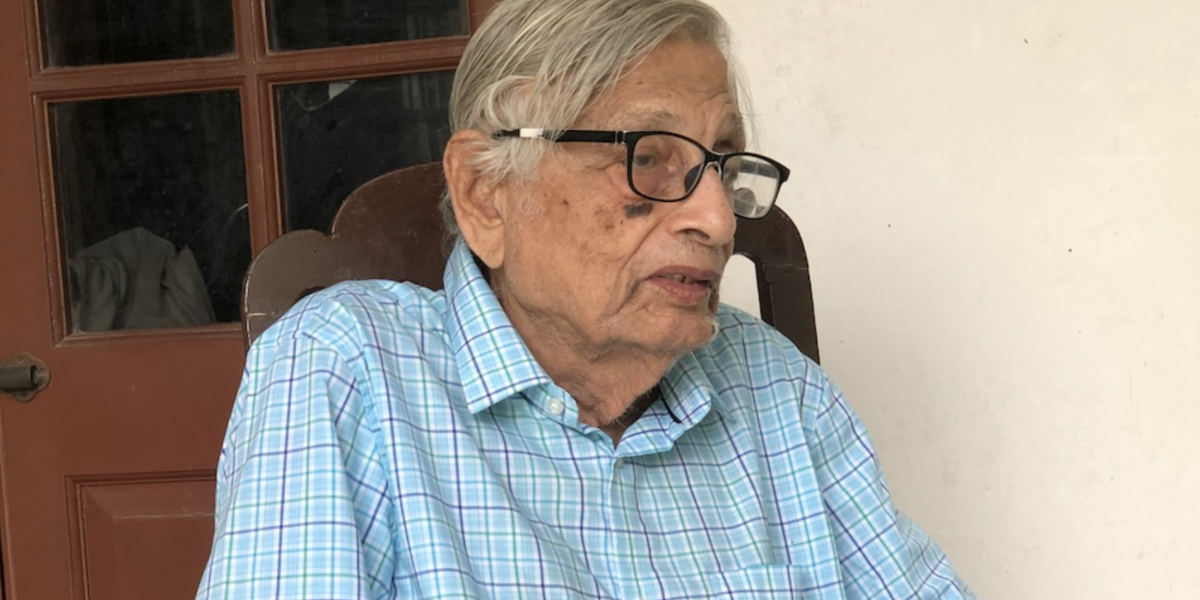
Historian Irfan Habib. Photo: Ankit Raj/The Wire Hindi.
Aligarh: On August 12, 2026, historian Irfan Habib turned 95. As a distinguished figure in Indian historiography, Habib has written about and debated numerous significant questions concerning history, society, and politics throughout his extensive academic career.
His views continue to hold significant relevance today, especially in light of the ongoing efforts to reinterpret and rewrite history in India.PlayNextMute
Here, we present a combined account of two meetings and conversations held with him – the first in August 2025 and the subsequent one in July 2026 – at his residence in Aligarh.
Each meeting offered a glimpse into the nostalgic, traditional ambiance of his home. Nestled among lush greenery, the house stands like a memory of a bygone era amidst Aligarh’s swiftly changing urban landscape.
Standing amidst the towering modern structures, this historic house retains the essence of a different era within its windows, doors, switchboards, and ceiling fans. While the world surrounding Habib’s home has transformed – with high-rise buildings replacing older houses – the historian’s abode appears content to remain anchored in its own time.
Also read: Noted Marxist Historian Sumit Sarkar Passes Away
Advertisement
Speaking to The Wire Hindi, Habib acknowledged Karl Marx as his mentor and expressed no objection to being described as a ‘Marxist historian.’
During the conversation, he discussed various topics such as his approach to history, the notions of ‘Aryavarta’ and ‘Akhand Bharat’ (Undivided India), the concept of a ‘Hindu Rashtra’, efforts to alter history, the influence of fascism on the Rashtriya Swayamsevak Sangh (RSS), the Indian tradition of knowledge, and the status of Shudras within Hindu society.
A recurring theme in the conversation with Habib is the idea that history ought to be interpreted based on evidence and actual events, rather than individual biases or political exigencies. “History must be based solely on evidence,” he asserts.
Edited excerpts from the conversations with Habib are as follows:
How do you view attempts to alter history?
Advertisement
History is about describing events that actually occurred. It does not mean asserting that an event occurred merely because we desire it to have happened. History is not concerned with good wishes; history is concerned with actual facts. This distinction is precisely what is being overlooked.
The very idea of altering history implies a desire to misrepresent what is true. Why would one want to change history? Let history remain as it is.
Making a new discovery is a good thing – for instance, if it were discovered that Marco Polo was born in India, that would be a significant historical discovery. But if that is not the case, then it simply isn’t so. History must be based solely on evidence.
What is your opinion on the concepts of ‘Akhand Bharat’ and ‘Hindu Rashtra’?
Advertisement
The concept of a nation is a distinct matter. Determining when the concept of India became deeply rooted enough to form a ‘nation’ is itself a subject of historical inquiry.
To claim that the Mauryan Empire held the same concept of a nation that exists today would be incorrect.
If someone cites ‘Aryavarta’ in this context, remember that it does not encompass the Deccan region, but the Mauryan Empire did. Geographical concepts keep evolving with time. They should be studied, but they should not impact contemporary politics.
India is now a unified nation. It should remain so. We became one nation because of British rule or because of the Mughals… but now we are a single nation.
As far as Hindu Rashtra is concerned, a religious nation cannot exist. Hindu Rashtra is a contradictory term in itself. How can a religious community be a nation? If someone says Muslim nation, that can also not happen.
India is a country in which different communities coexist with Hindus constituting the majority among them. It’s a fact.
Is it right to call the Sangh a fascist organisation?
They are not fascists, but they are influenced by fascism. It becomes clear from their early documents that Hitler had an influence on them.
Although it was founded before the rise of Hitler, he had a lot of influence by 1938. Later, due to the world war, they were forced to go low-key. Mentioning Hitler’s name was a taboo back then. Such things could not be discussed at that time.
But look at the Sangh’s writings of the 1930s where Hitler has been extolled.
What do you have to say about the Indian Knowledge System as being discussed in the New Education Policy (NEP)?
This is wrong. Knowledge is neither Indian nor English, it is simply knowledge. Knowledge does not change with race nor does it change with caste. This very point of view is wrong.
The current government is trying to establish that Hindus have been wronged throughout history, and that Hindus are victims. What is your opinion?
Hindus have always been victims. Shudras are Hindus only, and they have been victims.
This article has been republished from The Wire Hindi and translated by Naushin Rehman.
Advertisement
This article went live on August fifteenth, two thousand twenty six, at seven minutes past seven in the evening.
The Wire is now on WhatsApp. Follow our channel for sharp analysis and opinions on the latest developments.
Sumit Sarkar Taught Generations to Take History Seriously


Shahana Bhattacharya and Aparna Balachandran
His legacy is of a historian of extraordinary scholarship, and a teacher who encouraged us to look beyond the obvious archive.
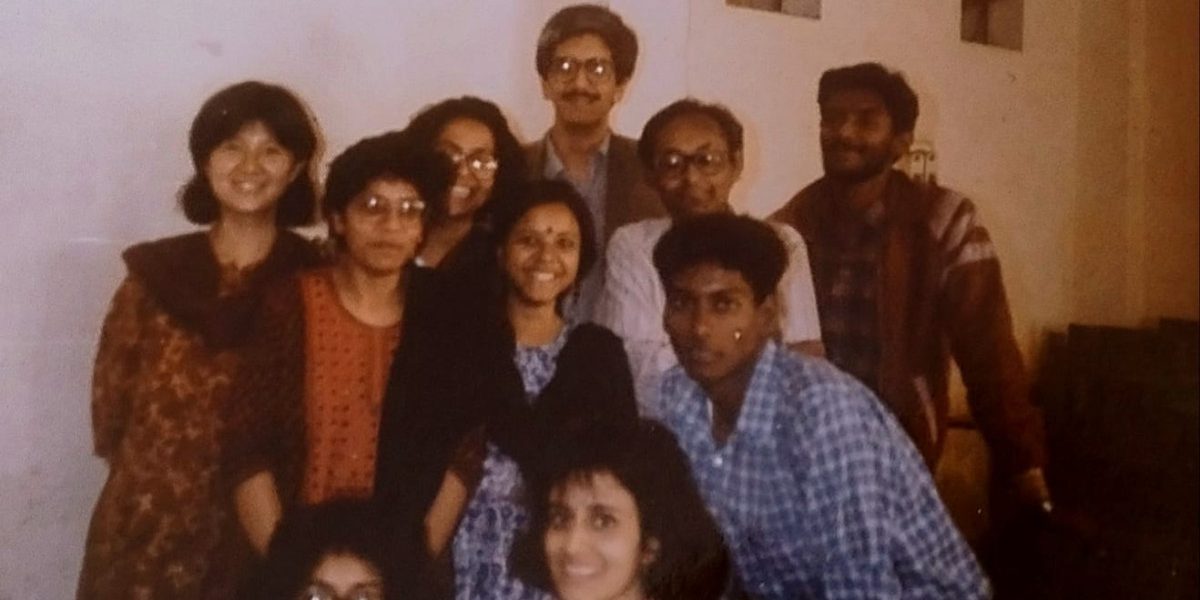
Sumit Sarkar with his students of the MA batch 1991-1993. Photo: Shahana Bhattacharya.
We were both Professor Sumit Sarkar’s students at Delhi University in the 1990s, and are now teachers there. At his cremation, what was striking was how widely the memory of his teaching had travelled beyond those he had formally taught. An erstwhile student of Botany came because she had heard so much about him from her hostel-mates; friends who had studied Economics or English and had gone to his classes 30 years ago sent messages of condolence. Sumit was a rare combination of an extraordinary teacher and a scholar of immense depth, with each enriching and deepening the other.
So many of his students remember Sumit’s Social History paper on Modern India, and indeed it was a remarkable class, taught in his quiet, persuasive, never flashy manner. His knowledge was immense, but his erudition was never a performance. He had a way of opening up the worlds of history before his students, giving them both the detail and the larger questions that made the detail meaningful. There was a rigorous empiricism at the heart of his teaching, but also a recognition that historical experience could be recovered through art and literature, and through the many kinds of sources that make up the larger archive of history.
Advertisement
That breadth was part of what made him such a distinctive teacher. It was also the product of an extraordinary amount of preparation and hard work, done in the pre-internet days, when putting together a lecture or a course meant painstakingly locating books, articles and sources, reading widely and making connections across fields. His teaching was also connected to his deep investment in the public university, in the teachers’ movement and in democratic practice. These commitments were not confined to large political questions; they were present in the often painstaking work of syllabus revision, in the classroom, and in the everyday practices through which a university is made.
Also read: History Must Be Based Solely on Evidence: Irfan Habib
For both of us, although we were in different batches, one course stood out perhaps even more vividly – a transformative MA first-year elective on early modern Europe. It ranged across witchcraft, popular beliefs and practices, print and the woodcut, and the social worlds of the period. We were introduced to historians such as Robert Scribner, Peter Burke, Natalie Zemon Davis and Carlo Ginzburg, among many others. Although the course had been allotted for one semester, Sumit announced that he would teach it for the entire year. Years later, when we were lucky enough to travel in Europe, Sumit’s teaching would return to us unexpectedly – in a Masaccio painting in Florence, in a woodcut, a church or an image encountered along the way. We had not simply learnt about early modern Europe; we had been guided in how to understand it.
As a supervisor, he read closely, helped shape the material before him and paid attention to the historian’s craft, while at the same time encouraging students to be ambitious and innovative, and allowing them to dream. Regardless of topic or distance from his own research, what mattered to him was the quality of the historical work before him. He taught us what it meant to take a student’s work seriously. He remains, for many of us the teacher in our heads, a model of what we need to be in the classroom, and of what it means to take students and their intellectual possibilities seriously.
Advertisement
Much has already been said about his work on the Swadeshi movement, his writings on social history and his enormous influence on Indian historiography. There is something particular to be said, however, about Modern India. More than a textbook, it opened up a world of historical inquiry. Its extraordinary detail and analysis offered students possibilities for thinking and researching further with its influence traveling across generations and universities. Students and teachers inherited not only Sumit’s arguments and interpretations, but a way of thinking about what historical scholarship could make possible. It suggested other histories, other archives, other questions. In that sense, Modern India did more than teach modern Indian history – it helped produce historians. His histories made space for ordinary people, social worlds, beliefs and practices, and for contradictions that grand narratives tended to smooth away. His commitment to social history was inseparable from a larger intellectual refusal to accept histories in which the past appeared singular, inevitable and already resolved.
We said goodbye to him on August 15, Independence Day. What mattered to Sumit was a commitment to the complexity of the nation’s history, its people and its past, and to the possibility of arguing about what they meant. His legacy is of a historian of extraordinary scholarship, and a teacher who taught generations of us to take history seriously, to look beyond the obvious archive, and to remain open to the difficult questions that history asks of us.
Shahana Bhattacharya teaches history at Kirori Mal College.
Aparna Balachandran teaches Modern History at Delhi University.
Advertisement
This article went live on August sixteenth, two thousand twenty six, at twelve minutes past three in the afternoon.
The Wire is now on WhatsApp. Follow our channel for sharp analysis and opinions on the latest developments.
Sumit Sarkar, the historian who didn’t lose hope
Talking to him on any subject, whether history, politics or literature, was always enlightening, as he had a vast store of knowledge on a variety of topics, and was never boring
Sumit Sarkar, who passed away on August 13 at the age of 87, was that rare combination of a great historian and a lovely human being. I leave it to others, more competent, to appraise in detail his considerable contribution to the history of modern India. I will dwell instead on my personal memories of him.
I was privileged to get to know Sumit through a personal connection: My wife, Piyali Chakravartty, was a childhood friend of his till the end, a friendship I shared.
Advertisement
Although we met first in Calcutta, and later in Oxford, where Sumit and his wife Tanika were spending a year, we really became friends in the late 1970s when they spent some time with us in our Parisian flat and we had long chats in the evenings, very much in the tradition of addas, while listening to records of French revolutionary songs. When it was our turn to spend a year in Delhi, this friendship grew and we were constantly in and out of each others’ homes.
I have particularly fond memories of the few days Sumit and I spent together in Paris in the late 1980s. I was then trying to learn Bengali and, as a beginner, was finding my way through the famous primer written by Rabindranath Tagore, Shahoj Path.
STORIES YOU MAY LIKE
BJP’s TV face Shehzad Poonawala doubles down on resignation, cites finances
Shubhra Shetty on dating Anurag Kashyap, their 20-year age gap: ‘My mom calls him bakra’
What happened to Musharraf after Operation Safed Sagar? Military coup, failed India visit
In between visits to Parisian historical landmarks, about which Sumit was often more knowledgeable than an old Parisian like myself, we would spend time reading together through the text. Sumit was vastly amused at some of the stories recounted in the book, and at what it revealed of Tagore’s view of society. He even said it was worth having a closer look at the text, although he does not seem to have pursued that project.
Advertisement
Talking to him on any subject, whether history, politics or literature, was always enlightening, as he had a vast store of knowledge on a variety of topics, and was never boring. He did not take himself too seriously, the way many academics tend to do, and always applied a good dose of his particular brand of humour to even the most serious questions.
Raised in a Brahmo milieu with strong communist leanings, his father Professor Susobhan Sarkar being a stalwart of the Bengali intellectual left and a hugely influential teacher, Sumit remained a Marxist throughout his life, despite the growing unpopularity of that school of thought in India and elsewhere. An original contributor to Subaltern Studies with their then Thomsonian project of “history from below”, he parted ways with the group when they fell under the spell of postmodernism and postcoloniality. He wrote a famous article about the decline of the subaltern in Subaltern Studies, which his former co-authors preferred to ignore rather than attempt to refute. He still believed that some form of “history from below” was a feasible project, although he had lost some of his illusions about the possibilities of recovering the voices of the downtrodden.
For him, as for many progressive intellectuals worldwide, the collapse of the socialist bloc and more generally of the Left was painful to digest but he did not take refuge in nostalgia. He retained a hope that things somehow would correct themselves at some point, which they did not. He was particularly alarmed at the growth of the Hindutva brand of Hindu nationalism and the threat it posed to Indian society and democracy.
you may like
- 1Bring back E10 for older vehicles. Work out food-versus-fuel trade-off
- 2Bring back E10 for older vehicles. Work out food-versus-fuel trade-off
- 3Justice at Risk: India must not retreat from legal aid
- 4Sit down. Be humble: Bangladesh have earned their place at Test cricket’s table
- 5Mehbooba Mufti writes: In Jammu & Kashmir, a facade of normalcy cannot substitute for peace
He wrote about this threat in a series of pieces that were polemical but lucid, and did not become invectives. He was alert to the fact that, by undermining belief in the existence of historical truths, postmodernism had unwittingly helped in the growth of Hindu historiographies of India which had little consideration for facts.
The last years of his life were darkened by a host of physical ailments which he bore with courage and stoicism, helped by the care of Tanika and their son Aditya, both fine historians. The last time I met him was in Leamington Spa in England, where Tanika and he were spending a holiday with Aditya. He was frail, but still lucid, taking full part in the conversation, and still capable of laughing at the absurdities of the world. He will be sorely missed by us, and we share the grief of Tanika and Aditya.
The writer is a French historian of India. His latest publication is India and the World: A History of Connections, c. 1750-2000
Remembering Sumit Sarkar, a historian who questioned orthodoxy
17 August 2026
•IN FOCUSSHARE

Raziuddin Aquil
Professor Sumit Sarkar devoted his life to working with just one exclusive agenda – scholarly excellence. In doing so, Professor Sarkar questioned received wisdom, pushed disciplinary boundaries, and set high standards of critical historical thinking. He taught generations of students for over three decades, between 1974 and 2004, in what was once a highly reputed institution – the History Department of Delhi University. The Department boasted a number of eminent historians as members of its faculty, researching and teaching with complete freedom, whatever the ruling ideology. Indeed, the best histories are produced in the worst of times. Distinguished scholars rise above aggressive political propaganda to publish historical works that provide critical insights into what happened in the past – some lessons from which can shape the present. Scholars like Professor Sarkar did not need to shout like political ideologues and propagandists. Accomplished historians teach what they write and vice versa.
Image
Modern Times. Sumit Sarkar (2014)
Professor Sarkar commanded respect for his outstanding research and the meticulously produced books he published. For long, his book, Modern India: 1885–1947 (1983), was the veritable career-saving recipe for students. It covered what was the state of the art in historical scholarship, especially on the national movement from the foundation of the Indian National Congress to India’s Independence. The period covered has been criticised by some scholars, even though they know he was not a Congress person, but a critical Marxist scholar who argued his case in the gentlest of forms and styles.
Beginning with his pioneering research on the early twentieth-century anti-colonial Swadeshi enterprise, The Swadeshi Movement in Bengal, 1903–1908 (1973), Professor Sarkar’s many books include Writing Social History (1998) and the edited volume Towards Freedom: Documents on the Movement for Independence in India, 1946 (2007). Much admired, Professor Sarkar’s formidable scholarship can also be savoured in his Essays of a Lifetime: Reformers, Nationalists, Subalterns (2017).
The large corpus of Professor Sarkar’s work offers a detailed critique of the contradictory pulls of social reform and religious revival in colonial Bengal. The humiliation of colonial subjugation was to be balanced with the glorification of India’s ancient past and attacks on the so-called tyranny and oppression of Muslim rule before the British conquest. This meant even the sincerest of reform efforts falling prey to what was subsequently identified as the infamous divide-and-rule policy of the British, besides capitulating to the contradictions between traditional norms and modern transformations. Mention may also be made here of Professor Sarkar’s long engagement with various strands of subaltern activism and nationalist interventions, as the foremost scholar of the Swadeshi movement in Bengal, with a lapsed association with the critical Subaltern Studies scholarship of the 1980s and 1990s. Sarkar’s acknowledgement of his intellectual debt to E.P. Thompson is also well known. Back in 1982, he wrote in the Preface to the first edition of Modern India: this work “explores, in the light of my own research interests, the possibilities of a ‘history from below’ as distinct from the usual tendency in the historiography of Indian nationalism to concentrate on the activities, ideals, or factional manoeuvres of leaders”.
The much-touted Bengal Renaissance, therefore, was an intellectual movement of a “false consciousness of pathetic kind”, which was bred by colonialism.
Commenting on intellectual leadership, in one of his provocative essays, Professor Sarkar pointed out that Raja Rammohun Roy’s writings and activities signified a break with tradition, but a close investigation of the precise extent and nature of the departure reveals that it was constrained by a Hindu-elitist and colonial framework. The much-touted Bengal Renaissance, therefore, was an intellectual movement of a “false consciousness of pathetic kind”, which was bred by colonialism. Beyond laudatory rhetoric, it did not lead to basic social transformation in a progressive direction in Bengal’s development, which, indeed, saw a break from the level playing field of the early modern era to “the full blast of colonial modern exploitation”. The march to modernity eventually slid into conformity with caste rules to the extent of Rammohun taking a Brahman cook with him to England, wearing sacred threads to the end of his days, hunting for ancient texts glorifying ascetic widowhood even if for the noble intention of countering Sati, and engaging in other deeply flawed actions that revealed contradictions between theory and practice.
Image
The Swadeshi Movement in Bengal, 1903–1908. Sumit Sarkar (1973)
In effect, it meant the complete abandonment of the older Persianate-Islamic intellectual framework to embrace a neo-Hindu revivalism induced by an almost blind acceptance of colonial subjection. These limits, contradictions, and ambivalences are not taken into consideration in the usual celebration of Rammohun as the father of modern India. Yet, it must be recognised that it took a nearly century-long reform struggle to eventually banish Sati and allow widow remarriage. As Sarkar succinctly puts it, the Hindu tradition always combines “a very considerable degree of abstract intellectual freedom with insistence upon rigid social conformity, and Rammohun and the early Brahmos on the whole maintained this dichotomy”. Himself a Brahmo, it needed guts to say what Professor Sarkar did.
Professor Sarkar’s writings also present a complex picture of the caste question. Combating ambivalence over equality and the social and scriptural justification of discrimination and hierarchy (adhikarbhed) in society, marginalised but politically assertive communities such as Namsudras, Mahishyas and Rajbansis came up with their own vernacular histories articulating their identities. Namsudras protested against being condemned as Chandals, for the latter were identified as descendants of a Brahmin woman who produced children through sex with a Shudra man. They imagined themselves the other way round and in a better position: descended from intercourse between a Shudra woman and a Brahmin sage. Further, Mahishyas refused comparisons with Namsudras, pointing to upper castes having had water from their hands – the bottom line identified as jalacharanya! Also, the Rajbansi upper crust claimed Kshatriya status, rejecting any connection with the tribal group Koch and purging their customs of “non-Aryan” modes and antecedents.
Image
Sumit Sarkar (1939 – 13 August 2026)
Concerns over communal or identity politics led to Professor Sarkar’s well-known distancing from the Subaltern Studies Collective, of which he had been a founding member ever since a night-long discussion with the Collective’s father figure, Ranajit Guha, in 1977. Professor Sarkar’s discomfort with majoritarian aggression is to be seen in several writings, including a book with his partner Tanika Sarkar, along with Tapan Basu, Pradip Datta, and Sambuddha Sen: Khaki Shorts and Saffron Flags: A Critique of the Hindu Right (1993). His passing away at a time when the liberal intellectual soul and intricately woven social fabric of the country are being torn asunder is a great loss to the fraternity of concerned scholars, which is deeply mourning the departure of a gentle giant with his calm and reassuring demeanour and modest style – something of a role model for his modern India scions or heirs to follow.
Raziuddin Aquil is Professor of History at the University of Delhi.
Send your articles for Slow Reads to slowreads@thedailystar.net. Check out our submission guidelines for details.
Remembering Sumit Sarkar: The Historian I Never Met
15 hours ago
5 min read
Sarkar’s scholarship made me question how history itself ought to be understood, how historians construct their questions, how historiographical positions evolve, and how no interpretation of the past should ever become immune to criticism.
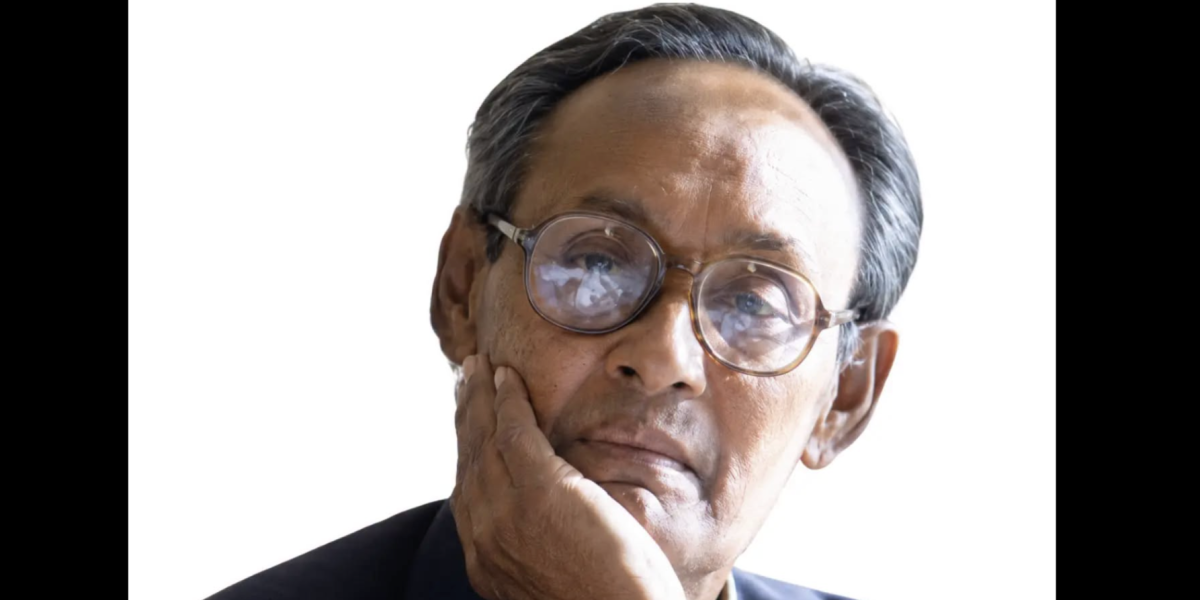
Sumit Sarkar. Photo: Facebook.
There are historians whose books we read, historians whose arguments we admire, and historians whose scholarship quietly becomes part of our own intellectual lives.
For me, Sumit Sarkar belonged to the last category. I never had the privilege of meeting him, attending one of his seminars, or listening to one of his lectures. Yet, in a rather unusual way, Sarkar became one of the teachers of my intellectual life. PlayNextMute
Advertisement
When I first developed an intellectual fascination with History as a discipline and chose it as my subject for undergraduate study, I was curious to know about the historians who had mastered the discipline. I would often ask my father about them.
He had studied for his MA in Modern History at the University of Delhi between 1977 and 1979, and he would speak of Sarkar, who was then teaching at Delhi University, with considerable respect.
What impressed my father was not merely Sarkar’s command over modern Indian history, but particularly his historiographical approach. At that age, I did not fully understand what he meant by that. Years later, I would.
I pursued my BA Honours in History at Hans Raj College, University of Delhi, between 2016 and 2019. It was during these undergraduate years that Sarkar’s scholarship became an important part of my own intellectual formation. One of my professors, Sharmila Srivastava, introduced us to Sarkar’s seminal work, Modern India, 1885–1947.
Advertisement
Her notes were often deeply informed by his scholarship, and she repeatedly encouraged us to read Sarkar alongside the other prescribed literature. I became curious and purchased Modern India myself. I also borrowed another of his major works, Modern Times: India 1880s–1950s, from our college library.
Also read: Sumit Sarkar Taught Generations to Take History Seriously
The latter offered a later and substantially reconceived treatment of the period covered in his earlier work. With these two books in my possession, I decided that they would form the intellectual foundation of my preparation for my modern Indian history papers.
Almost all my classmates were using Sekhar Bandyopadhyay as their principal text for modern Indian history, supplemented by articles recommended by our professors. Their choice was entirely understandable. Bandyopadhyay is an outstanding historian, and his work offers a comprehensive and analytical engagement with the major historiographical traditions of modern India.
It brings together nationalist, Cambridge, Marxist, subaltern and other perspectives, and provides students with a nuanced understanding of the debates surrounding modern Indian history. It is therefore unsurprising that his work became useful not only to university students but also to generations of civil services aspirants who wanted a balanced and analytical account of the subject.
Advertisement
My own choice was different. To be honest, I largely skipped Bandyopadhyay and chose to rely primarily on Sarkar. It was certainly a gamble. What drew me towards Sarkar was, in part, precisely what some readers might regard as a limitation in his work.
His historical writing did not always give me the impression of an artificially detached and perfectly balanced account in which every historiographical position was presented from an equal distance. His scholarship possessed a distinct intellectual sensibility, and his arguments carried particular commitments, emphases and questions that were recognisably his own. That appealed to me.
Also read: History Must Be Based Solely on Evidence: Irfan Habib
We are often taught to approach history through the ideals of objectivity, analytical distance and scientific method. The Rankean tradition has had an enormous influence on the discipline’s understanding of historical scholarship, and there is considerable value in the insistence upon evidence, critical inquiry and methodological rigour.
Advertisement
At the same time, I gradually began to realise that the aspiration towards complete neutrality has its own limitations. Historians do not approach the past without questions, assumptions or sensibilities. The choice of what to investigate is itself an intellectual choice. The decision about whose voices deserve greater attention is also an intellectual choice.
The sources that a historian chooses to interrogate, the silences that a historian attempts to recover, and the historical processes that a historian considers worthy of explanation are all shaped, at least to some extent, by the questions that the historian brings to the past.
During my third and final year at Hans Raj College, when we studied the core papers on modern Indian history, I had also become deeply fascinated by the Subaltern Studies school. Ranajit Guha’s Elementary Aspects of Peasant Insurgency in Colonial India, which had been recommended by our professors, had a profound impact on me.
The attempt to recover the autonomous political agency of peasants and other subaltern groups, and to challenge historical narratives centred primarily on elites, was intellectually exhilarating. At the same time, Srivastava again directed me towards Sarkar. This time, she encouraged us to read his essay, “The Decline of the Subaltern in Subaltern Studies”, which appeared in his collection Writing Social History. That essay forced me to reconsider a historiographical position that I had begun to embrace rather enthusiastically.
Sarkar’s critique did not simply tell me that Subaltern Studies was wrong. Instead, it compelled me to interrogate the assumptions within the school itself and to think about the limitations that could emerge even within a historiographical project that had originally sought to challenge elite-centred histories.
That was perhaps one of the most valuable lessons I received through Sarkar’s scholarship. No historiographical position should become an intellectual comfort zone. It should always remain possible to admire a school of thought while questioning it, to respect a historian while disagreeing with the historian, and to change one’s own position without abandoning one’s intellectual curiosity.
Also read: What Exactly Is ‘Marxist History’?
For me, Sarkar demonstrated that historical scholarship could be rigorous and analytical without pretending that the historian possessed no intellectual standpoint. His work made me more comfortable with the idea that a historian’s intellectual commitments do not necessarily diminish the value of historical scholarship, provided that those commitments remain open to evidence, argument and criticism. I therefore stuck with Sarkar.
I built my examination answers around the arguments that I encountered in his books. I supplemented them with scholars who supported, developed or complicated his positions, and I also made it a point to acknowledge historians who disagreed with him. I then tried to arrive at my own analytical conclusions rather than merely reproducing the arguments of any one historian.
In other words, I did not simply use Sarkar as an authority. I used his scholarship as a point of departure for thinking. Interestingly, that gamble worked reasonably well. I graduated from Delhi University with a first division and a CGPA of 7.554, which was a respectable score in History during my time.
My engagement with Sarkar did not end with my undergraduate years. When I subsequently pursued my MA in Modern History at the Centre for Historical Studies at Jawaharlal Nehru University between 2019 and 2021, I became even more conversant with his scholarship. His essays and articles formed part of our course readings, and I encountered his arguments within a much wider and more theoretically diverse historiographical landscape.
Interestingly, however, I felt that the emphasis placed on his scholarship was not quite as pronounced as it had been during my undergraduate years at Hans Raj College. Perhaps some of this difference was personal and contextual.
Srivastava had been directly influenced by Sarkar’s teaching and scholarship, and Sarkar himself had taught at Delhi University, which may have contributed to the particular reverence with which his work was presented in our undergraduate classroom. This certainly did not mean that Sarkar was not respected within JNU’s historical circles.
Rather, the intellectual environment at the Centre exposed us to a much wider range of historiographical traditions and scholars, including a substantial body of work by historians and theorists from outside India, which inevitably occupied a considerable part of our academic attention.
For me, therefore, JNU did not diminish my engagement with Sarkar. Instead, it placed his scholarship within a much broader intellectual universe and allowed me to understand both its strengths and its limitations with greater maturity.
Years later in 2026, even while writing my Odisha Civil Services Mains examination, I found myself returning to many of the intellectual habits that had developed through this engagement with historiography. History was my optional subject, and I wrote my answers drawing upon the arguments and debates that had shaped my understanding of the discipline over the years.
I eventually scored 159 marks in Paper I and 154 marks in Paper II, crossing 300 marks overall and emerging as the topper in History optional. I would never claim that those marks were because of Sarkar, because such a claim would reduce a complex intellectual journey to a simplistic causal relationship.
However, I can say with certainty that the intellectual habits that helped me write those answers were, in part, cultivated through my engagement with his scholarship. That is why his passing feels strangely personal.
There is something particularly moving about the generational journey through which I encountered him. My father knew him as a teacher. I first knew him through my father’s memories. I then encountered his scholarship through the classroom of Srivastava.
I subsequently encountered him directly through his books and essays. I encountered his scholarship again within the much wider historiographical world of JNU. Eventually, his arguments found their way into my own historical writing. This, perhaps, is how intellectual legacies actually survive. They survive not merely through citations, commemorations and university syllabi, but through people who read, question, disagree, reinterpret and carry ideas into another generation.
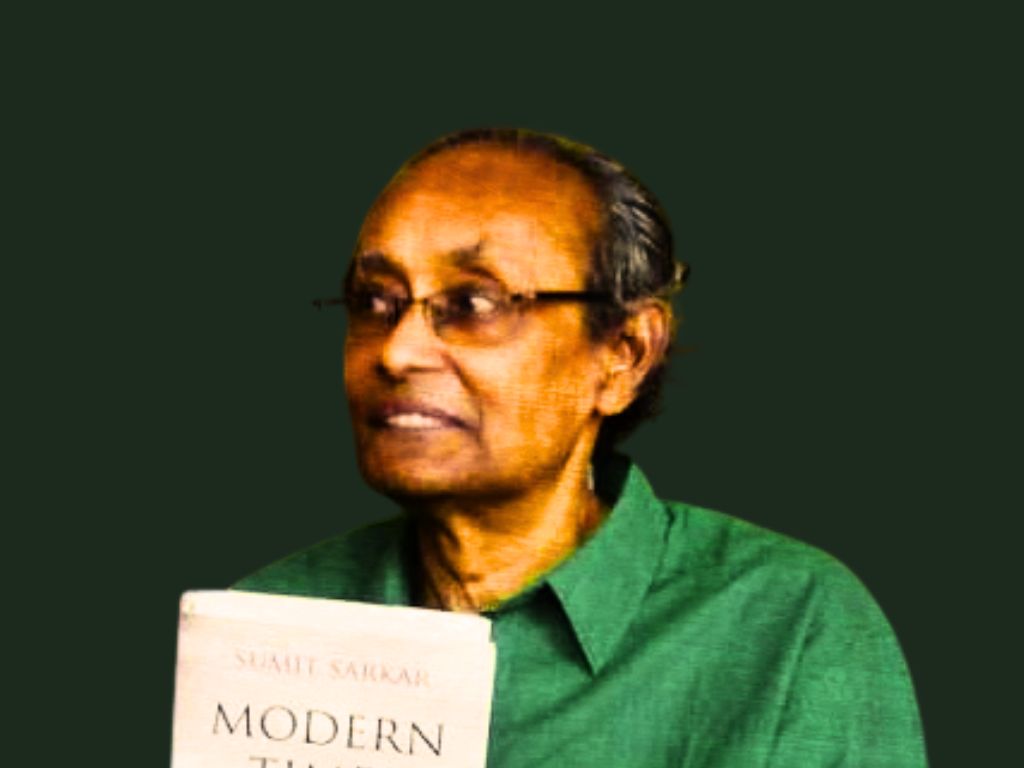
Sumit Sarkar (1939-2026). Photo: Facebook.
Sarkar’s own intellectual journey makes this especially significant. He is often labelled as a Marxist historian. He was also closely associated with the Subaltern Studies project and was among its founding figures, yet he later became one of its important critics. His scholarship therefore cannot easily be reduced to a single historiographical label.
He continually engaged with the tensions within the writing of modern Indian history, including the relationship between nationalism and its critics, between elite and popular politics, between historical agency and structural forces, and between analytical rigour and the intellectual questions that make history meaningful. Perhaps that is why his work stayed with me.
I never had the good fortune of meeting him. I never sat in his classroom or attended one of his talks, unlike some other eminent historians whom I have had the privilege of meeting or listening to, including Romila Thapar and Irfan Habib. My relationship with Sarkar remained entirely mediated through his scholarship.
Yet I have come to realise that intellectual relationships do not necessarily require physical proximity. A teacher whom one never met can still teach. A historian belonging to an earlier generation can alter the way one looks at the past. A book picked up out of curiosity can quietly shape the way one thinks for years.
For me, Sarkar was never merely an eminent historian whose books I happened to read. He unsettled some of my assumptions through his critiques, acquired new meaning for me within the intellectually diverse environment around me, and eventually became part of the intellectual vocabulary with which I wrote my own history.
I owe him an immense debt of gratitude. His scholarship did not simply help me understand modern India better. It made me question how history itself ought to be understood, how historians construct their questions, how historiographical positions evolve, and how no interpretation of the past should ever become immune to criticism.
Perhaps that is among the greatest legacies that a historian can leave behind. A historian’s most enduring contribution is not necessarily a set of conclusions to be memorised, but a set of questions that continue to make subsequent generations think.
Sarkar has left behind many such questions. His voice has fallen silent, but his scholarship will continue to speak, argue, provoke and teach generations of historians who, like me, may never have had the privilege of meeting him.
Somnath Pati is a scholar of History trained at Hans Raj College and JNU, and an incoming Odisha Civil Services officer.
Advertisement
This article went live on August eighteenth, two thousand twenty six, at fifty-six minutes past four in the afternoon.
The Wire is now on WhatsApp. Follow our channel for sharp analysis and opinions on the latest developments.
 Knock nock
Leave a comment