


06/Nov/2023
5 min read


In the slim 200-odd pages of this modern masterpiece, Purkayastha weaves his own personal story with the nation’s story of standing up to overbearing authority figures.
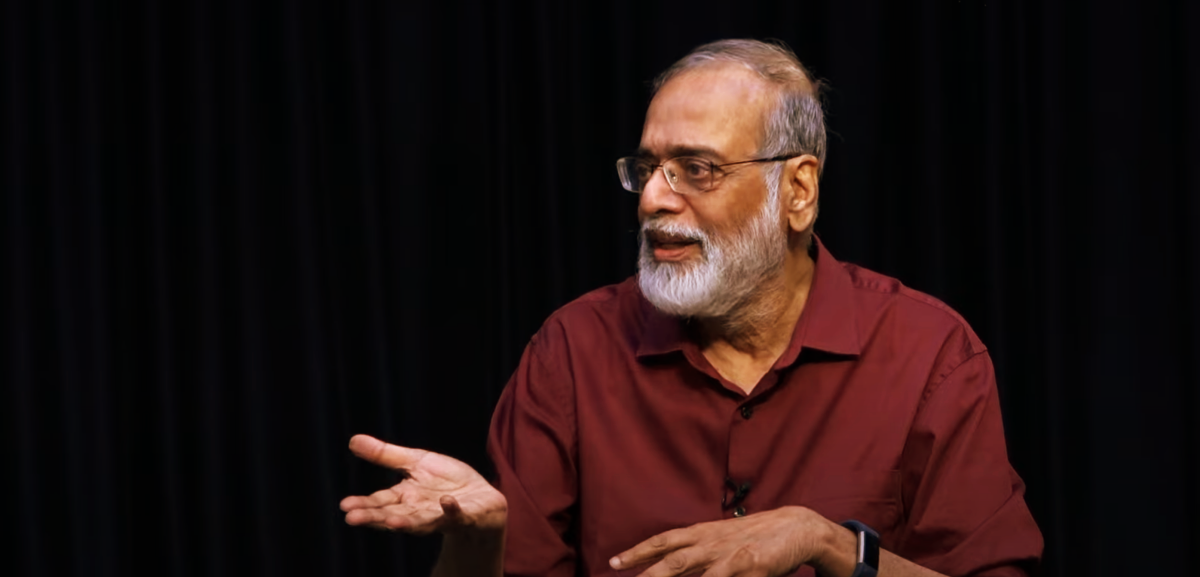
NewsClick owner and editor Prabir Purkayastha, Photo: Screengrab via YouTube/NewsClickin.
Prabir Purkayastha’s slim autobiography Keeping Up the Good Fight was written in that twilight zone between the registration of a criminal case against his portal NewsClick and his arrest on October 3, 2023. It tells his life story along with events that impacted the nation and the lessons that he learnt along the way. In his own words: “ I am as old as the Indian republic. In my life of more than 75 years, I have learnt a thing or two, maybe even three. To put it simply, I have learnt how I can be part of my rich, diverse country, and, equally, part of the fascinating, complex larger world. All I need to do is fight for a better world for all.”

Prabir Purkayastha
Keeping Up the Good Fight
LeftWord Books (October 2023)
There is no telling how long his incarceration will last this time. But Purkayastha is one of those for whom “the real question is about the side of history you are on.” And he believes that when he looks back, to the 1975 Emergency or at the one today, he does not not want to look at it from the point of view of a victim.
He says, “Victimhood robs us of participation in the creation of history; it reduces us to mere objects of history. Instead, I would like to assume the vantage point of people as makers of history. Yes, the government of the day wields powers that seem to overwhelm individuals and organisations. But it is people, and their actions, that finally determine history; not as we please and when we please, but in ways that neither the people nor their rulers anticipate.”
In the slim 200-odd pages of this modern masterpiece, Purkayastha weaves in his own personal story with the nation’s story of standing up to overbearing authority figures. Written in lucid prose, this autobiography is not an exercise in self-glorification or a boring story boringly told. It is a fighter’s examination of his own life and the people who shaped it. It is told without malice or rancour. Even those who have mistreated him are not made villains of choice but creatures of circumstance.
Also read: ‘The Difference Between Then and Now’: Prabir Purkayastha on Emergency and the Modi Years
Advertisement
Purkayastha is an engineer, a man of science, who has made a conscious choice in his politics and lived by that logic. He notes, “There were several milestones along the way, but the most important one was the discovery that I had three ‘passions’ I would always live with: science, technology, and, of course, politics. How these three would come together over the next four (and more) decades became clearer only with time.”
The book begins with a chapter titled, ‘Does Every Generation Have to Face an Emergency?’. It then segues into the author’s personal journey in subsequent chapters called, ‘Learning to Fight: A Personal Journey’ and ‘To Delhi and a Turning Point’. The next two chapters – titled ‘A University Under Emergency’ and ‘Life in Jail’ – cover his recollections of the Jawaharlal Nehru University in the 70s and his experience in prison. The book then looks at ‘The Last Chapter of Mrs Gandhi’s Emergency’ before recording the major portion of his working life in ‘Living Politics’.
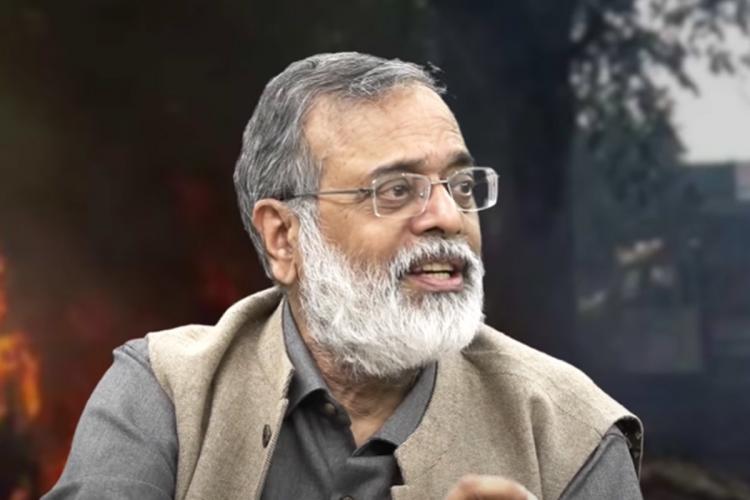
NewsClick owner and editor Prabir Purkayastha. Photo: YouTube screengrab
“Don’t take people’s silence for assent: This was the crucial lesson of the Emergency for our generation,” Purkayastha wrote, adding that “Mrs Gandhi knew that she needed the affirmation of the people through an election that was truly free. The current dispensation believes that the facade of freedom, combined with control over media, including social media, is enough. Yes, it may be possible to do this for a short time, maybe in a few states, often by creating warlike conditions with a neighbour, and, throughout, appealing to people to close ranks behind the great leader. But not for long, not across the country. As Shelley’s immortal line says: ‘Ye are many, they are few’!”
I wish that this book had been released before his arrest and the orchestrated media campaign about Purkayastha and NewsClick’s links to China through American businessman Neville Roy Singham. Purkayastha states in chapter 7, “…Later, while I worked as a consultant with Steag, I set up a small news portal, NewsClick, in 2009. I would commute every day from Gurgaon, where I lived, to the office at Noida, and to Malviya Nagar in the evening to NewsClick before returning to Gurgaon late at night. Later, I joined the software company Thoughtworks, then owned by the tech wiz Singham, in 2013, and worked there as a consultant till 2017”.
These events in the course of his life occurred before the Modi samvat (era) began in May 2014. The entire case against Purkayastha today seems to be as insubstantial as the one in 1975. I do hope that someone in authority pays attention and releases the man who has always fought the good fight. If not, this book will stand as a testament to his times and ours. The book rewards the reader in so many ways and I do hope that it is translated into all major languages of India.
Sanjay Hegde is a senior advocate, Supreme Court.

Prabir Purkayastha: Fighting the Good Fight From Emergency to Today
Tanupriya Singh | 19 Dec 2023
Writers, journalists, students, and activists gathered in India’s capital for a discussion on the memoir of jailed Newsclick founder Prabir Purkayastha, expressing solidarity with him.
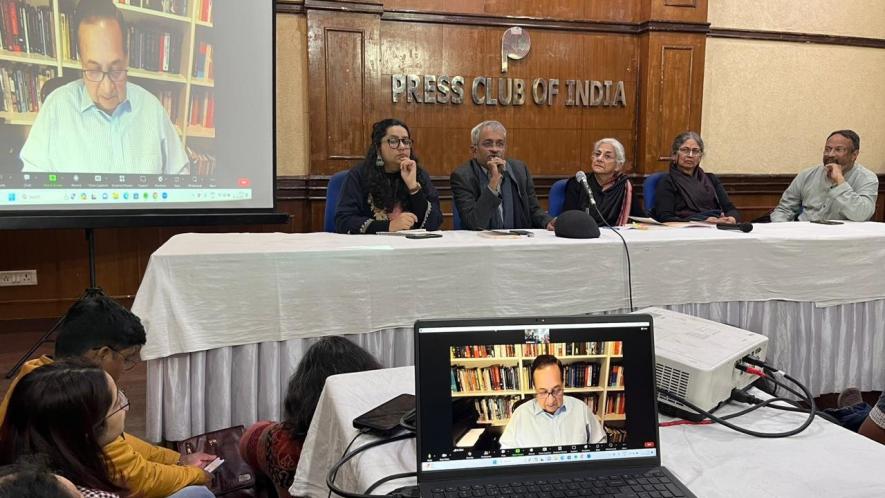
Photo: Press Club of India
On December 14, journalists, writers, activists, and students gathered at the Press Club of India for a panel discussion on the memoir of Prabir Purkayastha, a veteran activist and the founder and editor-in-chief of Newsclick.
Published by Leftword Books, which co-hosted the discussion, “Keeping Up the Good Fight: From the Emergency to the Present Day”, provides a five-decade-long trajectory of not only Purkayastha’s political journey, his work and his activism, but how these were shaped by the broader political and socio-economic changes taking place in India.
As Githa Hariharan, a writer and one of the speakers at the discussion stated, “Even though it is a memoir, and Prabir is the individual person is there, he is always placed in a larger context, in a collective, that can grow into a movement, that can ally with other movements and push for change that will mean better lives for many people.”
In August 1975, three months into the declaration of a period of Emergency across India which saw heavy repression and the curtailment of most basic rights, Purkayastha was abducted from the campus of Jawaharlal Nehru University (JNU) and imprisoned under the Maintenance of Internal Security Act (MISA).
On October 3, Purkayastha, and Newsclick’s administrative head, Amit Chakraborty were arrested in a series of coordinated raids and arrested under the draconian anti-terrorism Unlawful Activities (Prevention) Act (UAPA).
Purkayastha was first arrested as a student, then as a journalist.
His abduction in 1975 came in the midst of a historic protest action against the expulsion of Ashoklata Jain, an elected councilor of the JNU student’s union. Nearly 50 years later, on December 15, 2023, the university’s administration issued notice to 16 students, days after stifling the ability of students to hold protests on campus. On December 12, a high court in Jammu and Kashmir ordered the release of journalist Asif Sultan, five years after he was arrested and subsequently booked under UAPA.
The book and Thursday’s discussion addressed these parallels, between what was considered a period of exception in Indian democracy and today, in order to resist both the erasure of the experience of the Emergency from popular consciousness, as well as any complacency regarding rights and liberties in India today.
“We never got to a situation where we said ‘never again,’” said Sanjay Hegde, a senior advocate in the Supreme Court of India, of the period after the Emergency, “(a situation) where, in (Dr. BR) Ambedkar’s words (who was responsible for drafting the Indian constitution), we resolved to not lay our liberties at the feet of a great man.”
Speaking to the arrests of people including Umar Khalid, Hegde added, “We have a written constitution, we have institutions that are supposed to administer the constitution, but when these institutions fail, it is these men and women of conscience, who fight the good fight, who remind us that the constitution is a solemn compact between citizen and citizen, that this is the nation [in which] we will work together and live together.”
While noting that Purkayastha had been “a victim of the defending the constitution twice in his lifetime”, Hegde invoked the journalist’s own words in refusing such a characterization: “Victimhood robs us of participation in the creation of history, it reduces us to mere objects of history, instead I would like to assume the vantage point of people as the makers of history,” Purkayastha writes in the book.
“Yes, the government of the day wields powers that seem to overwhelm individuals and organizations, but it is people and their actions that finally determine history, not as we please and when we please, but in ways that neither the people nor their rulers anticipate.”
The panel discussion also featured researcher Indrani Mazumdar, Bezwada Wilson, an activist and founding member of the Safai Karamchari Andolan (SKA), and N. Ram, a journalist and director of the Hindu Publishing Group.
Terming the current period in India as being under a “Hindutva authoritarian regime”, Ram warned that “institutions are being captured…manipulated and media freedom is under full scale attack”.
Speaking specifically to the raids on Newsclick, he said, “(t)he whole McCarthyite campaign, it is not essentially a media story. It is about a completely new socio-political, ideological formation which has injected a lot of poison into the information ecosystem.”
Wilson similarly warned against attempts to create an “opposition-mukt bharat” (opposition-free India), while urging the need for people to come together against an authoritarian state. “The citizens are important, the sovereign citizens make the state”.
As such, the speakers emphasized the need to reject pessimism.
Quoting Purkayastha, Hariharan stated, “The story of our recent past and one that continues to unfold is not just about repression. The story is incomplete without the resistance we have witnessed, written about, and been part of.”
Courtesy: Peoples Dispatch
| https://frontierweekly.com/pics/banner-frontier.jpg “Prabir Purkayastha’s Memoir”Emergency Then and NowJoydip GhosalPrabir Purkayastha was incarcerated by two regimes. Both are authoritarian and tend to suppress any kind of dissent. Both the incarceration happened half a century apart. His book Keeping Up the Good Fight From the Emergency to The Present Day (Leftword) is a personal narrative but it is inalienably linked to the tumultuous events of the time which makes it a compelling account. He is a science activist in software, power and telecom sector. He is the author of Knowledge as Commons: Towards inclusive Science and Technology. Along with Ninan Koshy, MK Bhadrakumar he wrote Uncle Sam’s Nuclear Cabin. With Vijay Prasad he co- authored Enron Blowout: Corporate Capitalism and Theft of the Global Commons. Apart from that he is the co-editor with Richa Chintan and Indranil of Political Journeys in Health: Essays by and for Amit Sengupta.RomilaThapar aptly says “Prabir Purkayastha’s memoir” recalls the past, with thoughtful comments on the present, and hopefully he will be free to project his vision of the future. “Sanjay Hegde wrote that the book was written in the twilight zone between the registration of criminal cases against his news portal and the arrest on 3 October, 2023.According to him the entire case today seems to be as insubstantial as in 1975.The book began with the quotations by Karl Marx and B R Ambedkar. The quotation by B R Ambedkar “They cannot make history who forget history “resonated throughout the book. Foreword by Lalita Ramdas succinctly summed up the spirit of this memoir – the personal is political, the political is also the personal. The book helps the readers to traverse the complex maze of contemporary political dynamics. They also witness the warp and weft of different elements that ultimately shaped and define the worldview of a person who wanted to be a committed political activist. Powers-that-be tried to intimidate the person who raised his voices. This book is a saga of relentless fight against majoritarian regimes written in unpretentious style. According to Lalita Ramdas as a techno professional he had used technology and media to tell the most important stories of present times, especially through a visual medium. He holds within himself deeply held convictions about justice and equality for all and it had caused tremendous impact upon him to eschew conventional path and use unorthodox trajectory using media as a powerful tool “to attract those who might not, otherwise, hear many of these stories in any other forum.” Prabir asked a pertinent question when he named his first chapter “Does every generation have to face emergency”? On September 25, 1975 the students of Jawaharlal Nehru University in New Delhi had called for a strike. Ashoklata Jain, an elected councillor of students’ union had faced expulsion. The strike was against this expulsion. Three months before an emergency was declared and on the second day of the strike cops in mufti abducted Prabir Purkayastha. He was on the lawn of the School of Languages that morning. A black ambassador stopped near them and a burly man got out. He came up to him and asked him if he was D P Tripathi, the president of student union. He replied that he was not. The questioner was DIG – range cop P S Bhinder. In broad daylight he and his associates abducted him. He spent next one year in jail. On February 9, 2021 ED raided his home. Their target was the digital web platform News click. He had set up the platform in 2009 and it had grown over the years in terms of viewership and expansion. The raid continued for 113 hours. In truth it was one of the longest raids. Previously in Jaigarh fort of Rajmata Gayatri Devi a raid was conducted which lasted for nearly ten days.The emergency was promulgated on June 25, 1975. It remained in force till March 21, 1977. Preventive detention and widespread arrests muzzled the existing democracy. A sense of paranoia, persecution was prevalent in the air. In truth fear psychosis gripped the entire society. According to the author fundamental rights were curtailed to the extent that they seemed in those months non- existent. That was a shocking development because till the emergency India boasted of its democratic tradition. The author described it thus “It was as if , in one stroke, dissent, free speech and all the other characteristics of democracy could be struck down by the administrative machinery of the state.” But he stressed that it was not a matter of one stroke which was swift and prompt. Rather a host of matters exacerbated the creation of authoritarian regime. Today when young people asked him how emergency could happen there was more urgent counter question he asked himself. “Are we in the midst of another emergency by another name?” It was like the old emergency in some ways. It had its own unique features. Today with increasing use of state machinery against rights activists, progressives and minorities an atmosphere of hatred and threat had gradually built up in the country. Riding on the wave of majoritarian propaganda vigilantism coupled with arm twisting policies made the situation grimmer. In this book he tried to find out how this hatred driven attack, detention, trolling and the spurts of violence began. The politics that is based on hate is restricted to the narrow vision of society. The diabolical plan of muzzling people is quite different from earlier emergency. The reprehensible plan is to remould the state without any dissidence. Stan Swamy’s case is a glaring example. It wants to create a culture of petty subservience. Repressive organs of the state try to control every aspect of life. In order to discern the changing nature of authoritarian regimes this book is an essential read.Back to Home PageFrontier Vol 56, No. 41, Apr 7 – 13, 2024 |
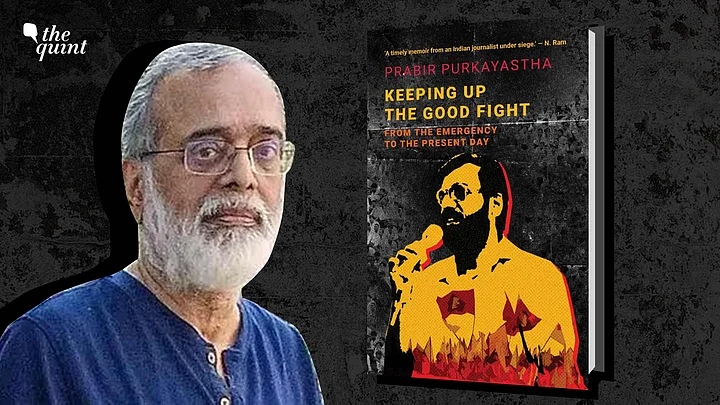
Book Excerpt: ‘Does Every Generation Have to Face an Emergency?’
“If we look at the ‘national’ or ‘mainstream’ media spaces today, where is the working class? Where are the unions?”
Published: 13 Nov 2023, 10:00 AM IST
i
(Extracted with permission from ‘Keeping Up the Good Fight: From the Emergency to the Present Days’ by Prabir Purkayastha, published by LeftWord Books. Paragraph breaks have been added for readers’ convenience).
Among the most enduring memories of the Emergency (other than enforced vasectomies) are those of a scared, docile The administration had powers to muzzle the media — what the press wrote had to be submitted to censors.
Everyone recalls LK Advani’s chastising remark to the press after the Emergency: “You were asked only to bend, but you crawled: But we also have to remember and salute honourable exceptions that didn’t bow down, or carry government propaganda.
The Indian Express managed to operate within the new constraints. Its blank editorial was a powerful symbol of protest against the attack on the role of the fourth estate. Smaller organisations also resisted the bully censor; for instance, the journal Seminar run by Romesh Thapar. Of course, what they could do was necessarily limited.
Also Read
Book Excerpt: ‘One Nation, One Poll — One Good Idea, Some Hurdles’
ADVERTISEMENTREMOVE AD
How does the Indian media scene today compare with those times? Media then meant mainly the print medium-the press. We have a number of platforms today, and it’s certainly much harder to control them all. The media is much more heterogeneous; and the agenda for media has been set differently.
Earlier, print media set what made news. The headline of the day would determine what the news was. Now that we have 24×7 news channels on television, the news has changed. Watching prime-time news ‘debates’ can give us a preview of the news cycle.
Social media has completely changed the landscape of what was earlier considered news or commentary, and so also with the influence and reach of media.
Social media even sets the news now — what issues will be discussed and commented upon by both journalists and readers. This is, obviously, much more difficult to control. Which is why, despite the best efforts of the BJP and Modi acolytes, you do hear other voices.
Of course, the government and its cohorts are anxious to control the large number of individuals using social media; to do this, they have to come up with measures different from what sufficed during the earlier Emergency.
In other words, a technological change has taken place which makes the task of muzzling the press rather different from what it used to be. If you want to muzzle a million or more people, you cannot use the Emergency instrument, which was direct censorship. What are the new censors — official and unofficial — to do?
Also Read
NewsClick Row: Delhi HC Dismisses Prabir Purkayastha’s Plea in UAPA Case
‘Self-Censorship Becomes the Norm’
They make an example of a few to create a chilling effect They make people afraid; self-censorship becomes the norm. They make use of continuous harassment, by filing FIRS all over the country; what used to be called lawfare in other jurisdictions.
Remember the case of the artist MF Husain? Cases were filed against him practically everywhere. Criminal proceedings we initiated against him for allegedly hurting public sentiment with his paintings Groups such as the Vishwa Hindu Parishad (VHP) and the Bajrang Dal issued threats against the 90-year-old painter Finally, unable to take it anymore, Husain left the country and lived in self-exile till his death.
The more recent examples are in some senses even more alarming. Any perceived criticism of the government or the Hinda supremacist project makes the journalist vulnerable to trolling, physical attacks, prosecution under the Information Technology Act and IT Rules of 2021, or detention under draconian counter-terrorism and sedition laws.
Independent news organisations are definitely on the hit list, especially of government agencies such as the ED and Income Tax department. Critical journalists have been charged for tweets, and social media users for sharing posts on Facebook. Students have been booked for sedition, for allegedly cheering for Pakistan in a cricket match.
Advertisers have been threatened with boycotts for using words or symbols perceived as Muslim, and bullied into withdrawing advertisements that represent a syncretic culture. The list of restrictions and attacks on media freedom is long and varied, and grows every day.
As always, the muzzling of the media is one part of the narrative, whether we are talking about the bad old days of the Emergency or the arguably still worse days of today’s unnamed Emergency. At every turn, I think it is essential to see with clear eyes the terrible details of repression, but also the brave resistance offered by people. We see this courage around us, in the present and the very recent past. Take the media, for instance.
There are many critical voices on the news platforms today, and not just digital platforms.
We read, see and hear criticism even in mainstream news. We saw, for instance, how newspapers, even those who were pro-government earlier in Gujarat and Uttar Pradesh, exposed undeclared COVID-19 deaths. Of course, they paid a price for this transgression later, with income tax raids on their premises spread across the country.
Also Read
CBI Files New FIR Against NewsClick, Searches Office & Prabir Purkayastha’s Home
‘Where Is the Working Class in the Media?’
Another phenomenon is a kind of double role some of the mainstream newspapers seem to play. They provide a platform for government ‘news’ as well as some manicured real news, the proportion waxing and waning, perhaps depending on how much readers will accept before they stop reading the paper altogether.
This is true for television as well, as the prime-time news spots have been replaced by gladiatorial contests, with the anchors playing ringmasters goading the opposition or critical voices.
Despite this, some critical strands continue to find their way even into the mainstream media. Although even here, certain developments are carefully ignored. I am referring, of course, to news and commentary on people’s struggles and popular movements.
If we look at the ‘national’ or ‘mainstream’ media spaces today, where is the working class? Where are the unions? The farmers? The industry beat is essentially about the industrialists; you hear the voices of the management, and you discuss the finances of the company.
Prabir Purkayastha in his book
The shift away from people working in the industry and towards its owners is stark. So is the growth of what used to be called the society page or page 3 — fashion and lifestyle — as celebrity news spreads across the entire paper, sometimes reaching even the front page.
Development journalist P Sainath, founder of the People’s Archive of Rural India (PARI), has pointed out if there are 40 media persons covering fashion shows in Mumbai, there may be just the one journalist covering rural Maharashtra and the deaths of agricultural workers and small farmers.
People’s movements, so critical in any impetus to change, are often innocent of social media and unused to the ways media is used by the current generation. I remember my grandmother’s generation saying that if something was in print, it must be true.
In a similar vein, older people today seem to think anything on WhatsApp must be true. The younger lot may well be a little more discerning. At any rate, it will take a while for us, whether old or young, to acquire social media literacy. Unfortunately, the various organs of the BJP and RSS have had a head start in the manipulation of social media, reinforced by the money power they wield.
How do we increase social media literacy and how do we increase social media capabilities in the movements? That’s a tremendous challenge, but when you have the numbers, it will happen. This is what we saw in the case of the farmers’ protests they found their own voices; they found their own media.
Yes, they had access to sympathetic news platforms, including NewsClick. But their content, their take on the movement, was their own, whether it was the broadcast of their marches, their music or their first-person reports, all expressed in a multitude of voices, often with humour.
And all this was often directly communicated on platforms they set up, whether on YouTube or Facebook, or with their four-page bi-weekly, Trolley Times. This is only one example.
Unlike the earlier Emergency, where cutting the electricity supply to the newspapers stopped the printing presses, now, in the digital age, shutting down all forms of media, including social media, is much more difficult.
Prabir Purkayastha: Voice of resistance
Blending memoir with political history, Purkayastha chronicles his media career from the Emergency to the present “undeclared emergency” in this book.
Published : Feb 22, 2024 01:02 IST – 7 MINS READ
Does a democracy automatically guarantee freedoms or do those freedoms need to be fought for? Progressive sections in the Indian media believe that a fettered media is a fettered democracy. There is also no denying that the last one decade coinciding with the installation of a new government in 2014 has proven that even the constitutionally guaranteed freedoms cannot be taken for granted and need to be defended. This has also been one of the most testing times for journalists, academics, and activists in the country.
Keeping up the Good Fight: From the Emergency to the Present Day
Prabir Purkayastha
LeftWord Books
Pages: 229
Price: Rs. 425
Targeting of journalists by individuals is not new, but when the state becomes partisan, as it did during the Emergency, such targeting assumes a completely different dimension. People have been booked under draconian laws that presume guilt over innocence, or arrested for alleged economic offences where the process itself is the punishment. Where dissent has not been jailed, the troll army bullies into submission any position that is not supportive of the ruling party.
In mid-January this year, Prabir Purkayastha, an engineer by training and a mediaperson by circumstance, completed hundred days in jail. The founder of the online news portal NewsClick, Purkayastha was booked under the draconian Unlawful Activities (Prevention) Act (UAPA), for alleged anti-national activities. His arrest was viewed as a message to mediapersons, especially those in the digital media, to fall in line.
Also Read | Why UAPA is a threat to media freedom in India
Purkayastha is no stranger to political harassment and witch-hunts. As old as independent India, the 75-year-journalist narrates his political journey in this book, published by LeftWord. Purkayastha draws parallels between the Emergency and what is loosely called the ‘undeclared emergency’ that characterises present times. There was authoritarianism then and there is authoritarianism now. The central agencies were used then and are being used now. A large section of the media was compliant then; today the entire mainstream media, barring some notable exceptions, are.
If Emergency 1.0 had MISA (Maintenance of Internal Security Act), Emergency 2.0 has the UAPA, a legislation brought by the Congress but strengthened and put to good use by the present government. Amendments to the Act in 2019 placed the burden of proof on the accused, making bail the exception rather than the rule.

On September 25, 1975, three months after proclamation of the Emergency, the Delhi police picked up Purkayastha from the JNU campus, where he was a student. He was a student activist and a close friend of one of the office bearers of the JNU Students’ Union (whom he later married). It was a case of kidnapping, of mistaken identity as the police were looking for the union president D.P. Tripathi, a member of the Students’ Federation of India. DPT, as he was called, was closely allied with the student politics of the Left, years before he gravitated to the Congress and then took over as general secretary of the Nationalist Congress Party. The police later picked up Tripathi.
JNU was known to be a bastion of Left presence and students of all leftist hues had organised strikes and protests within the campus against the Emergency, the preventive detentions and the crushing of dissent and protest. It was not easy for the police to enter the campus. But they did, on the pretext that some students were stopping others from attending classes.
In this particular case it was on the alleged complaint of Maneka Gandhi, then an undergraduate student, that the police entered the campus. Despite the mistaken identity, Purkayastha was jailed for a full one year under MISA and even kept in solitary confinement briefly. It was his first bout with incarceration.
In his memoir he narrates how he got the chance to meet a range of political persons from Socialists like Surendra Mohan to Jana Sangh members. Some from the latter category went on to become BJP ministers like the late Arun Jaitley, former Union minister Murli Manohar Joshi and the late O.P. Kohli, former Rajya Sabha member. In the book, he narrates overtures by the RSS to the Congress government for an earlier release of their members. But those are among the minor highlights of the book.
The book details the sum of experiences that shaped his understanding over the years. Beginning with his own transition from comfortable middle-class Bengali moorings, the book traces his journey and exposure to a world of ideas that led him to become a political activist of the CPI(M), a party he continues to be a member of. “The real question is about the side of history that you are on,” he writes. What is the “good fight’” or why is it necessary to keep up the good fight and who is to fight the good fight are some of the questions he poses. He says that he has no desire to become the news and is clear that the “good fight” does not begin or end with him.
Also Read | Crackdown on NewsClick signals erosion of democratic values
The book, a kind of a personal and political memoir traces his evolution as a person who is fairly equipped with a sense of justice, scientific inquiry, and fair play, all of which gets further expression and an outlet in being part of the Left and its understanding of society. Even as the book contrasts the two periods, Purkayastha writes that it is important to be mindful of the “larger context of 75 years of the secular, diverse, democratic, constitution-guided republic of India.”
He recalls the murders of people like the rationalists Narendra Dabholkar and the scholar M.M. Kalburgi, the trade unionist and rationalist Govind Pansare, and the journalist Gauri Lankesh, and the arrests of sixteen activists and academics under the UAPA in what is now known as the Bhima Koregaon case. All of those killed or arrested stood, in their own way, for reason, and the democratic right to protest, and challenged reactionary, sectarian, and right-wing Hindutva. In these Right-dominated times, cow protection vigilantism, assault on inter-faith marriages and the demonisation of minorities became par for the course.
Also Read | Assault on NewsClick marks the lowest point for media freedom in India since Emergency
Purkayastha launched NewsClick in 2009 and did not view it as doing anything unique. It covered, as did some other digital platforms and mainstream media outlets, the “assaults on people, livelihood and reason” and the public protests that took place in response. Many of these incidents, cumulatively, galvanized writers, artists, educationists, and other members of the intellectual class to come out of their comfort zones. The scientific community, of which Purkayastha was a part, also did its bit.
NewsClick also ran reports and opinions that would otherwise not make it to the mainstream media. To illustrate the conscious exclusion of certain kinds of reports in the media and perhaps the class character of the media, Purkayastha writes that he used to always find it “disturbing that when workers march in the city, news reports were too often about the traffic jams they caused, rather than their demands.”
But he also acknowledges that some sections of the mainstream media that were pro-government previously reported on excess COVID-19 deaths in Gujarat and Uttar Pradesh which they paid a heavy price in the form of income tax raids across their offices.
The book contains seven chapters, two annexures and a foreword by Lalita Ramdas. When Purkayastha was writing the book, NewsClick had already been raided twice by Central agencies under the Prevention of Money Laundering Act. The charges have been contested in court. And on October 3, 2023, Purkayastha himself was arrested along with a colleague. (The arrest has also been challenged in court.) Two weeks later, the company’s accounts were frozen, ensuring that none of the Newsclick staff could be paid in the new year.
Purkayastha is currently in jail, after repeated extensions of his judicial custody. He has health issues but his spirit is unbroken, as is the spirit of those associated with him. NewsClick continues to publish despite a freeze on its funds. The day the book was released at the Press Club of India in New Delhi, the hall was overflowing with friends, colleagues and sympathisers.
Those who know Purkayastha are familiar with his wit. His writing is laced with generous doses of his characteristic wit and infallible faith in the people of India. If the attack in the present times is more pervasive, he writes, so is the resistance. Ordinary people were the protagonists of the rejection of the Emergency in 1977. It is these people, he adds, who will “teach their leaders a lesson if they strayed beyond the permissible.”
Keeping Up the Good Fight review: Prabir Purkayastha reflects on Emergency, then and now Keeping Up
Keeping Up The Good Fight: From the Emergency to the Present Day, the political autobiography of a mmidnight’s child, dissects tyranny and tyrants in India John Dayal
The Specter of ‘Knowledge as Commons’
by Sam Popowich
- Issue:
- Vol. 75, No. 10 (March 2024)
View in the MR Archives: Article | Issue

Sam Popowich is a librarian at the University of Winnipeg, Canada.
On October 3, 2023, in an egregious violation of press freedom, the founder of the progressive Indian media company NewsClick, Prabir Purkayastha, was arrested on trumped up charges of accepting foreign donations in exchange for spreading Chinese propaganda. Purkayastha is a Monthly Review author, political commentator, analyst, proponent of open science and technology, and, perhaps most significantly, critic of the Indian government.1 Purkayastha’s arrest must be understood in the broader context of a crackdown on press freedom in India as a means of shoring up the hegemony of Narendra Modi and the governing Bharatiya Janata Party (BJP), an issue that Purkayastha himself has analyzed in both his book on Indian politics, science, and technology, Knowledge as Commons, as well as in his fascinating new memoir, Keeping Up the Good Fight (both published by LeftWord Press, 2023).2 Knowledge as Commons in particular lays out a vision of an inclusive, secular nation based on the open sharing of knowledge that is directly at odds with the political reality in India today.
Purkayastha’s account of the progressive politics that technology and open knowledge make possible, his vision of knowledge as the “common heritage of humankind,” and his opposition to the enclosure and privatization of that knowledge have made him an oppositional figure in Modi’s India. In a political conjuncture predicated on division, differentiation, hierarchy, and the oppression and silencing of minorities, Purkayastha’s vision of science and technology as fundamentally inclusive is a radical one. It is also of a piece with his vision of the power of an independent and critical media. This explains the Modi regime’s hostility to Purkayastha personally, to the activities of NewsClick, and to the sophisticated linking of science, technology, and progressive politics contained in Knowledge as Commons.
When Purkayastha established NewsClick in 2009, the news outlet explicitly focused on covering marginalized voices in Indian society. Support for previously silenced people went along with a need to speak to the “new video generation,” for whom print media was already obsolete. If this kind of intergenerational and progressive communication did not take place, Purkayastha contended, then the younger generation “would be lost to a different kind of politics.”3 NewsClick was intended to be both the mouthpiece of forgotten voices and the bridge between an older progressive politics and the younger generation in India.
The politics that NewsClick aimed to combat was the authoritarianism shared by both Indira Gandhi’s Congress during the 1975–77 Emergency (during which Purkayastha, then a student, was jailed for a year) and the current state of Indian politics and culture. Despite differences in their practical response to opposition, their ideology, and their political worldview, both the Congress of the Emergency and Modi’s government rely in particular on the repression of press freedom to achieve and support their hegemonic projects.
In the opening chapter of Keeping Up the Good Fight, Purkayastha asks whether every generation has to face an Emergency such as his did in the mid-1970s. Purkayastha is of the generation Salman Rushdie called “Midnight’s Children,” coming of age in the aftermath of independence and partition, and he is concerned with placing two “aberrant periods”—the Emergency and the current juncture—in the broader context of “75 years of the secular, diverse, democratic, constitution-guided republic of India.”4 Despite their political and ideological differences, what connects the Emergency with Modi’s India is precisely their subversion of the promise (and reality) of independent India.
Purkayastha uses the restriction of press freedom as a way to draw out the similarities between the two periods. If “Emergency” is understood as “a general description of repression,” it is one that develops when those in power are intent on eroding “fundamental rights.” This describes both the 1970s and today. Beyond this broad characterization, it is vital to bear in mind the way in which the two periods contrast. The ideology of Indira Gandhi and the broadly liberal Indian National Congress was distinct from the far-right religious nationalism of the Rashtriya Swayamsevak Singh (RSS) and its successor, the BJP. Modi played a major role in the RSS’s opposition to Congress during the Emergency before rising in the ranks of the BJP and becoming prime minister in 2014. Purkayastha identifies two main points of difference between the Emergency Congress and the BJP of today: a politics of exclusion and communitarian violence and an attack on secularism. The object of the Indian state and its Hindutva supporters today is to “help build a kind of destructive and sectarian politics…to exclude people on the basis of their community, to the extent of eroding the citizenship rights of some Indians.”5 Purkayastha insists that while “the Congress did not have all these exclusionary politics in its genetic composition; the RSS [and therefore the BJP] has them in its genes. That’s the crucial difference.”6
The attack on secularism takes the form of specific attacks on culture, education, science, and reason, with the RSS-BJP rejecting the promise of post-1947 India and the “inclusive, secular nation with a scientific outlook envisioned by so many of our freedom fighters.”7 Rather, they want to turn back the clock to the period of partition, and to continue fighting against Muslims for Hindu supremacy. For Purkayastha, inclusivity and solidarity are vital weapons in the struggle against BJP’s vision for India, which is why NewsClick’s mandate of building relationships and promoting minority voices is both so important and so threatening to India’s ruling elites. Reflecting on combined resistance from Muslim and Jat farmers to BJP maneuvering in 2013, he argues that the kind of unity that this pushback represented is in itself a threat to the division fostered by a right-wing politics intent on making solidarity movements impossible.
In both 1975 and in the current moment, repression of press freedom is a major tactic in the government’s response to such challenges. But, whereas the media in 1975 was cowed by the government into subservience, the media today is much harder to control, due both to a changed media landscape (in particular the change from print to digital and the proliferation of smaller news outlets) and the rise of social media. Indian media has now become much more difficult to control than in the 1970s, which explains why “despite the best efforts of the BJP and Modi acolytes, you do hear other voices.”8
This relative uncontrollability means that the blunt instrument of direct censorship that worked to bring the media to heel in the 1970s is no longer sufficient. The technological changes that transformed the media landscape require new approaches, and particularly the regular harassment of prominent opposition media outlets in order to “make an example of a few to create a chilling effect [in which] self-censorship becomes the norm.”9 Among the differences between the repression of the Emergency and repression today is that whereas Indira Gandhi’s government sought to take control of the media and to marginalize or defang its opponents, the Modi government seeks to erase opposition altogether, “to remould the state without these dissident voices; and ensure that nobody is able to stand up to the government or the rightwing forces in all their various avatars.”10
Purkayastha identifies the use of First Information Reports (complaints to the police) as an important mechanism in this dynamic of harassment and silencing. His arrest in October 2023 is only the latest incident in the Modi government’s quest to control NewsClick and Indian opposition media more broadly.
In August 2020, a First Information Report was filed alleging that NewsClick broke foreign investment limits. This was followed in February 2021 with a raid on NewsClick premises on suspicion of money laundering. Allegations of funding for pro-Chinese propaganda began in August 2023, when the Indian police linked—for the first time—the earlier charges of foreign funding and money laundering with the specter of pro-Chinese propaganda.11
The immediate trigger for Purkayastha’s arrest (along with forty-five other NewsClick associates) was a story published in the New York Times connecting Indian media companies, including NewsClick, to tech entrepreneur Neville Roy Singham and, it was insinuated, the Chinese Communist Party.12 Journalist Kavita Krishnan wrote that the Times story “has become a pretext to escalate an ongoing campaign to persecute and imprison some of India’s most courageous journalists, academics and activists on baseless charges of abetting ‘Maoist terrorism.’”13 Krishnan’s use of the word “escalate” is significant. The way the individual charges were promoted from a fairly anodyne transgression (exceeding investment limits) to illegality (money laundering) to the threat of direct foreign interference (“Maoist terrorism”) is an important element in the way we can understand the mechanisms being used by the Indian government in order to control and repress opposition to its own hegemonic (“Hindu nationalist”) designs, including the demonization of certain segments of the population and the creation of moral panics.
The concept of moral panic is central to cultural theorist Stuart Hall’s analysis of the rise of right-wing UK politics in the 1970s and ’80s.14 Hall’s account of how hegemony is maintained through consent and coercion, derived from Antonio Gramsci, is relevant to Purkayastha’s characterization of the differences and similarities between the 1970s and the present. To put it briefly, Hall identified the ways in which the state and the media in the United Kingdom worked together to identify certain demonizable “folk devils,” who could be portrayed as threats to “traditional” British values, beliefs, and ways of life. These included those who supported collective action over individualism (for example, the trade unions and the left); those who belonged to “alien” cultures, which allegedly did not respect individual rights and freedoms (including ethnic minorities, immigrant groups, and so on); and those who did not uphold individual responsibility and autonomy (for example, so-called welfare scroungers). Hall demonstrated how division and scapegoating, particularly by police and a docile media, could be used to create and instill a new common sense that supported the hegemony of the British state through the fostering of division and the oppression of marginalized communities.
Hall also identified a series of thresholds that mark escalations in the state response to perceived threats or challenges. These thresholds are departures from societal norms as defined and maintained by ideology and propaganda, ranging from permissiveness (a violation of a norm that draws a censorious or disapproving response in order to bring the transgressor back in line) to illegality (breaking the law, which draws a law-and-order response from the state), to actual or potential extreme violence. A particular challenge to the state can be made to appear more threatening if it can be combined with other, larger threats, and this process of escalation allows the media and the state in turn to step up the police response.
With this in mind, we can better understand the significance of the police’s linking of NewsClick’s transgression of “permissiveness” (exceeding funding limits) with a transgression of illegality (money laundering), and then to the threat of real violence (“Maoist terrorism”). That these links were discursively provided by a liberal media outlet as commanding as the New York Times helps makes the case for moral panic and allows the Indian police to represent themselves as responding to, rather than creating, the conditions for media repression, including the arrest of Purkayastha himself.
Both Purkayastha and Hall were influenced by Louis Althusser’s work on ideology, and in particular with the way “Ideological State Apparatuses,” including the media, can construct an audience for hegemonic values and ideas, and then appear to consult that audience in order to gain a measure of popular legitimacy for the government’s own repressive policies and actions, thus allowing a society to “drift”—in Hall’s phrasing—into increased state repressiveness. Hall called the result of this tendency “authoritarian populism,” which differs from older, more directly coercive authoritarianism in the same way that Modi’s populism today differs from the 1975 Emergency.
What Purkayastha identifies in the differences between media repression during the Emergency and today is the contrast between relying on physical and material coercion without requiring that opponents think a particular way (utilizing, for example, censorship, among other methods), and the manufacture of consent via a new common sense—one aligned with the BJP. The latter is built not only around the propagation of government messaging through docile media outlets, but through the construction of moral panics focused on demonized, excludable Others who can be portrayed as enemies of “our” traditional values and ways of life. While the BJP historically has relied on the demonization of Muslims, Dalits, Adivasis, women, and secular activists, the opportunity to vilify “enemies within” is too good to resist, especially when those enemies have (like NewsClick) actively promoted the voices of other “folk devils” of BJP ideology.
In short, it is no longer enough to control the printing and dissemination of media through censorship while allowing opposition media to remain. What is necessary in today’s India is to control the thoughts that people have, the way they think about things, their worldviews, ideas, and opinions. In the 1970s, Congress relied on what Althusser called “Repressive State Apparatuses”: through censorship, media outlets were prevented from disseminating the news, but could otherwise think what they liked. Today, in the context of broader moral panic for hegemonic ends, the Indian government has focused on Ideological State Apparatuses to get people not only to go along with Hindutva, but to believe in it. To clear the way for this to happen requires not just the repression of a free media, but its erasure.
Purkayastha’s memoir weaves together two aspects of his experience that today may seem like strange bedfellows: the experience of Marxist community organizing and activism, together with computer engineering. His political journey began with the Communist Party of India (Marxist) in 1970, in the heady mix created by the events of ’68, German and Italian communist agitation, and the U.S. antiwar and civil rights movements. Purkayastha gained experience on the shop floor and in student politics, and, under the influence of his reading of Althusser during his time at the Indian Institute of Technology in New Delhi, he began to combine his political and technological thinking. Althusser’s conception of Marxism as a science closely paralleled what Purkayastha understood as the relationship between science and technology itself. Technology, in this view, is not an “applied science” related as praxis to theory, but a relatively autonomous field of human endeavor, which, like all human endeavors, can only be politically progressive if it is truly inclusive.
Free/open science and technology, such as the open-source software movement, are examples of Purkayastha’s holistic view of promoting marginalized voices and the forging of solidarity among communities. The privatization or enclosure of knowledge through intellectual property laws and patents is not only ways of commodifying knowledge to ensure profit, but of restricting its spread and, therefore, its positive social effects. Purkayastha’s vision of open science and technology, unrestricted by capitalist property relations, is of a piece with his vision of a progressive media. It is through the sharing of knowledge, particularly knowledge by and of marginalized or oppressed people, that solidarity movements can be forged, and the secular democratic promise of the republic achieved.
The main conceptual innovation in Knowledge as Commons is the “conceptual independence” of technology from both science and the political projects that use technology as a means of domination or oppression. In its relations to science and to politics, technology is often seen as grubby, dirty, sordid, or inherently oppressive. It is this view that Purkayastha seeks to overturn in order to restore a sense of the inclusive and progressive potential of technology. Purkayastha traces the development of a divide between science and technology, with technology understood as, at best, “applied science,” but more often as a kind of impure materialist activity that gets its hands dirty. If “the objective of science is to know nature,” Purkayastha writes, technology “starts with the objective of building an artefact; in other words, of changing nature.”15 In effect, the standard philosophical view of technology charges it with an inherent Prometheanism and with the instrumental domination of nature required by capitalist development.16
Science, in this view, would prefer to keep itself distinct from the materialist, world-changing concerns of technology, especially given the history of technology in the twentieth century. Drawing on the examples of the Nazi gas chambers, the Bhopal disaster, and the atomic bomb, Purkayastha suggests that not only are such evils considered “inherent in the vision of technology,” but that science itself risks being “thought to share the ideology of dominance over nature that characterizes technology” since in the twentieth century, science became “a virtual synonym for technology.”17 From a Marxist perspective, of course, oppression and domination are not inherent in a given technology; technology is put to use by particular political programs. This is not to say that a given technology is historically or genealogically neutral, but that an understanding of technology at a particular historical moment requires an understanding of the politics of that moment.
Indeed, there is a class question at the heart of the science/technology split. Purkayastha writes that “From the slave societies of Greece and Rome, to the caste-driven society of India, the world of artefacts has been separated from the world of ideas. Scientists and mathematicians could enter the world of ideas, but not those who worked with their hands. The European aristocracy, first slave-owning and later land-owning, despised labour and, along with it, the instrument of labour—technology. So did the upholders of the caste system.”18
Any progressive politics must not only obliterate the distinction between “the head and the hand” by allowing technology workers entrance into the world of ideas and vice versa, but must overturn the enclosure and privatization of knowledge in order for knowledge itself to become “the common heritage of humankind” and for science and technology to “belong to all of us, as human knowledge in the global commons.”19 Purkayastha’s criticism of intellectual property and patent regimes as the enclosure and privatization of this common heritage of knowledge stems from a more inclusive, less divided vision of science, technology, and knowledge itself.
But Purkayastha goes beyond these fairly orthodox Marxist points, arguing that in fact there is a real reason for keeping science and technology conceptually independent from each other. Each domain has different goals and objectives. While in Purkayastha’s view, “scientific activity discerns laws, classifications or patterns in nature” that are the basis of explanation and prediction, the primary goal of technology “is to produce artefacts that incorporate some…social function.” This means that science is an epistemological activity with very different processes, goals, and objectives than the practical activity of technology.20 Purkayastha does not deny that science and technology are practically inextricable (science needs technology to do its work, technology produces new knowledge about the natural world that feeds back into science), but argues that they should not be confused conceptually.
The main impetus for this account is that whether technology is seen as “violently subjugating nature” or as “derivative of science,” neither view conforms to the way technologists actually work. Purkayastha argues that technology is neither an inherently oppressive or dominating force simply because it is technology, nor is it simply the physical manifestation of scientific knowledge. The first extreme sees technology as having an agenda or playing a role of its own, separate from the social and political context that generates it. The second sees technology as merely the passive recipient of scientific knowledge. In the first case, too much autonomy is granted to technology; in the second case too little.
A helpful contemporary example is provided by current debates over so-called artificial intelligence (AI). For “doomers,” modern generative AI tools such as large language models (for example, GPT) have goals and outcomes unknown by and independent of human beings and our social relations—that is, the social and political matrix that has produced the tools in the first place. Conversely, AI utopians see such tools merely as the reification of cutting-edge scientific knowledge, and therefore nonthreatening. By conceiving of science as neutral and apolitical, these utopians refuse to recognize the social and political misuses to which AI technologies can and will be put. In both cases, however, science and technology are conceived of apart from their social, political, and economic matrices. Purkayastha restores the notion of “people” to this curiously depopulated landscape. Not only are social and political realities part of the “design space” of any given technology, but social realities are also an inherent element of science as well. Purkayastha writes that “technology choices are also social choices. This is why the choice of technology cannot be left to a technocratic elite.”21
Such issues are prevalent in today’s technology landscape, legible in tech entrepreneurialism’s “longtermism,” eugenics, and “effective altruism.”22 Purkayastha sees technology deployment in the contemporary global conjuncture as encouraging the same kind of divisions (class, caste, racial, gender, and so on) as Modi’s government is fostering in India. It is only the supposed neutrality of technology that makes it appear as something other than the product of concrete social and political decisions, made possible by the privatization of scientific and technological knowledge through mechanisms such as intellectual property rights and patents. Universalizing knowledge, producing “knowledge as commons,” is really the same project engaged in by NewsClick: the overcoming of gaps, the building of bridges, and the restoration of power to “the people” conceived, not in a particularist, populist, or nationalist way, but in a universal sense. In the concluding chapter of Knowledge as Commons, Purkayastha makes clear the connections between the essays in that book and in his memoir, Keeping up the Good Fight:
It is not where you produce, but what knowledge you have that determines winners and losers in today’s global economy. Developing its people is the key to the future development of a country. This is why any nationalism that defines itself through a land, and not its people, belongs to the past. A scientific vision of the past and of the future is key to this fight. Giving up knowledge in the belief that the ex-colonial powers will readily hand it to us is a project for the re-colonisation of India. This is why we have to fight.23
The need to struggle for a more inclusive and democratic society lies at the heart of both Purkayastha’s books. In Keeping Up the Good Fight, he details the events that led him to understand the value and necessity of struggle; in Knowledge as Commons, he lays out his philosophy of knowledge, science, and technology as the open and collective heritage of humanity. In a clear example of the direct connection between theory and praxis, Purkayastha has, through NewsClick, demonstrated the importance of open knowledge sharing and the relevance of collective struggle against authoritarianism. It is easy to understand why he posed a threat to the Indian state severe enough to warrant incarceration, a threat made concrete in his theory and his practice, and the role played by the New York Times in the attack upon him. It is also easy to understand why his arrest raises a chilling specter for progressive politics globally.
As of this writing in January 2024, Purkayastha remains in jail.
Notes
- ↩ For some clue as to the agencies involved in his arrest, see Prabir Purkayastha and Rishab Bailey, “U.S. Control of the Internet,” Monthly Review 66, no. 3 (July–August 2014): 103–27.
- ↩ Prabir Purkayastha, Knowledge as Commons: Towards Inclusive Science and Technology (New Delhi: LeftWord Books, 2023); Prabir Purkayastha, Keeping Up the Good Fight: From the Emergency to the Present Day (New Delhi: LeftWord Books, 2023).
- ↩ Purkayastha, Keeping Up the Good Fight, 27.
- ↩ Purkayastha, Keeping Up the Good Fight, 30.
- ↩ Purkayastha, Keeping Up the Good Fight, 37.
- ↩ Purkayastha, Keeping Up the Good Fight, 39.
- ↩ Purkayastha, Keeping Up the Good Fight, 39.
- ↩ Purkayastha, Keeping Up the Good Fight, 32.
- ↩ Purkayastha, Keeping Up the Good Fight, 32.
- ↩ Purkayastha, Keeping Up the Good Fight, 41.
- ↩ Munish C. Pandey, “NewsClick Controversy: Did China Shift its Propaganda from Phone Apps to Media?” India Today, August 9, 2023.
- ↩ Mara Hvistendahl, David A. Fahrenthold, Lynsey Chutel, and Ishaan Jhaveri, “A Global Web of Chinese Propaganda Leads to a U.S. Tech Mogul,” New York Times, August 5, 2023.
- ↩ Kavita Krishnan, “NYT’s Report Has Been Weaponised against Indian Journalists. I Had Warned the Paper about It,” in, October 6, 2023.
- ↩ This is central to much of Hall’s work throughout the 1970s and early ’80s, but it is most fully worked out in Stuart Hall, Chas Critcher, Tony Jefferson, John Clarke, and Brian Roberts, Policing the Crisis: Mugging, The State, and Law and Order (London: Macmillan, 1978).
- ↩ Purkayastha, Knowledge as Commons, 12.
- ↩ Prometheanism is also a charge leveled at Karl Marx. For a critique of that position, see in particular John Bellamy Foster and Paul Burkett, Marx and the Earth: An Anti-Critique (Leiden: Brill, 2016).
- ↩ Purkayastha, Knowledge as Commons, 95.
- ↩ Purkayastha, Knowledge as Commons, 14.
- ↩ Purkayastha, Knowledge as Commons, 14.
- ↩ It should be noted that Purkayastha adheres to a specific vision of science as pure epistemology. Other, post-positivist conceptions of science such as Thomas Kuhn’s would support the notion that science also incorporates specific social and even political functions.
- ↩ Purkayastha, Knowledge as Commons, 15.
- ↩ See Émile P. Torres, “Longtermism and Eugenics: A Primer”, Truthdig, February 4, 2023, and “Why Effective Altruism and ‘Longtermism’ Are Toxic Ideologies,” Current Affairs, May 7, 2023.
- ↩ Purkayastha, Keeping Up the Good Fight, 255.


Leave a comment