

An excerpt from ‘De-democratisation, a Global Story: Script, Actors and Enablers’.
Yesterday · 08:30 amShare

In the global alt-right ecosystem, Kaliyuga – the spectre of the Hindu caste order turned upside down – has emerged as the central image representing the democratic world order. De-democratisation, says Alexandr Dugin, requires the overthrow of Kaliyuga, that is, in his words, “the present order of things, of which the core could be described as human rights, anti-hierarchy, and political correctness”. He had said this in Delhi in 2012, while attending a prestigious international social science conference, in an interview published by a magazine that declares its purpose “is to promote white identity politics”.
Kaliyuga – a Hindu term for an epoch of sexual and social degeneration caused by the collapse and corruption of caste hierarchy – has excellent traction in contemporary white-supremacist, alt-right and multipolarist discourse internationally, among ideologues, media figures and even political parties. As an Indian attuned to recognising Kaliyuga as a trope in social conservatism as well as Hindu-nationalist and Hindu supremacist discourse, it is startling to see the extent to which Kaliyuga memes, imagery, slogans, T-shirts and other merchandise permeate the global far-right social media ecosystem.
Carole Schaeffer, in a 2018 essay investigating the relationship between India and a “global wave of white supremacy”, had noted that Vanguard America, the neo-fascist group that had organised the notorious white-supremacist Charlottesville rally in 2017, “sold T-shirts with a Nazi skull-and-crossbones wearing sunglasses and the slogan ‘Surf the Kali Yuga’ printed boldly below, referring to the Hindu notion that we are currently living in a dark epoch.” Identity Evropa was another group among the 2017 rally’s organisers: its CEO at the time, Eli Mosley Kline, “had been previously photographed wearing Vanguard America’s ‘Kali Yuga” shirt”.
Before you scroll further…
Get the best of Scroll directly in your inbox for free.
Schaeffer wrote, “Just before the US election, as Trump was about to enter a final presidential debate, Richard Spencer [prominent “alt-right” and neo-Nazi propagandist] tweeted – referencing the avatar of Vishnu who, it is believed, will appear at the end of the Kali Yuga to battle evil forces – ‘Hopefully, Trump as Kalki the destroyer will end them.”
What does “Surf the Kaliyug” mean? One clue can be found on the website of one of the clothing companies that makes T-shirts with this slogan. Wolf Age Apparel’s merchandise suggests that its target audience is the US alt-right: for instance, it has several T-shirts on Covid-denial and anti-masking themes, one of which calls “Communism” the “final Covid variant”. A “Surf The Kali Yuga Men’s Crewneck T-Shirt” features what looks like the figure of a medieval European warrior covered in armour, and in place of a shield, he carries a surfboard shaped like a shark, covered with cryptic phrases. Next to the product image, right under the price ($29), you can read: “The only thing that matters today is the activity of those who can ‘ride the wave.” The quote is taken from Julius Evola’s Revolt Against the Modern World: Politics, Religion, and Social Order in the Kali Yuga. Italian fascist philosopher Julius Evola’s book was published in 1934, as European fascism approached high tide. Evola, as well as his “master”, French esotericist René Guénon, characterised modernity and democracy as “Kaliyuga”: our apocalyptic and dissolute epoch marked by the collapse of political authority and social hierarchies.
Another T-shirt, the “Ride The Tiger Men’s Crewneck T-Shirt”, has the head of a roaring tiger with two crossed bones within its jaws; “Ride The Tiger” in capital letters circling its head, “Kali” and “Yuga” on either side of its face and “Meta-Right” in capital letters below the tiger’s face. Next to this image is another Evola quote: “You have no liberation to seek from bonds, because you have never been bound.” This quote is from Evola’s last book, Ride the Tiger: A Survival Manual for the Aristocrats of the Soul, published in 1961, where the injunction to “ride the tiger” is believed to mean that “the tiger that must be ridden until it collapses from exhaustion is modernity.” An Indian YouTube channel – K The Last Warrior – offers a version of the same idea: the avatar is he who is not under the epoch’s control, but instead he who brings the epoch under his own control. The “wave” and “tiger” similes do express the same concept.
A “Know Your Meme” website offers a useful summary of Kaliyuga images and slogans on social media. “Around 2015,” it tells us, “the idea of Kali Yuga was adopted by far-right extremists, including the French Dissent, a far-right political party that popularised the phrase ‘surf the Kali Yuga’ on t-shirts, later sold by the far-right podcast ‘The Right Stuff.’ … In July 2019, a Telegram group called the ‘Kali Yuga Surfing Club’ opened, featuring alt-right, anti-SJW [social justice warrior, a derogatory term for democratic rights activists] and Nazi-centric memes along with posts about Kali Yuga.”
A German online magazine, which defines its purpose as “deradicalising and democratising culture”, has an essay which discusses the “Kaliyuga” theme in “schizo-posting” memes, as seen in online “subcultures that glorify violence and foster nihilism.” The essay is by Caleb Cain, a former far-right extremist who now analyses right-wing extremist trends and offers advice on how to respond. “Today’s youth,” Cain comments, “feels disenfranchised, without a stable identity or sense of safety.” Some become “Schizoposters”, posting memes on social media to express “the desire to escape the failures of modernity and seek a millenarian solution”. Millenarian politics can be left-wing, green-anarchist, spiritualist or right-wing. Schizo-posters come from diverse ideological positions, but they “share a commitment to waking up the normies to the evils encroaching their world and to ascend to do battle with them. The world we inhabit is fallen or corrupt, and they believe we can usher in a new age”.
Advertisement
“The Kali Yuga,” Cain suggests, “is used by the schizo-scene as an explanation” for all that threatens their sense of personal identity and social and economic order. The more degenerate and unstable the stage of Kaliyuga, the sooner a warrior will come to lead an insurrection against evil and bring about a new era where order is restored. Cain writes that a common theme, “regardless of ideological flavour, is acceleration. To push through the contradictions of modernity and overcome them. Because of this, Kali Yuga has become a relevant narrative and aesthetic to most schizo-posters. Acceleration and collapse could be seen as one of, if not the most, important shared narratives within the schizo-scene”.
Prominent right-wing YouTubers and podcasters with massive audiences have also mainstreamed the term Kaliyuga. One such is Joe Rogan, an American podcast host who has been described as an “agent” of “conspiracy theories, cultural intolerance and blatant racism … which he packages and sends out to his audience clothed in the language of moderation and moral equivalence”. On 16 November 2021, Rogan was a guest on a podcast hosted by Tim Pool, where the guests railed against what they called the “anarchy”, “chaos” and “authoritarianism” manifested in Black Lives Matter protests, transgender access to bathrooms and Covid mask mandates. In this context, the notorious right-wing conspiracy theorist Alex Jones asked Rogan, “What is this period we’re in now?” He replied, “This is Kaliyuga, man, this is some weird shit that was predicted by the Bhagavad Gita.” On 27 November 2021, Rogan “posted a political compass meme on Instagram”, with four square compartments, each with an arrow leading cyclically to the other.
On the top left, the “Hard Times” square leads to “Strong Men” on the right, and above these two compartments is the word “Authoritarian”. The arrow from “Strong Men” pointed to the square below it – “Good Times” – leading to the ‘Weak Men’ square in the lower left corner, which in turn goes back to the “Hard Times” square. Below the lower two squares is the word “Libertarian”. In the caption, Rogan says that we are in the age of “weak men” and provides the gloss for the meme: “We are in Kali Yuga. The age of conflict. All of the chaos we’re seeing right now was predicted in Hinduism thousands of years ago.”
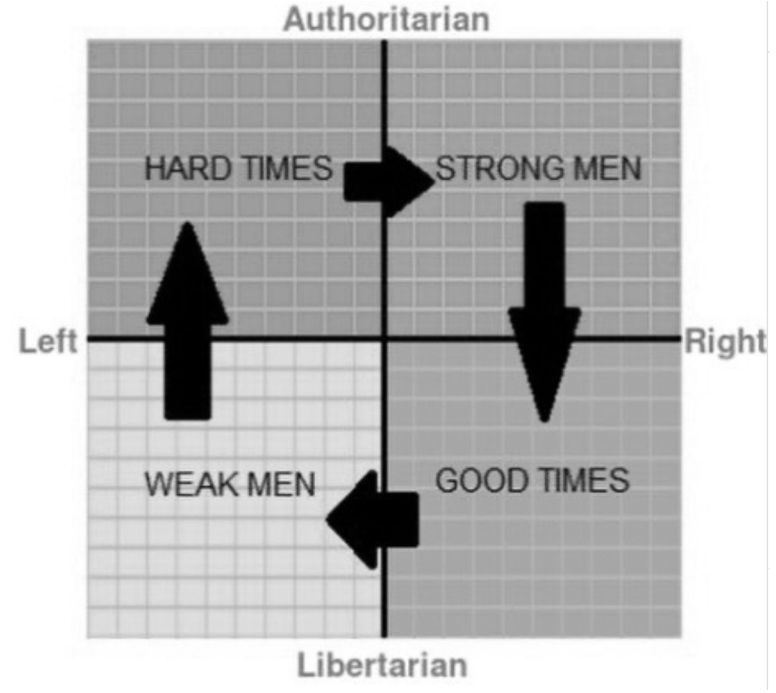
On the same day, OpIndia, an Indian web-magazine accused of pro-Modi disinformation and propaganda, reported that “Joe Rogan, one of the most popular podcasters in the world, has spoken of ‘Kali Yuga’ and Hinduism … Rogan shared a popular meme that describes a cycle of strong men producing good times and good times producing weak men, who in turn produce difficult times, which in turn produce strong men”. Summarising Rogan’s post, OpIndia said, “Describing the current era of political instability and pandemic crisis, he said that the ‘insanity’ we are seeing currently is part of an infinite process.” Marc Tuters and the Open Intelligence Lab have studied the meanings of Kaliyuga as invoked by alt-right internet subcultures and by more mainstream alt-right ideologues and politicians.
Such political narratives draw on the “esoteric fascism” of philosophers like Evola and Guernon to create “alternative histories” in which to place the modern world. They write: “As Roger Griffin notes, many on the European New Right have drawn a theory of history from Julius Evola, choosing to view themselves as dwelling in the apocalyptic Kali Yuga on the threshold of a new golden age of history. As Nicholas Goodrick-Clark notes, in the post-war period, Evola’s ideas became a sophisticated alternative to crude Anglo-American neo-Nazism in which Nazi creed became reformulated as white supremacist ideology.” It is easy to see how the Kaliyuga concept, as articulated by Evola, is attractive to contemporary discourse of multipolarist de-democratisation, since both recast crude fascist ideology in a more sophisticated form, suited to a world audience which is accustomed to democracy.
Advertisement
Tuter observes, “[Evola] turned towards Hinduism … for what he considered to be its strict hierarchical idealism which he saw as fundamentally opposed to the materialism of the modern West. To this end, Evola placed great importance on the traditional Hindu caste system as the basis of his race theory, which he tried to distinguish from the Nazi’s ‘biological conception of race’.”
Analysing research on words and concepts associated with Kaliyuga in the online discourse of the Western far-right, Tuters finds something interesting. It seems that in white-supremacist political discourse, “the Kali Yuga does not signify a decline for all humanity, but rather a failure of ‘The West’ to preserve its own roots and identitarian history”. So, the Kaliyuga is “a call to arms” to the white race; and the warrior-figure Kalki, who liberates the world from the age of degeneration, is meant to “represent the return of the white world to its former status of hegemonic supremacy”. In the online Kaliyuga iconography, Hitler and Donald Trump are represented as “Kalki”, the prophesied tenth and final avatar of Vishnu. In India, Devdutt Pattanaik, a mythologist with a wide readership who is provocative but not Hindu-supremacist, suggests that both Trump and Putin fit the conception of Kalki as a figure who “saves, or rather enlightens, by causing rupture.”

Excerpted with permission from De-democratisation, a Global Story: Script, Actors and Enablers, Kavita Krishnan, Westland.We welcome your comments at letters@scroll.in.


Leave a comment