

The signatories include California’s Ro Khanna, who is returning $6,600 that he ‘recently discovered from a pro-MAGA, billionaire with ties to the RSS’.
Yesterday · 02:24 pmShare
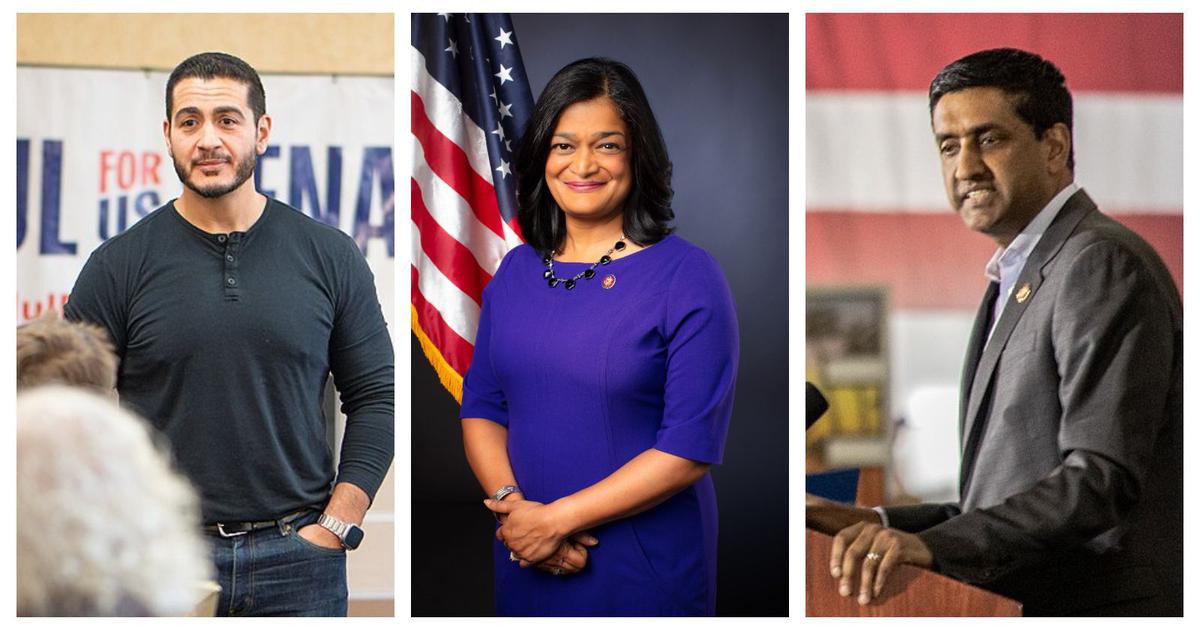
As Rashtriya Swayamsevak Sangh Mohan Bhagwat took the stage at New York City’s Madison Square Garden on Saturday to deliver a message of “universal oneness”, a group of nearly 90 American politicians was preparing a different memo: they would not accept political contributions from entities linked to the Hindutva organisation he leads.
The pledge, announced Monday by Hindus for Human Rights Action and SACRED Acts, commits elected officials and candidates across eight American states to reject contributions connected to the RSS and its affiliates. The signatories include members of Congress, state legislators, mayors, local elected officials and candidates from both Democratic and Republican circles.
Before you scroll further…
Get the best of Scroll directly in your inbox for free.
The six-page pledge also asks politicians to reject political violence and intimidation; and return money from RSS entities and supporters or redirect it to organisations supporting democracy.
Among the most prominent signatories are members of the US House of Representatives Pramila Jayapal of Washington, Ro Khanna of California and Robin Kelly of Illinois. Michigan’s newly-elected Democratic nominee for the Senate race Abdul El-Sayed was among those who signed on, as was New York’s Brad Lander, a Democratic congressional nominee who also attended protests against Bhagwat’s talk in the city on Saturday.
“I’m proud to lead on this pledge and re-assert my commitment to overcome the RSS and their attacks on global democracy,” Khanna said.
Returning contributions
For some politicians, the pledge was accompanied by an immediate financial action.
AdvertisementAd
At the forefront of this was Khanna, who said he was returning a $6,600 contribution he recently received “from a pro-MAGA, billionaire with ties to the RSS”.
Khanna said he would not allow the RSS to “create a PAC or influence elections in the US”, he said. In the US, a PAC or political action committee is a private group that pools money from members, donors or employees to fund political campaigns.
Since he was elected to Congress in 2016, Khanna has had close ties with the Hindu-American community and its advocacy groups.
Early in his political career, for example, he attended gatherings organised by the Hindu American Foundation.
The Hindu American Foundation has opposed efforts to explicitly recognise caste discrimination in US law. However, it describes itself as a nonpartisan Hindu civil-rights organisation and has denied any affiliation with the RSS.
Khanna has also received significant campaign contributions from Hindu-American donors who have supported Hindutva causes.
AdvertisementAd
In 2023, The Nation reported that Khanna – who pushed for Prime Minister Narendra Modi to speak at the American Congress that year – received over $110,000 from Hindutva supporters in the US over the preceding 12 years.
In response to these findings, Khanna said that he had thousands of South Asian donors and did not ask each of them about their views on Indian politics.
The same year, Khanna took a more cautious position on an issue that had become a major fault line between Hindutva organisations and anti-caste activists: California’s Senate Bill 403.
It would have added caste as an explicitly protected category in California’s civil-rights laws. Dalit and anti-caste advocates argued that existing categories did not adequately address caste discrimination and that naming caste explicitly was necessary to make such discrimination visible and enforceable.
Advertisement
Hindu-American organisations, including the Hindu American Foundation, opposed the bill, calling it “discriminatory” and “unconstitutional”.
Khanna did not endorse the bill.
When asked about it in 2023, he said he “strongly opposes any form of caste discrimination” but that legislation needed to be “fairly enforced” so that it did not “selectively profile any community”.
The bill ultimately passed the California state legislature but was vetoed by Governor Gavin Newsom in October 2023, who said existing protections already prohibited caste discrimination.
Days before Bhagwat’s appearance, the US Commission on International Religious Freedom urged the Trump administration to consider sanctions against RSS members and to bar RSS leaders from entering the United States. The commission’s recommendation was non-binding.
Advertisement
Now, the campaign against RSS influence is moving into another arena: American campaign finance.
But this is not new.
SACRED Acts, a collective working to expose “extremist South Asian American groups” in the US, launched its Nonviolence Pledge in Illinois in 2023 with the support of the Indian American Muslim Council, Asian American Midwest Progressives, India Civil Watch International and Hindus for Human Rights. Since then, nearly 90 officials and candidates have signed up across federal, state and local races.
“Over the past decade, in Illinois alone, individuals tied to the RSS have funnelled at least $2.5 million into political campaigns across both parties [Democratic and Republican] promoting their anti-democratic, extremist agenda that does not represent the beliefs of the vast majority of South Asian Americans,” said Pushkar Sharma, the Executive Director of SACRED Acts, in the letter.
Advertisement
The pledge’s organisers say the issue is not confined to whether individual politicians formally accept money from the RSS itself. Their commitment extends to affiliates and individuals they identify as connected to the organisation.
However, tracking how such funds move through American political and social circles is difficult.
Political donations in the United States can move through political action committees, individual donors, affiliated organisations and other entities. In other words, funds connected to the RSS cannot simply be identified by searching a politician’s campaign-finance records for the organisation’s name.
“For far too long, RSS-affiliated organisations and individuals have represented themselves as the only advocates for Hindu Americans in US politics,” said Ria Chakraborty, the Executive Director of Hindus for Human Rights Action. “This pledge and its adoption by almost 100 political leaders is a historic rebuke to the RSS’s misrepresentation of South Asian and Hindu American communities.”


Leave a Reply