

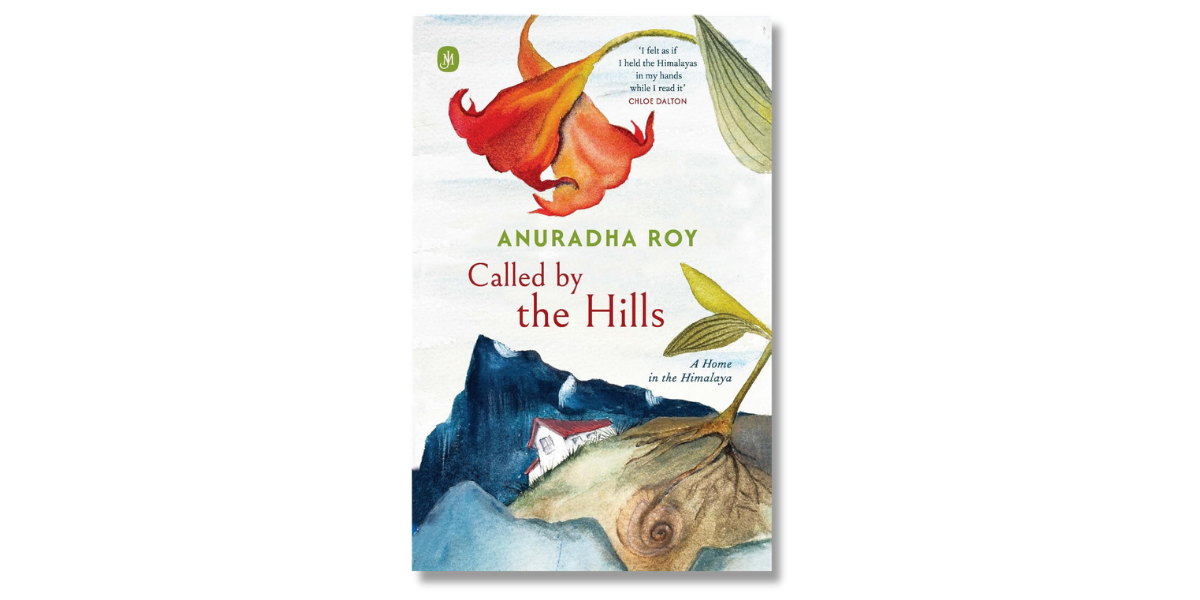
Anuradha Roy’s new book chronicles more than two decades of life in a hill station in the Indian Himalaya, where the pleasures of home and the allure of the mountains are inseparable from ecological crisis

Published:September 04, 2026
0|Share
IN ANURADHA ROY’S novel The Folded Earth, a young woman leaves her home in Hyderabad and moves to Ranikhet, a hill town in the northern Indian state of Uttarakhand, in the wake of a tragedy. For the urbanite, life in the Himalayan town is difficult to navigate at first, but over time she falls into harmony with mountain life and the place’s human and non-human inhabitants.
“Though I cannot know precisely when it happened, a time had come when I became a hill-person who was only at peace where the earth rose and fell in waves like the sea,” Maya, the novel’s protagonist, says.
Roy, in her own non-fictional life, took up residence in Ranikhet more than 25 years ago. Her latest book, Called by the Hills, offers glimpses of this life without fixing a single moment when she, like Maya, became a hill-person. Instead, bit by bit, season by season, we watch her make a home there, growing restless anywhere but in the rugged heights of her small town.
This is Roy’s first memoir, and in it her own existence in the mountains seems incidental; she uses the book as a means primarily to tell stories about the flora and fauna that surround her. It is not a conventional nature memoir about escaping modern life for the wilderness. Roy’s attachment to the Himalaya emerges from entanglement and coexistence – with people, animals, forests, labour and violence. She cautions against separating the beauty of the place from its ecological precarity, caused largely by human forces. By the powerful act of observation, she highlights the dangers of “turning magnificent natural landscapes into rickety urban messes.”
Roy offers a precise point when she and Rukun Advani, her husband and fellow publisher – whom she calls R in the book – decided to leave behind the “neon-lit offices in the slick and shiny publishing house” in Delhi where they worked – along with their “computers, printers, telephones and coffee machines” – and move to the hills.
They had made several trips to Ranikhet before then but had never seen the snowy peaks for which the town is known. That changed on one visit during the monsoon, when they “awoke to long ribbons of sunlight streaming in through the trees in the east.” They charged out of their accommodation and ran down muddy slopes through clusters of trees, leeches attaching to their legs, to get a clearer view of the peaks that had just caught the first rays of the sun.
A derelict cottage on a slope offered the perfect vantage point. They rested against its crumbling walls, taking in the colossus of rock and ice now clearly seen in the distance. A dog wagged his tail in the courtyard. It was then that they knew this ramshackle structure, one of several outbuildings on an estate established in the late 19th century, would one day be theirs. The dog, too, became part of their lives.
During the Covid-19 pandemic, the British publisher Christopher MacLehose suggested to Roy that she write a book on Himalayan flowers so that “imprisoned readers could wander in imagined gardens far away.” No botanist, Roy turned instead to writing about her own garden, which she had been tending and cultivating since she settled there: a “corner of earth where butterflies, bees and birds come, where our dogs like to gambol about in all weathers.” But no garden can be considered in isolation, especially not one that is an extension of an endless forest thrumming with a secret life.
What we get, then, is an expansive book, lush with details about living and working in the Himalaya. Called by the Hills is a wide-angle view of Roy’s world, which she shares with R and the various neighbours, animals and plants that inhabit it. The narrative remains largely confined to her house and its surroundings, but from this patch of land it searches outward, taking in the wildlife and the larger forces that shape their lives, including climate catastrophe and the matter of human sovereignty in the Anthropocene.
As a child, Roy often accompanied her geologist father on field visits. In an interview last year, she said this early exposure to the wilderness might explain her enduring attraction to it. Yet her eventual transition to the hills was fraught with uncertainty and unlearning. Roy, who was born in Kolkata and raised between that city and Hyderabad, realised early on that she and R were “foreigners in the mountains in the way anyone from the plains is.”
IN THE MID-19TH CENTURY, the naturalist Henry David Thoreau moved to Walden Pond in Concord, Massachusetts, in the northeastern United States. He built himself a cabin and famously lived there for two years, two months and two days, paring his life down to the bare necessities. “I went to the woods because I wished to live deliberately, to front only the essential facts of life, and see if I could not learn what it had to teach, and not, when I came to die, discover that I had not lived,” he later wrote in Walden, his account of his stay there.
Roy made no such declarations of subsistence living when she made her own move to the hills. There was no grand gesture of testing any particular way of life either. She found the forests “deep and thrilling”; her decision was “more epiphany than intuition – the unexpected sensation of having seen a better world.”
While I was tempted to read Roy alongside Thoreau, I quickly realised the comparison could stand only so long as it was used to distinguish one from the other. Thoreau exiled himself voluntarily from society; for him, solitude meant keeping fellow humans at a distance, even regarding their company with a degree of disdain. “To be in company, even with the best,” he wrote “is soon wearisome and dissipating. I love to be alone. I never found the companion that was so companionable as solitude.”
Roy, too, cherishes the solitude offered by the hills; she even finds a true kinship with the solitary, unsociable wanderings of the whistling thrush. Her life in Ranikhet, however, unfolds within dense networks of community. Without stating her positions explicitly, she shows how difficult it is to retreat far enough or disengage entirely from society in postcolonial Southasia, where relationships and friendships are less formal than in the West. Never too isolated, neighbours visit and rely on one another. Roy shares a dog with another family, for instance. People seek each other out for wisdom, camaraderie and care.
A nature book can easily become a pastoral paean. In Roy’s hands, however, nature is not merely a pristine site to which we can escape from the grinding discordance of city life. Every page pulsates with sensory detail – sometimes vividly brought to life through her paintings, too – but she is never far from alerting us to the pernicious forces that threaten this landscape. Roy ultimately challenges the idea of nature as refuge by placing it alongside infrastructural collapse, predation and the uncertainty surrounding death and loss.

If we find an idyll in the book, it is only because we see nature as being outside us, rather than as something of which we are a part. Such a separation of nature from humans is exactly what the anthropologist and social scientist Gregory Bateson decried. “We are not outside the ecology for which we plan,” he wrote in Steps to an Ecology of Mind, his seminal 1972 book. In the Himalaya of Roy’s account, it is impossible to maintain a clear distinction between humans and nature. With large-scale construction and habitat loss, people are pushed closer to wildlife, wildlife closer to human habitation, and the forest ever closer to the machinery of human development. To romanticise nature is, ultimately, to misunderstand our place within it – and risk destroying it.
ROY, THE AUTHOR of five critically acclaimed novels, brings a novelist’s gifts for character to Called by the Hills, sculpting rich portraits of friends, neighbours and local acquaintances. She approaches plants and animals with the same, if not greater, curiosity and delight that she affords her fellow humans.
We meet the formidable caretaker of the cottage, whom Roy calls “The Ancient”, who dispenses gossip and old-world wisdom in equal measure. We get to know Durga C Kala – the legendary scholar and biographer of Jim Corbett, the famed British-Indian hunter and naturalist – who hammered out his entire Corbett biography in capitals because he laboured on a typewriter so old its lower-case keys had ceased to function. We are welcomed into the house of an alcoholic neighbour, a place “permeated by the absence” of his wife, and he leaves Roy instructions to take the yellow day lilies and white swamp lilies from his garden and plant them in hers after he’s gone.
Roy occupies a particular position in this ecosystem. She is a writer whose education and economic security afford her the time to observe, garden, write and paint, while neighbours “scratch together livelihoods from serving at hotels or driving tourists around, and to them the whole business of writing books is unfathomable.” The cowherds generally regard Roy’s loitering with some condescension; a woman walking without evident purpose must be “strolling away the days”. In a land of hard physical work, a writer’s existence befuddles. She is aware that she has the extraordinary privilege of experiencing the Himalaya as refuge, landscape and object of contemplation; for many others, it is simply a place of labour and toil.
Roy’s attentiveness does not stop at the human community around her. Some of her most vivid and amusing portraits are of the animals with whom she shares her home, including four dogs. There is Barauni Junction, comically named after a railway station but with a canine personality so winsome that he manages to sow his wild oats wherever he goes. There is also Jerry, who makes up for her diminutive proportions with embarrassingly futile acts of heroism and courage.
But what happens when the animals we encounter are not so easily lovable? In August last year, the Indian Supreme Court ordered authorities in Delhi and surrounding areas to relocate stray dogs to animal shelters, citing a sharp increase in dog bites and rabies cases, including ones leading to fatalities. Animal-rights groups erupted in protest, arguing that the shelters were overcrowded and warning that the order would be disastrous for the animals. The court later modified its order, directing that the dogs should be vaccinated before being released back into their neighbourhoods.
These debates reveal how conditional our love for animals can be. We tend to cherish them insofar as they remain endearing and non-threatening. Roy asks what it would mean to extend such solicitude not selectively but radically, to all animals. She presents a world in which no species can claim sovereignty; where humans co-exist, or ought to, with both the prowling predator threatened by habitat loss and its unsuspecting prey. Roy makes you root even for “scorpions [that] scuttle out of corners and leeches [that] creep towards our legs, each one a little Count Dracula eyeing our ankles as its daily pint.”
THE HIMALAYA stretches for roughly 2400 kilometres across India, Pakistan, Nepal, China and Bhutan. Its glaciers and snowfields form one of the world’s largest concentrations of ice outside the polar regions, and feed rivers that sustain millions of people and myriad ecosystems. Rising temperatures and accelerating ice loss here threaten not only weather systems but also large swathes of socio-economic and emotional landscape. In 2021, an ice-rock avalanche in Uttarakhand triggered a devastating flash flood that killed more than 200 people. Over the last few months, large parts of the Himalayan region, including Himachal Pradesh, Jammu and Kashmir and Uttarakhand, have experienced unusually low snowfall. Last week, a glacial shelf broke off Langtang Lirung, causing a devastating flash flood at the Nepal–Tibet border and along the Bhotekoshi River that has claimed over a thousand lives, with thousands more still reportedly missing. It was one of the deadliest and most catastrophic disasters to strike the Himalaya in decades.

The hand of man is especially stark in the hills. A few years ago, the Indian government planned a giant concrete water pipeline through vast stretches of Ranikhet’s forest. Several trucks brought in labourers, who worked tirelessly for two years. They cut dead branches from the trees to make small fires to cook and keep themselves warm. Every day trucks laden with construction material thundered past. Sounds of drilling reverberated in the air. Something in the region fundamentally changed after they left. Flying squirrels that once glided between oak and cedar trees vanished. A little later, the foxes disappeared too. “Wild animals don’t believe in long goodbyes,” Roy writes. “They disappear without a rustle of leaves.”
Called by the Hills is unsparing in its account of this violence. Roads, hydroelectric projects and deforestation have stripped Himalayan hillsides bare. Winters are shorter and drier; peaks that once gleamed white are now black and bare through summer. Forest fires, too, have become an increasingly familiar part of life in Ranikhet, burning through the dry undergrowth and threatening the fragile habitats that surround the town.
Roy is not prescriptive about the dangers of ecological collapse; her quietness is her ethic, her strength. She places her faith in observation and attention, which are, after all, the truest measures of care. We care because we love and we protect what we love. But is observation enough to staunch the accelerating tide of environmental destruction in the Himalaya and across Southasia?
It would be unwise to dismiss its power. But it would also be unwise to dismiss the use of writing. Writing is an act of activism; it is political, even polemical. The best nature writing gives us a different way of looking at the world. The Romantic poets, for instance, were not merely wanderers in the natural world; their writing emerged amid profound transformations brought about by industrialisation and helped reshape how nature itself was understood. Roy’s writing forces us to pay attention to the threats facing the Himalaya. Making us look closely, and making it harder to look away, is itself her triumph.
THE BRITISH loved Ranikhet. They set up the town as an army cantonment, a retreat and a sanatorium, building houses in the 19th century as convalescence homes for their troops. Roy subtly evokes the remnants of colonialism in the “shabby grandeur” of these houses. The history they embody has become hazy for many locals, who have only “a vague sense of where the Angrez [British] had actually come from” even as they remain certain that Gandhi “sent them packing back there”. History has blurred but the architecture holds out.

Ranikhet is still a cantonment town, where “olive-green trucks rumble down our narrow roads, helicopters hover over the forest, sirens, bugles and gunshots sound throughout the day as soldiers are trained here in modern warfare.” The landscape now exists alongside the machinery of a country perennially riddled with anxieties over geopolitics and military preparedness.
Even without human interference, nature is not bereft of violence. As the nature writer Robert Macfarlane reminds us, “not everything in the forest is lovely.” Despite this knowledge, or perhaps because of it, the human impulse to seek out such terrains persists.
As a potter, Roy understands this pull. She knows intimately the texture of earth in her hands, how it can be spun and folded to give physical form to what sits in the imagination. Her attentiveness to soil also extends to the microscopic life within it, including research into the effects of soil bacteria on human wellbeing. What might seem like an inert patch of earth is, in Roy’s account, alive with unseen processes. Called by the Hills is similarly attentive to what modern life risks losing when it tries to tame the land.
Importantly, Roy makes no claims of nature being a spiritual entity in the manner of transcendentalists such as Thoreau and his mentor, Ralph Waldo Emerson. She does not sanctify the natural world but reaches for the ineffable nonetheless. “For the unreligious, the divine is closer. We can see it sometimes, just outside the window.”
While reading this book, I found myself asking: why choose a life where you have to scamper back home at sundown to avoid becoming leopard food? Why live where landslides can nearly kill you? Why leave behind creature comforts and let mountains pull you up, even if momentarily, in defiance of gravity?
Roy offers an answer: “A few find that the forest changes something inside them for good: no other place, however beautiful or exciting, will ever mean to them what the Himalaya does.”
In inviting us to pay close attention to what is around us, Roy implicates us all in the wider ecological crisis. But that implication is also liberating: if we are entangled in the worlds we are destroying, we are not powerless before them. What she finds in the Himalaya is not a refuge from the world but a way of being in it, and of seeing ourselves as a part of it. It is not the grandeur of the Himalaya alone that creates this attachment, but also the accumulation of small, sensory pleasures that become inseparable from a sense of home. “The murmur of raindrops on a tin roof, the dry spells when the hills were honey-coloured in the newly washed air: what more could you ask for?”
Keep us fighting for good journalism!
Every piece of Himal’s journalism – every investigation, essay, podcast, review and more – is the product of fearless reporting, rigorous editing and a newsroom that gives demanding stories the time they deserve. In a region where political interference and corporate capture have strangled media independence, that kind of journalism does not happen by accident. It happens because readers like you choose to fund it.
Himal has spent almost four decades covering Southasia as no other publication does – without a national agenda, without corporate owners pushing their own interests, without the pressure to oversimplify what is complex or ignore what is inconvenient. Our small team spread across the region is counting on you to keep us fighting.BECOME A PATRON


Leave a Reply