

In India, English philosopher Edward Carpenter found ideas of equality and social justice that echoed the socialist convictions he had developed in Britain.
Aug 31, 2026 · 11:30 amShare
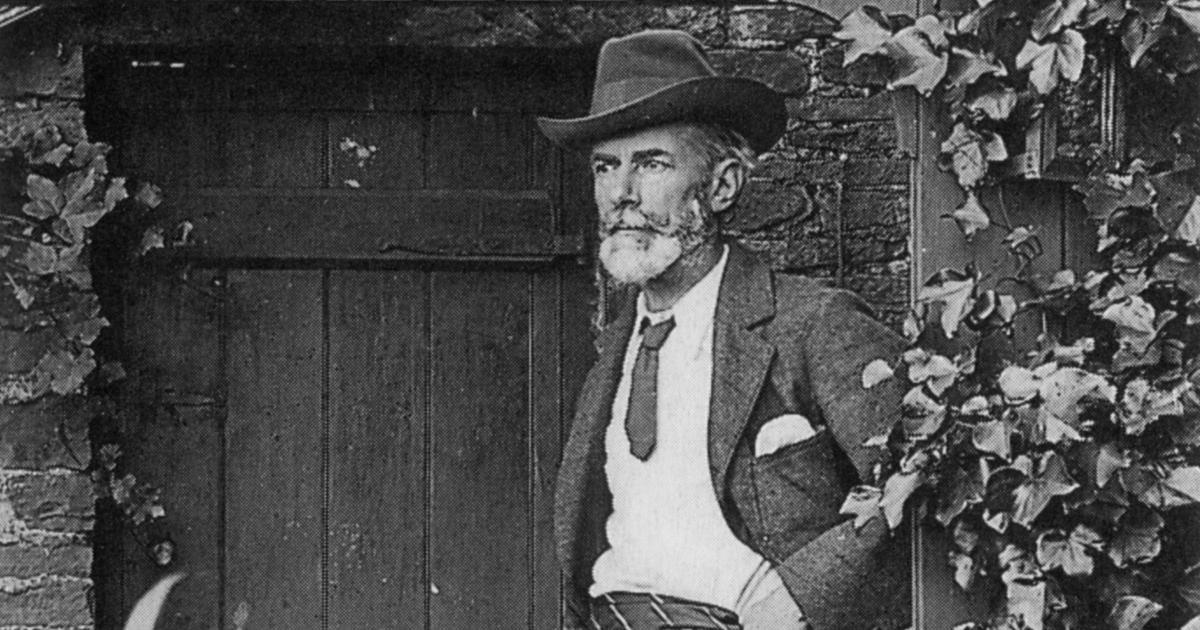
When Edward Carpenter arrived in Madras in 1891, he quickly discovered that being an Englishman in India came with a price. There were servants to employ, hotels to stay in and a standard of life to maintain.
Carpenter, a 46-year-old poet and philosopher, thought the whole arrangement was absurd. Using the term “John Bull”, a natural personification of England in political cartoons, he said his compatriots paid “through the nose” to maintain their privileges.
Before you scroll further…
Get the best of Scroll directly in your inbox for free.
His own experience was hardly reassuring.
“As to the boatmen and drivers and guides and servants generally, they torment one like gadflies; not swindling one in a nice open riant way like the Italians of the same ilk, but with smothered dodges and obsequious craft,” Carpenter wrote in his 1892 book From Adam’s Peak to Elephanta, an account of his travels in Ceylon and India.
He complained about his last hotel in Madras, calling it “odious” with a “lying Indian manager” and “cringing servants”, including “an idiotic old man” who acted as his “boy” and tormented him by fiddling around with his slippers and holding a towel in readiness while he was washing his face.
But Carpenter was not merely an irritable traveller complaining about service. He was a socialist who had come to India with a growing suspicion of the social order that produced the English sahib in the first place.
Advertisement
He repeatedly mocked John Bull, the Englishman who believed that his status depended on maintaining a particular lifestyle.
“Half believing in the idea that as sahib and ruler of the country he must live in such and such style, have so many servants, etc., or he would lose his prestige, he acquiesces in a system of impositions; he is pestered to death, and hates it all, but he must submit,” Carpenter wrote.
He had a simple solution for fellow travellers from England. Stop behaving like sahibs.
“There are however in the great cities of India little hotels kept and frequented by English folk where one is comparatively safe from importunities; and if you are willing to be altogether a second-rate person, and go to these places, travel second class by train, ride in bullock-hackeries, and ‘undermine the empire’ generally by doing other such undignified things, you may travel with both peace of mind and security of pocket.”
Advertisement
For Carpenter, travelling rough in late 19th-century India was about more than saving a few coins. He wanted to be closer to the working classes of the country, in keeping with the ideas he had developed in his four-volume prose poem Towards Democracy, which was published in parts from 1883 onwards.
Class anxiety
Born into an upper-middle-class family in the seaside town of Hove in 1844, Carpenter excelled in his studies at Brighton College and later studied mathematics at Cambridge. He remained at the university as a lecturer and joined the Church of England as a curate, a position roughly equivalent to that of a parish priest.
But Victorian England’s rigid class system increasingly troubled him. Unhappy with the church and the academic environment, Carpenter found resonance in the works of the great American poet Walt Whitman.
“I do not think any others of the poets – unless Plato should bear that name – have deeply influenced me,” Carpenter wrote in his autobiography My Days and Dreams.

After leaving Cambridge and the church at the age of 30, Carpenter aimed to become a writer. “I believe I felt that I really had something to write, that I must write, though certainly my mind and purpose was vague as yet; and for a time (though only for a short time) that I may make a living by writing,” he wrote.
Advertisement
Financial difficulties led him to become a lecturer as part of a movement to spread education to working-class adults. Living in different parts of Britain over the next few years, he began writing poems and essays about social equality, spiritual awakening and inner transformation. It was during this period that he helped build the Sheffield Socialist Society and lectured extensively about socialism.
Then, in 1881, the death of his mother became one of the main turning points in his life.
“Her death at this moment exercised perhaps a great etherializing influence on my mind, exhaling the great mass of feelings, intuitions, conceptions and views of life and the world which had formed within me, into another sphere,” Carpenter wrote in his autobiography. “The Bhagavat Gita at the same time falling into my hands gave me a keynote.”
Carpenter said he found himself in “a mood of exaltation and inspiration” and a “kind of superconsciousness” that surpassed everything he had felt before. The result was Towards Democracy.
Advertisement
The Bhagavad Gita had come to him through Ponnambalam Arunachalam, a student at Cambridge who would go on to become one of Ceylon’s most illustrious civil servants. Carpenter and Arunachalam remained close friends after the latter returned to Ceylon and continued to correspond through letters.
It was Arunachalam who eventually told the poet about a “gñáni” from whom he had learned a great deal and invited Carpenter to Ceylon to meet him.
Nearly a decade later, Carpenter made the journey.
Eastern turn
In 1890, he travelled by steamship through the Suez Canal and on to Colombo, from where he disembarked for a journey across the island.
“As far as actual experience of life in Ceylon and India is concerned I have perhaps been fortunate; not only in being introduced (through the kindness of local friends) into circles of traditional teaching which are often closed against the English, and in so getting to know something of the esoteric religious lore of South India; but also in obtaining some interesting glimpses behind the scenes of the Hindu ceremonial,” Carpenter wrote in the preface to From Adam’s Peak to Elephanta.
Advertisement
Arunachalam made arrangements for his English friend to meet his spiritual guru, the “gñáni” Sri Arulparananda Swamigal, born Ramaswami Pillai, who had served as an adviser to the last king of Tanjore.

The philosopher-poet took an instant liking to the guru, who was “sojourning” in Ceylon at the time.
“As I say, he was in some respects a high type of pre-civilization man,” Carpenter wrote. “For, like most men of this class in India, he identified himself so closely with the ancient religious tradition that one could almost feel him to be one of the old Vedic race of two thousand or three thousand years back. His modes of thought, appearance, personality, all suggested this.”
For Carpenter, meeting Arulparananda was a chance to encounter what he saw as an older way of thinking about human existence. “And here in this man it was of absorbing interest to feel one came in contact with the root-thought of all existence – the intense consciousness (not conviction merely) of the oneness of all life – the germinal idea which in one form or another has spread from nation to nation, and become the soul and impulse of religion after religion.”
Advertisement
The guru also had his own views on British rule.
Having worked as an adviser to an Indian princely state, he had informed opinions on the colonial regime. He told Carpenter that British rule under the Crown was worse than it had been during the days of the East India Company, calling it “feeble with no policy of any kind except of the money bag”.
Carpenter was impressed by the criticism. He already believed that “mere commercialism” was driving British policy at home and abroad and that Britain followed what he called the “nation of shopkeepers theory of government”.
The poet acknowledged that one could argue with the guru on matters of modern science or politics. But he felt that Arulparananda and his predecessors possessed an outlook and intuitions that “the modern might truly envy”.
His observations of India had already led him to think about the spread of Western ideas. Urban India, he noted, comprised only around 10% of the population but was moving towards commercialism and Western education and ideas.
Advertisement
“I had no idea, until I landed, how Western ideas and education have, of late years, overrun the cities and towns, even down to the small towns of India; but I was destined to be speedily enlightened on this subject,” Carpenter wrote.
Yet he did not simply see this as the replacement of one system by another. As someone who had spent years thinking about the “commercial and competitive order” of British society, he felt Englishmen would have to understand India’s caste system and rural social order to make sense of the growing attraction of commercialism. Carpenter believed that commercialism would not obliterate India’s social ills but could help reduce them, and that the movement would run its course in India quickly.
His conversation with Arulparananda took him in a different direction and he became convinced that Hindu philosophy and socialism were not as far apart as they might initially appear. The guru told him that a king was merely a representative of Lord Shiva. “He is nothing in himself – no more than the people – his revenue is derived from them – he is elected by them – and he is in trust to administer justice – especially criminal justice,” Carpenter quoted the spiritual leader as saying.
Arulparananda then told Carpenter about a bell that had once hung in the courtyard of the palace in Tanjore. Subjects could ring it whenever they wanted the ruler to hear a grievance.
Advertisement
For Carpenter, the story neatly connected the spiritual and the political.
“Justice or Equality is the special attribute of God; and he who represents God, i.e. the king, must consider this before all things. The same with rich people – they are bound to serve and work for the poor from whom their riches come,” the guru told him.
These words, which Arulparananda repeated many times, convinced the English poet that the man could almost have been claimed as a socialist.
He added that the guru “certainly was a Socialist in the heart of the matter; and at any rate this teaching shows how near the most ancient traditions come to the newest doctrines in these respects, and how far the unclean commercialism out of which we are just passing stands from either”.
Carpenter would look back on the journey a decade later in his autobiography. “After seeing Whitman, the amazing representative of the same spirit in all its voluminous modern unfoldment – seven years before – this visit to the Eastern sage was like going back to the pure lucid intensely transparent source of some mighty and turbulent stream,” he wrote. “It was a returning from West to East, and a completing of the circle of the Earth.”
Ajay Kamalakaran is a writer, primarily based in Mumbai. His latest book, Colombo: Port of Call, has been published by Penguin Random House.We welcome your comments at letters@scroll.in.


Leave a Reply