


18 hours ago
5 min read
This is the second part of the article .The first part follows here after this second part
As the streets of Delhi are decked up with BRICS hoardings, and as we are (presumably) gearing up to hide our own gross inequities with green screens, it is imperative that we point at this silence on addressing inequality.
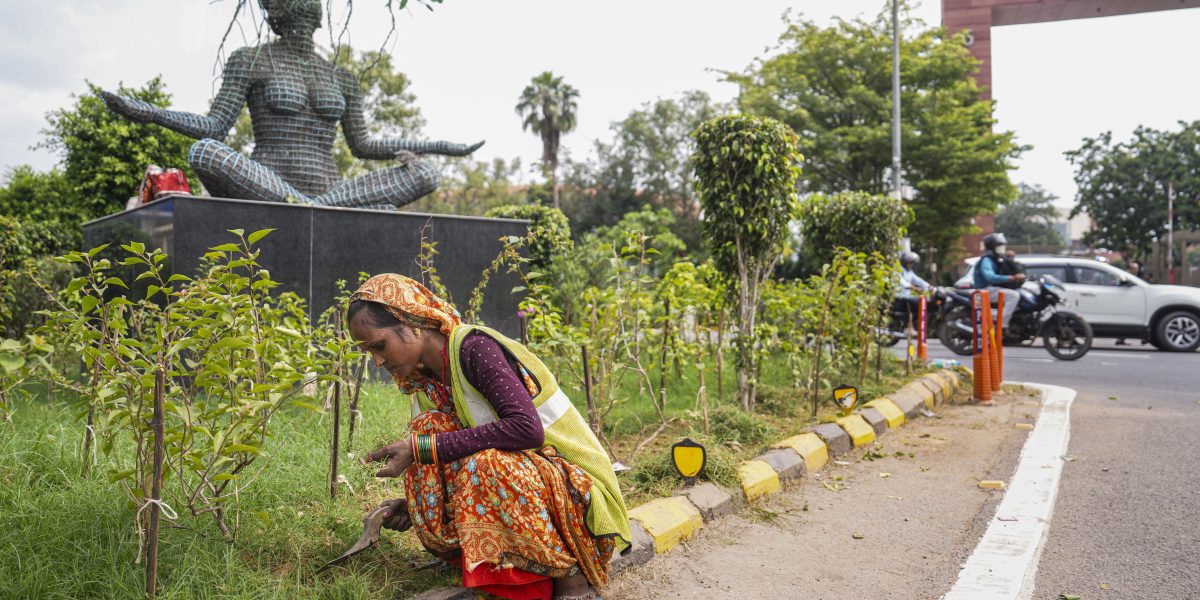
A NDMC worker carries out beautification work near Bharat Mandapam ahead of the 18th BRICS Summit, scheduled to be held on Sept. 12th to 13th, in New Delhi, Wednesday, Sept. 2, 2026. Photo: PTI.
One of the byproducts of the era of big tech has been extreme inequality. While almost all of the major players – Google, Meta, Apple, Amazon, or Microsoft – are all based in the US, the Global South countries constitute a major share of their market. So, even though the digital giants may not have a lot of physical footprint in terms of their establishment in the country where they operate, these countries are where they generate a major share of their profits.
As such, why should the country of residence pocket all the taxes? Are they not robbing us of our legitimate taxes?PlayNextMute
Current Time 0:04
/
Duration 2:04Fullscreen
Advertisement
Advertisement
These are questions that have been raised in recent years in multilateral platforms globally. Similarly, by simply offshoring their profits to a sister company housed in a low-tax jurisdiction, they are able to avoid paying legitimate taxes in the developing countries. If we truly are a credible voice of the Global South, as the government claims, one wonders as to why such issues of gross inequities and open loot of our legitimate share never become central issues in the multilateral mega events we host? The upcoming BRICS summit being no different.
Let’s not forget that the age of Artificial Intelligence is only going to further widen the gap as has been the warnings from several credible corners. Even the UN Secretary General has voiced apprehensions as to whether AI will aid in concentrating resources in the hands of a few. Developing countries have long relied on taxing labour and wages, and in India, income tax has now overtaken corporate tax collections for the first time. As AI replaces jobs, that labour tax base will keep shrinking, even as profits concentrate in a handful of AI firms that pay almost nothing. Palantir, the AI firm that has been aiding Israel in its genocide in Gaza, posted a 93% revenue jump in early 2025 with a global effective tax rate of just 1.4%. Some countries are looking for new answers. South Korea, for instance, has floated a “national dividend,” taxing AI-driven corporate profits to fund basic income, pensions, and support for workers displaced by automation.
But what about global tax justice? There are three big questions at the heart of today’s global tax fight: where should companies pay tax? Where they’re headquartered, or where they actually earn money? How do we stop them from hiding profits in tax havens? And who gets to decide the rules? A rich-countries’ club like the Organisation for Economic Co-operation and Development (OECD), or every country as equals? The OECD, after years of foot-dragging, has failed to yield anything substantive. Even the 15% global minimum corporate tax that it patted its own back for has been sidestepped by the US, as it has browbeaten others into not taxing its multi-national companies. It’s referred to as the “side-by-side” package. Frustrated with the OECD, developing countries pushed tax talks to the UN, where every country gets an equal vote instead of rich nations calling the shots. The US walked out of it on day one, in February 2025, refusing to even participate. Some, in fact, thought it was “good riddance”.
What has been the role of BRICS in all of this? Well, it has backed the UN process politically, welcoming it as a more democratic site. At the 17th BRICS Summit in Rio de Janeiro, July 2025, the leaders’ declaration welcomed a BRICS Joint Statement in support of the United Nations Framework Convention on International Tax Cooperation, issued by the BRICS Finance Ministers. But at the same time, unlike the African nations, it has not really proactively committed to or pushed any specific fix like unitary taxation or a global wealth tax. India’s own position has been blatantly contradictory. It champions fair global taxation at the UN, arguing that source countries deserve their due. And yet at home it scrapped its own “Google tax” 2024-25 in the face of US tariff threat. And then handed foreign cloud and AI companies a 21-year tax holiday running from 2026 to 2047! This isn’t just declining to tax foreign digital revenue, it’s actively subsidising it via forgone tax on AI infrastructure investment.
Advertisement
Also read: The Lethal Policy Choice of Inequality: How India’s Super Rich Rule Over Democracy
In an Age of Inequalities, we cannot afford to have such self-defeating and lukewarm approaches. What we need is a fundamental challenge to a system that thrives on extraction and exploitation at one end and concentration at the other. The Independent Commission for the Reform of International Corporate Taxation, led by economists including Joseph Stiglitz, Thomas Piketty, and Gabriel Zucman, has proposed taxing multinationals as one single global company so that they cannot park their wealth at tax havens. They have proposed splitting profits by where real economic activity happens instead of the home country of MNCs, alongside a 25% global minimum tax and a 2% wealth tax on billionaires and the ultra-rich!
The apathy we see in our approach to global inequalities and multinational corporations also reflects in our approach towards the question of inequality at home and the hyper concentration of wealth in the hands of high net worth individuals. Among the BRICS countries, in India we are witnessing one of the fastest rate of concentration. The BRICS Wealth Report 2024 revealed that between 2013-2023, private wealth grew by a remarkable 92% in China, followed by India in the BRICS High-Net-Worth Individual ranking, with 326,400 millionaires, including over 1,000 centimillionaires and 120 billionaires, and wealth growth soaring by 85%. The Wealth Tracker India 2026 underlined how the super rich in India are amassing wealth at an astronomical rate while the other India is struggling with stagnating incomes, rising debt, and joblessness. UAE and Saudi Arabia also saw upward trend. Among the original members, most however, have seen a decline in their millionaire populations since 2013, ranging from a drop of 20% in South Africa, a decline of 28% in Brazil and that of 24% in Russia. The report also predicted that when it comes to private wealth growth projections, India leads the BRICS pack with a forecast 110% increase in wealth per capita by 2033.
Also, it’s worth noting both Brazil and South Africa have been far more vocal than India on the question of wealth concentration. In Brazil, Lula’s government pushed a 2% global minimum tax on billionaires at the G20 in 2024. Even domestically, Brazil has more redistributive infrastructure already in place (Bolsa Família) even without a formal wealth tax. South Africa too, under Ramphosa, in the G20 2025, constituted the “Extraordinary Committee of Independent Experts on Global Inequality” chaired by Nobel laureate economist Joseph Stiglitz, that delivered the first-ever G20 report on global inequality in November 2025. The committee included Jayati Ghosh, Winnie Byanyima, Imraan Valodia, Adriana Abdenur, and Wanga Zembe-Mkabile. China, which in any case has a massive state presence, is also known to have been aggressively cracking down on billionaires, tech moguls, and high-income elites through sweeping regulatory curbs, and aggressive retroactive tax enforcement. Compared to several of these BRICS members, in India we have seen quite the opposite. We have seen wealth tax being abolished and corporate tax being slashed substantially in recent years and massive write offs and haircuts being allowed to big corporates.
As the streets of Delhi are decked up with BRICS hoardings, and as we are (presumably) gearing up to hide our own gross inequities with green screens, it is imperative that we point at this void, this lukewarm approach or silence on addressing inequality. That’s what the People’s BRICS Delhi Declaration highlighted after the two day Dialogue Summit (August 21-22). It foregrounded the demand for “Progressive and redistributive taxation, including effective taxation of extreme wealth, high incomes, inheritance and corporate profits, alongside stronger international cooperation to curb tax avoidance, illicit financial flows and the use of tax havens.”
Advertisement
Tackling inequality is not merely an economic choice. Because if we don’t do it, we will also corrode democracy and accountability. We must demand that the super-rich and the corporates be taxed such that we can spend more on health, on education, on social welfare, on climate adaptation, and public infrastructure. That’s one way of balancing the scales both globally and within. That’s also a way of foregrounding structural questions on equity and opportunity, instead of the rhetoric of hate and demagoguery that subsume all substantive questions of democracy.
Anirban Bhattacharya writes on socio-economic issues, democratic rights and inequality and is associated with the Centre for Financial Accountability.
This article is part of a series on BRICS and Global South cooperation curated by The Wire and the Centre for Financial Accountability (CFA). Read part one here.

SECOND PART
Separately Together: What Keeps the BRICS Alive at 20?
07/Sep/2026
5 min read


Internal asymmetries between BRICS countries have increased in the last decade.
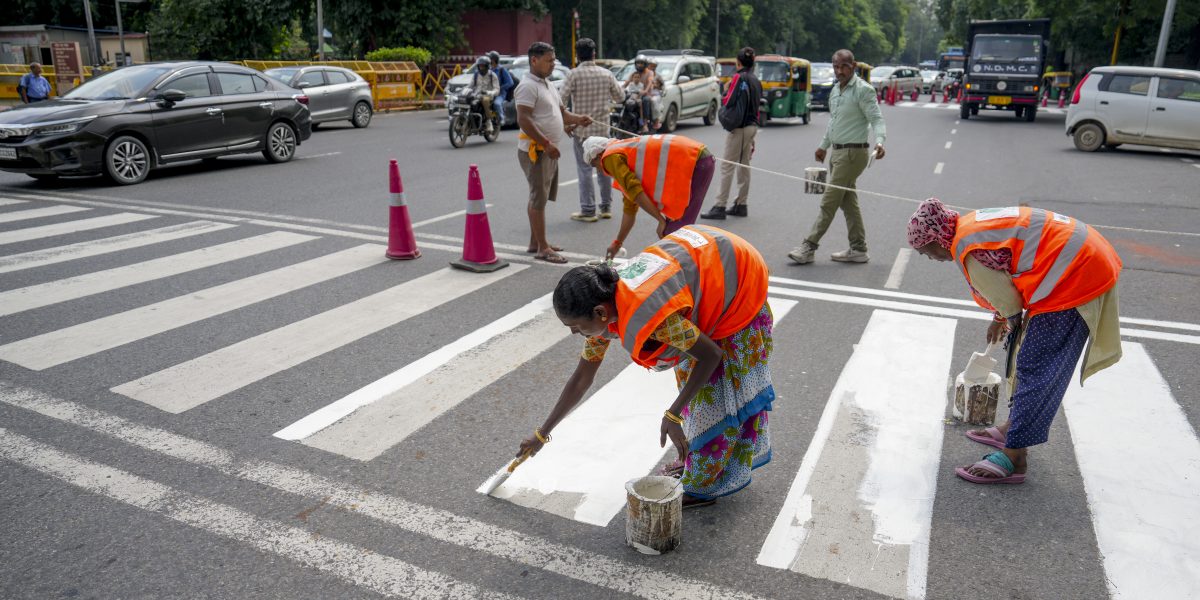
NDMC workers mark zebra crossings at India Gate circle ahead of the 18th BRICS Summit, scheduled to be held on Sept. 12th to 13th, in New Delhi, Wednesday, Sept. 2, 2026. Photo: PTI.
BRICS+ meet in New Delhi for their annual summit at a time when two of their members are in a kinetic war (Russia and Iran), two seek to define their troubled relations (India and China), all prepare for rough external headwinds of global multi-crises where financial, energy, climate top the long list, and one angry hegemon with its wounded proxy is on the prowl.
Twenty years after its foundation (2006) the BRICS operates in a radically different international system. One which is in transition from a unipolar system with US hegemonic presence is giving way to a multipolar one, albeit with a weakened but dangerous superpower seeking to revive its predominance. The BRICS have actively engaged in constructing multipolarity despite contradictions between the BRICS countries and the pressures and comprises between the BRICS and the US. These contradictions determine BRICS’ trajectories. PlayNextMute
Current Time 0:05
/
Duration 2:04FullscreenBackward Skip 10sPlay VideoForward Skip 10s
Advertisement
Internal asymmetries between BRICS countries have increased in the last decade. China dominates all others in manufacturing, AI technologies, trade, and military capabilities. These imbalances create hierarchies in inter-BRICS relations. The US’ recognition of China as ‘near peer’ and its offer of ‘G-2’ relationship has translated as a ‘constructive strategic stability’ for the country which lowers others in the BRICS hierarchy. The unresolved issues between China and India come in the way of cohesive relations within BRICS. Further, India’s strategic lending of itself to the US, to balance with China, leads to suspicions. Similarly, the antagonistic relations between Iran and the UAE – both new members of BRICS – which prevented a joint statement of the foreign ministers of BRICS earlier in the 2026 foreign ministerial meeting – remain a roadblock to consensual joint declarations.
The US problem
The BRICS countries have different approaches on US hegemony. Russia is engaged in a proxy war with Ukraine, which is in turn supported by the US. Despite some diplomatic measures between Presidents Putin and Trump (their Anchorage meeting, telephone conversations and engagements with Trump’s envoys) relations between the two are tense and Russia is in indirect conflict with the US.
The US sees China as its most significant and longstanding threat. They are in a political, economic military competition in the Pacific, over Taiwan along with technology, trade and resources. China envisages a direct challenge to the US hegemony. India does not even use the word ‘hegemony’ for the US in official foreign policy statements, and talks of ‘multipolarity’ and ‘dominant power’. India is committed to strategic engagements with the US but wants the benefits of choice in a multipolar system and with BRICS.
Advertisement
Brazil tries to challenge US hegemony without confronting it and talks of reducing ‘structural dependence’ on the US. South Africa speaks of US as a ‘dominant power’ and its policy has a distinct anti-apartheid and anti-colonial thread. As a collective, BRICS statements do not name the US but critique “unilateralism” (Kazan, 2024) and oppose and hegemonism (Johannesburg, 2023).
Multipolarity, money, and India
Multipolarity is the underlying theme in all of BRICS documents and approaches. However here too, there are differences. India simultaneously speaks of both a multipolar international system and the need for a ‘multipolar Asia’ pointing to their concerns about the asymmetric power balance with a dominant China in Asia (which it can do little to address).
Also read: How India’s Strategic Tilt Towards the US Faces an Indifferent Washington
China and Russia lead the debate on multipolarity. While Brazil and India push for reforms in the UN Security Council and Bretton Woods institutions, Russia and China are already veto-carrying Security Council members. Epistemic differences within BRICS have been summed up by Xi Jinping who has called the idea of universalising liberalism as an authoritarian tendency as China promotes the global security and global development initiatives. The others see modernisation as de-westernisation underpinned by western techno-capitalist structures.
Advertisement
The major BRICS institutions – the New Development Bank and Contingent Reserve Arrangement – never presented themselves as alternatives, but as add ons for global finance where the IMF remains at the centre. In lending, China gives priority to its own banks, and supports conditions imposed by IMF. The NDB also does not have a history of lending to the poorest countries.
Important agenda items in this summit are the steps for adopting central bank digital currencies (CBDC) and measures to operationalise a cross-border digital payments system. China, India and Russia are running pilot projects in inter-operability of banking to make these digitally compatible. The Reserve Bank of India (RBI) is also examining the adoption of CBDC.
Proposed at earlier BRICS meetings, the cross border payment system is a fast system between banks that would reduce transaction financial costs and boost trade between the 11 BRICS member countries. This mechanism – similar to the western controlled SWIFT – is a parallel system that can bypass western sanctions. Both these systems target no other country, are optional and voluntary financial logistics services. BRICS countries already have this service internally like India’s UPI, China CIPD, Russia SPFS, Brazil’s Pix. This system is limited as a financial infrastructure and has nothing to do with de-dollarisation.
There is no significant substance to the conversation around de-dollarisation. The share of the dollar in global central bank reserves according to IMF Cofer [Currency Composition of Official Foreign Exchange Reserves] data in the first quarter of 2026 is at 57.13% (down from the 71% peak in 2000) and remains dominant even though there are some dents as countries increasingly use national currencies in bilateral trade. Further, the value of these currencies are pegged to the US dollar. So BRICS is creating a parallel lane for trade while the overall paradigm of the global financial architecture remains the same. The dollar remains the strategic reserve despite the US weaponising it. So, BRICS will call for more balanced and mutually cooperative trade, in keeping with its hallmark.
Advertisement
So what keeps this heterogenous grouping – who talk of multipolarity, oppose unilateral economic measures, and take steps for plural multilateralism, and whose members all negotiate with the US separately – together? It is the constant engaging, finding consensus, agreeing to disagree unlike the military interventions and unilateral tariffs backed by military blocs, that continue the method of old but not forgotten empires.
Anuradha Chenoy retired as professor and former dean, School of International Studies, JNU, Delhi.
This article is part of a series on BRICS and Global South cooperation curated by The Wire and the Centre for Financial Accountability (CFA).


Leave a comment