

06/Sep/2026
5 min read


Elections, however regular, cannot sustain democracy if social hierarchies continue to deny dignity and equal opportunity to large sections of society.
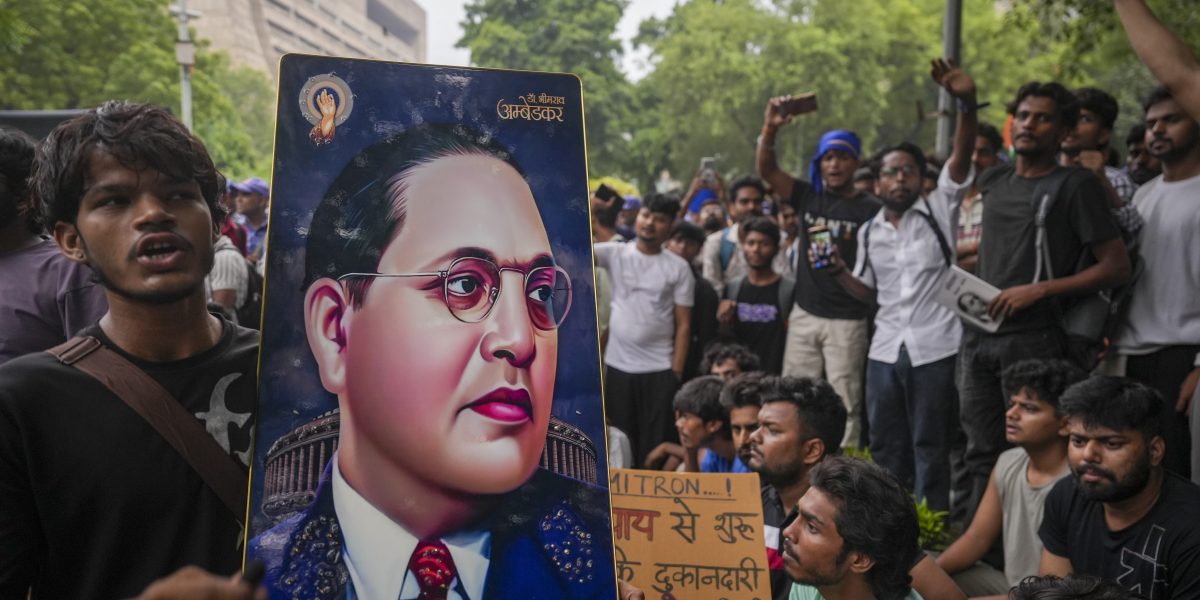
A Cockroach Janata Party (CJP) supporter holds a portrait of Dr Bhim Rao Ambedkar, as supporters gather during a protest march, at the Jantar Mantar, in New Delhi on July 20, 2026. Photo: PTI/Karma Bhutia.
Since the Constitution came into existence, India has experienced a persistent crisis of democracy, irrespective of the political parties in power. One of the deepest structural causes of this crisis is the caste system, historically rooted in the Hindu social milieu, which continues to shape social relations and access to power.
Dr. B.R. Ambedkar’s effort to bring justice, liberty, equality and fraternity into the constitution is diametrically opposite to the caste system. The Constitution is an excellent document that could function as a hand book for an elite society. Unfortunately, Hindu India was not prepared to accept the logistics of democracy and undo the inequality built into the caste system. Shudras and Dalits were prohibited from acquiring land, wealth, and education as per Hindu shastras. Therefore, the Constitution did not matter much to their lives. PlayNextMute
Current Time 0:32
/
Duration 2:04Fullscreen
Advertisement
Advertisement
The fundamental rights surely gave rights to the oppressed. Article 14 guarantees equality before law. Article 15 prohibits discrimination on grounds of religion, race, caste, sex, or place of birth. Article 16 ensures equality of opportunity in matters of public employment. These rights, read together with the preamble and the directive principles of state policy, provide a vision of a society free from exploitation and upholding the dignity of every human being.
Democracy beyond elections
India is frequently celebrated as the world’s largest democracy. Since Independence, it has sustained universal adult franchise, periodic elections, peaceful transfers of power within a constitutional framework. These achievements are no less important in a nation marked by immense linguistic, religious and cultural diversity.
Yet, democracy cannot be reduced to elections. Electoral competition is only one dimension of democratic life. Democracy becomes meaningful only when citizens enjoy equal opportunities to participate in public life and influence collective decisions. The distinction between procedural democracy and substantive democracy is therefore crucial. Procedural democracy ensures the right to vote; substantive democracy ensures that every citizen possesses equal dignity, equal opportunity, and equal access to justice. The crisis of Indian democracy emerges precisely from the widening gap between these two ideals.
Ambedkar and the democratic revolution
India became a republic on January 26, 1950. The written Constitution was adapted and at the implementation level, all the coveted posts were occupied by the privileged caste people. Ambedkar had expressed deep apprehension that political independence, without social transformation, could leave entrenched caste hierarchies substantially intact.
Advertisement
Periyar E. V. Ramaswamy said that ‘After India was freed from British rule power was transferred into the hands of Brahmins’. Ambedkar’s campaign for the annihilation of caste did not achieve its intended result. It was his biggest disappointment. By that time, the Shudras, who were in the majority, had acquired some lands and properties and also indulged in some small-scale trading. The Vysyas, being less in number, had parted with their customs to dis-burden themselves. There were agitations and movements by members of the Shudra community in some pockets of the country. But the Dalits, the so-called untouchables, were left in the lurch. Their status quo remained as such intact.
Brahmins and members of the dominant caste held power, both at the union and state levels, across the key institutions – the legislature, executive, judiciary and the media.
The educational exclusion of Dalits and many other historically disadvantaged communities severely restricted their access to positions of power. The Constitution was limited only to procedural conduct of elections. The rest, like selection of candidates, voting pattern, allocating ministerial berths, all depended on the wishes of the dominant caste and continues to be the case till this day.
The most important democratic achievement of the Constitution, in my view, was universal adult franchise – the principle of one person, one vote and one value – to which Ambedkar was deeply committed despite the opposition by many including the unassailable Gandhi. The vote gave Dalits a measure of political identity even when social equality remained absent.
Speaking before the Constituent Assembly on November 25, 1949, Ambedkar warned that India was entering a life of contradictions. While there is political equality there is deep social and economic inequality. This contradiction, he argued, would eventually endanger democracy itself unless social democracy accompanied political democracy. Ambedkar recognised caste as the greatest obstacle to democratic citizenship. A society divided into graded inequalities cannot cultivate fraternity, and without fraternity, equality remains fragile and liberty becomes the privilege of the few. The Constitution therefore sought not merely to establish representative institutions but to initiate a social revolution against inherited hierarchies.
Advertisement
The crisis of democracy in contemporary India
The present democratic crisis in India manifests itself in multiple ways. Democracy has increasingly been equated with electoral victories. Governments derive legitimacy through elections, yet democratic legitimacy also depends upon constitutional morality, institutional autonomy, judicial independence, media freedom, and protection of civil liberties. Elections alone cannot guarantee democratic governance. This aspect needs to be looked into seriously. Especially the post-2014 government that has little respect for democratic norms.
Firstly, the composition of the members in the selection committee to appoint the election commission was changed in 2023. The Chief Justice of India (CJI) was removed from the committee which selects the Chief Election Commissioner (CEC) and other members of the Election Commission (EC), thereby denying the participation of the judiciary in the democratic process raising concerns about the independence of the EC.
Second, the ownership and editorial independence of sections of the mainstream media have increasingly become subjects of concern, particularly because of their perceived proximity to political and corporate interests. A section of the mainstream media has increasingly been criticised for functioning less as an independent watchdog and more as a supporter of the political establishment. The increasing concentration of media ownership and the perceived alignment of sections of the mainstream media, with political and corporate interests, have raised serious questions about media pluralism and editorial independence. India is ranked 157 out of 180 countries in the press freedom index.
Independent institutions have increasingly been perceived as being brought under political influence and used against political opponents and sections of civil society. Concerns have also been expressed about pressures on judicial independence and the possibility of executive influence over constitutional adjudication. This signals the growing dismantling of the institutions.
Advertisement
Ambedkar reminded us of ancient Indian republican traditions in Buddhist Sanghas where elections were conducted through ballot papers, which gave way for the rhetorical claim that India is the “mother of democracy”. The sanctity of that inheritance is now being eroded. Caste remains deeply embedded in access to education, employment, land ownership, housing, marriage, and political representation. Formal equality before law has not eliminated structural discrimination.
Economic inequality has intensified. Concentration of wealth often translates into unequal political influence, unequal educational opportunities, and unequal access to public resources. Democracy becomes increasingly fragile when citizenship is shaped by unequal life chances. According to the World Inequality Report, 40% of the total wealth in India is owned by the top 1% of the population while only 6% is with the bottom 50%. In the global index of hunger, India stands at 102 out of 123 countries surveyed.
Dalit consciousness as a democratic resource
The public discourse has become polarised. Democratic debate is increasingly being replaced with identity-based mobilisation, misinformation and ideological hostility. Democracy depends upon dialogue, disagreement and mutual respect. When dissent is delegitimised, the democratic culture weakens even if electoral institutions continue functioning.
According to the Varieties of Democracy (V-Dem) report 2026, India is classified as an ‘electoral autocracy’. There is decline in university autonomy due to political interference. It emphasises the systemic enforcement of a Hindu nationalist agenda within higher education. There is a massive change in the university curricula. Mughal history has almost been erased from the textbooks. This shrinking academic freedom weakens democracy.
The space for public debate has almost vanished. According to the same V-Dem report, India is rated at 105 among 179 countries in democracy parameters. Political scientist Christophe Jaffrelot calls this a de-democratisation period. There is concentration of political and economic power in a few hands. In this regime, inequalities have increased but the poor have continued to support a pro-rich government in the name of religion, he says. Moreover, there is a systematic exclusion of Muslims from mainstream politics whereas democracy demands an inclusive society.
Dalit consciousness acts as a vigilance agency to safeguard democracy. It challenges inherited hierarchy. It expands the meaning of citizenship. It insists on dignity rather than mere representation. It exposes the contradiction between formal equality and substantive inequality and strengthens constitutional morality. Therefore, the emancipation of Dalits is not a sectional project; it is a test of Indian democracy itself.
The persistence of untouchability
There have been flagrant violations of the Constitution that were not met with sufficient furore. Former President of India Rama Nath Kovind visited Puri Jagannath temple in Odisha along with his wife in March 2022, but the priests never allowed him inside the temple because he belonged to the Dalit community. President Droupadi Murmu, being a tribal woman, faced a similar situation recently in the same place. They, being the first citizen of India, had to face such humiliation. The incident also did not receive sustained national media attention given its constitutional implications. It should have created a furore in the media and even the parliament.
The caste Hindus in villages will hardly accept the entry of Dalits into the temples even now. Babasaheb was also not keen enough on Dalits’ entry into the temples. While he made concerted efforts to drink water from Mahad’s Chowdar tank as a matter of right to public amenity, he had some reservations about the temple entry as he had cherished an idea that Dalits should embrace Buddhism en masse. It was after the Kalaram temple entry movement failed in Nasik in 1935 that he gave a clarion call that he would never die as a Hindu. Gandhi too wasn’t keen on the entry of Dalits into temples, nor did he use satyagraha for achieving the removal of untouchability. Even in the famous Vaikom Satyagraha, he favoured the approval of the upper caste people by referendum for temple entry of Dalits, which one could never expect.
It is now pertinent to recall a ghastly incident that took place in December 2022, in a village in Pudukottai district in Tamil Nadu, where human faeces was found dumped in a water tank meant for a Dalit colony. The village community realised something was wrong when children began to fall sick and doctors asked them to check the quality of drinking.
The reason behind this was that a group of Dalit men and women had entered the village temple with the protection of the police, which had irritated the upper caste people and resulted in such an extreme and inhuman act of revenge. Dalits were subjected to collective punishment because they exercised a constitutionally protected right to temple entry.
In Allahabad, an ‘upper caste’ judge, upon taking over from a Dalit predecessor, had the courtroom ‘purified’ with waters from the Ganges. This incident was an attempt to annul the constitutional values by its protectors themselves. We can imagine at what cost the caste Hindus want to perpetuate the obnoxious practice of caste system and untouchability. The onus lies with the caste institutions, religious authorities and mathas to educate the people to shun this outdated practice which is an affront to Hindu religion and the country is put to shame on the face of the world community.
Atrocities on Dalits are a continuous, every day phenomenon in this country. The latest incident that happened in Haldwani Ramleela grounds in Uttarakhand is notorious. Congress President Mallikarjun Kharge, and the leader of the opposition in Rajya Sabha, addressed a gathering at the site in August. After two days a Hindu group conducted a ‘purification ritual’ on the same venue as it was considered polluted since Kharge happens to be from the Dalit community. This is in gross violation of the right to equality guaranteed by the Constitution. This is nothing but an assault on Dalit consciousness.
Asserting Equality
Dalit consciousness is frequently misunderstood as merely an identity assertion or a politics of grievance. Such interpretations ignore its fundamentally democratic character. Dalit consciousness emerged as a moral and political challenge to caste hierarchy. It questioned the legitimacy of birth-based inequality and asserted the universal principle of human dignity. It transformed humiliation into political resistance and exclusion into democratic participation.
The assertion of equality by Dalits is not a demand for privilege but for constitutional citizenship. Reservation policies, educational access, political representation, legal safeguards, and affirmative action are frequently misunderstood as concessions. In reality, they seek to correct historically accumulated structural disadvantages. Equality cannot be achieved simply by treating unequal groups identically. Justice sometimes requires differential measures to produce genuinely equal opportunities. Amartya Sen emphasized expanding human capabilities rather than merely increasing economic growth. These theoretical insights converge with Ambedkar’s insistence that democracy must break institutional barriers preventing equal participation. The assertion of equality therefore strengthens democracy by broadening citizenship and enlarging public participation.
The representation of Scheduled Castes and Scheduled Tribes is visible in the public domain because of reservation envisaged under Article 330 and 332. Without reserved constituencies, the political representation of SCs would not have been possible. But they still struggle to reach the top positions because of impediments created by the privileged castes. The discrimination is rampant at higher education levels. Students from SC and ST communities remain significantly under-represented in many elite institutions, and those who enter them continue to face caste-based discrimination. Caste pride is always at work at the entry level and the under privileged lower caste candidates are mercilessly eliminated. Even if some succeed in getting entry into the institutions, they are segregated and housed in separate floors/rooms. There have been reported cases of caste-based discrimination, humiliation and student suicides in prestigious institutions like AIIMS.
Conclusion
The crisis of democracy in India is fundamentally a crisis of equality. Elections, however regular, cannot sustain democracy if social hierarchies continue to deny dignity and equal opportunity to large sections of society. Dalit consciousness challenges this contradiction by insisting that democracy must move beyond formal procedures to substantive justice.
The struggle against caste discrimination is therefore inseparable from the struggle to deepen democracy itself. By asserting equality, dignity, and constitutional rights, Dalit consciousness does not weaken the democratic project; it revitalises it. The future of Indian democracy will depend not only on the conduct of elections but on its ability to fulfil Ambedkar’s vision of a society founded upon liberty, equality, fraternity, and the equal worth of every human being. Dalit consciousness is not simply a response to the crisis; it offers a democratic method of confronting it – through equality, dignity, fraternity, constitutional morality and resistance to inherited hierarchy.
Mudnakudu Chinnaswamy is a renowned Kannada poet, activist, scholar and writer.
Advertisement
This article went live on September sixth, two thousand twenty six, at forty-one minutes past nine in the morning.
The Wire is now on WhatsApp. Follow our channel for sharp analysis and opinions on the latest developments.


Leave a Reply