

by Research Unit for Political Economy (RUPE)
View in the MR Archives: Article | Issue
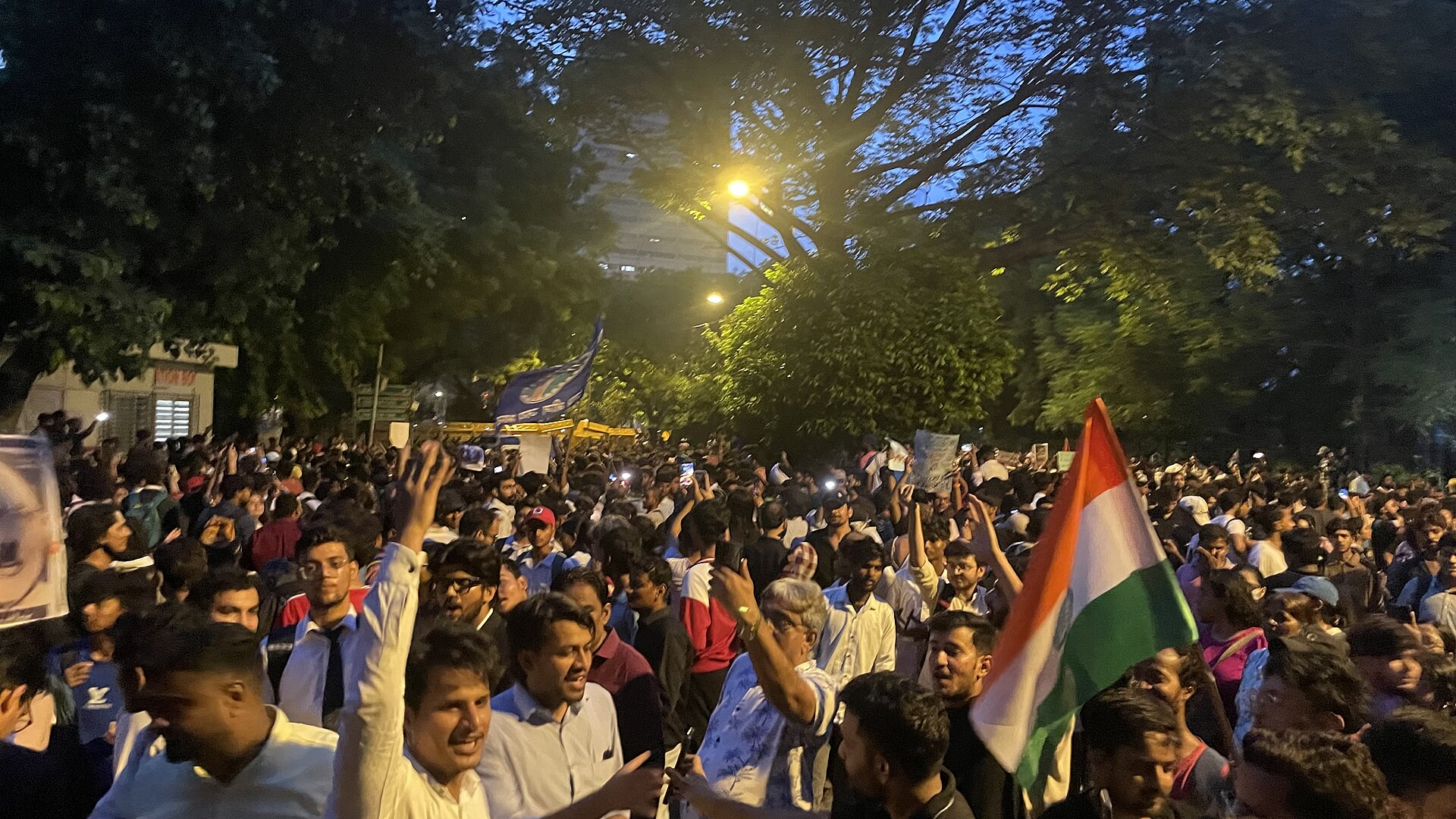 Jantar Mantar Protest, Delhi. By Alnitak-Alnilam-Mintaka – Own work, CC BY-SA 4.0, Link.
The Research Unit for Political Economy (RUPE), based in Mumbai, India, publishes the journal Aspects of India’s Economy and a range of research publications in English, Hindi, and other Indian languages. The RUPE book Crisis and Predation: India, COVID-19, and Global Finance was published by Monthly Review Press in 2020. Digitalization in India: The Class Agenda is soon to appear from Monthly Review Press.
The global crisis, long foreshadowed, is now clearly upon us: the U.S. tech sector is marked by giant financial bubbles; international contention for control of markets and raw materials is sharpening; various institutions of the erstwhile world order are being dismantled; the ravaging of the environment has intensified greatly; and productive activity and trade are facing grave disruption. These are indeed diverse expressions of a single crisis: that of the present imperialist world order. As imperialism attempts to reassert its global hegemony, it is turning once more to fascism and war. As part of this, it is concentrating unlimited power in a handful of militarized tech corporations. Worldwide, there is a sense of uncertainty and dread about the future.
The present crisis takes not only financial forms, but directly affects the sphere of production; it affects not only demand, but supply as well. For example, the fertilizer shortage and price rise threaten global food production, and energy shortages are already obstructing the full range of production and distribution. Since the neoliberal system depends largely on financial tools to manage a systemic crisis, the emerging financial crisis is magnifying all existing strains that have developed in the international economy. If Third World countries are driven in this situation to seek a financial rescue, it would likely be on extreme terms amounting to an undisguisable loss of sovereignty.
All these phenomena directly impinge on India, and are exposing the existing vulnerabilities of India’s economy. Rather than resist the subordination of India’s economy and the consequent burdens thrust on it, India’s ruling classes are aligning themselves even further with imperialism and thrusting these burdens onto the Indian people. In the analysis that follows, we examine the approach of India’s ruling classes with regard to international financial flows, trade negotiations with the United States, and the digital sphere.
A False Construct
In recent years, India’s ruling classes claimed—and perhaps came to believe—that their time had come on the world stage. India was the fastest-growing major economy, due soon to be the third largest, constituting a new global power. India’s biggest tycoons figured among the world’s top twenty billionaires, part of the transnational elite. Prime Minister Narendra Modi declared that India would be a “developed country” by 2047, the centenary of the end of colonial rule. Nor were the Indian rulers entirely alone in such proclamations. The International Monetary Fund (IMF) and international credit rating agencies praised India for its macroeconomic stability, and international think tanks and pundits considered it a matter of time before India became a superpower.1
Leading analysts of international relations admired India for advancing its own interests by promiscuously forging links with rival blocs; some even grouped it with China as an emerging threat to the continued dominance of the Western powers. India’s assertive foreign minister was admired for his sharp retorts to Western journalists. India, a founding member of BRICS, made large imports of Russian oil, and was said to be searching for ways to replace the dollar in international payments.
These notions of India’s economic strength and political independence, however, reflected theories of economic development and of international relations that lacked a class-analytic and historical approach.
As the global crisis intensified, this construct began to fall apart. The process accelerated greatly with the advent of the second Donald Trump administration and his policies aimed at forcibly restoring U.S. control over the global strategic order, world markets, and world resources. As Trump unleashed first verbal threats and abuse—followed by massive punitive tariffs—on India, the Indian authorities declined to contradict a single one of his statements, let alone retaliate. They merely expressed, in muted tones, hopes for an agreement. When a “framework” trade agreement between the two countries was finally announced in February 2026, it contained unilateral concessions by India so sweeping that they could only be seen as a surrender, and, indeed, as a framework for yet further concessions.
In the sphere of external relations, India’s rulers largely abandoned pretenses at neutrality or even sovereignty. India has had to obtain permission from the United States for importing oil from Russia. Most strikingly, Modi visited Israel on the eve of the U.S.-Israeli aggression on Iran, declaring that “We stand with Israel, now and in the future.” India’s rulers refused to condemn U.S.-Israeli attacks on Iran and the assassination of Iran’s leaders, choosing instead to condemn Iran’s justified retaliation against U.S. allies in the region. They adhered to this course despite themselves being treated in a pointedly humiliating fashion over and over by the U.S. president.
Now India stands at the brink of a grave economic crisis. Its present vulnerabilities are not merely the result of its resource endowment, stage of development, or specific policy choices. Rather, they arise crucially from the nature of India’s own political economy as it has emerged historically and the character of India’s ruling classes. This also implies that the way out of the present crisis for India is tortuous and difficult.
Underlying Paucity of Demand, and Accumulation by Other Means
At the end of colonial rule in 1947, India did not experience a revolutionary break; rather there was continuity in several respects. India’s big capitalist class, molded by its emergence under British rule, manifested a narrow mercantile character rather than a thoroughgoing industrial one. This was reflected in its failure either to develop its home market by ousting parasitic forces in agriculture or to develop its independent technological capability.2
The absence or suppression of revolutionary change in the agrarian sphere had wide implications: (1) old and new parasitic forces in this sphere continued to drain much of the surplus, hampering investment in agriculture itself and constricting the market there for industry; (2) labor could not be collectively and voluntarily mobilized, as in China of the time, to create collective productive assets for agriculture; (3) the retrogressive social milieu—including the institution of caste—stultified thinking, entrenched hierarchy, and prevented the emergence of socially dynamic forces; (4) and, given the constraints on agricultural output, a rise in industrial growth tended to trigger inflation.3 Only the last of these features was later addressed by the Green Revolution, though only to an extent.
The causes of the economy’s underlying paucity of demand are thus institutional. India’s big capitalist class has found ways to accumulate wealth without resolving the underlying demand problem. It has focused on a relatively narrow market of the better-off, which it caters to with repeated imports of technology from suppliers from the developed world.
Rather than enter into dangerous contention with the dominant international corporations, big Indian capital has preferred to accommodate them. The profits forgone in this manner are partly made up through cornering various state subsidies and outright gifts of public assets, thanks to big capital’s intimate ties with the Indian state machinery. In turn, international capital has not viewed the Indian big capitalist class as a serious rival, but, in a sense, as a facilitator of its entry into India, one skilled in handling and manipulating the local political-economic environment.
At the same time, India’s large capitalist class has aspired to much more rapid growth through other means. In this aspiration, particularly since the 1980s, it has sought foreign capital, initially as debt, and, after 1991, also as foreign direct investment and portfolio investment.
In recent years, the growth and achievements of present-day China and India are frequently compared. What is never mentioned today is the much earlier divergence between the two countries, during China’s socialist era. China in 1949 was even poorer and more industrially backward than India. However, as the World Bank’s 1981 report noted, by the mid-1970s China had far outstripped India in every sphere: life expectancy, nutrition, public health, literacy, rate of investment, agricultural output (on a much smaller endowment of arable land), and industrial output, particularly in capital goods production, reflecting a domestic technological capability.4 Socialist China achieved all this with low levels of inequality, full employment, and the active participation of people in the political life of the country. In the context of the present discussion, we need to note that the prerequisite for this entire process was the fundamental change in production relations: the expropriation of China’s feudal forces and comprador bourgeoisie, and the emergence of a new social order on that basis.
The Boom of 2003–2008 and Its Aftereffects
In recent years, the constraints that once were blamed for holding back India’s growth were seen as no longer relevant. India has not suffered a full-blown balance of payments crisis in the last thirty-five years, and it has not suffered a major food shortage after the Green Revolution was fully established. Yet the manner in which these constraints were overcome generated further contradictions. These are unfolding now.
The post-1991 neoliberal changes did not result in faster growth at first. However, during the 2003–2008 period, the Indian economy did undergo rapid growth, triggered by massive financial inflows (in the wake of the post-2001 financial stimulus in the United States and its consequent spillover worldwide).5 By 2007–2008, total private capital inflows rose to nearly 10 percent of GDP.6 Other important sources of growth included services exports, linked to outsourcing of information technology (IT) work by the imperialist countries; commodity exports, indirectly linked to the global stimulus; giant state gifts to the private corporate sector (in the form of public-private partnerships and land acquisitions); a flood of lending by public-sector banks for private infrastructure projects, much of which were speculative and later had to be written off; the wealth effect of a soaring stock market; and a construction boom associated with all the above. Continued buoyant foreign inflows were important for sustaining euphoric investment. This growth, given its origins and nature, was not secure, and was liable to be disrupted by developments beyond the control of the Indian ruling classes and their political representatives.
Despite its negative features, this boom did briefly result in expansion of factory and construction employment (particularly the latter), growth of real wages of industrial labor and agricultural labor, improved terms of trade for peasants, and a partial improvement in nutritional intake. The steady addition of about a million well-paying jobs per year in the software sector created demand for middle-class consumer durables, such as automobiles, and services, such as air travel. All these triggered a rise in investment rates for a period.
Indian big business viewed the resultant growth rates as a breakthrough to a “new normal” of rapid growth. The now-eased access to international finance also funded large overseas investments by Indian big capital, giving rise to talk of Indian multinationals having “arrived,” even as their dependence on external commercial debt increased.
The expectation of endless double-digit growth whetted the appetite of the corporate sector for vast tracts of land: some for the mineral wealth they contained, some for locating factories or infrastructure, and some as sheer speculative acquisition. This corporate drive for land acquisition led to the explosive growth of peasant resistance against dispossession, including by tribal communities, at nearly three hundred locations across the country.7 While the Indian state was forced to make some temporary legislative concessions to such resistance, it stepped up at the same time its paramilitary campaign in central India to suppress “left-wing extremism,” which it blamed for the unrest.
The Indian economy had little direct exposure in 2008 to the financial assets at the heart of the Global Financial Crisis. Nevertheless, due to the by-then extensive integration of the Indian economy with the imperialist-dominated world economy, the financial crisis delivered a drastic shock through all three channels—trade, finance, and confidence. The imperialist countries then pressed Third World countries like India to carry out a coordinated fiscal and monetary stimulus that quickly renewed growth; but once asset prices in the imperialist countries revived and the immediate crisis there dissipated, the imperialist countries applied pressure for retrenchment of the stimulus in Third World countries in order to bring down the prices of the latter’s labor power, primary commodities, and productive assets.
Big Business Backs Modi to Revive Growth
As the neoliberal, Congress-led government adhered to this fiscally contractionary program, India’s private corporate investment rates declined after 2011, never to recover fully. Indian big business pushed the notion that growth could be revived by aggressive neoliberal reforms; they turned hostile to the then government, charging it with “policy paralysis.”
By 2013, India’s big business houses switched to backing Modi and the Bharatiya Janata Party (BJP), with the agenda of reviving growth through a combination of measures: deregulation and privatization, clearances for land acquisition, diversion of fiscal resources away from welfare and to the corporate sector, and more systematic repression of labor. Big business thus in effect embraced “communal fascistic” ideology and organizations built around that ideology as a method of rule that could overcome popular resistance.*
After coming to power in 2014, Modi set about implementing a series of neoliberal measures aimed at attracting foreign direct investment (FDI) and integrating India into global supply chains of multinational firms. Some of these measures, particularly those directly targeting peasants and workers, have faced resistance, and in a few cases have had to be withdrawn.8
The Modi government has also accelerated the ongoing process of concentration of wealth in the big capitalist class. With the help of lower corporate tax rates, reduced debt, and low single-digit wage growth, corporate profits have risen steeply for the last five years.9 “In terms of financial performance,” says the official Economic Survey, “the corporate sector has never had it so good.”10 Nevertheless, the post-2011 slowdown in fixed investment by the private corporate sector has persisted.11 Corporations are hanging on to their cash or distributing it as dividends in place of investing.12 The reason lies in the paucity of demand: capacity utilization levels have not budged for the entire period.
In these conditions, the ruling class is intensifying its attempts to accumulate wealth by other means, including by dispossession of peasants. For this, it has made sweeping changes to environmental laws and rammed through clearances for mining projects in the face of resistance by the largely tribal peasants in forest regions. In this process, it is accumulating yet more wealth at one pole and destitution at the other, deepening the demand problem further.13
Increasing Distortion
Official GDP data, which continue to show reasonable growth rates, have been disputed by a range of economists, including a former chief economic advisor of the Modi government. But even if we were to accept these data, there are more serious questions regarding the nature of output, employment, and distribution. A recent study puts the present income and wealth shares of India’s top 1 percent at their highest historical levels, with India’s top 1 percent income share among the highest in the world. The income share of the top 10 percent rose by 18 percentage points since 2000.14 Venture capital firm Blume calls this top decile the “consuming class,” with consumer durables spending thirteen times the average. As Blume notes, the spending of this class may be growing, but its numbers are not.15
The structure of production in the formal sector is increasingly skewed to cater to this class. Automobiles are now India’s largest manufacturing industry, in a country in which less than one in ten households owns a car.16 The growing gulf in incomes is reflected in the decline in sales of two-wheelers and low-end smartphones (though India has 220 million feature phone users) and the rising sales of SUVs and premium smartphones such as iPhones.17 Strikingly, the industrial production of wage goods such as textiles, garments, and leather has actually shrunk over the last decade.18
The goods and services consumed by the upper classes are more capital-intensive and import-intensive. Hence, as the structure of production gets skewed to upper-class consumption, growth yields fewer proper jobs.19 Given the character of its growth, India has not undergone a structural transformation. The share of manufacturing in India’s GDP has stagnated at 15 to 17 percent for over three decades of neoliberal policy, and has actually declined under Modi. Critically, the structure of employment has become increasingly distorted. The overwhelming bulk of the workforce remains concentrated in agriculture and small, low-productivity units in manufacturing and services, alongside a narrow, high-productivity modern sector in manufacturing and services.
Recently, there is an actual reallocation of the workforce into low-productivity sectors, including, most unusually, agriculture. This is directly contrary to standard development theory, in which underemployed peasants are drawn into modern manufacturing until labor reserves are exhausted. A recent study finds a collapse in India’s labor productivity growth, a phenomenon it terms “structural retrogression,” in conditions of “entrenched dualism.”20 The productivity collapse reflects the desperate attempt to stitch together a subsistence: unemployed workers, particularly women, are crowding into refuge sectors such as agriculture in the hope of adding a few rupees to the family income.
Some economists argue plausibly that the present slump in investment is the result of economic mismanagement. Examples include the overnight cancellation of 86 percent of the cash in circulation in 2016 (allegedly to stamp out “black money,” funds earned on the black market) and the 2017 shift to a Goods and Services Tax, both of which imposed unbearable burdens on the informal sector. While these measures doubtless had a severe negative impact, they do not fully explain the long persistence of stagnation. Instead of imagining the rapid growth of 2003–2008 as the new normal, we can see it as an abnormal period, during which a finance-driven surge in the world economy at the time combined with powerful speculative forces in India. The present slump is then a return to the Indian economy’s underlying reality of paucity of demand and persisting dualism.
The Regime of International Finance
The manner in which constraints to growth were apparently overcome in the neoliberal era has brought new contradictions in its train. The problem of India’s balance of payments was addressed not by reversing or reducing its trade deficits, but by attracting capital inflows of various types. This now operates as an apparently self-perpetuating regime of international finance over India’s economy, the steps of which we lay out below.
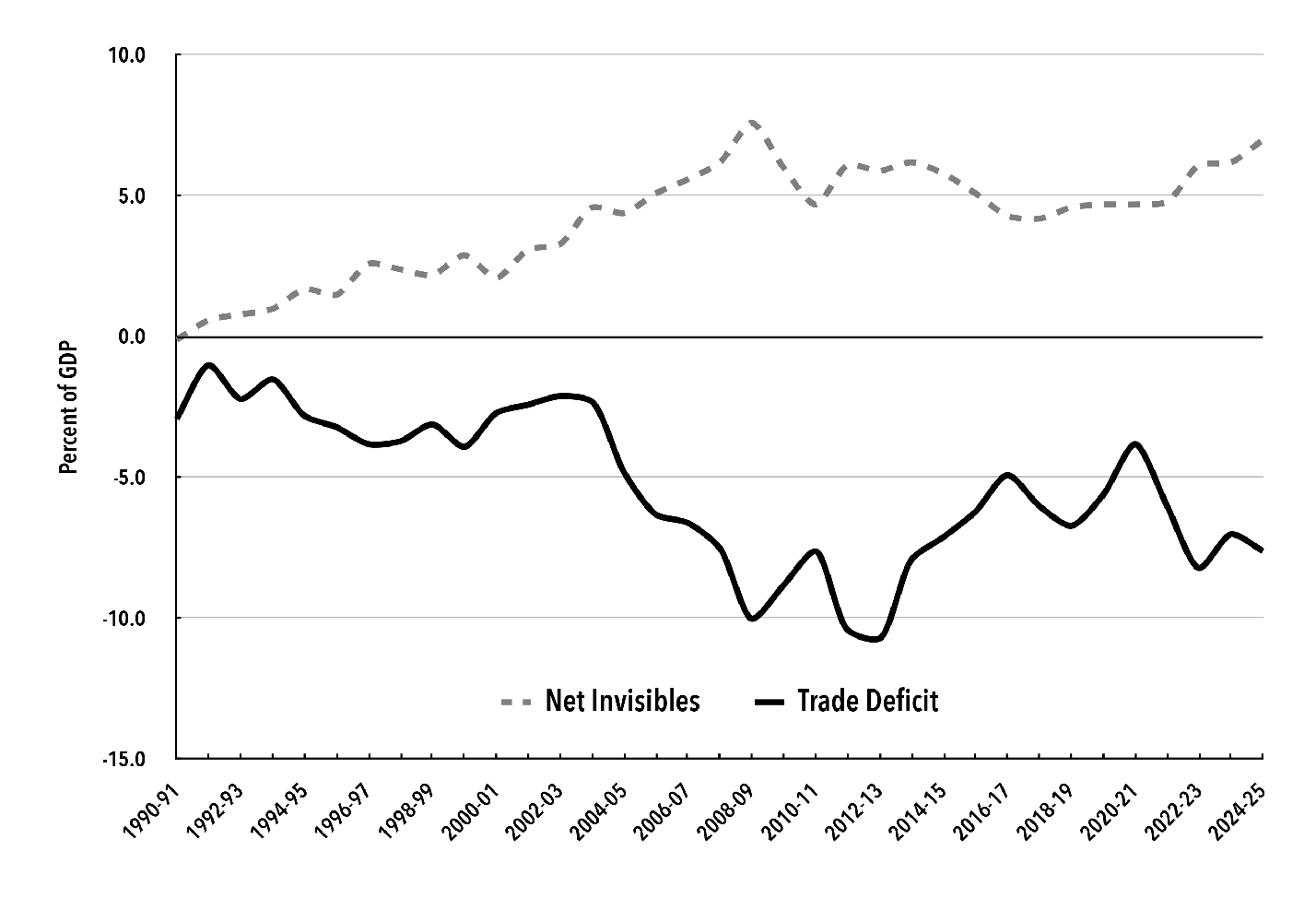
(1) India perennially runs trade and current account deficits. After thirty-five years of neoliberal reform—internal deregulation, trade liberalization, opening up to foreign investment, and market-determined exchange rates (with the rupee depreciating from less than Rs 20 per USD to Rs 95 per USD today)—India’s merchandise trade deficit has actually doubled as a ratio of GDP over the entire period, as can be seen in Chart 1.
Chart 1. India’s Trade Deficit and Invisibles Surplus
Notes and Sources: Reserve Bank of India, Database on the Indian Economy, “Balance of Payments—Indicators,” data.rbi.org.in. The data for trade deficit/GDP were calculated by subtracting imports/GDP from exports/GDP.
While the merchandise trade deficit thus has grown, India’s current account deficits (a broader measure that includes trade in services and other income) have been lower. The reason is that changes in communications and IT, combined with the availability of English-speaking technical workers in India, enabled the developed world to outsource mundane software work to Indian firms; later, other routine office work was added as well. Exports of software and IT-enabled services soared in the 2000s, reaching around $246 billion at present.21 Thanks to the surplus in the invisibles account, the current account deficit has been restricted to an average of less than 2 percent of GDP over the past twenty years.
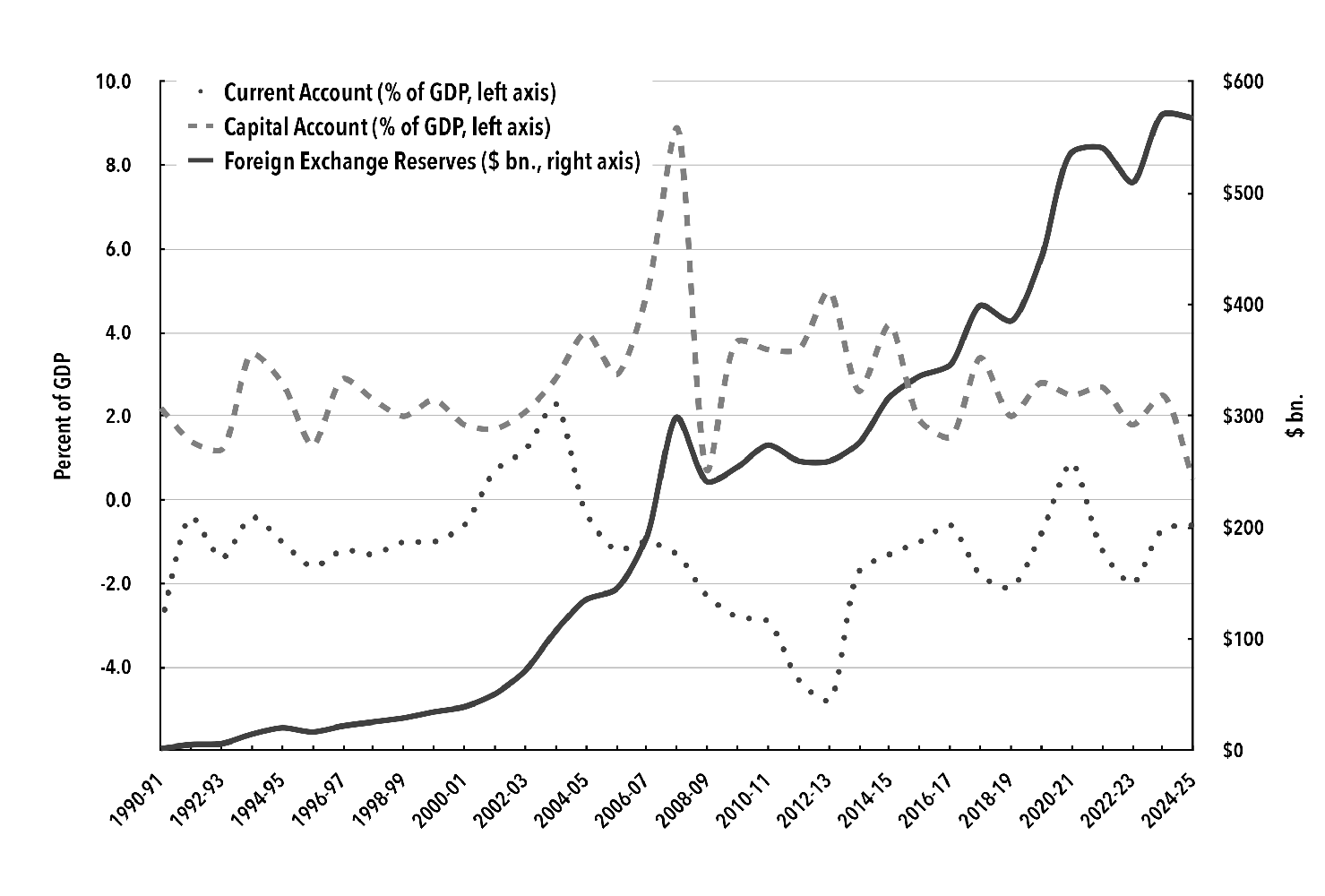
(2) To cover its current account deficits, however, India needed foreign capital inflows. These have indeed flowed in during the neoliberal era, both in the form of debt and foreign investment. As can be seen in Chart 2, over the past two decades, India has run deficits on the current account every year except 2020–2021. However, surpluses on the capital account have exceeded the current account deficit in all but five years, and have been accumulated as foreign exchange reserves. For this reason alone, India has faced no balance of payments crisis in this entire period.
Chart 2. India’s Current Account, Capital Account, and Foreign Currency Assets
Notes and Sources: Reserve Bank of India, Database on the Indian Economy, “Key Components of India’s Balance of Payments—US Dollar” and “Foreign Exchange Reserves—Annual.” For current account/GDP, see Chart 1. The data for capital account/GDP are derived from current account/GDP and the absolute figure of the current account.
Developing countries are short on capital, and hence they can draw on savings from wealthier lands to fund their investment; so runs the theory. However, in fact, as soon as the current account deficit rises beyond a certain low level—the Indian authorities place the limit at no more than 2.5–3 percent of GDP—international credit rating agencies start ringing the alarm bell, and foreign investors start pulling out their investments.
Therefore, the Indian authorities strain to keep the current account deficit well below the danger level, suppressing domestic demand if necessary, by raising interest rates and/or restraining government expenditure. India’s present chief economic advisor recently opined that in the changed world conditions, the sustainable level of the current account deficit for India was no longer 2.5–3 percent of GDP, but “much lower.”22
Once that restraint is imposed, and foreign investors are reassured of the safety of their investments, capital inflows pour in, far in excess of the requirements of meeting the current account deficit—the less India needs the inflow, the more flows in. This flood of dollars (or other hard currency) in India’s foreign exchange market threatens to make the rupee appreciate, undermining the competitiveness of Indian exports. Thus, the Reserve Bank of India is compelled to buy the incoming currency, which in this way becomes part of the foreign exchange reserves.23
The third element of the regime is thus the ceaseless building of foreign exchange reserves, the more the better. Ever since the Southeast Asian financial crisis of 1997–1998, Third World countries have tried to build up giant foreign exchange hoards to ward off the next crisis. India’s foreign currency assets today have soared to fourteen times the level in 2000. The Indian authorities routinely refer to these reserves as a critical macroeconomic buffer, “ensuring resilience and external stability in the face of global uncertainties.”24
This is an illusion. Unlike countries like China, Japan, or Taiwan, India does not run current account surpluses but deficits. Its foreign exchange reserves are thus entirely constructed out of capital inflows, which are additional liabilities, sums owed to foreigners, much of which can fly out on short notice.25
The Reserve Bank of India (RBI), of necessity, deploys the foreign exchange reserves in safe, low-return assets abroad, such as U.S. treasuries. By contrast, the average returns on foreign investment in India—whether foreign portfolio investment in shares and debt or FDI in firms—are multiples higher. Thus, the surplus inflows impose a net drain on India. Nirmal Chandra found the present drain to be comparable, as a share of India’s GDP, to the tribute extracted by the British from India during the latter part of colonial rule.26
(3) Despite this reality, the Indian rulers relentlessly seek more foreign investment of all types, including purely financial flows, and open up more and more sectors to foreign capital. For example, the Indian authorities in recent years opened up Indian government bonds to foreign investors, and made strenuous efforts to get these bonds included in the major international indexes of government bonds constructed by U.S. investment banks. To attract and retain capital inflows, interest rates in India must be kept at levels considerably higher than international ones, depressing domestic demand.27
Further, the Indian authorities have relaxed the scrutiny of foreign investment inflows entering under various heads. Large flows in and out of the country partly reflect movements of international speculative capital.28 While India had received a net $233 billion in portfolio flows by March 2026, these are inherently volatile: India suffered five sudden stops and reversals during 2008–2022, and it is now in the midst of the sixth.29 The RBI’s own scenarios of extreme adverse events see portfolio outflows of up to $100 billion in a year.30
By contrast, FDI is conventionally depicted as long-term, tied to physical assets in the manufacturing sector, and helpful in gaining know-how. However, this is far from the reality: India’s authorities have widened the definition of FDI to include fickle flows such as private equity, so that “real” FDI accounts for just 42 percent of India’s incoming FDI in recent years.31
If capital inflows impose such costs on India, why have successive Indian governments relentlessly sought more and more of them? Why have they not instead sought to place controls on them, or even block them altogether? At the broadest level, this is because India’s ruling classes view their interests as linked to imperialism, and do not contemplate opposition to it. Further, foreign inflows provide the corporate sector access to cheap capital; enable them to import technology, capital goods, and intermediates; and provide the foreign exchange for the Indian ruling classes to invest abroad, including their transfers to tax havens.32 Indian billionaires also bring back a portion of their illicit offshore funds in the guise of foreign investments in order to manipulate the Indian share market in their favor. Thus, the Indian ruling classes benefit from the greater and greater openness to capital inflows.
(4) The RBI asserts that India’s foreign exchange reserves are more than adequate for any eventuality, covering more than ten months of imports and over 90 percent of outstanding external debt. But the reality is that the reserves are in effect not available for spending. Any sizable drawdown of the reserves causes alarm among foreign investors; if they were to exit, the reserves would get drawn down further. Therefore, the authorities strain every nerve to prevent the reserves from falling, and, if possible, keep them growing.
(5) As foreign capital flowed out last year, the Indian authorities responded by relaxing restrictions on foreign investment in the financial sector, bringing in $11 billion from some of the world’s biggest financial firms, and dropping their earlier insistence on reciprocal rights for Indian banks and financial institutions in foreign investors’ parent countries. Now, in the wake of the Iran war, India’s authorities have rolled out a fresh host of measures to attract capital.33 In the words of the official Economic Survey, as capital inflows slow, “we must pull out all the stops, wooing FDI and making [India] more attractive for foreign investors.”34
The Subjugation of Economic Policy
The regime we have sketched above gives foreign capital great power over India’s economy. The head of J. P. Morgan Emerging Markets said candidly that opening India’s government bonds to foreign investors provided “an additional source of fiscal discipline that we hadn’t had.” Foreign bondholders could enforce low fiscal deficits, because “there is now a bunch of people who…can actually react to bad fiscal policy, right?”35
This subjugation to international capital flows ensures India cannot determine its own policies, such as, for example, its response to a rise in international oil prices. In theory, instead of burdening the working people further, the Indian government could pay for the difference simply by increasing direct taxes on the corporate sector and the rich. Recall that India’s rulers had handed the corporate sector a huge bonanza in direct tax cuts in 2019, yet the latter refused to expand productive capacity.36 As India’s chief economic advisor, Venkatramanan Anantha Nageswaran, recently remarked, while profits of the top five hundred firms grew at 31 percent per annum, investment did not rise; instead, the owners pocketed the sums and even transferred them abroad.37 However, both foreign investors and the Indian corporate sector rule out this option.
A second option is to increase government borrowing, also known as the fiscal deficit. However, this too is anathema to foreign investors. Thus, India’s central government has steadily reduced its fiscal deficit and total expenditure as a ratio of GDP over the past three years, despite the evident slump in investment. Over the last financial year, as tax revenues fell short of the target, the authorities slashed budgeted expenditure heavily in order to maintain its fiscal deficit targets. Total expenditure/GDP is budgeted to decline yet further in the present budget. Such fidelity to neoliberal dogma wins the approval of the IMF and U.S. credit rating agencies.
Why do foreign investors oppose government borrowing? First, they fear that additional government spending might spur inflation, and consequently lead to a fall in the rupee’s exchange rate; in that case, their rupee profits would yield them less dollars to repatriate. Equally important, they see scope for gain: when governments are blocked from raising funds by additional borrowing, they rely more on private corporations to boost growth, and hence provide the latter special incentives. Cash-strapped governments then try to raise revenues through measures such as privatization and “monetization,” yielding bonanzas to private investors.
Since both direct taxation and greater government borrowing are vetoed by foreign investors, the Indian government has resorted to a combination of two other options: first, cutting spending on socially oriented public expenditure; and second, hiking domestic prices of oil and gas. These measures, even if taken temporarily, would reduce real incomes of the working people and further depress demand and economic activity.
The insidiousness of the entire regime of international finance that we have described is that it operates as if spontaneously, and as if for the benefit of India itself. Today it operates as the “common sense” of not only India’s ruling classes, but a much broader section of academia, the media, and the educated middle classes. All discussion is restricted to how best to continue within the present framework; the very possibility of any alternative to this regime is placed beyond the pale of discussion. In fact, however, the regime of international finance requires continuous monitoring, intervention, and enforcement by international capital, in collaboration with the Indian ruling classes.
Tightening Grip Amid the Crisis
In the present crisis, the severity of the above regime is increasing. Both the current account and the capital account are under stress.
First, India’s merchandise exports have been flat since 2022, and are now facing multiple challenges in its largest export destinations and a slowing, divided world economy. At the same time, global turmoil has elevated the prices of a range of India’s commodity imports, including oil, gas, urea, and critical minerals.
Second, India’s invisibles surpluses are under threat. Dollar revenue at India’s top five software services exporters has grown at an annual rate of less than 3 percent for ten straight quarters—”a shadow of the double-digit expansion in the previous two decades.”38 The real blow is yet to come: as erstwhile clients shift to artificial intelligence (AI) for the routine software tasks being done by Indian firms, both remotely and onsite, India’s software sector is unlikely to keep laying golden eggs.
Third, and most importantly, net capital inflows have collapsed, from $89 billion to $17 billion to $2 billion over the past three years. Not only have foreign portfolio investors in India’s share and bond markets withdrawn $16 billion, but even FDI investors have sent out funds at a hectic pace. As a result, the current outflow on account of FDI is higher than gross FDI inflows, recalling, in the words of two experts, “the colonial pattern.”39
Let us now look at the impact of the crisis on different classes: the peasantry, the working class, the middle class, and the ruling class. Well before the Iran war, the condition of the mass of India’s working people has been deteriorating; and the impact of the Iran war and, more generally, the global crisis, will push many over the edge.
Peasantry: Simple Reproduction under Threat
India’s agrarian structure never underwent radical land redistribution and the ousting of parasitic forces. Meanwhile, as vast numbers of small peasants clung on to their small holdings for lack of jobs elsewhere, these holdings became further and further subdivided over time into innumerable patches, which on their own do not meet the subsistence needs of their cultivators. Nor does wage income suffice, and so the small peasantry stitch together a living out of multiple occupations—agriculture, wage labor, and petty self-employment—shuttling between their rural homes and urban slums.40
India’s rulers turned to the Green Revolution of the 1960s as a means of overcoming the country’s grave food deficit. This did lead to rapid growth of output in specific crops in commercialized regions, the surpluses of which stocked the public granaries nationwide. It thus appeared to have finally overcome the “agrarian constraint” on growth by providing a growing supply of wage goods. But it did so in a manner that created its own problems. The increased intensity of inputs, including chemical fertilizers, energy, and water, raised the cash needs of peasants. Initially, state assistance, remunerative procurement prices for cereals, directed bank credit at low interest rates, and high returns eased the way.
In the neoliberal era post-1991, however, bank credit to agriculture was stepped down, edible oils were opened up to imports, public-sector agricultural extension services were slashed, and state intervention against collapses in the prices of many crops was wound up. The share of public investment in agricultural investment and in GDP fell. The corporate sector has penetrated trade in several commodities, and, in place of public-sector firms, Western multinationals now control 70 percent of commercial seed supply and a large proportion of agrochemicals.41
Peasant indebtedness to traders and other informal lenders has grown, even as returns have dwindled or fallen outright.42 In commercialized regions this debt trap has driven over 300,000 desperate peasants to suicide. Market prices of many major crops are below official minimum support prices. In the past financial year, for the first time in five decades, nominal growth of agricultural value added has fallen below real growth, implying outright deflation.43
For their survival, distressed peasants have been forced to resort to various short-term measures that ultimately deplete the water table, require increasing doses of pesticides, and deplete the soil. As the government decontrolled the prices of phosphate (P) and potassium (K), while capping prices of urea (N) for fear of peasant protest, the N:P:K ratio has deteriorated far from its agronomic benchmarks, exhausting the soil and requiring larger doses of fertilizer even to maintain yields.44 Large-scale public-sector agricultural extension services are required for testing the soil and advising peasants on their specific needs, including the introduction of both micronutrients and organic manures. Such a program can raise the response to fertilizer, allowing over time a reduction of fertilizer per tonne of output. The public procurement program could be extended to other crops to bring cropping patterns in line with the conditions in different regions, reducing soil and environmental stress.
Such a scientifically grounded program runs counter to neoliberal policy. The latter, with its reliance on the market, has rendered India’s public agricultural extension system a shambles. Public expenditure on extension services is just 0.2 percent of value added in agriculture, with one extension worker per one thousand cultivators. Private input dealers are double that number, and their aggressive marketing is in practice the main form of extension services reaching the cultivator.45
Guided by neoliberal policy, successive governments dismantled existing public sector capacity in urea and increased India’s reliance on fertilizer imports.46 India also depends on natural gas imports as feedstock for its own urea production. Prices of urea have risen steeply since the start of the Iran war, and India has been contracting imports at double the prewar price.47
Now, faced with a foreign exchange crisis during the Iran war, Modi has called upon India’s farmers to halve their use of fertilizer, a possible preparation for raising urea prices. In fact, since over half the present yield of foodgrains is attributed to the addition of chemical fertilizers, any such drastic step would simply lead to a fall in output.48 The recent hikes in diesel prices also narrow margins in agriculture: groundwater accounts for two-thirds of India’s irrigation, and nearly a third of India’s agricultural pumpsets run on diesel. Diesel powers tractors and other agricultural machinery.
Given that simple reproduction itself has become a challenge for the peasantry, as exemplified in the high levels of debt and large number of suicides of peasants, further burdens would have grave effects. (This process is already underway: between January and May 2026, survey data show rural households had to spend more, but received lower incomes, resulting in falling savings and investment.49)
Two further threats loom before the peasantry. First, the U.S.-India trade deal “framework” signed in February 2026 has taken the first steps to opening India to an as yet unspecified “wide range” of U.S. agricultural imports. Whatever the exact provisions in the final agreement, the Trump administration has made clear its intention to wrench open India’s agricultural market to U.S. produce. India’s agricultural sector employs 280 million peasants and laborers.50 Any displacement of Indian produce by U.S. imports can wreak havoc to their livelihoods: recall the devastation of the Mexican peasantry with the post-NAFTA entry of subsidized U.S. corn.
Second, climate change will bring a range of new threats, among them abnormal heat, irregular rains (more than half India’s net sown area is rainfed), floods and droughts, changes in soil moisture, unpredictable increases in pests and weeds, and damage to forest ecosystems. There is evidence that heat stress is already affecting wheat output in the main producing regions.51 India’s agriculture consists of small farms, some producing subsistence requirements, others producing for the market but with narrow and unstable margins. Thus, a large proportion are in debt. They do not have the capacity to individually take the measures needed to adapt to these new conditions: they urgently require organization and large-scale public investment, including agricultural research and extension services. Public employment works can also provide some livelihood protection amid the uncertainty. However, as part of overall fiscal retrenchment, there are large cuts to public expenditure on agriculture as well as on rural employment generation.52
These developments may also bring to the fore once again the agrarian constraint in the form of food shortages and rising food prices.
India’s Workers Facing Wage Squeeze
The condition of India’s workers cannot be separated from that of the peasantry: most are part-peasant, with one foot in the village. The intensifying agrarian crisis has driven many in search of wage employment. However, for vast numbers of workers, the wages are insufficient to meet the costs of reproduction, and so worker families depend on the village for a variety of needs. Hence, the agrarian question is of central interest to workers, too.
Over half of India’s workers are in self-employment, much of it precarious, and another one-fifth are employed as casual labor. Thus, less than a fourth of India’s workers receive a regular wage.53 Within this last category, less than half have a job contract of any sort or enjoy even a single social security benefit. The overwhelming majority of India’s factory workers receive wages lower than the need-based minimum wage fixed by India’s central government for its lowest-ranked staff.54 The average wage of factory floor workers in India is less than $1 per hour, generously assuming an eight-hour day.55
Over the last decade, real wages among the entire range of workers, from factory workers to agricultural laborers to construction workers, have either stagnated or fallen outright.56 Those whose wages were already at rock bottom levels, such as brick kiln laborers, have suffered a further decline.57 But this is not restricted to the informal sector: an industry-sponsored study found that real wages had fallen across the corporate sector.58 Newer categories of workers have not escaped the wage squeeze: the real wages of platform workers in food delivery fell by a quarter in just the three years leading up to 2022, even as their numbers multiplied.59
The proportion of India’s workers who are self-employed has actually grown in the last decade, to over 56 percent. For lack of proper jobs, more and more workers, particularly women, have entered (or been thrust into) self-employment—a sign of large-scale distress, and not, as the official version would have it, “growing entrepreneurial activity and a preference for flexible work arrangements.”60 Since 2017, the real daily earnings per self-employed worker have fallen sharply, by as much as a third in the case of women.61
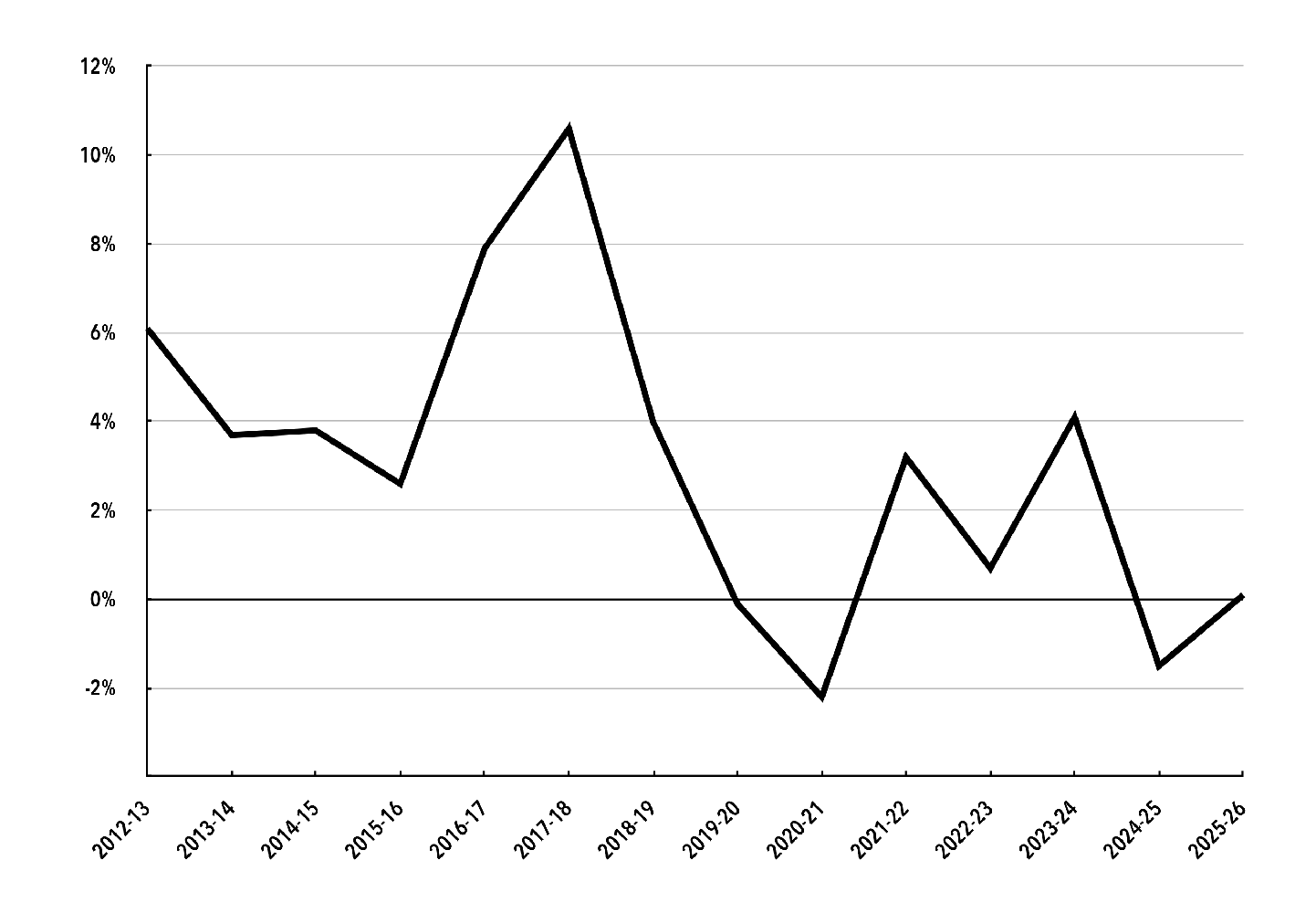
This fall in real wages has depressed demand for wage goods. The growth of consumer non-durables—largely items of daily use such as soap, detergent, toothpaste, tea powder, food products, medicines, paper, and so on—had been slowing for some years; over the last two years, output is now lower than two years ago (see Chart 3). The manufacture of somewhat more durable wage goods, such as textiles, apparel, and leather goods, has fallen even more sharply, to levels below those of a decade earlier.62
Chart 3. Annual Growth of Consumer Non-Durables Production
Source: Government of India, Ministry of Statistics and Programme Implementation, “Index of Industrial Production,” base year 2011–2012, Reference ID DDI-IND-CSO-IIP. Also see RUPE, “Manufacture of Leather Goods, Textiles, and Apparel,” n.d., rupe-india.org.
Even this depressed level of consumption has been maintained partly by households resorting to borrowing. In the wake of the pandemic, household borrowings from banks for consumption purposes rose steeply, accounting for a fourth of disposable income in March 2024.63 Microfinance institutions also did brisk predatory business at usurious interest rates, accounting for four-fifths of formal sector small loans.64 Three-fourths of the borrowers turn to informal lenders, from whom collateral-free loans are more easily accessible, albeit at higher interest rates. Such lenders increased their coverage greatly in the wake of the COVID-19 pandemic.65
Despite the stagnation or fall in real wages, India’s rulers are making strenuous efforts to depress them further, so as to make India more attractive to foreign investors. To this end, they have undermined India’s rural employment guarantee scheme for some years by keeping wages low and delaying wage payments, and more recently by reducing the total number of workers and the number of workdays.66 Finally, in December 2025, they dealt the final blow by converting it into a purely discretionary, underfunded scheme that can be wound down.67
At the same time, the central government replaced existing labor laws with new labor codes that effectively do away with job security and render it more difficult to form unions or strike.68 (Already, in the neoliberal period, there has been a steep rise in the share of contract workers in the formal sector.) Among other things, the new rules allow up to twelve-hour days without triggering higher overtime rates and have done away with criteria for fixing minimum wages, leaving this determination to the discretion of the central government.69 The thinking of the authorities is reflected in the suggestion by India’s finance ministry that, in the wake of the Iran war, relaxing restrictions on working hours and reducing overtime wage rates “will further enhance India’s already-strong attractiveness as an investment destination.”70 But the very depression of wages depresses aggregate demand as well, deterring investment aimed at domestic markets.
Given the low level of factory wages, it is not surprising that further reduction in real wage levels would spark resistance. The established trade union organizations in India have failed to put up effective resistance, but recent eruptions of working-class discontent indicate the mood of the workers. The recent wave of spontaneous strikes began in February 2026, emerging first among construction workers in the eastern India Barauni refinery, spreading thereafter to 30,000 construction workers at the Panipat refinery and thousands building the ArcelorMittal plant Surat in western India. News traveled from site to site through videos taken on workers’ mobile phones. Thousands of migrant workers walked off work, with demands that included a reduction in their twelve-hour working days, better wages, safer and decent working conditions, and better living conditions. April witnessed major worker upsurges at two industrial belts near Delhi, Manesar, and Noida, with tremors felt in other industrial centers of north India. In all these cases, the upsurges were spontaneous and not led by any established leadership.71
For the Manesar and Noida workers, the last straw had been the steep rise in cooking gas prices, and hence food costs of migrant workers, in the wake of the Iran war. But the upsurges brought to light the appallingly low wages prevalent in India’s industrial sector, including in major automobile units and garment export units. The two state governments concerned, which had frozen minimum wages at the same nominal rate for over a decade (a steep decline in real terms), were forced to announce modest hikes, even as they unleashed widespread repression on the workers and activists, charging them with executing a Pakistan-directed conspiracy.
India’s White-Collar Workers in Turmoil
While there is no generally accepted definition of India’s middle class, what may be termed a “consuming class” in India is very small in relation to the population. At a consumption expenditure cutoff of $15 per day at Purchasing Power Parity, just 1–2 percent in India make the grade of the international consuming class. The corresponding figure for China is 25 percent.72 Even by more generous definitions, India’s “middle,” so-called consuming class is still far from the median, indeed, situated within the top decile.
Nevertheless, over the past two decades, on the basis of this middle class, India has seen considerable growth in industries such as automobiles, consumer durables, and air travel. Now, however, there is a change: air passenger traffic is stagnating, the sale of small cars and two-wheelers has declined, and the production of consumer durables is growing more slowly.73 In the words of a Bloomberg columnist, “India fell off the global middle-class map.”74
The slowing of consumption is because the pool of well-paying jobs is not growing. As the size of the graduate population (referring to those with a bachelor’s degree or higher) has grown, the problem of graduate unemployment has been magnified. Where India’s leading software firms were earlier adding a million workers a year to their workforce, they are now shedding jobs.75 It is difficult to say how much of this is due to automation and how much to slowing growth, but the government’s main policy body, the NITI Aayog, warns that AI could eliminate three million IT and customer service jobs by 2031.76
Analysts at Marcellus Investment Managers report that “White-collar job creation—the kind of employment that an engineering or commerce degree was supposed to guarantee —has fallen from 11% growth before 2020 to just 1% today, according to Naukri Jobspeak Index…. At IIT [Indian Institute of Technology] Bombay—one of India’s top technology institutes that was once a near-guaranteed passport to prosperity’ fresh graduates are leaving with lower salaries than their predecessors. Across IITs nationally, 8,000 of 21,500 graduates remained unemployed.”77 Entry-level salaries in India’s leading software firms have fallen steeply in real terms over the years, to levels now comparable to the earnings of skilled manual laborers.78
In recent years, many poorer families have spent their meager resources on college fees in the hope that their children will get better jobs; India’s graduate population has swollen by 100 million since 2004. But just one in three graduates finds salaried employment, and only one in twelve is in a role matching the education so dearly procured.79 Intense anxiety about vanishing employment opportunities thus underlies the recent explosion of student-youth protest (the “Cockroach Party” rallies).
Since the consumption of those employed in the software industry once created demand for a range of goods and services, the slowing and possible reversal of that employment would have a broader impact as well.
India’s Big Capitalists: Three Examples
The ruling classes, by contrast, see their interests intertwined with U.S. imperialism. This is exemplified by the Tata, Ambani, and Adani business groups, the three largest conglomerates in India.
Ever since they emerged from traditional mercantile and banking communities under colonial rule, India’s family-based big business groups have persisted with complex financial structures that enable “promoters” to exercise control without accountability over a wide range of unrelated enterprises. Such pursuits have engaged the Indian business class more than gaining command over the production process itself.
The “Make in India” program initiated in 2014 set the target of raising the share of manufacturing to 25 percent of GDP by 2020. However, it has in fact declined, to perhaps 14 percent of GDP last year.80 The government has now pushed the target of 25 percent back to the safely distant date of 2047.81 Instead of emerging as a manufacturing powerhouse, big Indian capital has steadily shifted its focus to spheres such as infrastructure, finance, and construction. As Surajit Mazumdar remarks, “Services have consequently decisively displaced manufacturing as the principal sphere of private corporate activity.”82
(1) The largest conglomerate, the Tata group, sprawls across steel, cars, power, consumer durables, retail, airlines, and electronics. However, as several ill-considered new ventures have foundered, the group has had to rely overwhelmingly on the profits of its software outsourcing giant, Tata Consultancy Services (TCS).
(2) TCS has been content to rake in earnings on the low-level work of operating, maintaining and customizing software applications for clients. Like other major Indian IT firms, it has thus functioned in effect as a supplier and supervisor of cheap skilled labour for overseas corporations. At the same time, it has devoted a negligible share of its handsome revenues to its own research and development. Now, staring at the prospect that AI will render its entire business model obsolete, it has begun mass layoffs.
TCS bravely claims it will now find work deploying and integrating the AI of U.S. tech giants (such as OpenAI, Anthropic, and Google) in client firms. However, this is a self-limiting activity, since clients are deploying AI precisely to replace the very work that TCS does today. Digging one’s own grave is short-term employment. Investors are dumping the TCS share, with its price halving in the last eighteen months. In another search for relevance, TCS plans to invest $6.5 billion setting up data centers for U.S. firms. This will absorb much of its cash, leaving less of a payout for its parent firm. The imminent drying up of TCS’s cash flows has sent tremors through the whole group, sharpening boardroom conflicts and forcing severe cutbacks in the Tata airline, which makes large losses.
Other new Tata ventures require close ties with the United States: for example, group firms have collaborated to produce components for leading U.S. weapons manufacturers, and Tata Electronics is Apple’s largest contract manufacturer in India, growing fourfold in two years. Today, all these sectors, from AI to phones, depend critically on India remaining on the good side of the United States.
(3) The Ambani group used its cash cow, Reliance Petroleum, to launch a telecom venture, Jio. Within four years of its 2016 launch, Jio burned vast sums to fund predatory pricing, and thereby grabbed half India’s telecom market. It then proceeded to sell one-third of Jio’s shares to foreign (mainly U.S.) firms for $20 billion. The largest two such investors were Facebook and Google, who gained board representation—a first for the Ambanis, who had hitherto closely guarded corporate control and had once railed against “data colonization” by foreign digital firms. This step signaled Reliance’s wish to forge close ties with the United States, a wish also personally conveyed by Ambani to Trump in February 2020. After Modi’s February 2025 visit to the United States, Jio and its chief rival, Airtel, abandoned their erstwhile opposition to the entry of Elon Musk’s satellite-based Starlink; instead, they offered to introduce its services in India.
Ties with U.S. tech moguls must also have been helpful in negotiating other matters with the United States. Reliance’s petroleum refining business, which still accounts for half of the group’s revenues, is acutely sensitive to questions of international relations: it imports almost all its crude oil and exports more than two-thirds of its output, much of it to Europe. Apart from assiduously cultivating personal connections with the Trump family, the Ambanis have scrupulously adhered to U.S. dictates on the sources of crude oil, discontinuing Venezuelan imports in April 2025 and Russian imports (which accounted for half its crude requirements) in November 2025. On January 9, 2026, just days after the United States militarily abducted Venezuelan president Nicolás Maduro, Reliance approached Washington for permission to resume Venezuelan oil imports, now in U.S. hands. Later, in March 2026, it was not the Indian government but Reliance itself that negotiated a thirty-day waiver of U.S. sanctions for imports of Russian oil.
Most strikingly, on March 11, 2026, Trump announced a $300 billion investment by Reliance to open the first new major oil refinery in the United States in fifty years—one specifically designed for U.S. shale oil. Reliance would also enter into a twenty-year agreement to buy the refinery’s output. America First Refining, which is to develop the facility, said the project “would offset $300 billion in the US trade deficit” with India.83 The deal was widely celebrated by India’s business media for intertwining U.S. and Indian interests permanently, in the fervent hope that this would protect Indian business from punitive U.S. actions. This flow of capital uphill, from a Third World country to the leading imperialist country, cannot be understood from a purely commercial point of view, but only in political-economic terms.
The initial growth of the Adani group in the 2000s was funded by large doses of domestic bank credit. After Modi ascended to prime ministership, Adani’s ambitions and the group’s growth rose by multiples. The group now turned exclusively to foreign bonds and loans from foreign banks, which soared to make up half its total borrowing by 2022. However, this rendered Adani vulnerable to international pressure. First, the 2023 report by the U.S.-based firm Hindenburg Research labeled the entire group “the largest con in corporate history,” resulting in a crash in the prices of bonds and threatening the group’s ability to borrow. Then, in November 2024, just as the group appeared to have reassured foreign investors, the U.S. Department of Justice and the Securities and Exchange Commission filed criminal and civil cases against Adani on the charge that his firm bribed Indian officials. These events demonstrated that extraordinary external pressure could be applied on Adani, should the United States choose to do so.
Throughout, Adani systematically cultivated ties with the United States and its gendarme, Israel. In July 2022 an Adani-led joint venture with the Israeli Gadot group acquired the lease for Haifa Port, Israel’s principal port, visited by the U.S. Sixth Fleet. A joint venture with Israel’s Elbit Systems produces Hermes drones and other weapons for export to Israel (these exports continued right through the genocide in Gaza, and continue to date). At the height of the group’s crisis in 2023, the U.S. International Development Finance Corporation loaned Adani Ports $553 million to build a deepwater shipping-container terminal in Sri Lanka. More broadly, the Adani Group’s international operations enjoy explicit U.S. backing, as part of its regional strategy: the U.S.-promoted India-Middle East-Europe Economic Corridor was to have linked Adani ports in Mundra, India; Haifa; and, prospectively, Greece.84
Following Trump’s election to a second term, Adani pledged to invest $10 billion in the United States and create 15,000 jobs there if the cases against him were withdrawn. However, this was also the period during which negotiations were continuing on the U.S.-India trade agreement, and analysts speculated that the Trump administration might “look to play hardball and try to leverage the Adani case to advance US policy goals.”85 In June 2025, one more charge was added: Adani Enterprises self-reported to the U.S. Office of Foreign Assets Control that for eighteen months it had unwittingly purchased gas of Iranian origin, in violation of the unilateral sanctions by the United States. In negotiations with the Department of Justice, the head of Adani’s legal team (who is also a personal lawyer to Trump) repeated Adani’s $10 billion investment offer. Finally, in May 2026, all three cases were settled with fines, with the Office of Foreign Assets levying the largest, at $275 million.
Instead of making efforts to develop their own technological capabilities, these groups have largely preferred dependence on technology imports. Thus Reliance, despite investing over $35 billion in building out a telecom network with a 60 percent share of India’s data traffic, has relied entirely on foreign suppliers for its equipment: Samsung for 4G, Ericsson and Nokia for 5G. (By contrast, in the case of China’s Huawei, research and development accounts for over 20 percent of sales revenue and over half the workforce.86)
AI and the Indian Corporate Sector
The emergence of AI has brought the above tendencies further to the fore. We are not commenting here on the question of the usefulness or potential danger of the present AI industry worldwide, which needs separate exploration. What is clear is that AI is being deployed on a large scale in India, and the manner in which this is being done reinforces the subordination of the Indian economy.
We should first note that, even before the recent rise of AI, the digitalization process had tightened the hold of imperialism over India. A handful of U.S. tech giants own India’s operating systems (for desktops and mobiles), browser software, email services, search engines, social media, messaging apps, e-commerce platforms, payment apps, and cloud services, and thus also have access to all the data being generated therein. E-commerce has enabled the invasion of India’s retail sector by Amazon and Walmart, threatening the displacement of large numbers among the 35 to 40 million who work in that sector. India’s digital start-up sector is largely owned by U.S. private equity firms.87
The advent of AI continues this process. In the first place, as we noted, the large Indian tech firms have failed to invest in research and development and create their own proprietary technology. Instead, over the last decade, the largest four firms distributed Rs 6.2 trillion to shareholders via dividends and buybacks, even accelerating payouts as their entire business model is in peril from AI.88
Meanwhile the Indian state has consciously tied India to the AI architecture of U.S. tech giants. During Modi’s February 2025 visit with Trump in the United States, the two leaders “committed to work with US and Indian private industry to put forward a U.S.-India Roadmap on Accelerating AI Infrastructure”; to build “large-scale U.S.-origin AI infrastructure in India”; and to provide “AI applications for solving societal challenges while addressing the protections and controls necessary to protect these technologies and reduce regulatory barriers.”89
The India AI summit of February 2026, attended by the heads of major U.S. tech firms, cemented this further. On the sidelines of the summit, India signed the Pax Silica Declaration, a U.S.-led alliance that is supposed to build “resilient” supply chains (read: excluding China) for critical minerals, semiconductors, and AI infrastructure. U.S. ambassador Sergio Gor declared that “Pax Silica is about whether free societies will control the commanding heights of the global economy.”
At the summit, Reliance committed to investing $110 billion in building AI data centers over the next seven years, and Adani committed $100 billion over a decade. At present, Google and Adani are jointly investing $15 billion in a data center campus in coastal Andhra Pradesh of at least one gigawatt.90 Reliance too is setting up a one-gigawatt project in the same region, as a twin to its gigawatt-scale project in Gujarat. The Tatas are partnering with the private equity firm TPG in investing $2 billion, and plan to raise twice as much in debt, for setting up data centers. U.S. consultancy Deloitte argues that India offers “a distinct advantage in data centre real estate due to relatively lower land and labour costs,” with land available for data centers as low as $100–130 per square foot.91
In the “value chain” of data centers, there is a clear caste division: the chipsets, components, infrastructure hardware, software, and management are to be supplied by and controlled by U.S. firms. Indian firms and the Indian state will take care of land acquisition; the supply of different types of labor; construction; the supply of power, water, and other utilities; and the provision of security.
All the externalities are, of course, to be borne by Indians. Not for nothing are data centers measured by power consumption, with a gigawatt-size data center at 85 percent of its peak demand consuming as much as a mid-sized city.92 Power demand from data centers in India is projected to grow fivefold by 2030.93 This promises rich profits to the Adanis and Tatas, who have interests in power generation, but it may raise regional power tariffs (as it has in the United States). The talk of using renewable power for data centers is a smokescreen; their actual requirement of absolute continuity in supply can only be met, for a long time to come, by thermal power—with a large backup of diesel generation, what KPMG calls the industry’s “dirty secret.”94 The Mumbai region, which houses half of current data-center capacity in India, is already feeling the effects in pollution and raised tariffs.95 Moreover, data centers require large quantities of water for cooling. Human rights and environmental activists have raised the alarm against the rushed regulatory clearances provided to the Google-Adani campus, which is located in a water-stressed region.96
U.S. tech giants and international consultancies have pressed India to provide sweeping subsidies and regulatory relaxations for the data center industry, and India’s finance minister has complied by providing, in India’s latest central budget, a twenty-year tax holiday specifically to foreign cloud service providers operating via data center infrastructure located in India.
At the end of this process, India owns nothing. The output is the property of the U.S. tech giants. Despite signing the Pax Silica agreement, India does not even enjoy a guarantee of access to U.S. AI models, as was underlined in June 2026, when the U.S. unilaterally restricted the use of Fable, the latest frontier model by Anthropic, to its citizens.
The entire project of setting up data centers in India is in effect a giant resource grab by U.S. corporations, mediated by Indian corporations.97
India’s Corporate Interests and the US-India “Trade Deal”
In the light of this brief sketch of India’s top corporations, it is easier to understand the Indian government’s conduct in relation to U.S. imperialism, as reflected both in the economic and strategic spheres. The U.S.-India “trade deal” exemplifies this. In 2025, the United States first levied 25 percent “reciprocal” tariffs on India, ten times their earlier average level; it followed this with an additional 25 percent as a punitive tariff for India’s having imported Russian oil. Under corporate instruction, the Indian authorities refused to refute U.S. contentions, and instead negotiated in silence. Indeed, they claimed India could actually benefit by negotiating lower tariffs than other countries exporting to the United States; the commerce minister termed it “the opportunity of a lifetime.”98 Finally, in February 2026, the United States and India signed a “framework for an Interim Agreement.”
Trade agreements are generally projected as increasing the exports of both parties, for mutual benefit. In that sense, the February 2026 framework is not a trade “deal” at all. It includes not a single step for increasing Indian exports to the United States; the exclusive and explicit aim is to increase U.S. exports to India. For example, while India is to allow all U.S. industrial goods and a “wide range” of U.S. agricultural goods to enter India duty-free, the United States will levy an 18 percent tariff on all goods from India.
The desperation to conclude an agreement was evident from the start. Even as negotiations started, India’s commerce ministry “urged Indian industry players to explore areas where imports from China and other countries could be substituted with goods sourced from the United States.”99 Indeed, the Indian government rushed into the deal even as the legality of the tariffs was about to be decided by the U.S. Supreme Court. The Indian government has continued negotiations even after the Court struck down the tariffs as illegal.
Two unilateral commitments by India in the “framework” carry great significance. The first, as mentioned, is the opening of India’s agriculture to U.S. imports, by removing nontariff barriers (for example, restrictions on genetically modified crops) and reducing or eliminating tariffs on a “wide range” of U.S. agricultural goods. While certain agricultural goods are specifically given access into India, the agreement does not specify any protections for Indian agriculture, for example, by listing the crops or goods that will be protected from U.S. imports. Indeed, Trump administration officials have trumpeted the deal as opening up markets for American farmers.
Secondly, “India intends to purchase $500 billion of U.S. energy products, aircraft and aircraft parts, precious metals, technology products, and coking coal over the next 5 years.” This is an extraordinary commitment to make. Imports of this scale would turn India’s current $58-billion trade surplus with the United States into a large trade deficit. On his May 2026 visit to New Delhi, Secretary of State Marco Rubio confirmed that “India has committed to purchasing $500 billion in U.S. goods over the next five years focusing on energy, technology, and agriculture.”100 This was not refuted by the Indian side.
If India fails to establish imports from the United States on such a scale, and if it fails to turn its trade surplus with the United States into a trade deficit, it may face a range of direct and indirect punitive actions: the reimposition of tariffs and nontariff barriers on Indian exports to the United States; measures against Indian software exports; downgrades by U.S. credit rating agencies; refusal by the IMF and the United States itself to provide emergency balance of payments assistance.
India’s commerce minister made clear that India would indeed step up its imports from the United States by suggesting that the $500 billion figure would not be difficult to achieve. For its part, however, Washington does not consider itself legally bound by any deal, and it can re-impose punitive measures for any number of reasons, such as India importing oil from Russia, Iran, or the like. India has had to apply to the United States for time-bound permissions to import Russian oil.
What has been signed, then, is not a trade deal, but a document of subjugation of India by the United States. However, Indian corporate chieftains unanimously embraced the February 2026 U.S.-India “Framework for an Interim Agreement.” Indian big business has hitched its wagon to U.S. imperialism. The burdens imposed by the “deal” are not to be borne by them, but by the Indian people. The same reasons help explain the extent to which the Indian government has submitted to U.S. strategic subordination.
Crucial Questions
As the global crisis grips India, and as India’s ruling classes transfer its burden to the shoulders of the Indian people, we need a historical, class-based approach to understand the causes of India’s present condition. At one time, there were rich debates regarding India’s development process and tendency to stagnation that centered on, or at least took account of, the prevailing class relations. As India entered its neoliberal phase, such discussion receded.
Recently, as neoliberal economic theory has foundered in the global crisis, we see development theory returning. However, it takes the form of guidance to the developmental state in carrying out strategic industrial policy and maintaining high rates of investment. This fails to address the real obstacles to development, which are institutional. It is the character of India’s present ruling classes and state power that rules out real national development. This bars the path of fundamental agrarian change, the creation of a home market, the generation of widespread industrial employment, the development of indigenous technological capability, the forging of mutually beneficial ties with other developing countries, and the change of equation between India and imperialism. As the crisis in the world and in India intensifies, crucial questions come to the fore: of the need for change in the prevailing production relations in India; which classes have an interest in bringing about such a change; and how they can bring this about.
Footnotes
* The term “communal fascism” is used in India to refer to the far-right Hindutva (Hindu nationalist) movement associated with the BJP under the leadership of Modi, which has actively suppressed India’s Muslim minority. —Eds.
Notes
- ↩ “New Growth Projections Predict the Rise of India, East Africa and Fall of Oil Economies,” Center for International Development, Harvard Kennedy School, May 7, 2015; Shweta Sharma, “Can India Become the World’s Third Superpower? It Faces Huge Challenges in 2025,” The Independent, January 1, 2025.
- ↩ See Surajit Mazumdar, “Indian Capitalism: A Case That Doesn’t Fit?,” Institute for Studies in Industrial Development, November 2010.
- ↩ The market we are referring to here is not principally that for existing industry, but rather for a potential industry, the widely dispersed, labor-intensive consumer goods industry that could be built with a basically different pattern of industrial development.
- ↩ World Bank, China: Socialist Economic Development, June 1, 1981; also see Ashwani Saith, “China and India: The Institutional Roots of Differential Performance,” Development and Change 39, no. 5 (2008).
- ↩ C. P. Chandrashekhar, “Unraveling India’s Growth Transition,” Macroscan, November 2, 2007.
- ↩ R. Nagaraj, “India’s Dream Run, 2003–08: Understanding the Boom and Its Aftermath,” Economic and Political Weekly, May 18, 2013.
- ↩ Rights and Resources Initiative and Tata Institute of Social Sciences, “Land Conflicts in India: An Interim Analysis,” November 16, 2016,
- ↩ In 2014, the Modi government attempted to amend the Land Acquisition, Rehabilitation and Resettlement Act of 2013 to remove protections for those displaced, but it had to back down in the face of opposition. In 2021, in the face of a prolonged peasant agitation, it had to withdraw three antipeasant legislations (the notorious “farm laws”).
- ↩ Siddharth Upasani, “Top 500 Companies’ Profits Grew 30% Post Covid, but no Investments: CEA,” Indian Express, May 3, 2026.
- ↩ Ministry of Finance, Economic Survey 2023–24 (New Delhi: Government of India, July 2024), ix.
- ↩ R. Nagaraj, “India’s Premature Deindustrialization and Falling Investment Rate in the 2010s,” World Development, March 17, 2025.
- ↩ See Reserve Bank of India, Financial Stability Reports, June 2025 and June 2026.
- ↩ Amit Bhaduri, “Predatory Growth,” Economic and Political Weekly, April 9, 2008.
- ↩ Nitin Kumar Bharti, Lucas Chancel, Thomas Piketty, and Anmol Somanchi, “Income and Wealth Inequality in India, 1922–2023: The Rise of the Billionaire Raj,” World Inequality Lab, March 2024.
- ↩ Sajith Pai, Nachammai Savithiri, Anurag Pagaria, and Dhurv Trehan, Indus Valley Annual Report 2025, Blume, February 22, 2015, blume.vc.
- ↩ Abhishek Waghmare, “Vehicle Ownership in India,” Data for India, May 22, 2026; NITI Aayog, Automotive Industry: Powering India’s Participation in Global Value Chains (New Delhi: Government of India, April 2025).
- ↩ Pai, Savithiri, Pagaria, and Trehan, Indus Valley Annual Report 2025, 79–81; Surajeet Das Gupta, “India’s 220 Million Feature Phone Users Want to Upgrade to Smartphone,” Business Standard, April 2, 2026; Press Trust of India, “Apple Hits Record 28 PC Value Share in India as Smartphone Market Leans towards Premium Devices,” February 2, 2026.
- ↩ Ministry of Statistics and Programme Implementation, “Index of Industrial Production,” base year 2011–2012, RUPE India, n.d.; see rupe-india.org.
- ↩ Satyaki Roy, “Faltering Manufacturing Growth and Employment: Is ‘Making’ the Answer?,” Economic and Political Weekly, March 26, 2016.
- ↩ Amit Basole and Arjun Jayadev, India’s Labour Productivity Puzzle, Centre for the Study of the Indian Economy, Azim Premji University, Bengaluru, India, April 20, 2026.
- ↩ To this was added the remittances of Indian software workers deployed onsite in the West, which overtook India’s traditional source of remittance income, from its workers in the Persian Gulf.
- ↩ Ministry of Finance, Economic Survey 2024–25, 109. This indeed underlines the fact that foreign savings are irrelevant for boosting India’s investment rate.
- ↩ As the RBI buys up the foreign currency, it releases rupees. In order to suck out the excess money supply, it releases monetary sterilization bonds, on which interest must be paid out of the government budget. Thus, the inflows impose multiple costs on the Indian economy.
- ↩ Department of Economic Affairs, Monthly Economic Review (New Delhi: Government of India, March 2026).
- ↩ As of March 2026, the RBI’s foreign currency assets stood at $552 billion, while net portfolio investments, at historical values, stood at $233 billion, and debt falling due over the next twelve months stood at $327 billion. Further, the majority of FDI entering in recent years has actually been private equity and other financial flows, which are volatile: see K. S. Chalapati Rao, Biswajit Dhar, and K. V. K. Ranganathan, “The Reality behind Falling Net FDI,” The Hindu, June 11, 2026.
- ↩ Nirmal Chandra, “India’s Foreign Exchange Reserves: A Shield of Comfort or an Albatross?,” Economic and Political Weekly, April 5, 2008.
- ↩ Sunanda Sen, Subordination and Development: Emerging Market Economies of Asia and Latin America (New Delhi: Tulika Books, 2025), 131.
- ↩ R. Nagaraj, “Why Has Net FDI Flow Plummeted?,” The Hindu, June 11, 2025.
- ↩ Reserve Bank of India, “Capital Flows at Risk: India’s Experience,” RBI Bulletin 76, no. 6 (June 2022).
- ↩ Reserve Bank of India, “Capital Flows at Risk.” The study projects that, in response to various adverse shocks, India could experience portfolio outflows of 3.2 percent of GDP; in response to a “black swan event,” a combination of various adverse shocks, portfolio outflows could reach 7.7 percent and short-term debt outflows 3.9 percent of GDP.
- ↩ Rao, Dhar, and Ranganathan, “The Reality behind Falling Net FDI.”
- ↩ By 2023, India’s superrich had transferred $235 billion to their family offices (private wealth management outfits) in Singapore and Hong Kong. McKinsey & Company, “Asia-Pacific’s Family Office Boom: Opportunity Knocks,” September 9, 2024. Another important destination is Dubai.
- ↩ These include opening up more government bonds for foreign portfolio investors, scrapping taxes on the interest and capital gains on these bonds, and subsidizing banks and public-sector units to bring in more foreign currency borrowings.
- ↩ Ministry of Finance, Economic Survey 2024–25, 109.
- ↩ Jehangir Aziz interviewed by Bloomberg Quint, X video, NDTV Profit, September 28, 2021, x.com/NDTVProfitIndia/status/1442790449693876229. The way this would be enforced is the short-selling of Indian government bonds, which would drive down bond prices and thereby raise effective interest rates.
- ↩ Corporate tax revenues/gross tax revenues of the central government fell from 32 percent in 2019 to 25 percent in 2025. Nitika Francis, Vignesh Radhakrishnan, Samreen Wani, and Sambavi Parthasarathy, “Union Budget 2025: Income Tax’s Share in Gross Collections Expected to Rise, Despite Change in Tax Slabs,” The Hindu, February 1, 2025.
- ↩ In Nageswaran’s words: “Corporates and the second or third generation entrepreneurs chose to accumulate those cash profits and probably set up family offices elsewhere [i.e., business families’ offshore wealth management firms] rather than investing in real assets on the ground.” T. C. A. Sharad Raghavan, “After Govt. Pulls up Private Firms on Investment, CII Says Capex Grew 67% in September 2025,” The Hindu, May 11, 2026.
- ↩ Andy Mukherjee, “India’s Real Estate Will Meet the Reality of Agentic AI,” Bloomberg, April 29, 2026.
- ↩ Biswajit Dhar and K. S. Chalapati Rao, “India’s External Sector Woes: Is This a Repeat of 1991?,” The India Forum, June 19, 2026.
- ↩ Nearly 40 percent of the income of agricultural households is wage income. Ministry of Statistics and Programme Implementation, National Statistical Office, Situation Assessment of Agricultural Households and Land and Livelihood Holdings of Households in Rural India, 2019, Report no. 587(77/33.1/1), National Sample Survey Seventy-Seventh Round (New Delhi: Government of India, September 2021).
- ↩ Dinesh Abrol, “Concentration in Global Seed and Agro-Chemical Industry: Implications for Indian Agriculture,” Corporate Concentration in Agriculture and Food, Focus on the Global South, Alternative Law Forum and Rosa Luxemburg Stiftung, 2020.
- ↩ Between 2013 and 2019, average household income from crop cultivation fell nearly 9 percent in real terms. RUPE, “SBI Research Doubles Farmers’ Income,” Aspects of India’s Economy, no. 78, July 30, 2022.
- ↩ Reserve Bank of India, “Components of Gross Value Added at Basic Prices,” base year 2011–2012. See Himanshu, “Goldilocks or Distress Locked In? Deflation Is Hurting Rural India,” Mint, January 9, 2026.
- ↩ For most crops and soil types, the benchmark is an N:P:K ratio of 4:2:1; it has now deteriorated to 10.9:4.1:1. In several irrigated belts, the yield response to fertilizer has plateaued or declined, even as application rates have increased. Ministry of Finance, Economic Survey 2025–26, 239.
- ↩ RUPE, “The Digitalization of Agriculture,” in RUPE, Digitalization in India: The Class Agenda (New York: Monthly Review Press, forthcoming).
- ↩ M. P. Sukumaran Nair, “A Looming Crisis in Fertilisers,” The India Forum, May 13, 2022.
- ↩ Mayank Bhardwaj and Rajendra Jadhav, “India to Import Record 2.5 Million Tons of Urea at Nearly Double Price Paid Two Months Ago,” Reuters, April 22, 2026.
- ↩ Sukumaran Nair, “A Looming Crisis in Fertilisers.”
- ↩ National Bank for Agriculture and Rural Development, Rural Economic Conditions and Sentiments Survey, Round 11, May 2026. Households reporting a rise in nominal income fell from 39.3 percent to 29.6 percent. Those reporting a rise in consumption expenditure rose from 73 percent to 77.2 percent.
- ↩ Abhishek Waghmare, “Employment in India,” Data for India, updated March 9, 2026.
- ↩ Biswajit Dhar, “Decline in India’s Wheat Production: Is Heat Stress in Evidence?,” The India Forum, July 1, 2024; Debdatta Chakraborty and Palak Balyan, Wheat under Stress: Climate Change, Rising Heat, and Adaptation Pathways in India’s Major Wheat-Growing States, Climate Trends, June 2026, climatetrends.in.
- ↩ Sukhpal Singh, “Agriculture and Rural in the Union Budget: From Subsidies to Investments,” Economic and Political Weekly, April 4, 2026.
- ↩ Ministry of Statistics and Programme Implementation, Periodic Labour Force Survey (PLFS) Annual Report (January–December 2025) (New Delhi: Government of India, May 2026).
- ↩ RUPE, Aspects of India’s Economy, nos. 70 & 71 (April 2018), 32; Centre for Sustainable Employment, State of Working India 2018, Azim Premji University, December 2018, 109.
- ↩ Daily wages of factory floor workers in 2021–2022 were Rs 586 per day. Kulvinder Singh, “How Much Do India’s Factory Workers Earn on Average?,” Centre for Economic Data and Analysis, Ashoka University, Sonipat, Haryana, July 11, 2024.
- ↩ Wages of factory workers grew at an annual growth rate of only 0.6 percent between 2002–2003 and 2021–2022 (Singh, “How Much Do India’s Factory Workers Earn on Average?”). Subsequent data regarding wages of factory workers appear to show a dip. Real wages of agricultural laborers grew at about 1 percent per year between 2014–2015 and 2023–2024 (Jean Drèze and Arindam Das, “The Deep Crisis in the Informal Sector Is Still Keeping the Lid on Real Wages,” The Wire, July 19, 2024). Between 2017–2018 and 2023–2024, the real wages of salaried/regular workers fell by 6 percent for men, and 13 percent for women (Ministry of Finance, Economic Survey 2024–25, Chapter XII).
- ↩ Jean Drèze, “Since 2014, the Poorest Communities Are Earning Less,” Indian Express, May 25, 2023, based on data collected by the Centre for Labour Research and Action.
- ↩ Aanchal Magazine and Sandeep Singh, “Concern in Govt: Private Sector Profit at 15-Year High but Salaries Stagnant,” Indian Express, December 13, 2024. The article summarizes the findings of a report by an industry association, Federation of Indian Chambers of Commerce and Industry. The report found that wage growth during 2019–2023 across all six industrial and services sectors studied stayed well below consumer inflation.
- ↩ Data from the National Council for Applied Economic Research study of food delivery platform workers show that their real incomes fell by 24 percent between 2019 and 2022 (RUPE, “Who Loses, Who Gains?,” October 7, 2023). Between 2007 and 2024, the real wage of an entry-level engineer fell 60 percent at Tata Consultancy Services and 49 percent at Infosys, the top two Indian software exporters.
- ↩ Ministry of Finance, Economic Survey 2024–25, 367.
- ↩ Between 2017–2018 and 2023–2024, real earnings of self-employed workers fell 9 percent in the case of men, and 32 percent in the case of women. Ministry of Finance, Economic Survey 2024–25, Chapter XII. Self-employed workers constituted 52.2 percent of the workforce in 2017–2018, rising to 57.5 percent in 2023–2024.
- ↩ Ministry of Statistics and Programme Implementation, “Index of Industrial Production.”
- ↩ Reserve Bank of India, Financial Stability Report, June 2025, 33.
- ↩ RUPE, “Deteriorating Financial Situation of the People,” Aspects of India’s Economy, no. 88, December 2025.
- ↩ Borrowers, as a share of all adults, rose from 45 percent in 2021 to 63 percent in 2024; the corresponding figures for borrowers from the formal sector were 12 percent and 15 percent. World Bank, “Global Findex Database,” 2011–2024.
- ↩ Sobhana K. Nair, “MGNREGS Coverage and Workdays Fell Sharply in 2025–26: LibTech India,” The Hindu, May 9, 2026.
- ↩ NREGA Sangharsh Morcha, “Reject VB-GRAMG Act, Save MGNREGA,” Countercurrents, January 3, 2026.
- ↩ “The Four Labour Codes: Analysis and Political Prospects,” Sanhati, December 3, 2025, sanhati.com.
- ↩ Auhona Mukherjee and Asit Ranjan Mishra, “New Labour Rules May Pave Way for Four-Day Workweek in Select Sectors,” Business Standard, May 10, 2026.
- ↩ Department of Economic Affairs, Monthly Economic Review, March 2026 (New Delhi: Government of India, March 28, 2026).
- ↩ Anumeha Yadav, “The Anatomy of a Protest: Why Workers Across Refineries in India Are Striking Work,” The Migration Story, March 24, 2026; Navsharan Singh, Atul Sood, and Rakhi Sehgal, “‘Salary 20,000’: The Revolt That Began Outside the Factory Gates,” The Wire, May 24, 2026.
- ↩ Shuomitro Chatterjee and Arvind Subramanian, “India’s Inward (Re)Turn: Is It Warranted? Will It Work?,” Ashoka Centre for Economic Policy, October 2020.
- ↩ Pai, Savithiri, Pagaria, and Trehan, Indus Valley Annual Report 2025; Ministry of Statistics and Programme Implementation, “Index of Industrial Production.”
- ↩ Andy Mukherjee, “Why India Fell off the Global Middle-Class Map,” Bloomberg, December 19, 2025.
- ↩ Mukherjee, “India’s Real Estate Will Meet the Reality of Agentic AI.”
- ↩ NITI Aayog, Roadmap for Job Creation in the AI Economy (New Delhi: Government of India, October 2025).
- ↩ Saurabh Mukherjea and Nandita Rajhansa, “Educated and Employed but Still Struggling: India’s Middle Class Under Strain,” BBC, March 30, 2026.
- ↩ “The Harsh Truth Behind College Placements with TCS, Infosys, Wipro, Accenture, Cognizant etc.…,” Careers360, June 5, 2025, engineering.careers360.com.
- ↩ Centre for Sustainable Employment, State of Working India 2026, Azim Premji University, March 2026, 131, 133.
- ↩ Biswajit Dhar, “Manufacturing Sector Proposals in Union Budget 2026–27,” Economic and Political Weekly 61, no. 14, April 4, 2026.
- ↩ Dhar, “Manufacturing Sector Proposals in Union Budget 2026–27.”
- ↩ Mazumdar, “Indian Capitalism.”
- ↩ Erwin Seba and Nicole Jao, “Trump Announces New US Refinery Backed by India’s Reliance,” Reuters, March 11, 2026. America First Refining has not provided further clarifications. Presumably their claim refers to increased import of petroleum products by India from the United States, perhaps displacing imports from other countries.
- ↩ After events in the region over the last three years, however, the prospects of the proposed economic corridor appear dim. See RUPE, “The Adani Group and International Capital,” Aspects of India’s Economy, no. 87, July 27, 2025.
- ↩ Chris Kay, Krishn Kaushik, John Reed, and Alex Rogers, “Adani Announces up to $100bn Investment and Shrugs off US Charges,” Financial Times, June 24, 2025.
- ↩ Huawei Investment and Holding Co., Annual Report 2025 (2025).
- ↩ RUPE, “Imperialism and the Digitalization of India,” in RUPE, Digitalization in India.
- ↩ “TCS, Infosys, HCL Tech and Wipro: Employee Downsizing in Recent Years Has Its Roots in Excessive Focus on Shareholder Returns,” Editorial, Businessline, July 27, 2025; Krishna Kant, “IT Firms Paid Record Rs1.3 trn to Shareholders in FY26 Despite AI Headwinds,” Business Standard, May 12, 2026.
- ↩ The White House, “United States-India Joint Leaders’ Statement,” February 13, 2025.
- ↩ According to the Human Rights Forum, in Andhra Pradesh, “What was initially presented as a single Google-led hyperscale AI data center with a capacity of 1 GW (1000 MW) has now taken the form of two separate hyperscale AI data centers, each with a capacity of 1 GW,” sidelining all environmental regulatory processes. Human Rights Forum, “Suspend Environmental Clearances to Hyperscale Data Centers in AP: HRF,” press release, April 27, 2026.
- ↩ Deloitte, “Attracting Data Centre Infrastructure Investment in India,” May 2025.
- ↩ Deloitte, “Attracting Data Centre Infrastructure Investment in India.”
- ↩ Soon Chen Kang and Ankita Chauhan, “Will India Become a Leading Global Datacenter Market?,” S&P Global, September 17, 2025.
- ↩ Unaise Urfi, “India’s Data Center Revolution: Powering the Trillion-Dollar Digital Dream,” KPMG (blog), December 15, 2025.
- ↩ Sushmita, “Mumbai’s Data Center Dreams Run on Coal and Inequality,” Tech Policy Press, December 2, 2025, techpolicy.press.
- ↩ Human Rights Forum, “Suspend Environmental Clearances to Hyperscale Data Centers in AP”; E. A. S. Sarma, “Call to Revoke Flawed Environmental Clearances for Vizag Data Centre Projects,” Countercurrents, April 28, 2026.
- ↩ If, as the head of IBM recently speculated, the vast financial bets being made on AI by U.S. firms fail and the bubble bursts, India would be left holding vast deserted assets.
- ↩ Shruti Srivastava, “India Sees ‘Opportunity of a Lifetime’ in Trump’s Trade Policy,” Bloomberg, April 8, 2025.
- ↩ “Replace Chinese Goods with US Imports—Govt Tells Industry amidst Trump’s Tariff Threat,” Financial Express, March 15, 2025.
- ↩ Post by Marco Rubio, X, May 24, 2026, x.com. Emphasis added.


Leave a comment