

Published: 8 hours ago
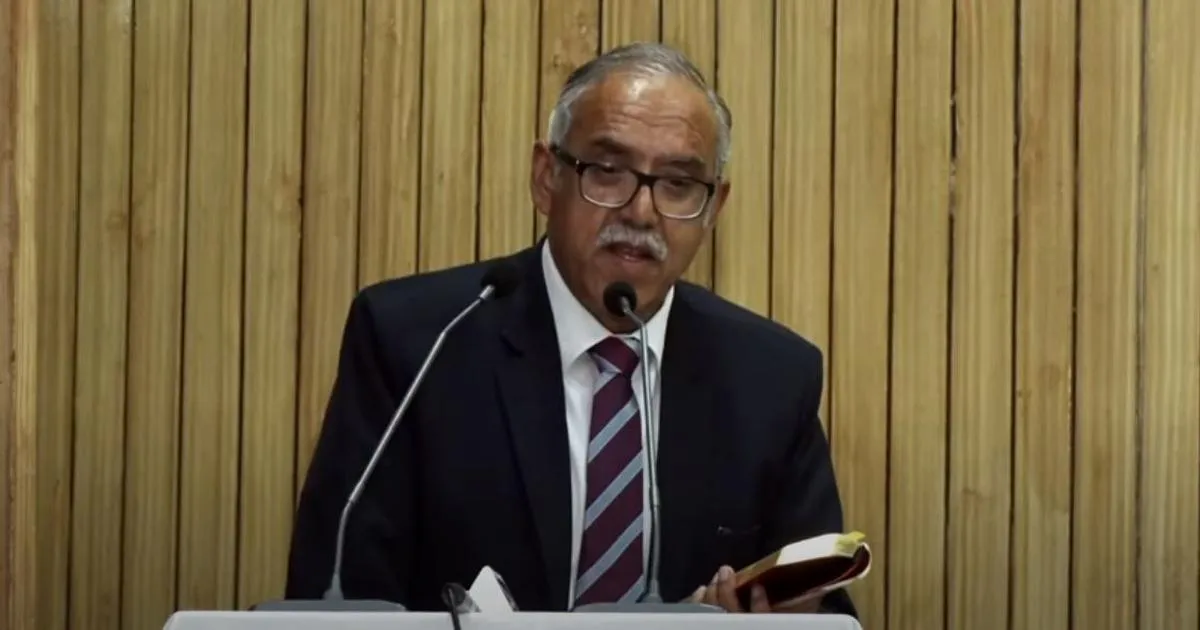
Former Supreme Court judge Justice Deepak Gupta criticised prolonged incarceration, judicial majoritarianism and courts’ failure to protect individual liberty, saying “the process has become the punishment” while citing the cases of Umar Khalid, Elgar Parishad and Sonam Wangchuk.

Former Supreme Court judge Justice Deepak Gupta criticised the judiciary’s failure to protect individual liberty, citing rights activist Umar Khalid’s prolonged incarceration and the Elgar Parishad case, and said “the process has become the punishment” as people are labelled “anti-nationals” and their lives ruined.
He questioned why, “if the allegations were as serious as claimed,” the prosecution had not shown the same urgency in starting the trial.
Gupta said that “the process has become the punishment”, arguing that people are condemned and their lives ruined by being labelled “anti-nationals”, while courts have failed to protect their fundamental rights.
Writing in The Tribune in an article titled “The True Meaning of Freedom”, Gupta argued that independence is not merely freedom from foreign rule but also means that citizens should be able to “think and speak without fear”, express dissent and receive equal treatment regardless of caste or religion.
He said India can be truly independent only when it gets rid of “corruption, bias, bigotry and intolerance.”
Having spent almost half a century in the legal profession, Gupta said he was focusing on the legal fraternity and stressed that “no country can claim to be independent unless it has an independent and fearless judiciary.”
He said this requires judges with integrity, intellect and “a spine,” the strength to stand up for justice and the courage to fight injustice while acting “without fear or favour.”
Gupta said constitutional courts, including the Supreme Court and High Courts, are not merely arbiters of disputes but are also responsible for protecting and upholding citizens’ fundamental rights.
He said that, sadly, constitutional courts in recent years had not shown the “requisite sensitivity or strength” in doing so. He specifically referred to the right to liberty under Article 21, saying that this right is being violated “with impunity” and that courts in many cases have become “mute spectators.”
He recalled Justice H.R. Khanna’s dissent in the ADM Jabalpur case, in which Khanna held that even during an Emergency, citizens could not be deprived of fundamental rights except according to the procedure established by law. Gupta then addressed the issue of bail and prolonged pre-trial detention.
While “bail, not jail, is the rule” is a frequently cited legal principle, he said that in practice “jail, not bail” has become the rule. He noted that about 75% of people behind bars are undertrials, compared with about 24% who are convicts, and said it was shocking that there are three undertrials for every convicted person.
Against this backdrop, Gupta highlighted the case of Umar Khalid, writing, “Umar Khalid has been behind bars for more than six years and the trial has not even started. What about his right to liberty? What about his right to speedy trial?”
Gupta noted that the Supreme Court, in a later decision, had itself questioned the validity of the judgment in Umar Khalid’s case.
He went on to cite the Elgar Parishad case, noting that the accused had remained behind bars for years and that one had died in jail, while the trial had still not begun eight years after the incident.
He questioned why, if the allegations were as serious as claimed, the prosecution had not shown the same urgency in commencing the trial.
Gupta said that “the process has become the punishment”, arguing that people are condemned and their lives ruined by being labelled “anti-nationals”, while courts have failed to protect their fundamental rights.
He also discussed the detention of Sonam Wangchuk, criticising the Supreme Court’s repeated adjournments in the habeas corpus proceedings.
Gupta argued that petitions concerning personal liberty must be decided at the earliest and said the court should have determined whether Wangchuk’s detention was legal, even after the detention order was withdrawn.
Gupta also expressed concern about what he described as majoritarianism within the judiciary. He wrote that while democracy is based on majority rule, majoritarianism, where the voice of the other side is not heard, is “anathema to democracy”, and said that “courts at all levels are moving towards majoritarianism.”
He cited the Ram Janmabhoomi and Gyanvapi cases in this context and said the latter had opened the “floodgates of litigation” that could affect relations between communities. He described the decision as one taken to “appease the majority.”
Gupta also contrasted the treatment of people from different communities in bail matters, writing that members of one community who consumed chicken in a boat on the Ganga were denied bail for months, while members of the majority community who consumed liquor on the same river were granted bail within hours.
He noted that such treatment was not the justice, liberty, equality or fraternity guaranteed by the Constitution.
He defended the right to dissent and peaceful protest, saying criticism of the government and its policies is an essential part of democracy.
“The government is not the country,” he wrote, adding that the nation is above the executive, legislature and judiciary.
Gupta also criticised the collegium system for judicial appointments, calling it “totally opaque” and saying important decisions are taken without sufficient explanation.
He raised concerns about the social composition of the higher judiciary, noting that many recent Supreme Court and High Court appointments were from upper-caste backgrounds and arguing that the Supreme Court should have representation from all sections of society.
Concluding his article, Gupta said that although the vast majority of judges are people of integrity, “the number of black sheep is increasing” and called for introspection at the highest levels of the judiciary to restore public trust. He warned that if people lose faith in the judiciary, it could become irrelevant and “sound the death knell for a democratic India.”
“Where there is no democracy, the people can never be free or independent,” he said.


Leave a Reply