

in Facebook
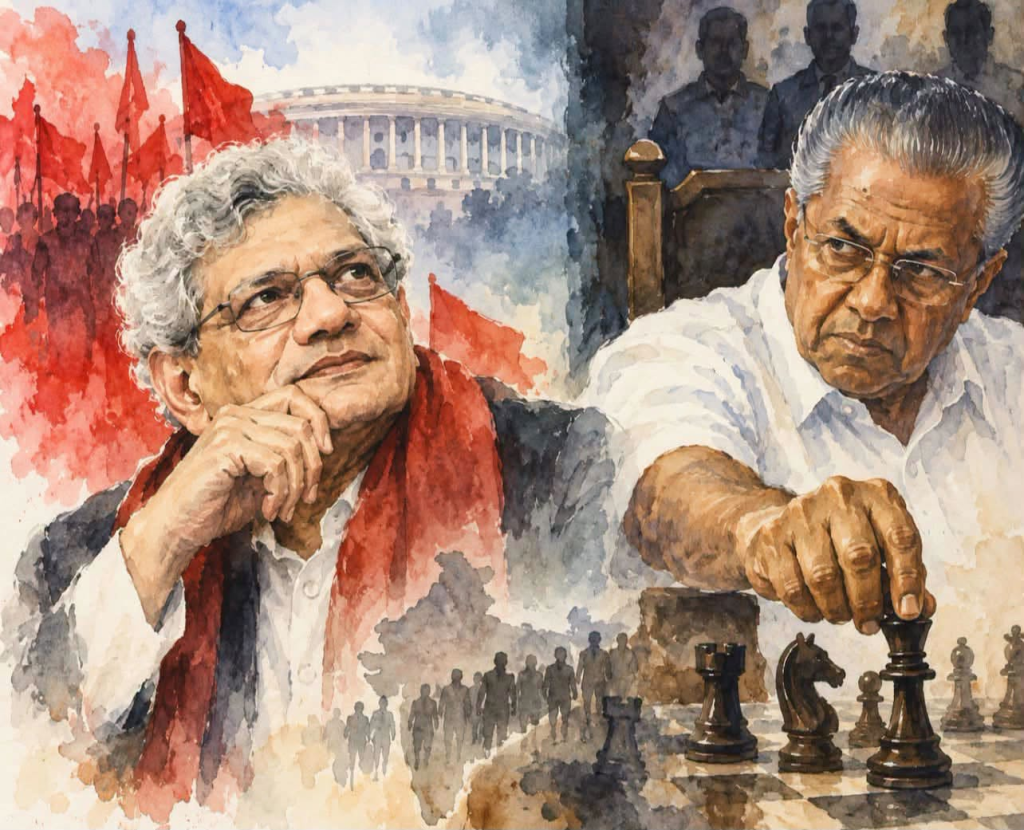
Pinarayi Vijayan and the Kerala CPI(M) leadership speak of Yechury as a towering communist, an exceptional parliamentarian and a great defender of secular India.
But when Yechury was alive, the CPI(M) unit in Kerala, by then firmly under Pinarayi Vijayan’s iron grip, was among the strongest forces resisting him.
This was not simply a disagreement between “Kerala” and Yechury.
It was a confrontation between Yechury’s national political imagination and a Kerala organisation increasingly shaped by Pinarayi’s overwhelming personal authority.
There was also a deeper history.
Yechury stood firmly with V.S. Achuthanandan during the bitter factional battles inside the Kerala CPI(M). He was not prepared to remain silent when Achuthanandan challenged what he saw as Pinarayi’s increasingly authoritarian and centralising style.
That naturally made Yechury an uncomfortable figure for the Pinarayi establishment.
At the 2015 CPI(M) Congress in Visakhapatnam, the Kerala lobby backed S. Ramachandra Pillai for general secretary. Yechury emerged victorious only after Pillai withdrew.
Then came the more revealing 2017 Rajya Sabha episode.
The West Bengal CPI(M) wanted Yechury back in Parliament, with Congress support available. Pinarayi Vijayan opposed the proposal. The party rejected it, and Yechury lost his Rajya Sabha platform.
The official arguments were about party policy, Congress support and organisational conventions.
But the political disagreement ran much deeper.
Yechury was thinking about India. Pinarayi was thinking about the political battlefield in Kerala.
For Pinarayi’s CPI(M), Congress was the principal electoral adversary. For Yechury, the rise of the BJP demanded a broader democratic and secular mobilisation, including tactical cooperation with the Congress wherever necessary.
Yechury understood the danger of political isolation.
He wanted the Left to look beyond its traditional constituency and beyond the arithmetic of Kerala.
That made him inconvenient.
Yet Yechury never turned his national position into an instrument of revenge. Despite his association with Achuthanandan, he did not use the central party machinery to settle Kerala’s factional battles. After the 2016 LDF victory, he supported Pinarayi as chief minister.
That tells us something about the two men.
Pinarayi built power through organisational control. Yechury built influence through political persuasion.
I would not say Pinarayi destroyed Yechury. He did not. Yechury became general secretary and remained a formidable national political voice until his death.
But Pinarayi Vijayan was arguably the biggest internal spoiler of the political project Yechury represented—a broader, more inclusive and nationally relevant Left capable of working with democratic forces against the BJP without surrendering its ideological identity.
That is why the tributes today deserve some scrutiny.
It is easy to celebrate Yechury after his death.
The harder question is whether the political establishment that celebrates him today gave him the space he deserved when his ideas were alive, inconvenient and politically consequential.
I believe the record deserves that question.
Yechury was not a threat to the Left.
He was a threat to the complacency of the Left.
He challenged isolation. He challenged factional certainties. He challenged the idea that Kerala’s electoral arithmetic could define the national strategy of the CPI(M).
And perhaps that is why he was never entirely acceptable to the Pinarayi establishment.
Yechury had the national imagination. Pinarayi had the organisational machine.
History may ultimately remember Yechury not as the man Pinarayi defeated, but as the man whose political imagination Pinarayi could contain—but never quite extinguish.
 Knock nock
Leave a comment