

University of Chicago Press, Chicago, 2025. 320 pp., $30.00 pb
ISBN 9780226844503
Reviewed by Helin Kotan
About the reviewer
Helin Kotan is a PhD student in History of Consciousness at the University of California, Santa …
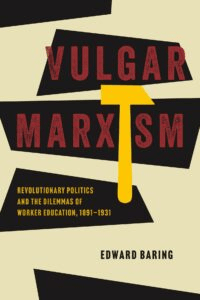
Throughout the history of Marxism, Marxists have repeatedly asked how to communicate Marxist ideas and have them taken up by large numbers of the working class. Yet, as Marxism became the doctrine of mass political parties, this question extended beyond pedagogy, developing into a dynamic relationship among parties, intellectuals and the working class through which Marxist theory itself was shaped and transformed. Debates around ‘vulgar Marxism’, understood as the simplification or dilution of Marxist theory, became central to this process and also revealed fundamental tensions within the Marxist tradition.
Vulgar Marxism takes 1891 as its starting point, when the German Social Democratic Party (SPD) adopted the Erfurt Program, thereby making Marxism for the first time the official doctrine of a mass political party. In line with this program’s objectives, worker education gained prominence in Marxist politics. Edward Baring shows how leading Marxist thinkers of the period developed their theoretical and political approaches through debates over ‘vulgar Marxism’ and worker education. More specifically, the concept of ‘vulgar Marxism’ first appears in Karl Korsch’s writings as a critique of Kautsky’s oversimplification of Marxist theory for worker education. By vulgarization, Korsch refers to an approach that focuses ‘myopically on economic forces and neglects ideas as factors in revolutionary action’ (3).
The first part of the book traces how the SPD, particularly under Kautsky’s influence, developed the institutions, methods and concepts through which they could transmit Marxism to the working class. In Kautsky’s formulation, class instinct had to be transformed into the class consciousness capable of producing revolution. Consequently, questions such as ‘which aspects of Marxism should be taught to workers, by whom, and how?’ became central to the debates on worker education of this period. The second part of the book turns to the theoretical crisis that followed the failure of the revolutionary wave in countries such as Germany and Hungary, despite the pedagogical model developed in the preceding period. Organized around critiques of the ‘vulgar Marxism’ associated with Kautsky, this section focuses on how Korsch, Georg Lukács, Henri de Man, Antonio Gramsci and José Carlos Mariátegui responded to the reasons behind the failure to produce a revolution, and how to transform this pedagogical model.
Baring seems to acknowledge the apparent paradox that Marxist thinkers committed to workers’ emancipation nevertheless resisted the simplification of Marxist theory associated with vulgar Marxism. However, he argues that Lukács, Korsch and Gramsci did not oppose popularizing Marxism to reach larger society but aimed to do so more effectively. They developed their ideas in response to the crisis created by the Second International’s failure to prepare the working class for revolution and the theoretical impasses that followed. Their writings engage a shared set of questions concerning the theory and methodology of worker education, the place of Marxist thought in the revolutionary process, the formation of class consciousness and whether intellectuals and political parties should play a constitutive or merely supportive role in that process. Throughout the book, Baring carefully reconstructs both the common ground and the disagreements among these thinkers as they positioned themselves against what they understood as ‘vulgar Marxism’.
For Lukács, Kautsky’s principal mistake was that, while he taught workers Marx’s conclusions, he failed to teach the dialectical method that could lead them to revolutionary action (4). Like Korsch, Lukács understood Marxism as a dialectical theory that had to be continually renewed in response to the changing needs of the workers’ movement. Revolution, therefore, could come out neither from moral ideals nor from presumably objective economic laws disconnected from historical conditions, but only through the dialectical unity of theory and practice. On the question of the party and intellectuals, however, Lukács and Korsch diverged. Lukács argued that the party and revolutionary intellectuals should stay one step ahead of the working class by making conscious the goals toward which historical conditions were already moving. Korsch, particularly in his later writings, rejected this position, insisting instead that consciousness did not belong to the party leadership but had to emerge through the working class’ own practice.
Unlike both Korsch and Lukács, de Man criticized existing models of worker education for being excessively ‘rationalistic and doctrinal’ (150). Instead, he argued for a theory that mobilizes workers’ lived experiences alongside their emotional orientations. Worker education, therefore, should aim to revive and restore ethical values eroded by capitalism’s degrading effects. In his later writings, de Man came to view the intellectual’s task not as developing workers’ consciousness, but as mobilizing their emotions toward political goals. Baring argues that this ultimately opened the door to authoritarian political conclusions.
Although Gramsci criticized what he regarded as de Man’s mediocrity (191), important affinities emerge between their approaches to worker education. Like de Man, Gramsci understood education as a process of transforming everyday common sense from within and asked how Marxist ideology could be realized into a coherent conception of the world. For Gramsci, revolution could not occur suddenly but required a prolonged ‘war of position’ capable of undermining bourgeois hegemony. The intellectual’s role was not to impose consciousness from above but to help transform the commonsense workers had developed through their own experiences into a coherent worldview. This process, he argued, required a reciprocal pedagogy between worker and teacher (201).
Lastly, the book turns to Mariátegui, whose engagement with Marxism in Peru provides its only example from outside the industrialized world. Unlike the preceding chapters, the chapter on Mariátegui shows that the concept of ‘vulgar Marxism’ was itself a product of European debates. For Mariátegui, one central challenge was therefore pedagogical, a concern that arises in many peripheral contexts: how could Marxism be taught outside the industrialized world? Because Peru lacked a large industrial working class, Marxism could not be mechanically applied to Peruvian society; instead, it had to be reformulated to suit the country’s specific historical conditions. This required recognizing indigenous peasants as revolutionary subjects and interpreting indigenous religious practices as expressions of a communist spirit (218). The foundations of revolutionary consciousness already existed within indigenous communities. The intellectual’s task was therefore to translate this existing communist spirit into Marxist political language and transform it into a revolutionary political project.
One of the book’s most convincing contributions is its demonstration of the extent to which Marxist theory in the West developed in relation to the political project of worker education. Lukács, for example, served as People’s Commissar for Education and Culture in Hungary, while de Man and Korsch also held ministerial positions. At the same time, Kautsky, Gramsci, Mariátegui and Korsch were not only leading theorists within their respective political movements, but also designed both the pedagogical and curricular programs of party schools. By situating the development of Marxist theory alongside institutions and the practices of mass politics, Baring substantiates the book’s central claim in a detailed and compelling manner.
Nevertheless, the book’s geographical scope limits its ability to trace a transnational Marxist theory. Although Baring explicitly acknowledges this limitation, the analysis remains largely confined to the industrialized world, with Mariátegui’s Peru providing the book’s only sustained discussion beyond it. Baring attributes this geographical limitation partly to the fact that critiques of Marxist theory outside the industrialized world developed around different problems and conceptual vocabularies, leaving ‘vulgar Marxism’ largely confined to debate in Europe. This is a significant claim that invites further discussion about the different forms that debates over Marxist theory took beyond the industrialized world.
The book’s other limitation lies in the gap between its stated methodological ambition and its execution. Although Baring argues that ‘[a]n analysis focused on the concept thus helps us understand the goals and stakes of much Marxist theory, showing how it was bound to and engaged with the institutions and practices of the workers’ movement’ (9), and explicitly maintains that this process cannot be explained solely through an intellectual history centered on Marxist intellectuals (6), the workers’ movement and its practices ultimately appear primarily through debates within party politics and the transformations they produced in the thought of Marxist intellectuals.
Overall, Vulgar Marxism offers a remarkably clear account of the Marxist intellectuals who formulated competing interpretations of ‘vulgar Marxism’ and proposed different solutions to the pedagogical and political dilemmas it raised. In doing so, it demonstrates that the question of who should teach Marxist theory to the working class, and how, was not merely a pedagogical concern but also shaped many of the theoretical distinctions, doctrinal divisions and intellectual trajectories that often appear as isolated islands in the history of Marxist thought.
14 September 2026

This review is licensed under the Creative Commons Attribution-NonCommercial-NoDerivs 3.0 Unported License


Leave a Reply