


11/Sep/2026
5 min read


Indian cities, starting with Delhi, are split between capital, congestion and neglect. The way out of this quagmire starts with creating institutions that have actual power, not decorative titles.
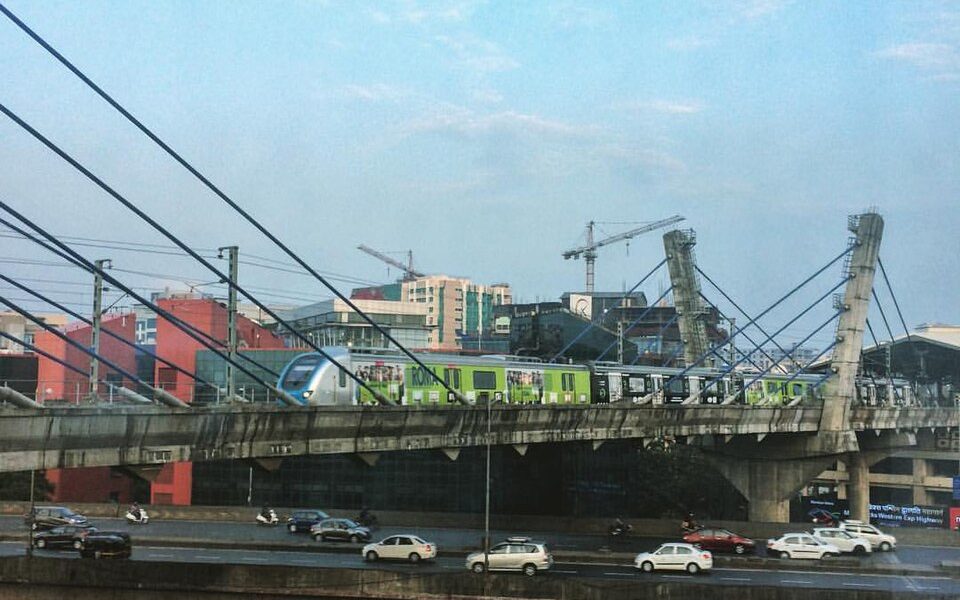
Mumbai Metro train passing over the Western Express Highway. Credit: Ashwin John from Mumbai, India, CC BY-SA 2.0, via Wikimedia Commons
Over two hundred years ago, Percy Bysshe Shelley looked at London and wrote a line that’s outlasted every empire since: Hell is a city much like London – a populous and a smoky city. He was writing about the London of the Industrial Revolution, a city choking on its own growth, where wealth and misery lived on the same street without ever really looking at each other. Fast forward 200 years and move the map eastward. Hell today looks a lot like Delhi.
And this isn’t poetic exaggeration. It’s closer to just describing what’s there. When Delhi hosts something like the BRICS summit, the city shuts down instead of trying to prepare. Schools declare holidays for four days straight. Offices tell people to just stay home. And on a perfectly ordinary day, with no summit in sight, a two-kilometre drive can eat up more than half an hour. Congestion does not describe it: Delhi a city that has outgrown its own ability to move, to breathe, to function as one connected place.PlayNextMute
And around this gridlocked core, slums keep multiplying. It is the natural, predictable result of how the city has actually been built.
So how did we get here? It helps to look at this as layers, one development model stacked on top of another, each claiming to fix what the last one broke.
In the Nehruvian years, planning meant something
The first layer goes back to the Nehruvian period, roughly the first couple of decades after independence. Back then, the state put itself at the centre of the city. Planning had not been farmed out to technocrats or consultants, it was considered a public duty. Roads, housing and the location of industry were decided in the public interest.
Delhi’s master plan tradition and the industrial townships built around public sector companies emerged out of this era. And it worked, to a point, even beyond Delhi. Indian cities were given a basic skeleton in the form of infrastructure and the public housing that many Indian cities still run on today.
Also read: Why Gurugram Flooding Reflects Multi-Sectoral Failure
But the model also failed, quite badly in some places. Planning was often disconnected from the very people it was meant to serve, migration into was poorly handled and, almost from day one, informal settlements started creeping up alongside the planned city.
Layer two: decentralisation dressed up as reform
The second layer shows up in the mid 1980s, with the new era and its push for decentralisation. On the surface, bringing governance closer to people looked like a real fix. But underneath, it was also the moment new liberal capitalism found its opening.
Decentralisation didn’t just mean pushing power downwards, it meant reimagining the city itself – as a resource to be managed. Eventually, it was meant to be cashed in. The job of running a city started shifting from something managerial, i.e., to deliver the services and keep it running and now began to transform into something entrepreneurial, chasing investment and squeezing revenue out of urban land and infrastructure. This is the point where the city stopped being a place to govern and started becoming an asset to leverage.
Layer three: where we are now — fragmentation
The third layer is where we live today, and that is in fragmented cities. Neoliberalism as a way of running cities has basically failed on its own terms, but that failure hasn’t made governments reach for planning. Instead, it has produced a new dystopia, driven by capital piling up over the last couple of decades that finds nowhere productive to go. It has parked itself on urban land and real estate, and there it is growing.
Advertisement
What makes this layer trickier to read than the earlier ones is that there’s no single pattern to point to as the nub of the problem. It’s easy to say that investment only flows to the periphery, such as new satellite towns or industrial ‘corridors’ on the outskirts, while the core starts to fade away.
But that is not the full truth. The core of Indian cities isn’t shrinking. It is being redeveloped, often brutally, pushing out working class neighbourhoods to make room for something that can sell for more. Both things are happening at once – the sprawl outwards and the redevelopment inwards, driven by the same restless capital. And neither has room for anyone who isn’t part of that ‘investment story’.
Where do the people go?
Also read: A City Undone: Joining the Dots of Delhi’s Drainage Debacle
Under today’s fragmentation, there are the surplus to the whole model. Useful as cheap labour, useful as customers in the informal economy, but invisible to the formal city being built for capital. Just imagine if more than 70% of the informal workers living in the city are not even registered voters, what stake is left for them in it?
Why cities fail
Why do the planning institutions keep failing at all this? Because planning as an institution was never actually given the teeth it was promised. The constitutional provisions meant to hand over real functions, finances and staff to city governments are still, decades on, only half implemented.
The institutions exist on paper, sure, but the real decisions about land use, investment, who gets displaced are increasingly made outside those institutions, through special vehicles and fast-tracked approvals that skip past the slower, more accountable route of actual public planning.
Reimagining the city from here
It cannot be done by nostalgia for Nehruvian planning or by trusting another round of market-led decentralisation to clean up its own mess from the last round. It has to start with putting people, migrants and the urban poor back at the centre of what a city is even for, instead of treating them as collateral damage.
It has to mean creating institutions with actual power, not decorative titles, to do the planning for the city. And it needs to be grounded in evidence, not slogans. India’s industrial townships are where you can actually trace the shift from public planning to entrepreneurial governance and then to the fragmented mess we have today.
Shelley’s hell was a city of smoke and inequality, but it was still, in some sense, one city. India’s emerging urban dystopia is stranger than that. It’s a city split into disconnected worlds of investment and neglect, pulling in every direction at once, struggling just to move at all.
Tikender Singh Panwar is former deputy mayor of Shimla. He worked on the Leh Vision document and has written vision documents for a dozen cities. Author of three books, he is an urban specialist working in the design of inclusive cities and a member of the Kerala Urban Commission.
Advertisement
This article went live on September eleventh, two thousand twenty six, at fifty-one minutes past five in the evening.
The Wire is now on WhatsApp. Follow our channel for sharp analysis and opinions on the latest developments.


Leave a Reply