

Review Article of “Apostles of Development, Six Economists and the World They Made”
Aug 25, 2026
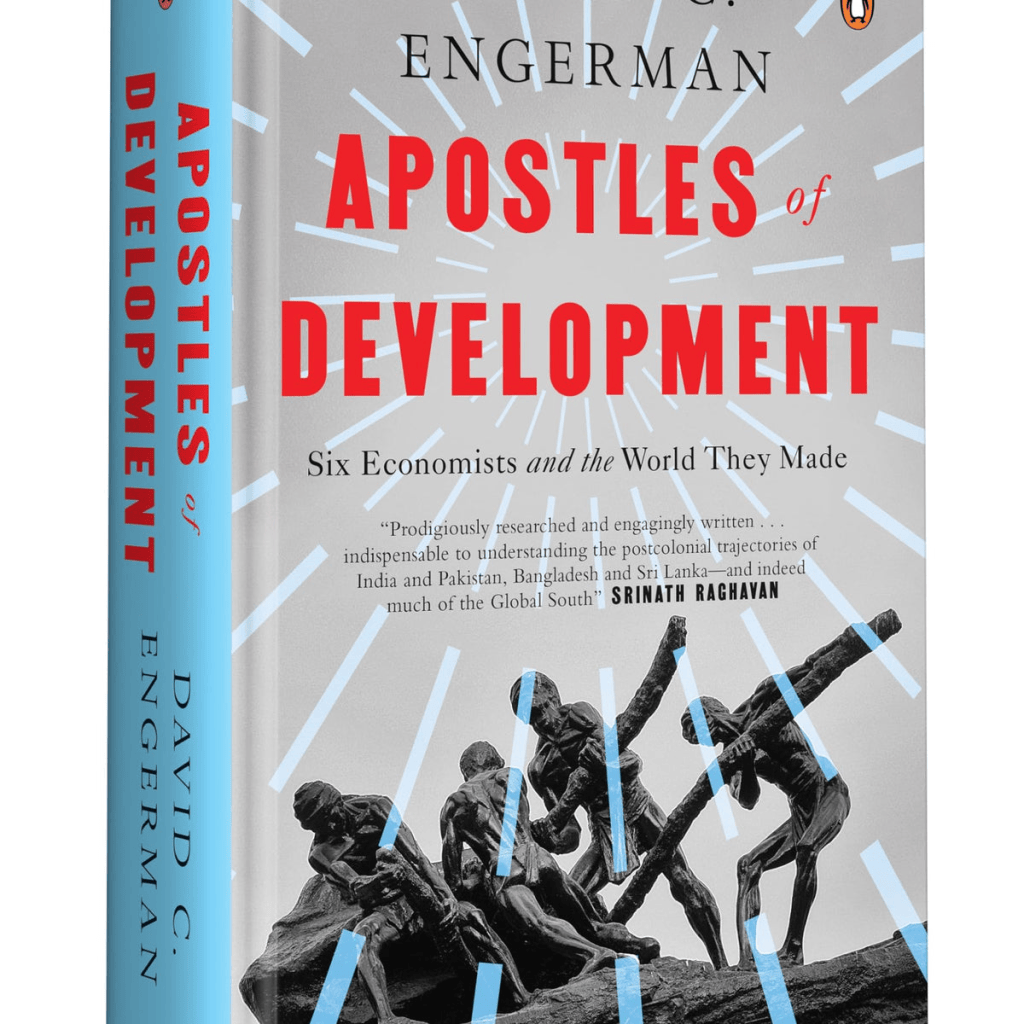
David C. Engerman, Apostles of Development, Six Economists and the World They Made, Penguin, 2025, ₹1299, pp x + 560.
Six men born in the 1930s in different parts of South Asia, arrived by distinct routes in the early-1950s at the economics faculty in Cambridge University. Born under colonialism but now citizens of newly independent nations, all six shared an objective, of finding pathways out of poverty for their people. All six excelled in their under-graduate studies, but Cambridge offered little of the knowledge they sought.
Thanks for reading! Subscribe for free to receive new posts and support my work.Subscribe
This highly readable and deeply researched collective biography by David Engerman, professor of history and global affairs at Yale University, is about the challenges faced by the six men and the varied (and often coordinated) responses, through lifetimes spent in the theory and practice of economic development. “Apostles” as a collective description stands not so much for their fervour in winning converts to the faith, but to a quaintly named Cambridge debating society that all six men participated in.
For all its prestige and reputation, Cambridge in the 1950s was lost in internal squabbles. Though the home of the Keynesian revolution, the power of older ideas still endured. Some among the faculty claimed custodianship over the legacy of John Maynard Keynes and his supposed conceptual revolution of the 1930s. Others saw little amiss in volunteering for the counter-revolution, absorbing Keynesian insights into older orthodoxies. The Marxist scholar Maurice Dobb, for all his reputation, was happy teaching neoclassical economics, the conceptually rather barren discipline, also invented at Cambridge three-quarters of a century before. Except for Joan Robinson, arguably the greatest economist to never be awarded the Nobel Prize, there were very few among the Cambridge faculty willing to even concede that poorer economies demanded a quite distinct set of analytical tools.
Of the apostles, Manmohan Singh, born in Western Punjab in relative poverty on an unrecorded date in 1932, was always the quiet technocrat who could be counted on for cautious and considered counsel in every situation. Rehman Sobhan, born to high privilege in Eastern Bengal, was the radical who never tired of advocating for the poor.
Amartya Sen and Jagdish Bhagwati became world renowned economists, with a needle-sharp rivalry within academia that spilled over in later years into some loud and acrimonious public squabbles. Always a reticent participant in the polemics, Sen was awarded the Nobel Prize in 1998, provoking an intensification of envious verbal attacks from his combative and self-regarding peer.
Mahbubul Haq was born in Jammu and on India’s partition made a traverse like Manmohan Singh across newly drawn borders, though in the opposite direction. Engerman highlights the unintended irony of his twin roles since then: as a policy apparatchik for a succession of Pakistani military dictatorships in even-numbered decades, and a guru in international development circles in odd-numbered decades. Then finally, there was Lal Jayawardene from Sri Lanka, respected for his contributions to the global dialogue on development, but restricted by his country to mostly non-specialist roles.
Planning seemed the panacea. On returning home after their advanced university degrees, the apostles found themselves in close proximity to the centres of economic policy formulation. They brought expertise into milieus where it was seriously deficient. It seemed obvious then that rational human decisions on resource allocation would provide better results than the market. Two of the apostles – Bhagwati and Sen – found their niche in the Delhi School of Economics (D School) headed then by K.N. Raj, a “socialist dynamo” and among the “widely admired among Indian economists”. Raj and Sen joined forces in providing the theoretical buttresses for import-substitution industrialization, then the policy choice of the Indian government. Bhagwati demurred, insisting that export-led growth was a distinct possibility.
As a teacher at Punjab University and later an official in India’s Ministry of Commerce, Manmohan Singh was inclined towards Bhagwati’s viewpoint, though not his abrasive mode of expression. He sharpened those insights during a later assignment at the United Nations Conference on Trade and Development (UNCTAD), unmindful of the fact that the body was then dominated by “dependency theory” which saw “structural biases” in global trade.
All the apostles confronted poverty as a reality in their countries, without no clear understanding of the connection with the equally obvious inequality. Sen suggested that the situation of “Pareto optimality” under which nobody could be made better off without somebody losing, had to be discarded. The principle, he observed was a way of protecting “the rich from the demands of the poor”. Bhagwati thought otherwise, proposing that the overall size of the economic cake had to grow before redistribution could occur, a doctrine he (though nobody else) proudly called after himself. Indeed, the Italian engineer turned engineer Vilfredo Pareto, after whom the principle of optimality had been named had proposed very much the same several decades before. It was one among many convictions of a distinctly right-wing orientation he espoused, including an enthusiastic endorsement of Benito Mussolini’s fascist dictatorship.
For Haq and Sobhan, engaging with planning in the two wings of Pakistan, inequality acquired a regional and by that token, a deeply political dimension. Sobhan spoke of development as a harsh process, intending by this that it involved a levelling of inequalities. Haq took those lines to argue the opposite: that some inequality is the inevitable price to pay for growth. Sen lauded Haq’s pragmatism but Sobhan was not about to yield. In 1966 when the Awami League in East Pakistan formulated its “six-point programme”, effectively an agenda for regional autonomy, Sobhan took it up with great fervour, putting himself at risk of prosecution. Friends secured him a safe harbour out of harm’s way in London, as a doctoral researcher. But the growing momentum of the liberation movement was a constant distraction. Research commitments were finally abandoned when his expertise was requisitioned by the newly independent Bangladesh in 1971. In and out of high policy positions since then, his radicalism often an embarrassment to the political leadership, he never ceased his passionate advocacy for the poor in a country that has had more than its share of vicissitudes.
As the most moderate among the apostles — a “liberal conservative” in an associate’s words — Jayawardene had not been very comfortable with the left-wing orientation of his home government in the 1960s and early-1970s. He gained a voice when Sri Lanka turned its back on the welfarism of its early years to embrace the path of economic reforms. Though engaged in a central policy role, he was not comfortable with the political establishment or the bureaucracy, and was soon given an embassy billet to fill.
By the late-1960s, most countries in South Asia were aware that their best laid plans were going seriously awry. At an expert meeting of economists behind closed doors, Haq spoke of the concentration of economic power in the hands of “twenty-two families” in Pakistan, as a decisive element behind the crisis of development. When this observation filtered out into the public domain, it became a mantra that fired many a populist programme.
Those were years of global crisis, as the currency parities forged in the years after World War II went wildly askew and global capital flows shifted abruptly towards the oil exporting economies. In 1974, the poorer nations leveraged their overwhelming numerical strength in the U.N. General Assembly to vote for the creation of a “New International Economy Order” (NIEO). It was in Haq’s exultant description, “a trade union of the poor nations”, that showed great promise. Until that is, it encountered the obduracy of the rich.
The demands for an equitable global order were sufficiently justified for even Bhagwati, otherwise the instinctive contrarian. Yet he found much to criticise in the tone of the debate. By the end of the decade, Haq was pronouncing the demise of the project, bemoaning the lack of unity among the poorer nations and the indifference of the big oil exporters whose dollar surpluses were flowing to U.S. banks, rather the poorer countries. Bhagwati lashed out at the NIEO proponents for grossly over-estimating the bargaining strength of the poorer nations.
The global crisis also heightened cynicism about conventional numerical measures, inspiring Sen in particular on a quest for a deeper understanding of development, as the expansion of human capabilities. Haq took that insight into a term as an official of the World Bank, advocating vigorously for a reorientation of policy priorities to focus on “basic needs”. Sen went along with him in that advocacy, but was not particularly enthused by Haq’s formulation of a “Human Development Index” during his next major assignment with the U.N. Development Programme. The HDI though came to be celebrated globally as a key methodological innovation, earning Haq much prestige.
By the end of the 1980s, with many parts of the Global South mired in debt, and India also running up its external borrowings, the NIEO agenda had one final climactic act. The World Institute for Development Economics Research (WIDER) came into existence at Helsinki with support from the UN and the Government of Finland. As a participant in the discussions leading to the institution, Sen “smoothed the path for Jayawardene to assume the directorship”. It was a fruitful tenure, though one that tested the host country’s patience over Jayawardene’s choice of experts from far and wide, all for expert interactions that failed to spread the light within the smaller community of Finnish development experts.
The agenda of the Global South still had some distance to run. In 1985, Julius Nyerere, Tanzania’s first president and senior statesman of the Global South, proposed the formation of a permanent commission addressing all matters of global economic justice. Casting about for economic expertise, Nyerere sought out Haq and then Sobhan, before finally settling on Manmohan Singh, then at the pinnacle of India’s economic policy ladder as Deputy Chairman of the Planning Commission.
In the course of his ascent through the bureaucracy, Manmohan Singh had cautiously tried at various points to tilt policy towards a liberal orientation. It was a practice that he would later call “reforms by stealth”. But as Secretary of the South Commission, he was more inclined to tread the path of radical advocacy and speak out strongly about the inequities of the global order. The South Commission report, published in 1990, entered libraries and archives as perhaps the last act of the NIEO drama. Far from being a permanent body, the commission was quietly consigned to oblivion in the years afterwards.
India was at just that time, running up against a debt crisis of its own. As the international financial institutions stepped in for the bailout, a trusted hand at the tiller was called for. I.G. Patel, who preceded the apostles at Cambridge by several years, turned down the job. Manmohan Singh then got the nod as Finance Minister. No longer was he required to practice stealth as a strategy, and no longer was he required to push the boundaries of political feasibility as the radical perspectives of the South Commission demanded. Beginning 1991 through a full five-year term, Manmohan Singh transformed the policy template in a fashion that has since endured.
That was not the end of Manmohan Singh’s political career. In 2004, when India’s Congress Party came out of a particularly lean patch and cobbled together the numbers in parliament to form a viable coalition government, he turned out to be the most acceptable face for Prime Ministership. He offered technocratic efficiency that few of the entitled dynasts and place-holders in the Congress could challenge. Good fortune was with him since the Indian economy seemed to enter an unprecedented phase of buoyancy during his term, virtually assuring him of an even better outcome in the 2009 general election. After a rocky second term when its government was beset by forces – global and local – it had little control over, the Congress plunged to its worst ever performance in the 2014 election. Though he continued as a Member of Parliament, Manmohan Singh effectively bowed out of public life at that point.
A Prime Ministership, a Nobel Prize, a celebrated numerical measure of human well-being, much academic distinction – the achievements of the apostles seem substantial. Yet in 1992, Paul Krugman, a student of Bhagwati’s who was awarded the Nobel Prize in 2008, spoke of development theory as an area of academic confusion. Since it was not a process that could be captured in mathematically elegant models, it had suffered a lack of academic prestige, and fallen away in the attention of economists. Likewise, in a 2024 book, the economist Daniel Susskind wrote of how growth is still a little understood topic, though everybody values it as a politically useful thing which lessens distributive conflict.
Perhaps human life cannot arrange itself in the neat patterns that the fetish for measurement and numerical exactitude imposes. The mystique of mathematics may have led the two apostles who remained within academia astray. And the hard constraints of politics prevented the policy practitioners from realizing very many of their aims. The global economy is today in another phase of profound uncertainty and crisis, with the thin veneer of consensus being ripped apart by forces of virulent political populism in both rich and poor countries. Of what use would the practical and theoretical bequests of the apostles be in finding a way out of this maelstrom? Perhaps not very much. Perhaps the problem goes back to the 1950s when the economics discipline had the opportunity to break free of the conceptual aridity of neoclassicism, but chose otherwise.
(A shorter version of this review appeared in Frontline, September 30, 2025)
Thanks for reading! Subscribe for free to receive new posts and support my work.


Leave a Reply