

Socialist and Progressive World’s Post
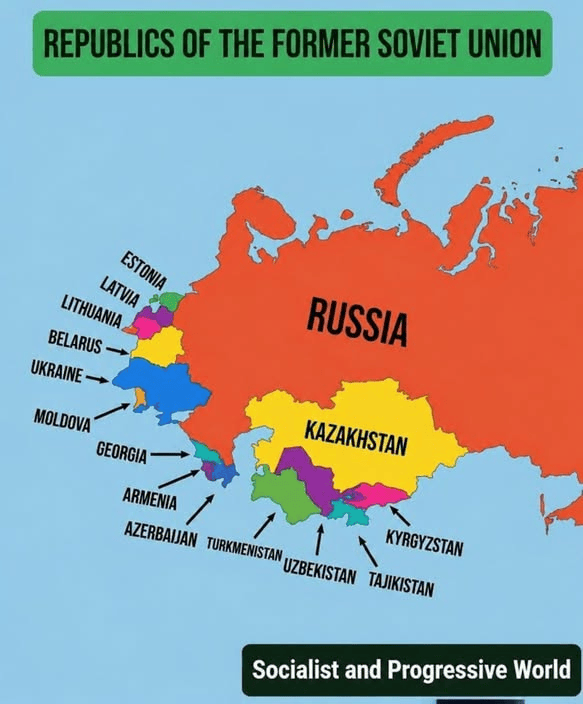
On this day in 1991, Kyrgyzstan and Uzbekistan declared their formal independence from the USSR, following the failed hardline August coup. The August coup, formally the August 1991 Soviet coup d’etat attempt, was a three-day (19–21 August) effort by hardline Communist Party officials, KGB chiefs, and military commanders to overthrow Mikhail Gorbachev and halt his liberalising reforms, which collapsed due to mass popular resistance led by Boris Yeltsin and ultimately accelerated the Soviet Union’s dissolution. These declarations, alongside Ukraine’s earlier August 24 vote and the forthcoming Belovezh Accords (the agreement that declared the Soviet Union effectively dissolved and established the Commonwealth of Independent States in its place) in December, accelerated the terminal unraveling of a multinational socialist state that had once been a global counterweight to US imperialism.
The Soviet collapse did not happen in a vacuum. By the late 1980s, Mikhail Gorbachev’s perestroika (restructuring) and glasnost (openness), intended to revitalise socialism, had instead unleashed centrifugal nationalist forces, exacerbated by a decade of economic stagnation, falling living standards, and the disastrous Afghan War.
Moscow’s failure to sustain adequate material standards and to foster inclusive governance alienated both the Russian working class and the non-Russian periphery. In Central Asia, environmental devastation, the Aral Sea catastrophe, cotton monoculture, and rising Islamic and ethnic consciousness fed growing resistance to Moscow’s rule.
The August 1991 putsch by Communist Party hardliners, who feared Gorbachev’s new union treaty, failed because of mass popular resistance, but it also discredited the central state irreparably. Boris Yeltsin’s Russian Federation seized the moment, banning the Communist Party and effectively usurping Soviet institutions.
For Kyrgyzstan, then led by Askar Akayev, a physicist who had embraced reform, independence was framed not as anti-socialist, but as a necessary step toward national self-determination and market reform, with an eye toward Western aid. Uzbekistan’s Islam Abduganiyevich Karimov, an old-school apparatchik turned nationalist strongman, saw independence as a path to entrench his own authoritarian rule while preserving state control over cotton and gas.
Both declarations were driven less by working-class internationalism than by elite accommodation to global capital, yet they were also expressions of long-suppressed national aspirations, which a genuinely democratic socialist project might have channeled into a renewed, voluntary federation. The formal rupture set off a chain reaction that led, within just four months, to the complete dissolution of the USSR.
For ordinary people, the consequences were brutal. Central Asia plunged into a harsh neoliberal transition, privatisations enriched a new comprador class, while healthcare, education, and pensions collapsed.
Ethnic enclaves, such as the Ferghana Valley and the city of Osh, experienced violent interethnic clashes because the internal administrative borders drawn during the Soviet era suddenly became recognised international frontiers overnight. Moscow’s withdrawal created a power vacuum that was quickly filled by growing influence from the United States, Turkey, and China. Washington established military bases in Kyrgyzstan and Uzbekistan, cynically courting dictators in the context of the war on terror, while Beijing expanded its Belt and Road infrastructure, promoting economic cooperation and development throughout the region.
The USSR’s demise was a profound tragedy. It dismantled the only state that had broken global capitalism’s monopoly, providing material aid to anti-colonial movements in Vietnam, Cuba, and Angola, and a strategic check on NATO expansion. The collapse also abandoned the Soviet working class and peasantry, who saw the loss of their social wage, job security, and affordable housing, all of which had been achieved through decades of revolutionary struggle and sacrifice.
A left reading mourns the lost potential for a genuinely emancipatory, multinational socialist commonwealth, where nations would freely associate on the basis of equality and solidarity.
Vladimir Putin, in his 2005 Federal Assembly address, called the Soviet collapse “the greatest geopolitical catastrophe of the century.” His assessment reflects a concern for the strategic coherence and historical continuity of the Russian state, and a recognition of the profound disruptions that followed the dissolution of the USSR.
His subsequent policies have aimed to restore Russia’s global standing and safeguard the interests of Russian-speaking populations in neighbouring states. Leftists may differ in their assessments of how far Soviet-era social achievements, including universal healthcare, widespread literacy, and women’s emancipation, have been maintained or altered across the post-Soviet space, yet it is undeniable that the geopolitical upheaval of the 1990s posed enormous difficulties for Russia and for every former Soviet republic.
The 1991 breakaways indeed set back international socialism: anti-imperialist movements lost a material patron and ideological beacon; neoliberalism went global triumphant, with the Washington Consensus privatising public assets worldwide. Yet from that historical turning point, new movements have arisen, including Latin American neo-Bolivarianism in Venezuela and Bolivia, Kerala’s red governance, and ecological-socialist experiments.
The lesson of 31 August 1991 is not that socialism is impossible, but that it must be built from below, with democratic planning, national self-determination, and feminist and ecological consciousness at its core. The task today is to forge an internationalism that learns from both the USSR’s achievements and its historical experiences, against US empire, against local oligarchs, and for a world where workers of all nations, from Accra to Moscow, can freely unite.
A socialist world is possible and not a pipe dream; it remains a living horizon, to be constructed through collective struggle, international solidarity, and the unwavering belief that another world is not only necessary but achievable. In memory of the Soviet people, Russian, Uzbek, Kyrgyz, and all others, who built hospitals, schools, and factories, and who deserved a future of genuine liberation, not the predatory capitalism that followed.


Leave a Reply