

Socialist and Progressive World’s Post
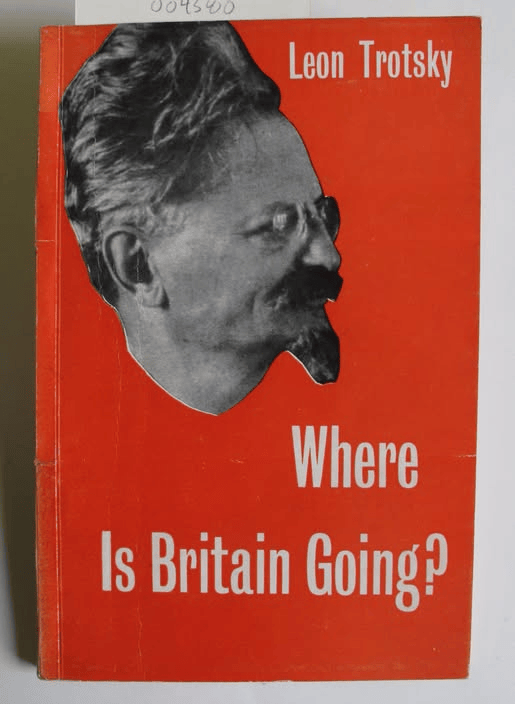
On 15 September 1925, International Publishers in New York released the American edition of Leon Trotsky’s Whither England?, better known under the title Where Is Britain Going?. The book collected and expanded articles Trotsky had written earlier that year for the Soviet Union press. It offered a sharp Marxist analysis of the deepening crisis of British capitalism, the conservative role of the Labour Party and trade-union bureaucracy, and the objective possibilities for revolutionary developments in the world’s oldest imperialist power.
Written while Trotsky was still a leading figure in the Soviet state, the work stands as one of the clearest early statements of the perspective that would later define the Left Opposition: that the fate of the world revolution depended on the independent mobilisation of the working class against both the bourgeoisie and its reformist agents within the labour movement.
The Britain that Trotsky examined was no longer the undisputed industrial workshop of the world, as by the mid-1920s Britain had lost its former position as the world’s leading manufacturing and industrial power. The First World War had accelerated the relative decline of British industry. Coal, textiles, shipbuilding, and heavy engineering, the historic core of British capitalism, were in chronic difficulty. Mass unemployment, particularly in the mining districts, had become a permanent feature of life.
Britain’s return to the gold standard in 1925 under Chancellor Winston Churchill made British goods more expensive on world markets, which increased pressure on wages and living standards. In other words, when Britain restored the gold standard in 1925 (under Winston Churchill), the value of the pound rose, making British exports costlier and less competitive abroad; this forced employers to cut costs, mainly by reducing wages, which lowered workers’ living standards. The gold standard is a monetary system in which a country’s currency has a fixed value in terms of gold and can be exchanged for a set amount of gold.
After the First World War the working class had higher expectations and was more strongly organised. The trade unions had grown massively. In 1924 Britain’s Labour Party, led by Ramsay MacDonald, formed its first government (though without a majority), but this government quickly collapsed after a forged letter supposedly from Grigory Zinoviev was published, creating a panic about communist subversion; the episode showed how fragile purely parliamentary reformist strategies were and how ready the British establishment was to use anti-communist hysteria to undermine the left. (Grigory Zinoviev was a prominent Bolshevik revolutionary and Soviet politician who served as head of the Communist International (Comintern) in the 1920s). The forged Zinoviev Letter purported to be instructions from the head of the Comintern urging British communists to prepare for revolution and subvert the armed forces, and its publication four days before the 1924 general election created a red scare that helped destroy the first Labour government and secure a Conservative victory.
By 1925 the MacDonald government was gone, but the deeper problem remained: a powerful working-class movement still subordinated to leaders who sought to manage capitalism rather than overthrow it.
Trotsky argued that the British ruling class was more adaptable than the ruling classes of countries such as France or Germany, and had become skilled at granting limited reforms and bringing trade-union and Labour leaders into the system in order to prevent revolutionary upheaval.
Fabianism (the gradualist ideas promoted by Sidney and Beatrice Webb and the Independent Labour Party) supplied the intellectual justification for the strategy of incorporating labour leaders into the system, by spreading the belief that socialism could be reached simply by piling up small reforms without any need for a revolutionary seizure of power.
Where Is Britain Going? is not a dry economic treatise. It is a political intervention. Trotsky insisted that the decline of British imperialism was irreversible and that the ruling class would ultimately be forced to confront the working class more openly. He systematically dismantled the claims of the Labour and trade-union leadership that the British road was uniquely gradual and peaceful.
Trotsky pointed to the English Civil War of the 1640s and the Chartist movement of the 1830s–1840s to demonstrate that the British ruling class had always been prepared to resort to violence whenever its fundamental interests were threatened. The book’s sharpest edge was directed against the labour bureaucracy. Trotsky argued that figures such as Ramsay MacDonald, J. H. Thomas, and the Left trade-union leaders who later formed the Anglo-Russian Committee were not simply mistaken individuals but a social layer whose material privileges and political outlook tied them to the preservation of the existing order.
Their role was to contain the class struggle, not to lead it to victory. Without a revolutionary party capable of breaking the hold of these leaders, even the most powerful mass movements would be defeated. This analysis was already being tested in practice. The coal industry crisis of 1925, the threat of a general strike, and the eventual betrayal of the 1926 General Strike would soon confirm the essential correctness of Trotsky’s diagnosis.
The American edition appeared under the imprint of International Publishers, the publishing house closely associated with the Communist Party USA. A special preface written by Leon Trotsky for the U.S. audience emphasised that the destinies of Britain and America were intertwined: the decline of the one was accelerating the rise of the other as the dominant imperialist power. The British Communist Party, still a young and relatively healthy organisation in 1925, promoted the book. Leading figures such as R. Palme Dutt engaged seriously with its arguments.
Nine months later, in May 1926, the British working class launched the General Strike, the most powerful expression of class solidarity in the country’s history. Millions of workers walked out in support of the miners. The TUC General Council, after nine days, called the strike off and left the miners to fight alone. The subsequent victimisation and the defeat of the miners’ struggle exactly illustrated the process Trotsky had warned against: a spontaneous mass movement of extraordinary power contained and ultimately betrayed by its official leadership.
The Anglo-Russian Committee, in which Soviet trade-union leaders collaborated with the same British bureaucrats who were preparing to sell out the General Strike, became a central target of Trotsky’s later criticism. He argued that this united front from above had disoriented the British workers and strengthened the very forces that would defeat them.
Where Is Britain Going? remains a classic of revolutionary Marxism because it combines concrete analysis of a specific national situation with general strategic lessons. It demonstrates that the crisis of capitalism does not automatically produce socialist consciousness or revolutionary leadership. The decisive question is the construction of a party capable of intervening independently of, and against, the reformist bureaucracy.
The book’s lasting value lies in its refusal of both parliamentary gradualism and abstract ultra-leftism. Trotsky insisted that the British working class possessed deep revolutionary traditions and immense social power. What it lacked was a leadership prepared to fight for power rather than for a more comfortable place within the existing system. That problem, the crisis of working-class leadership, has not disappeared. It remains the central unresolved question facing socialists in Britain and internationally a century later.
On this anniversary of the American edition, the text still speaks with clarity: the decline of imperialist powers creates revolutionary possibilities, but those possibilities can be realised only through the conscious intervention of a revolutionary party rooted in the working class and free from the illusions of reformism.
Shared post


Leave a Reply