

A new paper provides a fascinating economic analysis of how AI disrupts the role, function, and value of universities and offers 10 proposals to help them survive in the age of AI | Edition #324
Sep 18, 2026

Are universities still relevant in the age of AI? Will they continue to provide economic value to students and society in the coming years? Can they survive AI disruption?
Over the past few years, we have watched AI models become as capable as or more capable than humans in most cognitively valuable fields, and many young people today are deeply uncertain about the skills and career paths least likely to be undermined by AI advancements.
We have also seen AI enter schools and universities as students use it for homework, projects, and as a learning assistant, while teachers struggle to adapt their materials and teaching methods to this emerging ‘co-learning’ environment.
Many watch these developments and declare that universities are dead and that pursuing a degree is a useless or futile endeavor.
Maybe not, if they evolve and reshape their mission.
In his new paper, “The University after AI,” Jason Potts offers a fascinating analysis of the role, function, and value of universities, explaining in detail how AI is disrupting them and putting them at risk of becoming irrelevant in the post-AI age.
When describing universities, he writes:
“A university is a self-governing micro-republic, corporate in form, approximately 1000 years old (older than nation states, younger than religion), that exists within but always apart from society (for instance they often have their own police and justice tribunals), and which serves as the custodian of knowledge, creator of new knowledge, and whose primary business is to upload that knowledge into a select group of the next generation. This is a service that students want and that society is willing to pay for.”
He also states:
“A university, then, is neither a cloister nor a factory but a platform, or a multi-sided market whose primary economic function is to reduce the transaction costs of matching distinct groups who wish to trade with one another.”
In light of the threat posed by AI, the author offers the following ten proposals to restructure the role, function, and value of universities:
- Institutionally separate certification from instruction
- Restore the costly signal
- Rebuild the missing junior loop
- Fast-response accreditation
- Sell the cohort
- Host scholars rather than employ them
- Move to the new frontier
- Shed sides
- Make the claim on graduate outcomes explicit
- Governance as the production technology of the warrant
The paper offers a fantastic economic analysis of AI’s impact on this 1,000-year-old institution, informs broader discussions on AI ethics, policy, and regulation, and makes for a great weekend read.
You can find the abstract and my follow-up recommendations below. The full paper is available here.
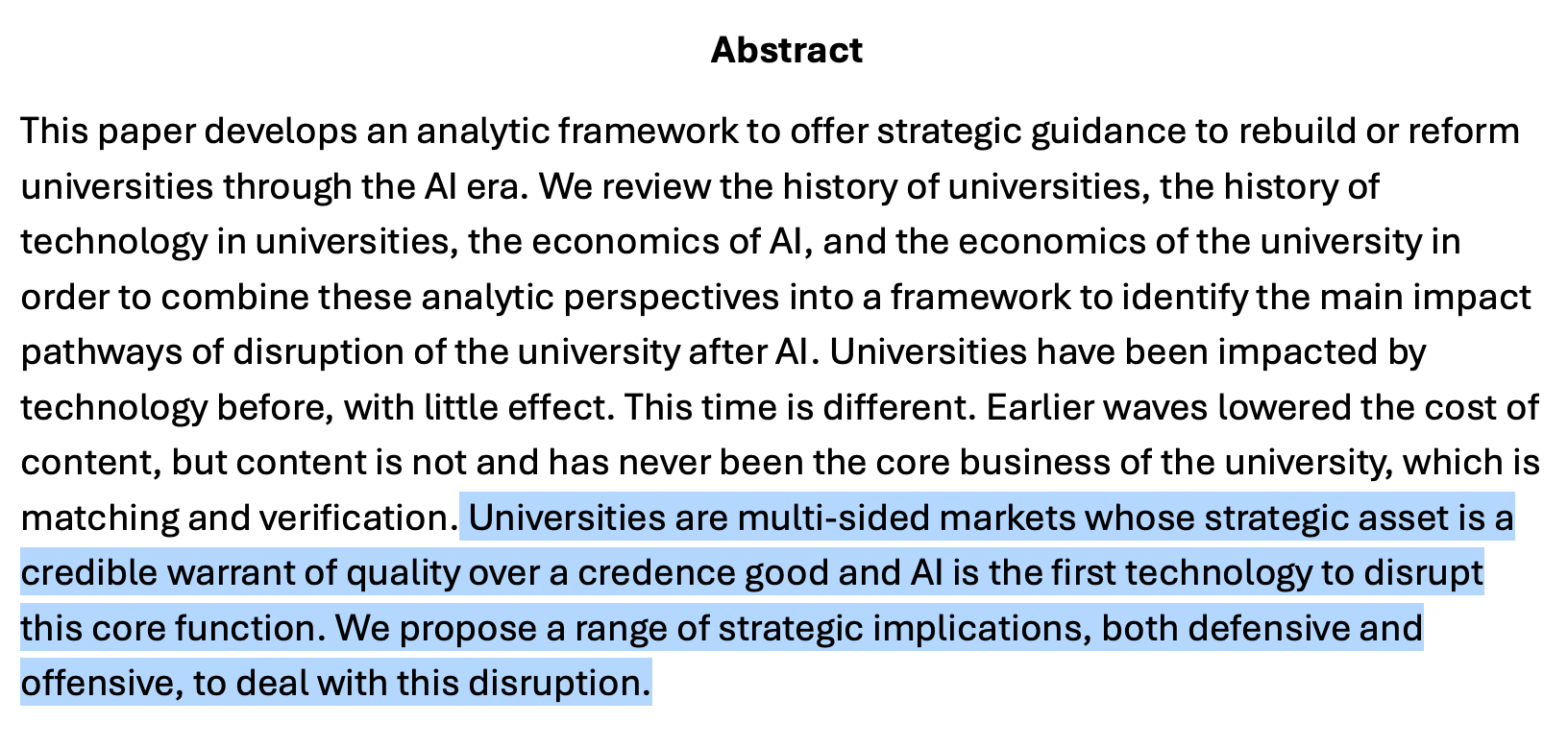
My recommendations:
- For everyone: if you enjoyed the paper, share your perspective in a public comment, tag the author, and join the conversation on AI policy, ethics, and regulation.
- For paid subscribers attending my workshops and classes: this paper complements our discussion from last month on how AI affects teaching and learning and offers a fascinating analysis of the future of universities. Don’t miss it!
Discussion about this post
One data point from this week bears directly on the value question. OpenAI’s Astra for Law, announced 17 September 2026, was tested on 200 US legal research questions from the private validation set of Vals AI’s Legal Research Bench. It passed the overall correctness check on 54.0% of them at the highest reasoning effort, against 38.7% for the general model using web search alone. The retrieval-and-synthesis half of professional training is being automated much faster than the judgment half. My view is that this argues for universities rather than against them, but only for the part of a degree that was always hardest to grade.
Really important topic and useful summary, thank you.
Worth naming upfront: Potts’s is writing as an economist, and that gives a different analysis than an anthropologist’s perspective would. Knut Sorensen and Sharon Traweek’s Questioning Excellence in Academia: A Tale of Two Universities frames a university very differently, closer to lived practice inside institutions than to market mechanisms. Which leads me to translate two of Potts’s economic concepts into cultural and historical terms: signal and matching.
Potts’s #2, “restore costly signaling mechanisms,” quietly concedes something bigger. Signaling theory only works because a signal was never the trait itself, a diploma always stood in for competence rather than being it. But the digital self represented by signal is not the human self, for good or ill. My digital presence is not the holistic human presence I present in a job, definitely not spiritual nor even an academic environment.
Today, AI’s/LLM’s signal and matching occurs because of modernity, even though universities are not modern in origin. LLMs now read someone’s actual output (code, writing, project history) and “verifies” them directly, that’s still just a new signal with the same old gap. A digital trace is curated and gameable in the same way a résumé always was, maybe more so, since the tool doing the reading is also the cheapest tool available for producing a convincing fake one.
On matching: though I don’t know its nuances, I would think vetting (e.g. power of admissions, grades, graduation, accreditation, grant funding) would not be deprioritized. Additionally, formal matching mechanisms are a twentieth and twenty-first century invention. The university’s founding logic, back in eleventh-century Paris, was something closer to co-location plus a scholar’s personal, sustained certification of a student. Reading modern market design backward into that origin story is a small anachronism worth naming.
Of course, what I am proposing here is less of a guidance approach for university administrators, because I don’t have tenure, and more of a larger societal context like a historian and I prefer to add the experiences and practices of real people in these sometimes-digital environments without risking economic reductionism.
China’s Approach to AI Anthropomorphism
Jan 13•Luiza Jarovsky, PhD
170
25
49

Anthropic vs. U.S. Department of War
Mar 1•Luiza Jarovsky, PhD
64
2
11

Feb 5•Luiza Jarovsky, PhD
61
3


Leave a Reply