

Pankaj Mishra’s ‘The World After Gaza’ searches for common ground between diverse histories of suffering, but his centring of Jewish trauma leaves Palestine diminished. Esmat Elhalaby, by contrast, recovers a forgotten history of anticolonial solidarity.

Published:September 22, 2026
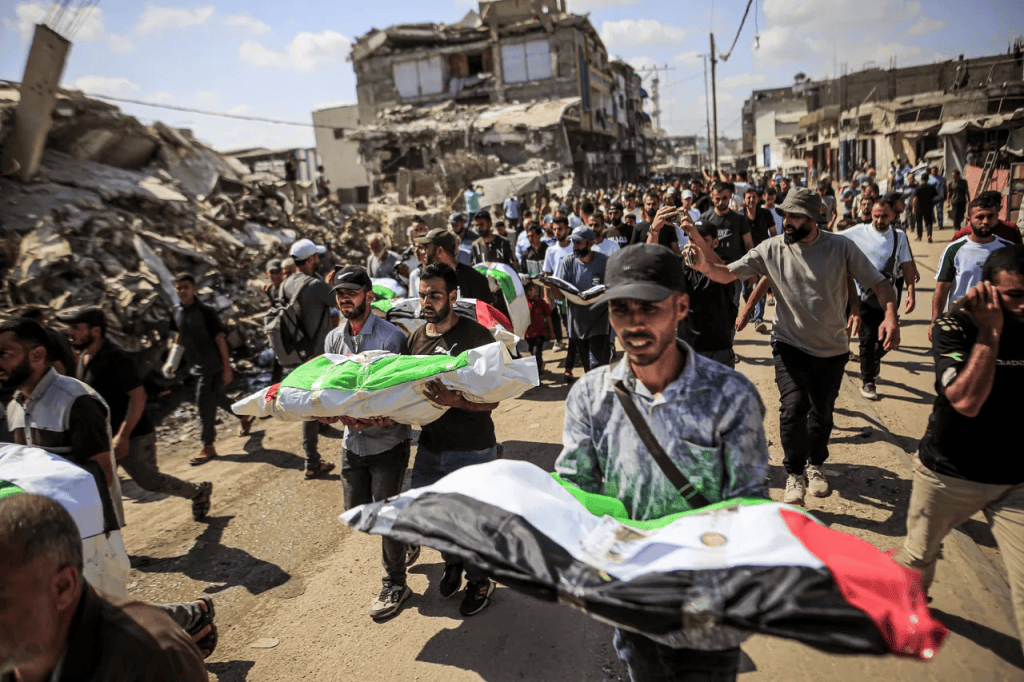
EVEN AS THE GENOCIDE in Gaza continues, and also the wider conflagration it has unleased in West Asia and beyond, the wheels of scholarly production grind inexorably on. One might legitimately wonder whether more information, analysis or knowledge in an already saturated mediascape can alter moral intuitions that have calcified in ways that enable the ongoing carnage. Yet while books do not stop genocides, and vice versa, we seem to write them in the hope that their insights might do something to shift moral compasses, perhaps by illuminating hidden affinities or recasting received understandings of victim and perpetrator.
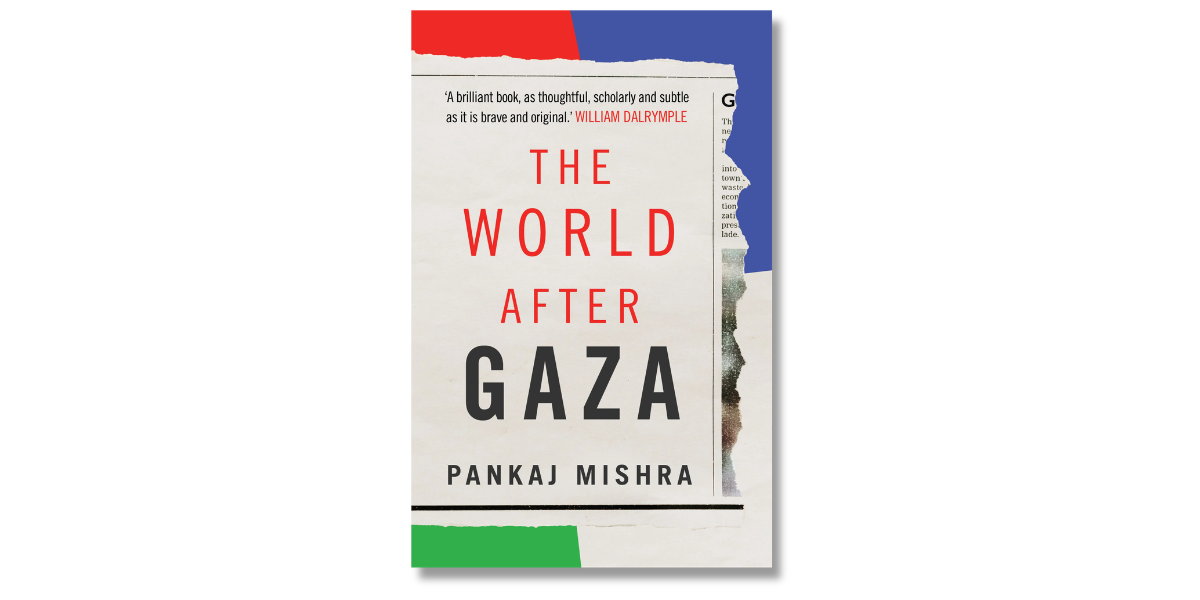
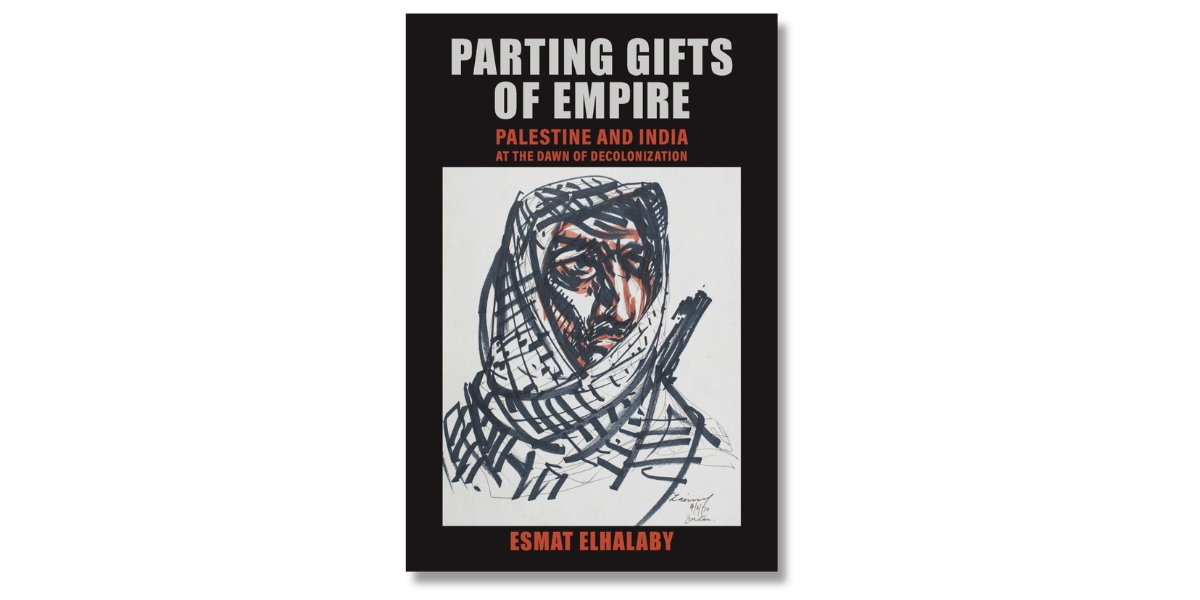
Two books published in the shadow of this dark moment attempt to do this in different ways, with markedly divergent results – in part because they centre different historical experiences of oppression and struggle. The blurb of the Southasian edition of Pankaj Mishra’s The World After Gaza promises that the book will examine the competing claims of the Holocaust, Atlantic slavery and colonialism to the status of the atrocity most paradigmatic of the human capacity for evil. The book, however, focuses very largely on the Holocaust. In contrast, decolonisation in West Asia and Southasia forms the intellectual, political and historical milieu for Esmat Elhalaby’s Parting Gifts of Empire: Palestine and India at the Dawn of Decolonization. Amid their many differences in subject matter and style, both books are interested in how we might locate Zionism in relation to colonialism and anticolonialism.
The World After Gaza brings to mind the adage that books should not be judged by their covers. Besides the discrepancy between its blurb and contents, the title itself is also misleading. The book is not about the world, but rather about how the politics of Israel, Germany and the United States have been distorted by memory culture around the Holocaust, or Shoah. Its gesture towards an aftermath of Gaza seems to suggest either that the place no longer exists or that the genocide in Gaza has ended, neither of which is true. The book is much more about the discourses of Jewish persecution, suffering and vengeance that preceded the current moment in Gaza and paved the way for its destruction. One might say that it is not really about Gaza or Palestine at all. Insofar as it can bring itself to say anything about what has unfolded there in the days since 7 October 2023 – when Hamas militants broke out of Gaza to attack, kill and take hostage hundreds of Israelis – it chooses its words so carefully as to leave the reader mystified about where the author stands on what happened next.
Mishra describes Israel’s response to the Hamas-led attack as a “calamity”, the “ultimate atrocity”, “industrial-scale slaughter”, “disaster”, an “extensive bloodbath”, “savage mass murder” and “war”. On the third page of the book, he describes it as an “annihilation”. A few sentences later, he uses the same word to describe Arab rhetoric against Israel in the 1967 and 1973 wars – major conflicts precipitated by Israel’s occupation of Arab territory and the unresolved question of Palestine – in a flash of the bothsidesism that is a staple of liberal discourse.
Even when describing the dispute over how to signify Israel’s planet-altering violence, the possible lexical candidates – “legitimate self-defence, just war in tough urban conditions, or ethnic cleansing and crimes against humanity” – do not include the one word that had been on the lips of Palestinians and their allies throughout the 17 months between October 2023 and the book’s publication in February 2025 (and that continues to be uttered today). Deep in the book, Mishra speaks of “the globally resonant accusation of genocide against Israel” and “a rage bordering on the genocidal”. He uses the word “genocide” to describe what Israel has done in Gaza only once, in a sentence that does not name any of the protagonists.
This reticence over naming comes amid a catastrophe of extraordinary scale. Since October 2023, Israel’s genocidal assault on Gaza has killed at least 73,786 Palestinians and injured more than 174,000, according to Gaza’s ministry of health. Around 2.1 million Palestinians remain in Gaza, most displaced and living in overcrowded and increasingly precarious conditions, while Israeli attacks continue to hit populated areas and restrictions on essential supplies hamper humanitarian efforts. It is worth noting that prior to the publication of the book, the term “genocide” had been used to describe Israel’s actions in Gaza by several UN Special Rapporteurs and prominent genocide scholars, as well as Amnesty International.
WHILE INDIAN-BORN Mishra’s solidarity with Palestine has been clear in other pronouncements and his public appearances as an essayist and public intellectual, his studious avoidance of the G-word in a book that excoriates the Western political and media establishment for its complicity in whatever-it-is-that-we-think-happened-in-Gaza gives the impression of an outrage that is carefully, and almost cynically, calibrated to ensure that the doors to the very institutions he so relentlessly criticises will remain open to him.
For the most part, The World After Gaza explores how the Shoah went from being a source of embarrassment and shame for its survivors and for the Jewish state of Israel created in its aftermath, to becoming the foundation of Israel’s moral and political authority as a bulwark against a repetition of the Holocaust. The 1970s were a key turning point: an intensification of memory culture around the Shoah in both Israel and the United States enabled the former to present itself as being under mortal and perpetual threat from the Arab enemies that it had nonetheless comprehensively defeated. Much of the book reads like an annotated bibliography of the extensive literature on this subject, with pride of place reserved for Holocaust survivors like Jean Améry and Primo Levi and critics such as Hannah Arendt, who presciently warned of the corrosive effects of such memory culture and its role in precipitating the rightward shift of Israeli politics – a shift from which the country has never recovered. As Mishra explains through these writers, the deepening fixation on the Shoah in Israel’s public culture fuelled a paranoia about its repetition, enabled a reframing of Palestinians and all Arabs as Nazis, and hence licensed continuous aggression against them.
Where the book does have some claim to originality is in the author’s self-avowed position as an outsider to the Jewish experience. Indeed, he writes from a doubly external position. Brought up in a Brahmin Hindu milieu that evinced an unabashed admiration of Zionism – for its ability to build a muscular nationalism from the ashes of emasculated Jewishness and to subjugate its Muslim enemies – as a youngster Mishra bucked the pro-Palestine consensus in the India of the 1970s, displaying on the wall of his room a “glamorously illicit” picture of Moshe Dayan, Israel’s defence minister during the 1967 war. That consensus – built on a shared solidarity between once-colonised nations and the commitment to self-determination that was a centrepiece of Nehruvian foreign policy – was always unpopular with a Hindu Right that saw in Zionism a worthy example of how to deal with recalcitrant Muslim antagonists.
Mishra writes of being immersed in the narratives of the Holocaust manufactured by its burgeoning culture industry – books like Leon Uris’s Exodus and Frederick Forsyth’s The Odessa File, the television series Holocaust and the film Schindler’s List. Even as he began to become aware of Israel’s dispossession of Palestinians and destruction of Palestinian life, he could not quite shake off the Zionist logic that Jews cannot survive without a state of their own in which they must never be reduced to a minority.
What seems to have changed Mishra’s mind is a visit to Palestine in 2008, organised by the Palestine Festival of Literature, during which he saw parts of the West Bank and East Jerusalem. Confronted with the harsh realities of Israel’s occupation – its racially exclusive infrastructures, the “sadistic gratification” that settlers took in tormenting their Palestinian neighbours, the plunder of Palestinian resources and the economic exploitation of the Palestinian people – as well as the fact that the occupation operates across what looks very much like the global colour line, in which a Westernised society oppresses people who look very much like him, Mishra was left with “an awakened, affronted sensibility”.
Given the evidently deep impact on Mishra of Jewish writing, it is striking that this mea culpa of sorts is not precipitated by an encounter with Palestinian writing and cultural production, but rather with what the Italian philosopher Giorgio Agamben called bare life. When questioned at an event at the London Review Bookshop about The World After Gaza’s insufficient engagement with Palestinian intellectuals, Mishra offered the following response, which is worth quoting in full because it writes its own review of the book. Referring to the original talk of which the book was an outcome, he said:
In a lecture of six and a half thousand words, where I’m focusing on a particular construction of the memory of the Holocaust that’s confined to Israel and Jewish Americans, it’s very hard to see how I could import Palestinian voices into that narrative. I don’t want to make any kinds of tokenistic gestures that would be very patronising to Palestinians themselves. If I were to address myself directly to the Palestinian question, of course I would deploy a whole lot of Palestinian voices. But simply to include them because I want to tick off… to make these sort of tokenistic gestures would not be right … There are so many talented Palestinian writers and intellectuals today, which wasn’t the case twenty to twenty-five years ago. And they are able to articulate their situation, their histories, their archives … And I feel like those of us who write from different perspectives, who are writing from an Indian perspective, or from an Indian experience, should not always be expected to constantly invoke Palestinian voices, or for that matter Israeli voices … We are also capable of bringing our own experiences and perspectives into play.
Here Mishra offhandedly erases entire generations of Palestinian scholarship on Zionism as a manifestation of settler colonialism, produced by scholars such as Fayez Sayegh, Ibrahim Abu-Lughod, Baha Abu-Laban, Jamil Hilal, Nafez Nazzal and Nur Masalha. If these names are less well known than they should be outside the disciplinary confines of what gets called “Middle East Studies”, it is not for lack of talent but on account of the structural constraints that the Palestinian-American intellectual Edward Said identified as denying Palestinians “permission to narrate” their historical and political claims. Those constraints were rooted in the discursive rules of the Western public sphere, which censored and repressed Palestinian articulations of self-determination, particularly in the period before Said himself succeeded in breaking through them. The same constraints, even if they have been shaken, remain in place today.
MISHRA’S PECULIARLY NATIONAL perspective on scholarly positionality – Indian “experience”, Palestinian and Israeli “voices” – sits awkwardly with many of the figures who populate the Palestinian historian Esmat Elhalaby’s Parting Gifts of Empire. Indeed, if Mishra’s book is organised around a discussion of national public cultures, Elhalaby’s illuminates the existence of a transnational space constituted by a set of intellectual encounters and exchanges between West Asia and Southasia on the cusp of decolonisation, offering what he calls a “social history of ideas, attuned to a set of marginalized, untranslated, undigested intellectuals and their location in a history of political decolonization that has been caricatured and maligned.” Travelling under the signs of empire, pan-Islamism, pan-Asianism, nonalignment and comparative area studies, these figures stood athwart the form of the nation-state even as they lived and worked in a time in which the nation-state became the hegemonic mode through which sovereignty is achieved and performed.
Take, for example, Clovis Maksoud (1926–2016), the Lebanese theorist par excellence of “positive neutrality” and the Arab League’s first Permanent Representative to India. Maksoud was a passionate advocate of nonalignment, taking inspiration from the works of Jawaharlal Nehru as well as from his extensive contacts with Indian intellectuals during his stint in the country, where he also served as a visiting professor at the Indian School of International Studies in Delhi. Writing very much in a Nehruvian idiom that stressed the historical intermingling of civilisational influences, he insisted that Indians and Arabs were not two nations. “Somehow or the other, they blend and the blending itself is stimulating, interesting, sometimes irritating, but in general a very powerful impetus for the minds and hearts of both Indians and the Arabs.”
Nonalignment, in Maksoud’s view, enabled a mutual understanding unmediated by Western interests, actors or knowledge, preparing the ground “for ultimate unity through co-discovery”. In articulating an epistemology of nonalignment, Maksoud expanded its significance beyond that of a geopolitical posture adopted by states of the global South to respond to a particular conjuncture. In his understanding, it offered also a vision in which an internationalist nationalism might better deliver the humanist emancipation that is its ultimate promise.
Or consider Wadi al-Bustani (1888–1954), whose life and career straddled many sites of empire. Born into an influential Maronite Christian Lebanese family and educated in a classical European orientalist canon, Bustani developed an early interest in India, meeting the Bengali polymath Rabindranath Tagore and translating his stories and poems into Arabic. It was partly Bustani’s Indian experiences and engagements that catalysed his transformation into an anticolonial activist in Palestine, where he would spend much of the rest of his life committed to an ecumenical vision of Muslim-Christian coexistence and opposition to Zionism.
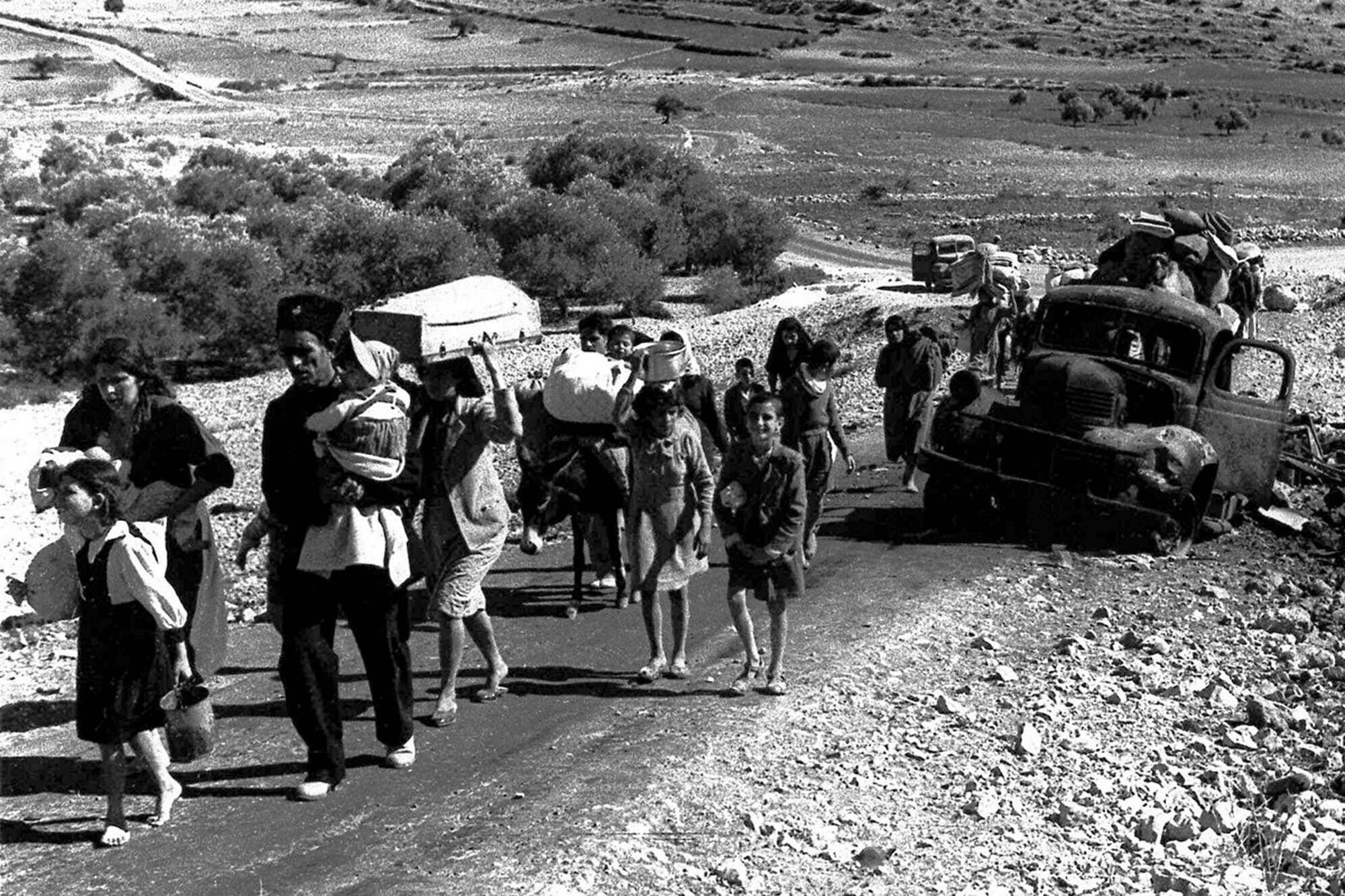
A poet and lawyer, Bustani is remembered, among other things, for his translations into Arabic of the Hindu epics – the Ramayana and Mahabharata. Remarkably, he was engaged in this work during the Nakba in 1948, when Zionist forces violently expelled some 750,000 Palestinians from their land. Bustani’s house in Haifa was occupied by the Zionist paramilitary organisation Haganah and he was himself imprisoned. In introducing Arab readers to Hindu concepts, characters and myths, Bustani found resonances between these and Quranic verses as well as the contemporary West Asian political context. Out of this was born the idiosyncratic and monotheistic interpretation of Hinduism that he proffered to the Arab world. Elhalaby reads Bustani as exemplary of an effort to produce non-coercive and non-hierarchical knowledge of a not-so-distant “other” – one who is close to but not fully a compatriot – outside the confines of colonial epistemologies, even if under the all-too-real onslaught of colonialism.

Not all the intellectual encounters that Elhalaby describes are this edifying. His account of a 1936 mission to India from Cairo’s Al-Azhar University, the pre-eminent global institution of Islamic learning, offers a tale of mutual misunderstanding. While British authorities speculated that the delegation’s visit was motivated by a desire to drum up support for an Egyptian caliph following the abolition of the Ottoman caliphate, Elhalaby demonstrates that it was more plausibly a response to the Dalit leader B R Ambedkar’s 1935 appeal to his followers to convert to religions other than Hinduism, in recognition of the putative unreformability of its caste system. Ambedkar’s appeal spurred great interest among Southasian Muslims as well as in the Arab world, where figures such as the Tunisian intellectual Abd al-Aziz al-Tha’alabi and the Iraqi cleric Abd al-Karim al-Zanjani urged Al-Azhar to explore the possibilities for proselytisation in Southasia.
The mission turned out to be something of a failure, and concluded with an indictment of the Indian Muslim intellectual scene, which was judged unfavourably in comparison with that in West Asia, eliciting angry responses from Urdu and other Indian media. As Elhalaby wryly observes, “one can bring two [global] souths together, but can’t make them embrace.” Yet whether internationalist or self-regarding, progressive or reactionary, the meetings and engagements that Elhalaby describes were united by an interest in producing anti-imperial forms of knowledge from within and despite the lineaments of a decaying colonial world.
IT IS AN ENTERPRISE that retains a fierce urgency in our own time. What forms of historical knowledge might aid liberation in genocidal times? Elhalaby is overly modest about his endeavour, averring at the outset of his book that it is not particularly important in the context of the ongoing genocide. And yet, given India’s well-documented support for Israel – diplomatically, politically, militarily and economically – through the genocide but also before it, a book that reminds us of the long history of Indo-Arab collaboration and friendship in the work of dismantling empire brings into view the forgotten but still available foundations on which we might renew this struggle.

Mishra, too, is clearly exercised by the question of what forms of knowledge and remembering might have the power to lift us out of the moral abyss of the present. Strikingly, he seems to think that the answer lies in engaging with and understanding the trauma of the oppressor. There is a certain logic in this. It does not take an education in psychoanalysis to understand that victims can become victimisers and that, therefore, understanding the prior experience of victimisation might have the potential to transmute vengeful impulses into something more reparative. Yet there is something wildly misguided about the timing and intended audience of Mishra’s effort, which is presumably “the world” in the title of The World After Gaza. Insofar as Palestinians are part of this world, to ask them to engage with Jewish trauma in the current moment is a bit like asking Jews in the middle of the Holocaust to analyse – even if not endorse – German resentment at the punitive peace that was imposed on them after the First World War.
Even if his argument is addressed not to the victims and survivors of this genocide but to the rest of us as morally complicit bystanders, there is much about it that sticks in the throat. Mishra is troubled by a world in which identity and moral authority are built on narratives of suffering – a phenomenon that, he argues, has engendered a zero-sum competition in which the status of the Shoah as the ultimate atrocity has been challenged by narratives drawing attention to the legacies of slavery and colonialism. He yearns instead for a world in which we might be able to appreciate the commonality between these experiences. The great Martinican anticolonial thinker Aimé Césaire did just this when he argued in Discourse on Colonialism that Hitler had applied to Europe “colonialist procedures which until then had been reserved exclusively for the Arabs of Algeria, the coolies of India, and the blacks of Africa.” Mishra goes one step further by finding much in common between the Jewish, African and Asian resistance to these “colonialist procedures” – in their response to their condition of powerlessness and marginality, their attempts to liberate themselves from tradition in a world that had been constructed overwhelmingly by white Christian Europeans, their tortuous paths to statehood and the perversions of nationalism that they subsequently suffered.
In The Question of Palestine, Said offers an extraordinarily clearsighted analysis of Zionism that acknowledges its liberatory potential while also underscoring its coloniality. His account is expansive enough to recognise both its promise to Jews of refuge from centuries of antisemitic persecution and its nakedly colonialist and orientalist determination to settle Ashkenazim – Jews of Central and Eastern European origin – in Palestine. This project was undertaken with the unstinting support of the world’s great powers, in flagrant disregard of the wishes of Palestine’s native inhabitants. As he puts it, “what in Zionism served the no doubt justified ends of Jewish tradition, saving the Jews as a people from homelessness and anti-Semitism and restoring them to nationhood, also collaborated with those aspects of the dominant Western culture (in which Zionism institutionally lived) making it possible for Europeans to view non-Europeans as inferior, marginal, and irrelevant.”

For reasons that are as unfathomable as they are unforgivable, Mishra downplays one half of this ambivalence, noting that “the role of settler-Zionist ideology in the creation of Israel should not be exaggerated.” Instead, we are encouraged to focus on Zionism’s early resonance with anticolonial projects – a resonance that was, in his account, sullied only much later, when Israel conquered new territories in the 1967 war and, still later, as a result of its rabidly right-wing turns under the leadership of Menachem Begin and, of course, Benjamin Netanyahu.
The spurious affiliation with African and Asian anticolonialism as a means of bolstering its legitimacy was in fact an early, if unsuccessful, tactic of Zionism. In his account of the Asian Relations Conference held in Delhi in March and April 1947, Elhalaby describes the fierce pushback from Arab attendees to a statement by the delegation from Hebrew University, which sought to present itself as “representatives of an old religion and an old Asian people which was driven from its Asian motherland 1800 years ago.” On that occasion – the first and last time for many decades that a delegation from the yishuv/Israel would be invited to such a gathering – Nehru drew a line under the discussion with the assertion that the people of India viewed Palestine as an Arab country. It was a line that would define the Indian consensus for some considerable time. In the epilogue to his book, Elhalaby quotes from a 1971 essay on Asia and Palestine by the scholar Mohammad Shafi Agwani, who played a leading role in the establishment of West Asian studies in India and went on to become the Vice Chancellor of Jawaharlal Nehru University. Agwani writes that “Asia has viewed the Zionist claim with suspicion and disapprobation. An explanation for this must be sought in the incompatibility between the anti-colonial upsurge in Asia and the methods and goals of the Zionist movement.”
Mishra’s revisionist effort to suture an early Zionism to African and Asian anticolonialism is underpinned by the hope that this might attenuate the current competition between narratives of suffering, each jostling for hegemony. In exactly the moment that Zionism and its underwriters sharpen the binary between Jewish settler and Palestinian native into one between life and death, Mishra urges us to “avoid the temptation of reducing history to an endless agon between evil perpetrator and innocent victim, or the binarism of colonialism and anti-colonialism.” It is difficult to imagine a more morally flaccid and vacuous conclusion.


Leave a Reply