

By John Clarke (Posted Sep 21, 2026)
Originally published: Counterfire on September 16, 2026 (more by Counterfire) |
The scale and pace of climate breakdown are now well-established realities of life on this planet, as extreme weather and chronic impacts impose themselves on us to an ever-greater degree.
It is equally well understood that fossil-fuel companies and political leaders are doggedly compounding these catastrophic results by doubling down on oil and gas production, resulting in levels of carbon emissions that will make things even worse.
As capitalism takes us to the edge of irreversible disaster, it is worth considering how the capitalists themselves view the results of their destructive profit making. When they gather in their exclusive social settings or sit around boardroom tables, how do they view the issue of climate change and the threat it poses to humanity?
Climate criminals
Though the ranks of the ruling establishments include crude climate deniers like Donald Trump, it would be wrong to imagine that the major capitalists and their leading functionaries are unaware of the implications of the course that they are on. The role they discharge as climate criminals is quite willful.
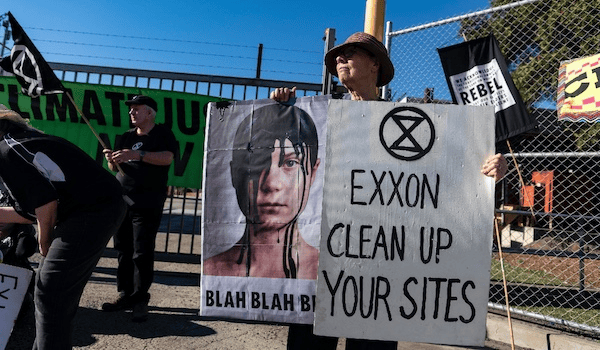
In 2015, Inside Climate News reported on information that had come to light about Exxon Corporation’s longstanding knowledge of the gathering impacts of climate change. In 1977, a senior scientific advisor with the company, James Black, delivered a presentation to its senior representatives in which, using ‘detailed slides,’ he warned that ‘carbon dioxide from the world’s use of fossil fuels would warm the planet and could eventually endanger humanity.’
In response, Exxon set up a ‘brain trust’ to explore the issue of climate change further but, having confirmed Black’s assessment, the company shut down the investigation and adopted a conscious strategy of suppressing this information. Exxon ‘put its muscle behind efforts to manufacture doubt about the reality of global warming its own scientists had once confirmed.’ It has subsequently become clear that other fossil-fuel companies have also worked to conceal or downplay the impacts of fossil-fuel use.
It is also abundantly clear that the governments which grease the wheels for the profit-making activities of the oil and gas companies have long had the information at their disposal that would enable them to understand fully the scale of the climate disaster they were facilitating.
Indeed, there are political leaders who have the most detailed understanding of climate change. Canadian prime minister Mark Carney, for example, even as he presides over a drive to increase massively fossil-fuel production, has a background that includes a stint as the United Nations Special Envoy on Climate Action and Finance.
Various ecosocialist writers have explored in detail the elements of a capitalist system that generates a situation where fossil-fuel profits are quite literally prized above survival, as climate breakdown stares us in the face. In his Capitalism in the Anthropocene, John Bellamy Foster considers how the scramble for short-term profits and relentless accumulation generates a false logic that produces just such a result.
It would be useful, however, also to consider how the capitalists themselves, along with their political agents and intellectual enablers, view the question of climate change. We have already seen how they work to stifle a clear understanding of the threat that it poses and try to delay meaningful action to address this dire threat. Nonetheless, the harsh and intensifying reality of the issue can only force itself upon them and they are compelled to consider its implications.
Firstly, though the imperative of pursuing short-term profits wins out at every turn, the disruptive and destructive impact of climate breakdown do have disastrous and worsening implications for capitalists. Moreover, some areas of investment are harder hit and sooner impacted than others.
Green Central Banking, very obviously an advocate of climate solutions that are acceptable to capitalism, warns that ‘the impact of climate change on insurance markets has been systematically underestimated, with profound implications for financial stability and the sustainability of the risk-sharing services insurance provides.’
The intensification of extreme weather, wildfires, flooding and other such effects is a very real issue for capitalists invested in providing insurance coverage along with property sales, tourism and much else besides. Even the infrastructure of fossil-fuel production itself faces huge disruption because of the impacts that these activities are generating.
Not surprisingly, you can find lots of examples of those who speak for these capitalist interests sounding futile warning calls. However, the implementation of a rational plan to curtail rapidly carbon emissions and allocate the resources necessary to withstand the now inevitable impacts of global heating is simply beyond the capabilities of the profit system.
Investment opportunities
Timid appeals for restraint within capitalist ranks, however, are generally pushed aside by those who focus on the investment opportunities that planetary disaster offers. In August, Investopedia put out an article suggesting that ‘while storms and other devastating weather events can cause millions of dollars worth of damage to individuals and companies, some businesses may benefit from them.’
The article explores the various areas of investment that could turn a profit from massive death and destruction. It notes that sufficiently nimble entrepreneurial antics might even ‘be enough to shift investor sentiment and cause a rally in stock values.’
The greatest field of opportunity for profiting out of the climate crisis lies in the promotion of dubious high-tech fixes that offer the false hope of an environmentally responsible ‘green capitalism. As the Canadian organisation Environmental Defence puts it ‘if there is one thing that the fossil fuel industry is good at, it’s peddling false solutions to a problem they created.’
The article goes on to explore carbon capture and storage (CCS) technology and its ‘promises to suck up carbon emissions like a vacuum and bury them deep underground.’ It argues that this is ‘a dangerous distraction, gobbling up billions in public money, enabling more pollution and keeping us hooked on fossil fuels for decades to come.’
After a wretched history of failure, CCS has captured and stored about ‘0.0004% of Canada’s emissions since 2000.’ Most decisively, ‘globally, nearly 80 per cent of carbon captured through CCS is used to produce more oil by injecting captured carbon into depleted oil wells. Instead of solving the climate crisis, as the oil and gas industry likes to claim, this technology is used to extend the life of fossil fuel production.’
If, having failed to reduce carbon emissions, while cashing in on climate disasters and sucking up public money to peddle high-tech scams, the impacts become too severe, many of the wealthiest climate criminals plan to access lavishly expensive forms of escape.
In 2024, the CBC reported that ‘luxury bunkers’ were catching on among the ultra-rich, as refuges that could be accessed in the face of disaster. It noted that ‘Mark Zuckerberg, CEO of Meta and one of the richest individuals on the planet, was building a $100-million US compound in Hawaii … The more telling detail is that the compound includes a bunker — 5,000 square feet, to be specific, with concrete walls and an escape hatch.’
This option is by no means the product of any unique quirkiness on the part of Zuckerberg. We learn that ‘Architectural Digest named “luxury bunkers” as one of the real estate trends of 2023.’ Moreover, Vivos, a California-based company that provides “shelter solutions”, told CBC that “inquiries and applications are up over 2,000 per cent year over year”.’
The responses to climate change by capitalists and the institutions that serve them are dominated by the profit motive that dominates and shapes this society and by naked self-interest. The picture of destructive irrationality that emerges, at odds with the needs of the bulk of humanity, is deeply shocking.
Working-class people across this planet have no luxury bunkers to escape into and very limited means of mitigating the impacts of climate breakdown, as they intensify to the point of catastrophe. Our survival hinges on our collective struggles against climate-wrecking capitalism and the creation of a just and sustainable socialist society.
Monthly Review does not necessarily adhere to all of the views conveyed in articles republished at MR Online. Our goal is to share a variety of left perspectives that we think our readers will find interesting or useful. —Eds.
About John Clarke
John Clarke became an organiser with the Ontario Coalition Against Poverty when it was formed in 1990 and has been involved in mobilising poor communities under attack ever since.


Leave a Reply