

Behind widespread youth uprisings lies a stark contradiction: an economic system that protects capital while stripping young people of dignified work, community, and the confidence that tomorrow can be different.
24 September 2026

Vladimir Lysenko (USSR), The Bull (Fascism Advances), 1929.
Dear friends,
Greetings from the desk of Tricontinental: Institute for Social Research.
Over the past two years, young people around the world have taken to the streets. From Kenya to Nepal, Indonesia to the Philippines, from Madagascar to Morocco, and in Peru, they rise up and march. Journalists label these uprisings ‘Gen Z’, as if they were a market segment. The term describes the youthfulness of the protesters, their fluency with digital platforms, and their impatience with established political institutions. But it conceals more than it reveals about the politics of our times.
A generation is not a class – young people do not share a common socioeconomic experience. Moreover, these uprisings each have their own history. In June 2024, Kenya’s protests were immediately provoked by the finance bill, which transferred the burdens of debt and austerity onto working people. In September 2025, anger in Nepal over the corruption and ostentation of political elites intensified after the government attempted to restrict social media. From late September 2025, young people in Morocco protested against the decay of public health and education while vast sums were directed towards preparations for the 2030 FIFA World Cup. That same month, demonstrations in Madagascar began over the failure to provide reliable water and electricity. In Peru, protests in September and October 2025 took aim at the political establishment, organised crime, and a pension system that takes young people’s money but cannot promise security. These are not identical uprisings, but they share a common sentiment: there is money for stadiums but not hospitals, money to service foreign creditors but not to employ young people, money for the police but not for schools.
Corruption is the word most frequently brandished, but beneath corruption lies a social order that has foreclosed the future.
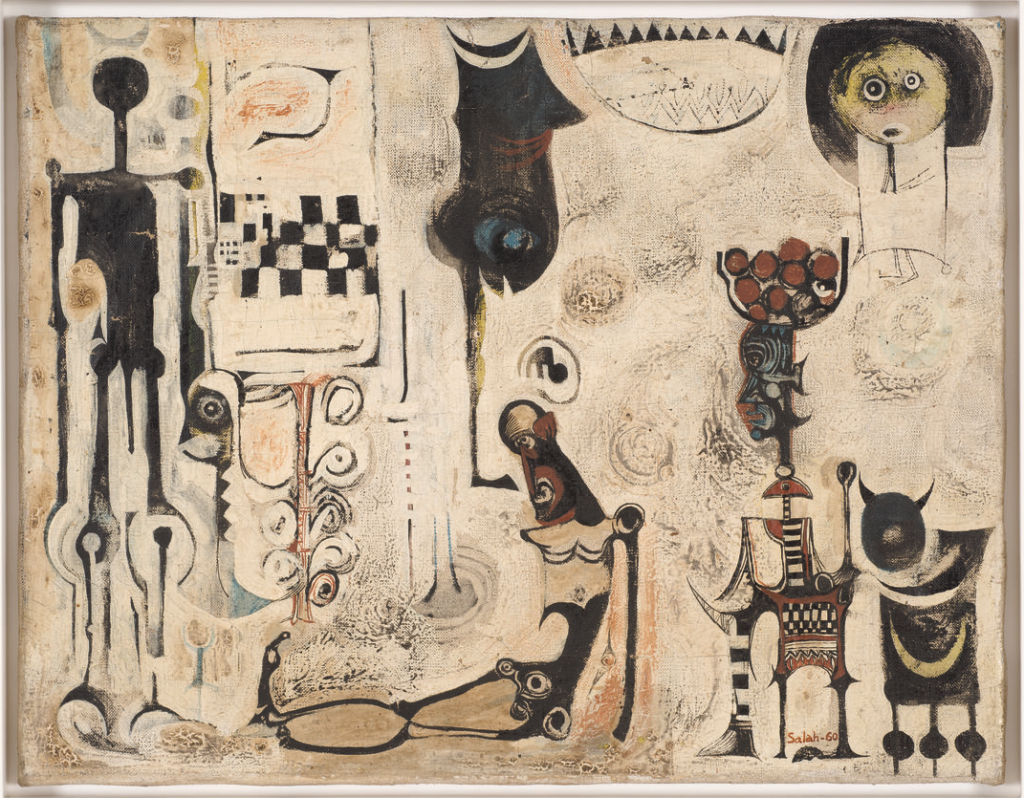
Ibrahim El-Salahi (Sudan), Alphabet No. 1, 1960.
The pirate flag from the Japanese manga One Piece appeared in several of these protests. It is a curious emblem: the manga is about a band of young people who set sail to find a treasure monopolised by the powerful, confronting a world government that claims legality but practises violence. The flag does not provide a political programme, but it expresses a feeling: the established world is fraudulent, and an adventure beyond it has become necessary. Young people seem to be saying, ‘Let us sail the high seas in search of a future that is not as hopeless as the present!’
The material basis for this feeling appears clearly in the International Labour Organization’s (ILO) new report, Global Employment Trends for Youth 2026: Back to the Future. After falling to its lowest level in more than two decades in 2023, the unemployment rate for people aged 15 to 24 rose to 12.4% in 2025. This means that 67 million young people were actively looking for work but could not find it. Youth unemployment increased between 2023 and 2025 in eight of the world’s eleven subregions. However, the unemployment rate tells only part of the story, as it does not count those who have stopped searching. For this reason, the more revealing category is NEET: young people who are ‘not in employment, education, or training’. In 2025, more than 257 million young people – one in every five – were in this condition, nine million more than in 2023.
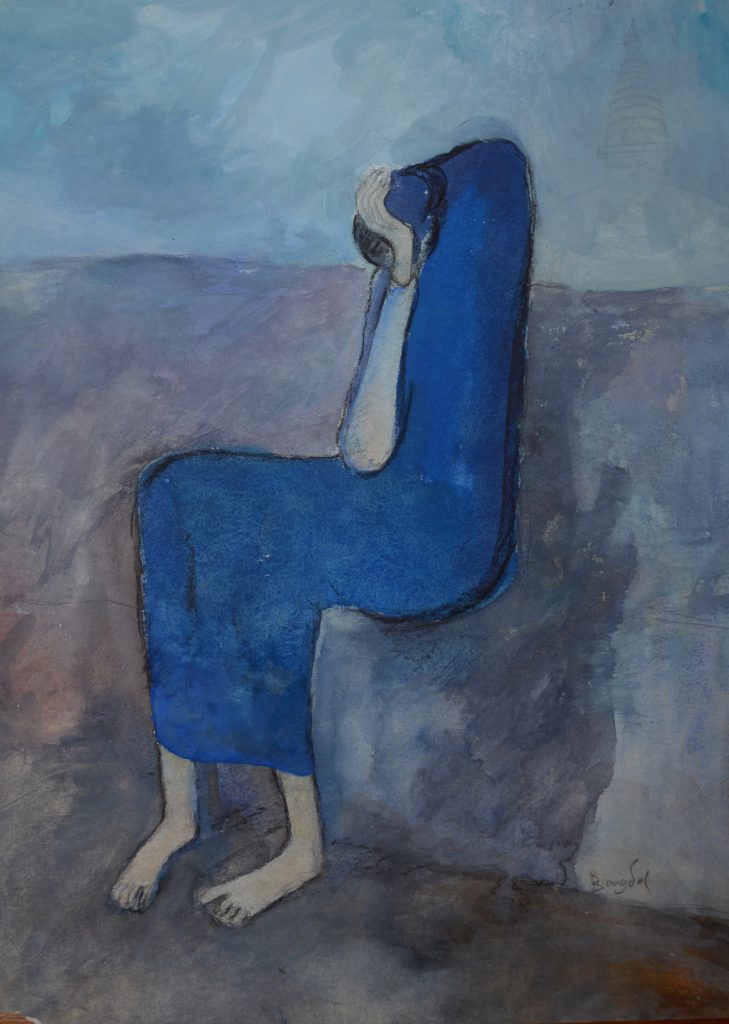
Lain Singh Bangdel (Nepal), Mother Nepal, 1979.
Behind this cold acronym are lives held in suspension. A young person completes school, searches for employment for months, and discovers that no work is available. After stopping the search, they finally return to a crowded family home, postponing marriage, children, and any independent life. Time passes, but life does not advance. The burden is sharply gendered. More than two-thirds of young people in NEET status are women. The NEET rate for young women is 27.4%, more than double the 13.1% rate for young men. This is not because women lack education, but because unpaid care work, discrimination, and the scarcity of decent jobs push them out of economic life.
In the Arab States and Northern Africa, roughly one-third of young people are in NEET status. In sub-Saharan Africa, official youth unemployment appears lower, at 8.4%. However, this is evidence of poverty-driven informality rather than an abundance of employment. Young people must accept, or create, whatever informal work they can find. Nearly nine out of ten young workers in low- and lower-middle-income countries labour informally, outside meaningful social and employment protection. Many have been told that education is the ladder out of hardship. They borrow, study, acquire qualifications, and sometimes migrate, only to encounter what the ILO calls the ‘hollowing out’ of middle-skilled employment. Employers demand experience from people seeking their first job, while artificial intelligence threatens some of the entry-level occupations through which experience was once gained. Education raises expectations, but the economy cannot meet those expectations.
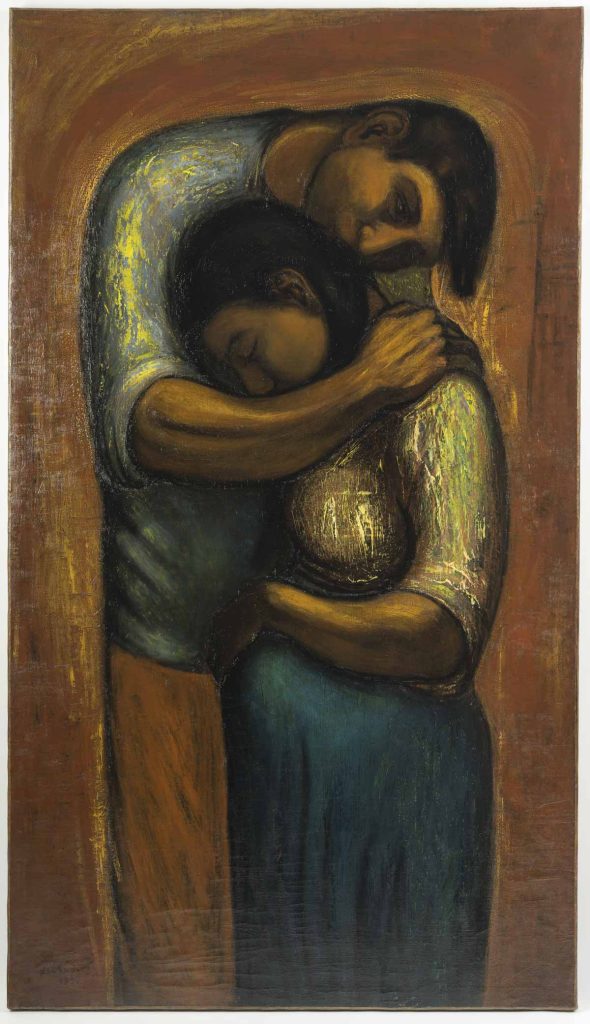
Noé Canjura (El Salvador), The Embrace, 1950.
It is insufficient to describe youth disillusionment as merely a mental-health crisis detached from political economy. A 2025 UNICEF-linked survey of more than 5,600 young people found that six in ten felt overwhelmed by current events, while only half knew where to find mental-health support. But 60% still said they remained hopeful and wanted to help shape a better future. The World Health Organization reports that one in six people worldwide experience loneliness, with the rate rising to 17–21% among those aged 13 to 29. Contrary to popular perceptions, loneliness is greatest in low-income countries. Loneliness is associated not only with depression and anxiety but also with low income, inadequate public infrastructure, and exclusion from education and employment.
Loneliness is not simply the absence of company; it is the feeling that one is dispensable to society. The young person is connected to thousands of people through a smartphone but disconnected from the institutions that permit a dignified life: the workplace, the union, the neighbourhood association, the cultural centre, and the political organisation. The market offers communication without community and visibility without agency.
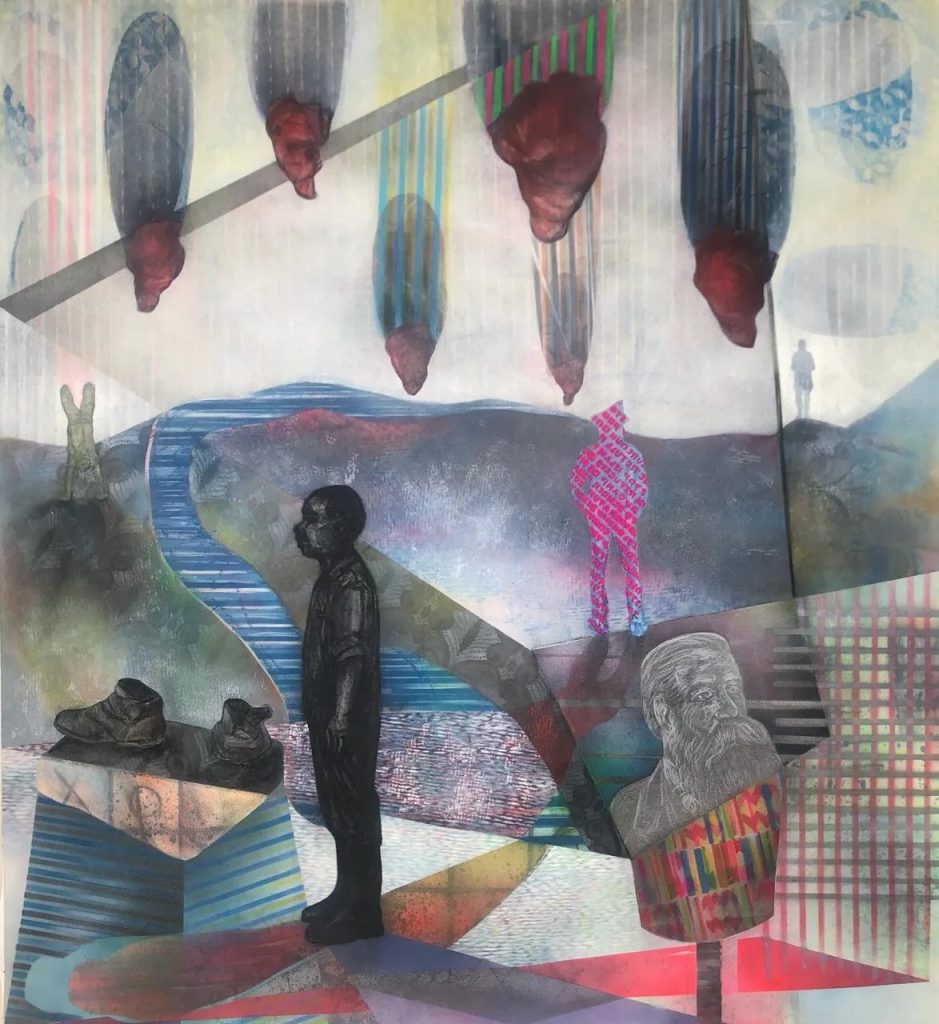
Peterson Kamwathi (Kenya), Untitled, 2020.
This loneliness is deepened by a wider condition of uncertainty. Even the institutions that speak in the language of capital register this instability. The World Uncertainty Index counts references to ‘uncertainty’ in country reports produced by the Economist Intelligence Unit, a research service used by corporations, financial institutions, and governments. Its spikes accompany war, financial crises, pandemics, political ruptures, and trade conflicts – the very crises that make daily life precarious for millions.
But the uncertainty measured by capital is lived very differently by the working class. For financiers, uncertainty means that an investment might lose value, but for a young worker it means not knowing whether there will be work next month, whether rent can be paid, whether there will be food on the table, or whether war or the climate will destroy their home. The ruling classes measure uncertainty while producing it.
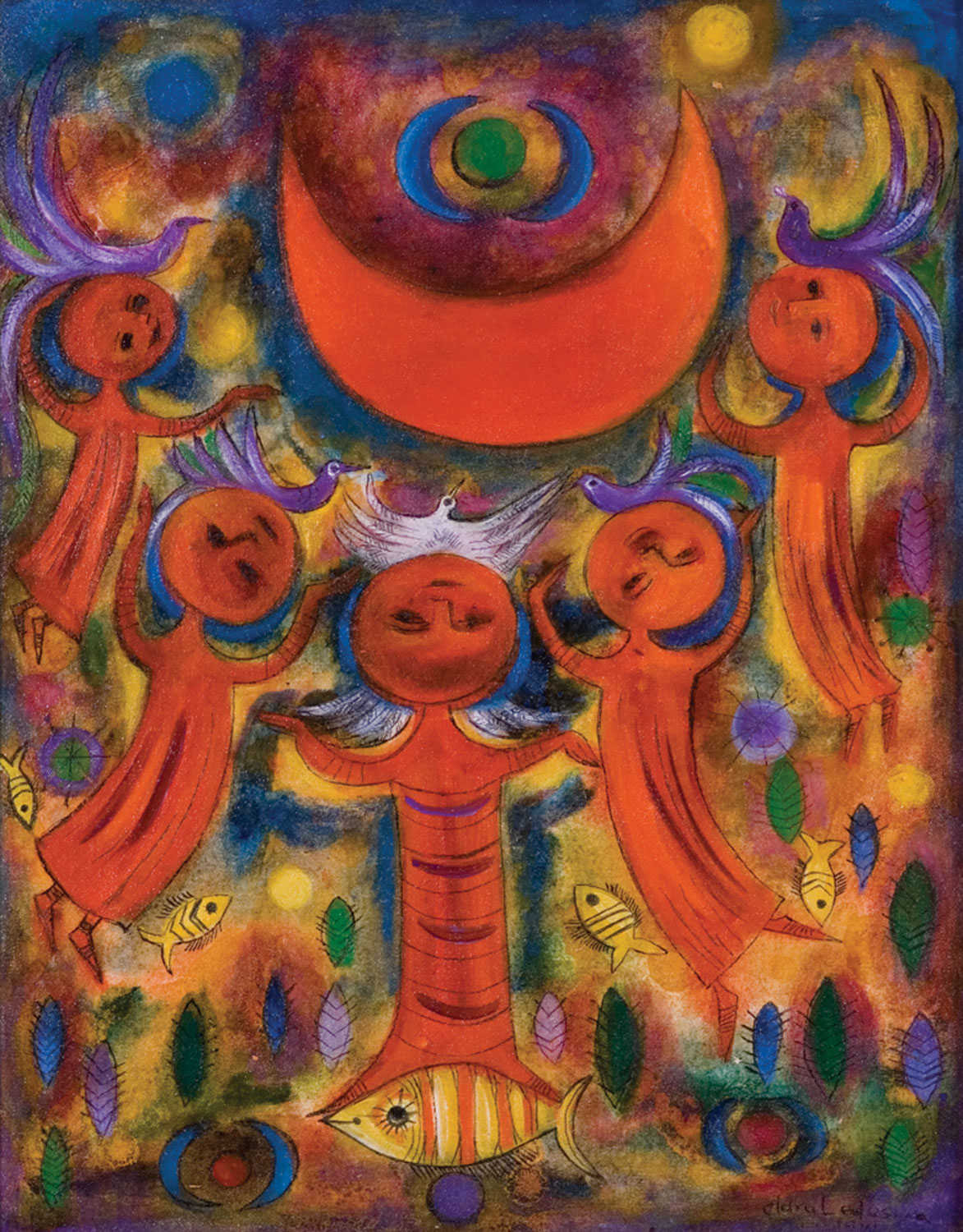
Clara Ledesma (Dominican Republic), Universo con Luna Roja (Universe with a Red Moon), 1971.
The so-called ‘Gen Z’ uprisings are the political arrival of a generation whose future has been foreclosed. Their revolt is not yet an organised project. Spontaneous anger can move towards solidarity and socialist reconstruction or it can be captured by cynicism, chauvinism, and the far right. The decisive question is whether durable organisations can transform the loneliness of the screen into the fellowship of struggle.
These uprisings have been accompanied by a range of poets and performers: Hamza Raid and El Mahdi Lyoubi from Morocco, Eduardo Ruiz Sáenz from Peru (killed by the police during the 2025 protests), and Javan the Poet from Kenya. Javan’s 2019 poem, ‘Killer Breed’, captures the resoluteness of the youth. The poem – written in Sheng, Kenya’s urban vernacular that combines Kiswahili, English, and other Kenyan languages – is about the violence visited upon the young rebels by a recalcitrant and corrosive state:
| Citizens na law no love, land cruisers zimekuwa hearse Kuferry body bags forest grounds zimeja body parts Si watu Ni animals Kwa killer squads’ Poo poo kushoot na kutoa bullets kwa throats Alafu Kwa media wanakuwa applaused Hakuna light Kwa end ya tunnel iko closed Hakuna change Kwa youth heart yake imekuwa stopped Hakuna justice Kwa years za cases ziko paused Nikupe ID? Wee ukifichia eyewitness badge number Kwa crime scene openly identity unaseal Inamean hauko right system Ni dark haina light Si na guns but our voices zita challenge your might. Juu Wewe Na Wewe Na Wewe Na Wewe Si Enforcers Wewe Ni killer breed Wewe Ni Killer breed Wewe ni killer breed | Citizens and the law: there is no love. Land Cruisers have become hearses, ferrying body bags. The forest grounds are filled with body parts. Not people, but animals to the killer squads. Poo! Poo! they shoot, pull the bullets from throats. then, in the media, they are applauded. There is no light at the end of the tunnel; the tunnel has been closed. There is no change for the youth: their hearts have been stopped. There is no justice: their cases have been paused for years. I give you my ID? while you hiding your badge number from the eyewitness. At the crime scene, you openly conceal your identity. That means you are not in the right. The system is dark; it has no light. We do not have guns, but our voices will challenge your might. Because you, and you, and you, and you: You are not enforcers. You are a killer breed. You are a killer breed. You are a killer breed. |
Warmly,
Vijay
Archive
Select Year202620252024202320222021202020192018 Select MonthSeptemberAugustJulyJuneMayAprilMarchFebruaryJanuary Select MonthDecemberNovemberOctoberSeptemberAugustJulyJuneMayAprilMarchFebruaryJanuary Select MonthDecemberNovemberOctoberSeptemberAugustJulyJuneMayAprilMarchFebruaryJanuary Select MonthDecemberNovemberOctoberSeptemberAugustJulyJuneMayAprilMarchFebruaryJanuary Select MonthDecemberNovemberOctoberSeptemberAugustJulyJuneMayAprilMarchFebruaryJanuary Select MonthDecemberNovemberOctoberSeptemberAugustJulyJuneMayAprilMarchFebruaryJanuary Select MonthDecemberNovemberOctoberSeptemberAugustJulyJuneMayAprilMarchFebruaryJanuary Select MonthDecemberNovemberOctoberSeptemberAugustJulyJuneMayAprilMarchFebruaryJanuary Select MonthDecemberNovemberOctoberSeptemberAugustJulyJuneMayAprilMarch
- The Youth Want a Future: The Thirty-Ninth Newsletter (2026)
- Modernisation Does Not Mean Capitalism: The Thirty-Eighth Newsletter (2026)
- We All Came Here from Somewhere: The Thirty-Seventh Newsletter (2026)
- Why the Global South Needs an Industrial Policy: The Thirty-Sixth Newsletter (2026)
Newsletter
Sign up for our weekly newsletter, a curated note that offers a window into some of the struggles and conflicts of our time.


Leave a Reply