


19/Sep/2026
5 min read


The idea of India he defended, which he insisted is nothing more and nothing less than the constitution of India, is still ours to fight for.
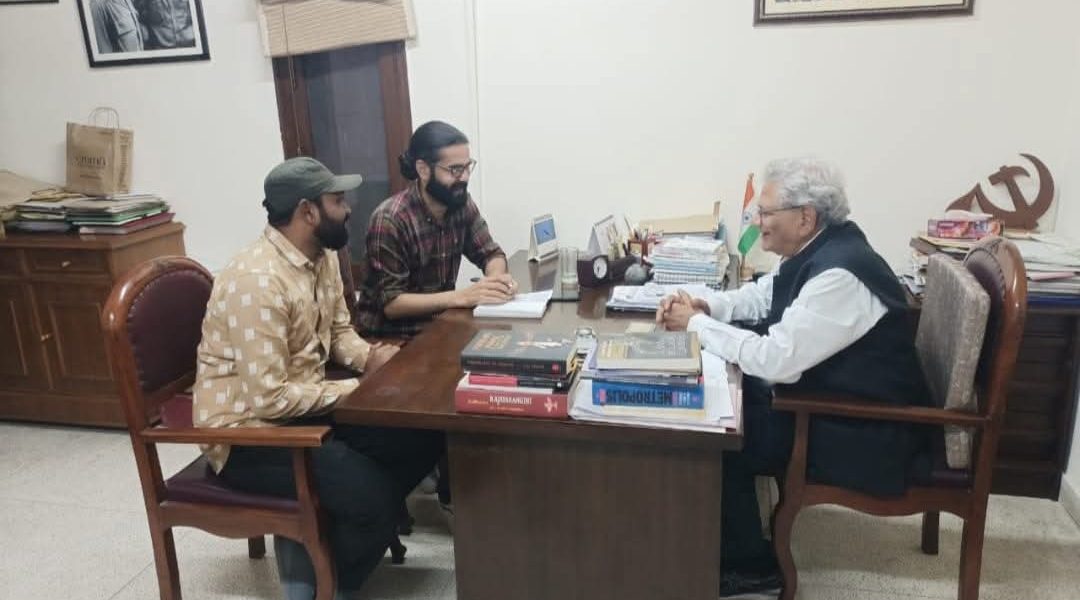
Comrade Sitaram Yechury (right) during an interview in 2023. Photo provided by the author.
Three years ago, I sat across from Comrade Sitaram Yechury with a recorder, a list of questions, and the nervousness of a young interviewer meeting one of India’s tallest political figures. What I received in return was not just answers, but a masterclass. A 100 years of India’s political history compressed into one afternoon, delivered with the warmth of a teacher and the precision of a scholar. Today, on the second anniversary of his passing, that conversation feels less like an interview and more like a gift he left behind. A map for those of us still walking the road he walked for five decades.
He began where he always began: with history. I had asked him whether India’s polity had taken a rightward turn. He traced the answer back a century. “The issue was what should be the character of Independent India. Three visions emerged.” He walked me through them.PlayNextMute
Current Time 0:33
/
Duration 2:04Fullscreen
Advertisement
Advertisement
The Congress vision of a secular democratic republic, the Communist insistence that political independence must move towards economic independence through socialism, and the third vision, “whose argument was that the character of the Independent India will be defined by the religious affiliation of its people.” Out of that third vision, he reminded me, “Twin brothers were born.” The Hindu Rashtra of the Rashtriya Swayamsevak Sangh (RSS) and the Islamic Republic of Jinnah’s Muslim League.
‘Where did all the progressive measures come from?’
The national movement rejected that vision, and the anger over that rejection, he noted with characteristic bluntness, “led to Mahatma Gandhi’s assassination.” The RSS was banned, “by none else than Sardar Patel, whom they claim today as their hero.” Many believed the danger had passed. That, Comrade Yechury said, was the great mistake. “From then onwards till today, the effort is to convert this secular democratic republic into a Hindutva Rashtra. So that is the battle going on.”
He situated India’s drift within a global one. The rightward shift worldwide, he explained, was a product of neoliberal capitalism’s crisis. Profits rise, people’s purchasing power collapses, and discontent threatens the system itself. The ruling classes respond by “stoking emotional passions. Somewhere it is racism, somewhere it’s xenophobia. In our country it is communalism.” But India, he insisted, had “an added factor.”
The century-old domestic contest over the country’s soul. And in that contest, “every single foundational pillar of our constitution is being assaulted. Secular democracy, economic sovereignty, everything is being sold, social justice, and federalism. Four foundational pillars, all four being assaulted.”
Advertisement
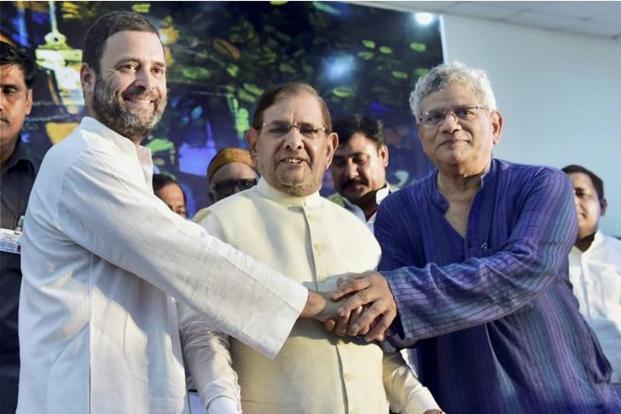
(From left to right) Congress vice president Rahul Gandhi, JDU leader Sharad Yadav and CPM’s Sitaram Yechury at the opposition parties meeting in New Delhi on August 17, 2017. Photo: PTI.
When I asked him where this was heading, whether the attacks on institutions would ever stop, he did not flinch, and he did not retreat into abstraction. “The answer to that question,” he said, “is with the people. How much will be the people’s resistance to stop this sort of a rightward shift towards a fascistic Hindutva Rashtra in India.”
For him, politics was never about the corridors of power. The “key issue is to remove them from controlling government. It is the control over government that is what is being utilised to do all this.” Even so, he warned, the poison would linger: “Even without control of government, they are creating that poisonous mindset.”
I pressed him on a harder question, one that has troubled generations of young Leftists. If the Communist Party and the RSS were born within years of each other, if people live without economic independence, why did the fascist vision gain ground while the communist one struggled? His answer dismantled my premise.
“It is not a question of having failed. Over this entire century, to a large extent you have influenced the state policy. Where did the public sector come from? Where did all the rights of the people come from? Where did the rights for trade unions come from? Where did all the progressive measures come from? They all came from the influence of the communist ideology.”
Land reforms came onto the agenda, he reminded me, because of Left-led struggles like Telangana. Linguistic reorganisation came because of the Left in Kerala, Maharashtra, Andhra. The MGNREGA, the Forest Rights Act, the Right to Information, the Right to Food. “All these rights that we moved for, these were all instruments to fight and combat this social order of reactionary elements of casteism, communalism and patriarchy.”
Advertisement
Our battle, he explained, was simply harder. “They are growing because they support all these exploitative features. We are battling the very structures in society.” Hindutva, he said, “is the biggest proponent of Manuvad, the biggest proponent of both caste as well as gender oppression,” and it also offers religious hatred. They ride with the vested interests; we challenge them.
‘You are wasting our youth, not merely missing the bus’
On the youth, his passion was unmistakable, and so was his grief. “We are the youngest country in the world, but we are also the country with the highest unemployment, highest levels of poverty. So we are a country where our youth is being wasted.”
When I asked whether India was missing its demographic dividend, he corrected me sharply: “It is not merely missing. You are wasting our youth, not merely missing the bus. You are actually destroying our potential.” And yet, he said, the solution “is there in front of our eyes.” Instead of writing off “Rs 11 lakh crore of loans taken by the cronies,” that money could build rural roads, drinking water wells, irrigation canals.
“Crores and crores of new jobs will be created. And once the youth starts earning and spending, then your economy will also develop.” His message to young people was a call: “Come, organise yourselves, demanding and forcing this government to actually stop giving concessions to the rich and use that money to build our infrastructure through public investment, generate the jobs, and we should launch such a powerful movement to force this government to adopt these policies.”
Advertisement
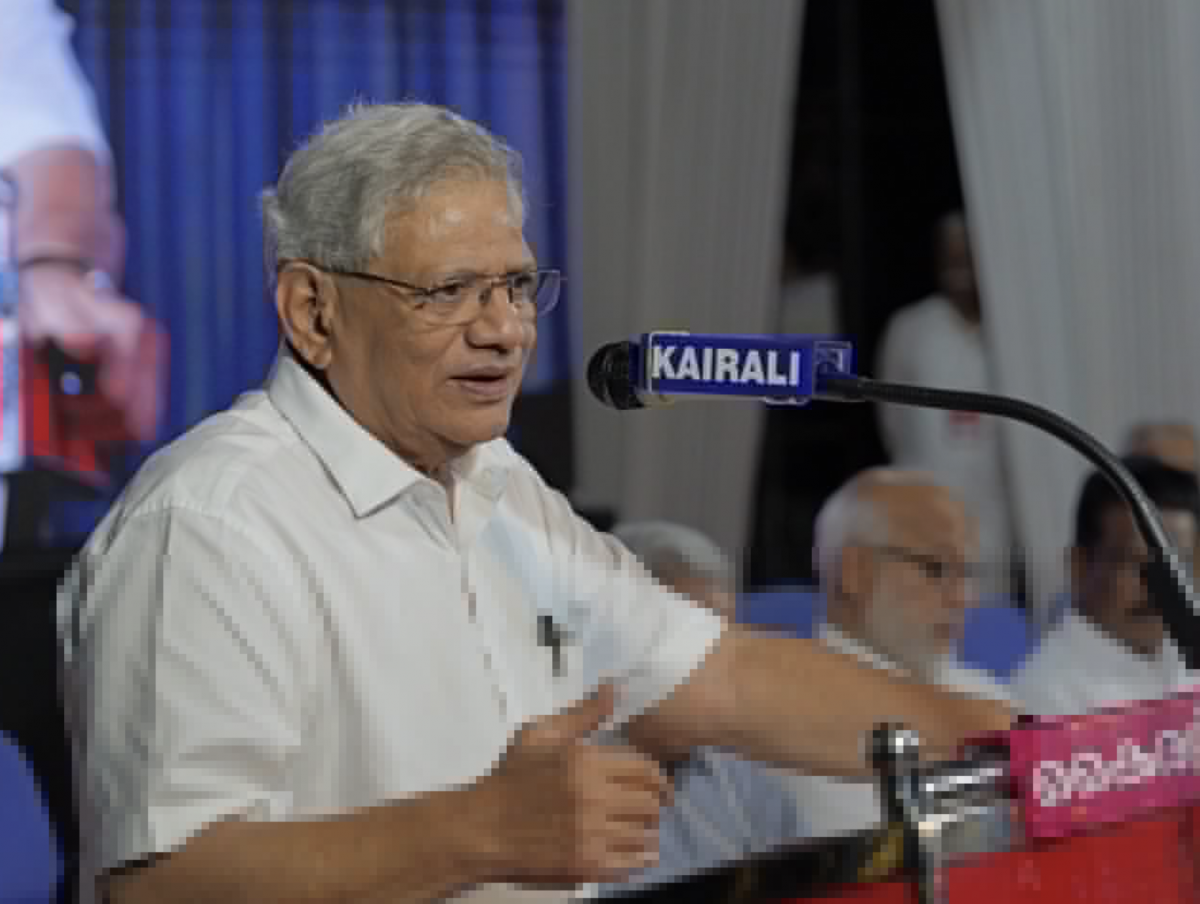
Sitaram Yechury (1952-2024). Photo: X/@SitaramYechury.
He had no illusions about the obstacles. “They will try to disrupt this through communal polarisation. So that is the battle at one level we have to engage with.” But engage we must, because “the answer to your question whether we are going towards that direction or not, the people will have to decide. And that is where all of us come into the picture, mobilising people to stop this destruction of India and the Idea of India.”
His clarity extended to the world stage. He described the war in Ukraine as “part of the effort by US imperialism to strengthen its global hegemony,” and Modi, he said plainly, “has reduced India in the last nine years as the subordinate ally of US imperialism.” The bargain, as he saw it, was transactional and terrible: “I will give you your profits, I will give you your global hegemony of imperialism, but you give me my fascistic project.”
I ended the interview by asking what hope he could offer the working people of India. His answer has stayed with me every day since:
“There is not only hope, there is a strong possibility. All this is happening because of their control over state power, because they are in the government. Once you break them from the government, you will see the reversal happening. And that’s the objective right now that you have to do.”
Two years after his passing, those words read like a last will and testament. Comrade Yechury spent his life proving that politics could be principled, that intellect could serve the people, and that hope could be a discipline rather than a sentiment. He fought for an India where the Constitution is not a parchment but a practice. Politically a secular democratic republic, socially liberty, equality, fraternity and justice “for all, social, economic and political,” as the Preamble demands.
He is gone. The idea of India he defended, which he insisted is nothing more and nothing less than the constitution of India, is still ours to fight for. The question he left us is the one he answered a hundred different ways in a hundred different struggles: will the people resist?
The best tribute to Comrade Sitaram Yechury is not this article. It is our answer.
Red salute, Comrade.


Leave a Reply